Table of Contents >> Show >> Hide
- What Is the Chaplet of St. Michael?
- Before You Begin
- How to Pray the Chaplet of St. Michael in 12 Steps
- Step 1: Place Yourself in God’s Presence
- Step 2: Make the Sign of the Cross and Pray the Opening Invocation
- Step 3: First Salutation The Seraphim
- Step 4: Second Salutation The Cherubim
- Step 5: Third Salutation The Thrones
- Step 6: Fourth Salutation The Dominations
- Step 7: Fifth Salutation The Virtues
- Step 8: Sixth Salutation The Powers
- Step 9: Seventh Salutation The Principalities
- Step 10: Eighth Salutation The Archangels
- Step 11: Ninth Salutation The Angels, Then the Four Closing Our Fathers
- Step 12: Pray the Concluding Prayers
- Tips for Praying the St. Michael Chaplet Well
- Why This Prayer Still Matters
- Experiences People Often Have When Praying the Chaplet of St. Michael
- Conclusion
- SEO Tags
If you have ever wanted a prayer that feels both sturdy and soaring, the Chaplet of St. Michael is a pretty great place to start. It is structured enough to keep your wandering brain from trying to reorganize the pantry mid-prayer, yet rich enough to draw your heart into something bigger than your to-do list. This devotion honors St. Michael the Archangel and the nine choirs of angels, making it a powerful Catholic prayer for protection, perseverance, humility, and spiritual focus.
In plain English, this chaplet is like a prayer route with clear turns: you begin by asking God for help, you move through nine angelic salutations, you pray repeated Our Fathers and Hail Marys, and you finish with closing prayers that ask for St. Michael’s protection and intercession. Whether you are new to the St. Michael Chaplet or just want a cleaner, easier guide, this step-by-step article will walk you through the whole devotion without making it feel like you need a theology degree and a traffic map.
What Is the Chaplet of St. Michael?
The Chaplet of St. Michael, sometimes called the Angelic Crown or Rosary of the Angels, is a Catholic devotion that honors St. Michael and the nine choirs of angels. The pattern is simple once you see it: after the opening prayer, you pray nine salutations. After each salutation, you say one Our Father and three Hail Marys. At the end, you add four more Our Fathers in honor of St. Michael, St. Gabriel, St. Raphael, and your guardian angel, then finish with the concluding prayers.
Many people turn to this prayer in times of temptation, fear, family stress, spiritual dryness, or simple daily chaos. That does not mean you need dramatic background music and thunderclouds to pray it. You can pray it on an ordinary Tuesday, in your room, at church, in the car before work, or while sitting quietly before Mass. The point is not theatrical intensity. The point is faithful attention.
Before You Begin
Before diving into the 12 steps, set yourself up for success. A little preparation makes this prayer smoother and more meaningful.
- Find a quiet place: Quiet helps, even if your “quiet place” is just the least noisy corner of the house.
- Use a St. Michael chaplet if you have one: If not, you can still pray using your fingers or a written guide.
- Set an intention: Pray for protection, clarity, your family, perseverance, healing, or gratitude.
- Slow down: This is a devotion, not a speed trial.
- Keep the prayers nearby: Especially the first few times, a guide is your best friend.
How to Pray the Chaplet of St. Michael in 12 Steps
-
Step 1: Place Yourself in God’s Presence
Start by getting still. Take a breath. Offer your intention to God. You might pray for your soul, your family, your peace of mind, or strength against temptation. This brief pause matters because prayer is not only about saying correct words. It is about turning your heart toward God on purpose.
-
Step 2: Make the Sign of the Cross and Pray the Opening Invocation
Begin with the Sign of the Cross. Then pray:
O God, come to my assistance. O Lord, make haste to help me. Glory be to the Father, and to the Son, and to the Holy Spirit, as it was in the beginning, is now, and ever shall be, world without end. Amen.
This opening sets the tone beautifully. It is honest, humble, and refreshingly direct: “God, help.” A strong start.
-
Step 3: First Salutation The Seraphim
Pray:
By the intercession of St. Michael and the celestial Choir of Seraphim, may the Lord make us worthy to burn with the fire of perfect charity. Amen.
After this, say one Our Father and three Hail Marys. This first salutation points your heart toward love of God, which is exactly where a good prayer life should begin.
-
Step 4: Second Salutation The Cherubim
Pray:
By the intercession of St. Michael and the celestial Choir of Cherubim, may the Lord grant us the grace to leave the ways of sin and run in the paths of Christian perfection. Amen.
Then pray one Our Father and three Hail Marys. This step is about conversion. Less drifting, more direction.
-
Step 5: Third Salutation The Thrones
Pray:
By the intercession of St. Michael and the celestial Choir of Thrones, may the Lord infuse into our hearts a true and sincere spirit of humility. Amen.
Then pray one Our Father and three Hail Marys. Humility is not spiritual self-insult. It is clarity. It means seeing God as God and yourself as someone who needs grace.
-
Step 6: Fourth Salutation The Dominations
Pray:
By the intercession of St. Michael and the celestial Choir of Dominations, may the Lord give us grace to govern our senses and overcome any unruly passions. Amen.
Then pray one Our Father and three Hail Marys. This is the part where the chaplet politely but firmly asks your appetites to stop acting like the boss.
-
Step 7: Fifth Salutation The Virtues
Pray:
By the intercession of St. Michael and the celestial Choir of Virtues, may the Lord preserve us from evil and falling into temptation. Amen.
Then pray one Our Father and three Hail Marys. If you have ever said, “Lord, keep me from making a mess of today,” this salutation is speaking your language.
-
Step 8: Sixth Salutation The Powers
Pray:
By the intercession of St. Michael and the celestial Choir of Powers, may the Lord protect our souls against the snares and temptations of the devil. Amen.
Then pray one Our Father and three Hail Marys. This is one reason many Catholics love the St. Michael Chaplet: it is a prayer for protection that does not pretend spiritual struggle is imaginary.
-
Step 9: Seventh Salutation The Principalities
Pray:
By the intercession of St. Michael and the celestial Choir of Principalities, may God fill our souls with a true spirit of obedience. Amen.
Then pray one Our Father and three Hail Marys. Obedience is not glamorous in modern culture, but in Christian life it means trusting God enough to follow Him.
-
Step 10: Eighth Salutation The Archangels
Pray:
By the intercession of St. Michael and the celestial Choir of Archangels, may the Lord give us perseverance in faith and in all good works in order that we may attain the glory of Heaven. Amen.
Then pray one Our Father and three Hail Marys. This step reminds you that prayer is not meant to be a burst of enthusiasm followed by spiritual hibernation. It is about perseverance.
-
Step 11: Ninth Salutation The Angels, Then the Four Closing Our Fathers
Pray:
By the intercession of St. Michael and the celestial Choir of Angels, may the Lord grant us to be protected by them in this mortal life and conducted in the life to come to Heaven. Amen.
Then pray one Our Father and three Hail Marys.
After the nine salutations are finished, pray one Our Father in honor of each of the following:
- St. Michael the Archangel
- St. Gabriel the Archangel
- St. Raphael the Archangel
- Your guardian angel
This is the home stretch. Stay with it. You are nearly there.
-
Step 12: Pray the Concluding Prayers
Finish with the traditional closing prayers:
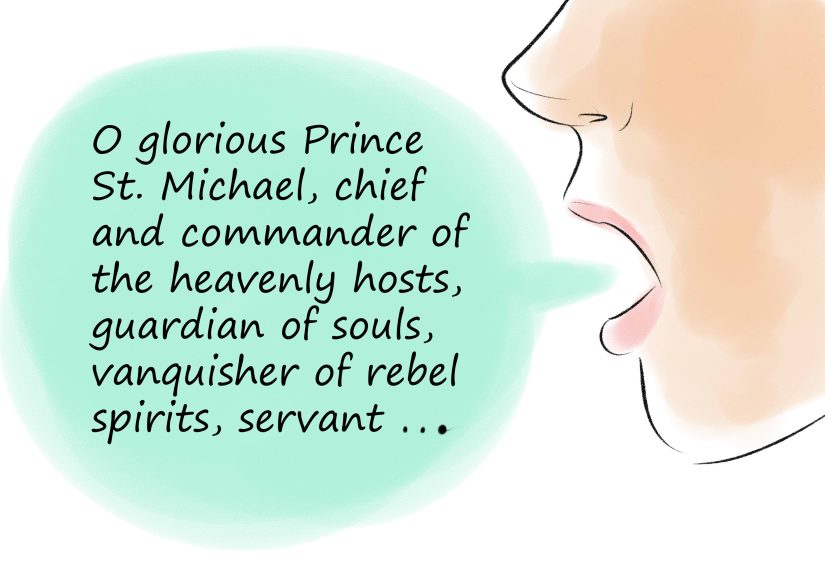
O glorious prince St. Michael, chief and commander of the heavenly hosts, guardian of souls, vanquisher of rebel spirits, servant in the house of the Divine King and our admirable conductor, you who shine with excellence and superhuman virtue, deliver us from all evil, who turn to you with confidence, and enable us by your gracious protection to serve God more and more faithfully every day.
Pray for us, O glorious St. Michael, Prince of the Church of Jesus Christ, that we may be made worthy of His promises.
Almighty and Everlasting God, who, by a prodigy of goodness and a merciful desire for the salvation of all men, has appointed the most glorious Archangel St. Michael Prince of Your Church, make us worthy, we ask You, to be delivered from all our enemies, that none of them may harass us at the hour of death, but that we may be conducted by him into Your Presence. This we ask through the merits of Jesus Christ Our Lord. Amen.
You may close with the Sign of the Cross. And that is it. You have prayed the Chaplet of St. Michael.
Tips for Praying the St. Michael Chaplet Well
Do not panic if you lose your place
Everyone loses track sometimes. Even very prayerful people. Especially very prayerful people who are also tired. Just return to the last step you remember and keep going.
Pray with attention, not anxiety
You do not need perfect pacing or perfect pronunciation. Prayer is not a performance review. Reverence matters more than polish.
Use a prayer card for the first few times
Once you learn the pattern, the devotion becomes much easier. Until then, let the card do the heavy lifting.
Attach a real intention to it
The chaplet becomes especially meaningful when you pray it for something concrete: a struggling child, a difficult season, freedom from a habitual sin, protection for your home, or strength to remain faithful.
Make it part of a routine
Some people pray it weekly. Others pray it during times of spiritual battle or before Mass. A routine helps turn a beautiful devotion into a steady one.
Why This Prayer Still Matters
The Chaplet of St. Michael remains relevant because it addresses realities modern people still face: temptation, fear, discouragement, distraction, pride, and the need for grace. It also reminds us that the Christian life is not lived alone. Catholic devotion speaks of the communion of saints and the help of angels not as decorative ideas, but as part of how believers understand God’s care.
And honestly, there is something healthy about praying a devotion that keeps redirecting your attention upward. In a world that constantly asks, “What do you feel right now?” this chaplet gently asks, “Where is your heart headed?” That is a much better question.
Experiences People Often Have When Praying the Chaplet of St. Michael
One of the most interesting things about the Chaplet of St. Michael is that people often begin praying it for one reason and keep praying it for another. At first, many come to it looking for protection. They are worried, stressed, spiritually tired, or going through a season that feels heavier than usual. They want help. They want peace. They want a prayer that feels strong. That makes sense. St. Michael has long been associated with spiritual battle, courage, and defense against evil, so this chaplet naturally attracts people who feel like life is hitting a little harder than expected.
But after a while, many discover that the deepest experience of this devotion is not panic relief. It is interior order. The repetition slows the mind. The salutations move the soul through themes like charity, repentance, humility, self-mastery, perseverance, and obedience. In other words, the chaplet does not only ask for rescue. It also trains the heart. A person may begin praying because they feel under pressure, but over time they notice something quieter and steadier happening: they become less reactive, more prayerful, and a little less likely to let every emotion grab the steering wheel.
First-time experiences are often surprisingly ordinary. Some people expect a dramatic moment and instead find themselves stumbling through the wording, checking the guide every thirty seconds, and wondering if they just prayed the same bead twice. That is normal. The grace of a devotion is not cancelled because you had to squint at the instructions. In fact, there is something humbling and beautiful about learning a prayer slowly. It teaches dependence rather than performance.
Other people describe the chaplet as deeply calming. Not magical. Not flashy. Just calming. The structure helps. When the mind feels scattered, a guided sequence can be a mercy. Each salutation gives you a clear next step, and that can be a gift on days when your thoughts are running in six directions like caffeinated squirrels.
Many who pray the chaplet regularly also say it sharpens their awareness of spiritual life in practical ways. They become more intentional about resisting temptation. They notice when pride is rising. They feel prompted to pray for their family more specifically. Some even connect the devotion with a greater sense of courage before confession, Mass, or difficult conversations. The chaplet does not remove every struggle, but it often changes how people walk through struggle.
There is also a communal side to the experience. Parents pray it for children. Spouses pray it for one another. Friends pray it for people going through illness, fear, grief, or addiction. The prayer becomes more than a private ritual. It becomes an act of intercession, a way of standing spiritually beside someone when you cannot fix everything for them. And that matters, because most people eventually learn the same hard lesson: love often means praying where you cannot control.
Perhaps the most lasting experience, though, is simple confidence in God. Not self-confidence. Not “I have mastered this prayer and now float three inches above the floor” confidence. Just the steady conviction that God hears, God helps, and God has not abandoned His people to chaos. That may be the quiet gift at the center of the Chaplet of St. Michael. It teaches people to ask for heavenly help without embarrassment, to take spiritual life seriously without becoming theatrical, and to keep turning to God with trust. That is not a small thing. That is a habit worth keeping.
Conclusion
If you want to learn how to pray the Chaplet of St. Michael, the key is not complexity. It is consistency. Start with attention, follow the 12 steps, and let the prayer do what good prayer does: lead you closer to God, strengthen you against temptation, and anchor your heart in trust. The first time may feel a little clunky. The second time will be easier. By the third or fourth, you may find that this beautiful Catholic devotion starts to feel less like a script and more like a spiritual home.