Table of Contents >> Show >> Hide
- What It Really Takes to Land on the Moon
- Why Landing on the Moon Is So Hard
- The Actual Descent: How a Lunar Lander Reaches the Surface
- Where Would You Land on the Moon?
- What Happens After You Land?
- Can Private Companies Land on the Moon Too?
- The Biggest Lessons We Have Learned About Moon Landings
- Conclusion: Landing on the Moon Is Hard Because It Has to Be
- What the Experience of Landing on the Moon Would Actually Feel Like
- SEO Tags
So, you want to land on the Moon. Excellent choice. It is scenic, famously quiet, and extremely low on traffic. It is also about 238,855 miles away, has almost no atmosphere, throws lunar dust at your hardware like glitter from a cosmic prankster, and offers zero room for a sloppy landing. In other words, it is not exactly the kind of place where you “wing it.”
Still, the basic idea behind a Moon landing is surprisingly elegant. You launch from Earth, head for the Moon, slip into lunar orbit, descend with absurd precision, touch down without tipping over, and then make sure you still have enough spacecraft left to come home. Easy on paper. Terrifying in practice. That is why the history of lunar exploration, from Apollo to modern Artemis-era planning, is really the story of turning a controlled fall into a repeatable science.
This guide explains how to land on the Moon in plain English, with real engineering logic, real mission lessons, and just enough humor to keep the rocket fuel from feeling too dry. If you have ever wondered what a lunar landing actually requires, this is your launchpad.
What It Really Takes to Land on the Moon
A successful Moon landing is not one dramatic moment. It is a chain of decisions, burns, calculations, and survival-minded design choices. Miss one step and your “giant leap for mankind” becomes a very expensive crater.
Step 1: Leave Earth Without Forgetting the Hard Part
The first part is launch. A Moon mission begins with a powerful rocket lifting the spacecraft into low Earth orbit. But reaching orbit is only the appetizer. To get to the Moon, the spacecraft must perform a trans-lunar injection, which is a fancy way of saying, “fire the engine at exactly the right time so Earth’s gravity stops being clingy and the Moon’s gravity starts becoming relevant.”
This step demands precise timing. Space is not a straight highway with a giant “Moon Exit” sign. The Moon is moving, Earth is moving, and your spacecraft must arrive where the Moon will be, not where it was. Think less “drive to the grocery store,” more “throw a dart from a spinning carousel onto another spinning carousel.”
Step 2: Cruise to the Moon and Correct Your Mistakes Early
Once the spacecraft is on its way, mission controllers make trajectory correction maneuvers. Even tiny launch deviations can grow into major problems over hundreds of thousands of miles. So the spacecraft gets small, careful nudges to stay on track.
This cruise phase is when navigation matters as much as propulsion. You need accurate position knowledge, reliable communications, and systems that can keep functioning far from Earth. Modern mission planning also pays close attention to communication delays and the need for onboard autonomy, because during the final landing sequence there may not be time to call Earth and ask, “Does this giant boulder look bad to you?”
Step 3: Enter Lunar Orbit Instead of Yeeting Past the Moon
Arriving at the Moon is not enough. If you do nothing, you simply fly by it like a tourist who missed the exit ramp. To stay, the spacecraft performs a lunar orbit insertion burn, slowing down enough for the Moon’s gravity to capture it.
This is where many modern mission architectures split into pieces. One spacecraft may carry the crew in orbit, while a separate lunar lander handles descent and ascent. That was the Apollo strategy, and it still influences how modern Moon missions are designed. It is a smart approach because hauling your entire Earth-return vehicle down to the surface and back up again is wildly inefficient. Even in space, baggage fees are real in spirit.
Why Landing on the Moon Is So Hard
Here is the first cruel joke the Moon plays on engineers: it has gravity, but not enough atmosphere to help you. On Mars, spacecraft can use heat shields and parachutes for part of the braking job. On the Moon, there is no meaningful air to push against. That means a lander must rely on rocket propulsion almost the entire way down.
The Moon’s surface gravity is about one-sixth of Earth’s, which sounds friendly until you remember that “less gravity” is not the same as “no gravity.” A spacecraft is still falling. It still has momentum. And it still has to reduce its downward and sideways motion to near zero at touchdown.
That is why a lunar landing is often described as a controlled crash. The art is making it controlled enough that the astronauts do not arrive as a cautionary tale.
No Atmosphere, No Parachutes, No Mercy
Because the Moon has only an ultra-thin exosphere, not a useful atmosphere, there is no aerodynamic braking. No parachutes. No wings. No gliding in with cinematic grace. A Moon lander must throttle its engines, control its attitude, monitor altitude, and continuously adjust its descent path.
This has huge design consequences. The engines must be responsive. The guidance software must stay stable under stress. Sensors must correctly read velocity, altitude, and hazard information. And the lander must touch down on terrain that is safe enough not to flip it over, snap a leg, or bury it in dust and regret.
Lunar Dust Is a Tiny, Nasty Villain
If the Moon had a customer review page, lunar dust would be the recurring complaint. It is fine, clingy, abrasive, and annoyingly good at getting into everything. Apollo astronauts reported dust sticking to suits, clogging mechanisms, interfering with seals, and generally behaving like it had a personal grudge.
Modern engineers worry about more than dirty boots. Rocket exhaust can blast dust and small particles across the surface at high speed during landing. That can damage sensors, coat solar panels, sandblast nearby equipment, and create visibility problems for the crew. So when people talk about future precision Moon landings, they are not just thinking about getting there. They are thinking about landing without turning the neighborhood into a lunar leaf blower accident.
The Actual Descent: How a Lunar Lander Reaches the Surface
Now for the dramatic part. Once a lander separates from the orbiting spacecraft, it begins powered descent. This phase is where navigation, propulsion, terrain awareness, and nerves all show up for the group project.
Powered Descent Begins
The lander fires its descent engine to slow down from orbital speed and drop toward the target site. At first, the vehicle may still be moving mostly sideways relative to the surface. Over time, it transitions into a more vertical descent as it approaches touchdown.
During this phase, onboard computers constantly process data from inertial systems, radar, lidar, cameras, and other sensors. In modern designs, hazard detection and terrain-relative navigation help the spacecraft compare what it sees below with mapped surface features. That allows the lander to recognize where it is and avoid bad touchdown spots such as slopes, large rocks, crater rims, or terrain that looks stable until it absolutely is not.
Hover, Divert, and Pick a Better Spot
One of the most important capabilities in a Moon landing is the ability to divert. If the original landing point turns out to be unsafe, the lander needs enough fuel and enough control authority to shift sideways and aim for a better location.
This is not theoretical. During Apollo 11, Neil Armstrong manually flew past a hazardous boulder field and landed farther downrange than planned. That moment became legendary not because the plan worked perfectly, but because the crew and the system were good enough to recover when reality politely ignored the plan.
Touchdown Is About Stability, Not Style
As the spacecraft gets close to the surface, it reduces vertical speed and tries to eliminate sideways drift. That last part matters a lot. A lander that touches down while sliding sideways risks tipping, collapsing a leg, or striking the ground in all the wrong ways.
Touchdown legs, crushable structures, engine placement, and plume effects all matter here. The lander must sit securely on uneven terrain, avoid blasting itself with debris, and remain healthy enough to support surface operations. You do not want to arrive beautifully and then discover your ladder is now a decorative suggestion.
Where Would You Land on the Moon?
Not all lunar real estate is created equal. Apollo missions targeted relatively flat equatorial regions. Modern exploration plans are more interested in the lunar south pole, and for good reason.
Polar regions may offer access to water ice trapped in permanently shadowed craters. Water is not just nice for drinking. It can support life support systems and, in principle, be split into hydrogen and oxygen for rocket propellant. Some polar areas also receive long stretches of sunlight, which is helpful for power generation.
Of course, the Moon refuses to give a free lunch. The south pole also brings complicated lighting, long shadows, extreme cold nearby, and rough terrain. So landing there is scientifically exciting and operationally rude.
Precision Matters More Than Ever
Future Moon missions are being designed around far more precise landing requirements than early lunar missions. If you want to land near a resource, a science target, or a pre-positioned cargo site, “somewhere over there-ish” is not good enough.
That is why modern lunar landing systems increasingly emphasize autonomous navigation, better sensors, improved onboard computing, and tighter landing ellipses. In plain English, the Moon is no longer just a place to reach. It is a place to arrive at on purpose.
What Happens After You Land?
Contrary to what movies suggest, the mission does not end at touchdown. In some ways, it becomes even more demanding.
Surface Operations Begin Immediately
After landing, crews and mission teams check spacecraft systems, confirm stability, and assess the surrounding terrain. Then come the science tasks: collecting samples, deploying instruments, testing technologies, and learning whether the Moon is as cooperative in person as it looked in the briefings. Spoiler: it usually is not.
Surface systems must handle dust, temperature swings, radiation, communications, and power constraints. Spacesuits must allow mobility without becoming dust mops. Tools must work in low gravity. Equipment must survive brutal thermal cycles. Every checklist item is a reminder that the Moon is beautiful in the same way a mountain during a lightning storm is beautiful.
You Still Need to Leave
A successful lunar mission also includes ascent. The lander’s ascent stage, or equivalent return system, must launch from the Moon, reach lunar orbit, and rendezvous with the orbiting spacecraft. Then the crew transfers back for the trip home to Earth.
This is one of the cleverest parts of lunar mission design. By separating descent and ascent functions, engineers avoid dragging unnecessary mass everywhere. The Moon may not have an atmosphere, but it still punishes inefficiency like a grumpy math teacher.
Can Private Companies Land on the Moon Too?
Yes, and they already are trying. The modern lunar economy includes robotic landers, cargo missions, navigation experiments, dust studies, and technology demonstrations from commercial players working with or alongside government programs. In the United States, launch and reentry activities also involve regulation and licensing, including oversight related to public safety.
But let’s be clear: “How to land on the Moon” is not a weekend garage project. It requires launch capability, mission operations, navigation infrastructure, spacecraft design, testing in relevant conditions, and a budget that makes luxury real estate look emotionally accessible.
The Biggest Lessons We Have Learned About Moon Landings
If there is one lesson from Apollo and modern lunar engineering, it is this: Moon landings reward preparation and punish swagger. The surface looks calm from far away, but the final descent is a brutal systems test. Guidance has to work. Engines have to behave. Sensors have to agree with physics. Dust has to be managed. Crew procedures have to be clear. And the vehicle has to be designed for the possibility that something slightly weird will definitely happen at the worst possible moment.
That is why the best Moon landing systems are not just powerful. They are resilient. They assume the unexpected will happen and build in enough autonomy, margin, and human judgment to survive it.
Conclusion: Landing on the Moon Is Hard Because It Has to Be
So, how do you land on the Moon? You do it with orbital mechanics, ruthless precision, reliable rocket propulsion, smart guidance software, hazard detection, and a spacecraft that can survive both touchdown and the environment afterward. You do it by understanding that the Moon is not empty space with a floor. It is an active engineering problem with gravity, dust, rough terrain, communication delays, and zero tolerance for lazy planning.
That challenge is exactly why lunar landing remains one of humanity’s greatest technical achievements. It is not just about planting flags or taking gorgeous photos. It is about learning how to operate on another world with confidence, repeatability, and purpose. Every future outpost, rover network, ice-mining experiment, and deep-space mission will depend on that skill.
In other words, landing on the Moon is not the end of the story. It is the part where the story gets interesting.
What the Experience of Landing on the Moon Would Actually Feel Like
Imagine the final descent from inside the lander. The cabin is compact, every display matters, and nobody is chatting for fun. You are wearing a suit, strapped in, and reading numbers that represent the difference between a historic landing and a permanent lesson in humility. Outside the window, the Moon does not look dramatic in a movie-trailer way. It looks stark, gray, bright, and unsettlingly close.
At first, the motion may not feel as theatrical as people expect. Spaceflight often hides speed. But the instruments tell the truth. Altitude is dropping. Velocity is changing. The engine is throttling. Guidance software is making calculations faster than any human could. Then the surface details sharpen. Craters stop being dots and become places. Shadows become hazards. Ridges become reasons to reconsider your life choices.
As the lander gets lower, dust becomes part of the experience. Apollo astronauts described how the engine plume kicked up the lunar surface and reduced visibility near touchdown. It is not like landing through clouds. It is more like descending into a fast-moving gray veil that you know you created yourself. The closer you get, the more you must trust your training, your instruments, and the machine under you.
Then comes touchdown, which is less cinematic than people think and more physical. There may be a subtle bump, a shift in vibration, a brief moment of “Are we stable?” and then the realization that the numbers have settled. You are no longer orbiting. You are sitting on another world. That mental transition may be the strangest part of all. For hours, days, or years, the Moon was a destination. Suddenly, it is the ground.
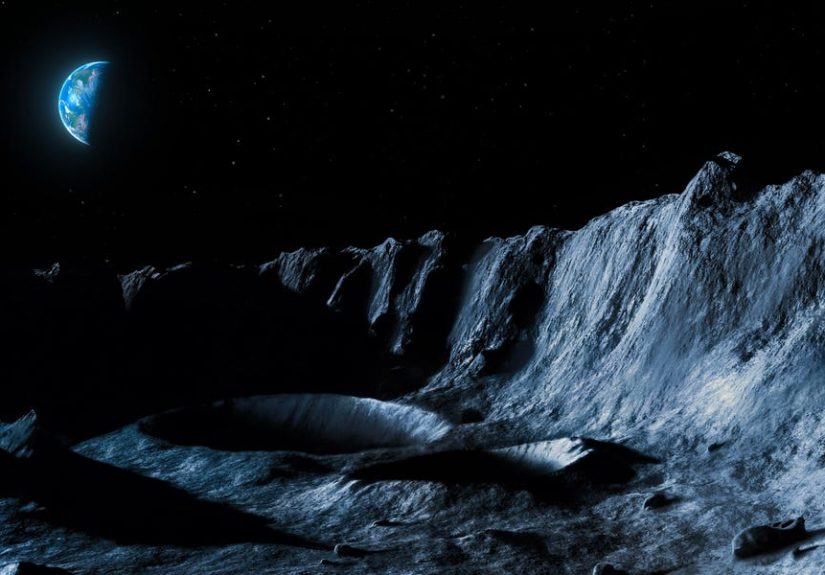
Open the hatch later and the visual experience would feel almost unreal. The sky is black even in daylight. The horizon seems closer because the Moon is smaller than Earth. The landscape is quiet in a way Earth never is. No wind. No leaves. No distant traffic. Just a frozen stillness broken only by radio chatter and your own breathing inside the suit.
Walking would be an adjustment too. Lunar gravity helps, but it also changes your sense of timing and balance. Apollo footage made it clear that moving efficiently on the Moon is a learned skill. You do not simply stroll like you are headed to a coffee shop. You bound, shuffle, adapt, and try not to face-plant in front of history.
There is also the emotional experience. Astronaut accounts and decades of lunar mission retellings suggest that the Moon inspires two feelings at once: intimacy and distance. The ground beneath your boots is immediate and detailed, full of dust, rock, shadows, and texture. But one glance upward reminds you that Earth is far away, beautiful, and absolutely not within driving distance.
That combination may be the defining human experience of a Moon landing. It is technical, yes. It is procedural, yes. But it is also deeply personal. You are trusting thousands of people, millions of parts, and generations of engineering just to stand in silence on a place that spent most of human history as a bright object in the night sky. That is the real magic of landing on the Moon. The science gets you there. The experience changes what “there” means forever.