Table of Contents >> Show >> Hide
- What Area and Perimeter Actually Mean
- Before You Calculate: A 5-Step Plan That Works Every Time
- Core Formulas for Area and Perimeter
- Step-by-Step Examples You Can Copy
- Same Perimeter, Different Area (and Vice Versa)
- Units, Conversions, and Rounding Rules
- Top Mistakes and How to Dodge Them
- How to Solve Word Problems Fast
- Why This Skill Matters in Real Life
- Experience Section: Real Stories and Patterns People Notice (500+ Words)
- Conclusion
If geometry ever made you feel like your brain was trying to parallel park in a tiny space, you’re not alone.
The good news? Area and perimeter are two of the most practical math ideas you’ll ever learnand once they click,
they really click. Whether you’re planning a garden border, buying flooring, framing a photo wall, or just trying
to crush a homework set before your snack break, knowing how to find area and perimeter saves time, money, and confusion.
In this guide, you’ll learn exactly how to find area and perimeter of a shape with clear formulas,
step-by-step examples, common mistakes to avoid, and real-world use cases. We’ll cover rectangles, squares, triangles,
circles, trapezoids, regular polygons, and composite shapes. By the end, you’ll know not only which formula to use,
but also why it works and how to check your answer like a pro.
What Area and Perimeter Actually Mean
Perimeter: the distance around a shape
Perimeter is the total length of a shape’s boundary. If you walked around the edge of a yard,
the total walking distance would be its perimeter. Perimeter is always measured in linear units
(inches, feet, meters, centimeters, etc.).
Area: the space inside a shape
Area measures how much surface is enclosed inside a shape. Think of paint needed to cover a wall
or carpet needed to cover a room. Area is always measured in square units (in², ft², m², cm²).
Quick memory trick: perimeter is a “fence,” area is a “floor.”
Before You Calculate: A 5-Step Plan That Works Every Time
- Identify the shape. Rectangle? Triangle? Circle? Composite figure?
- Write down known measurements. Label lengths, width, radius, base, height, and missing sides.
- Choose the correct formula. Use perimeter formulas for edges, area formulas for interior space.
- Calculate carefully with units. Keep units consistent before solving.
- Check reasonableness. Does the answer size and unit make sense?
Core Formulas for Area and Perimeter
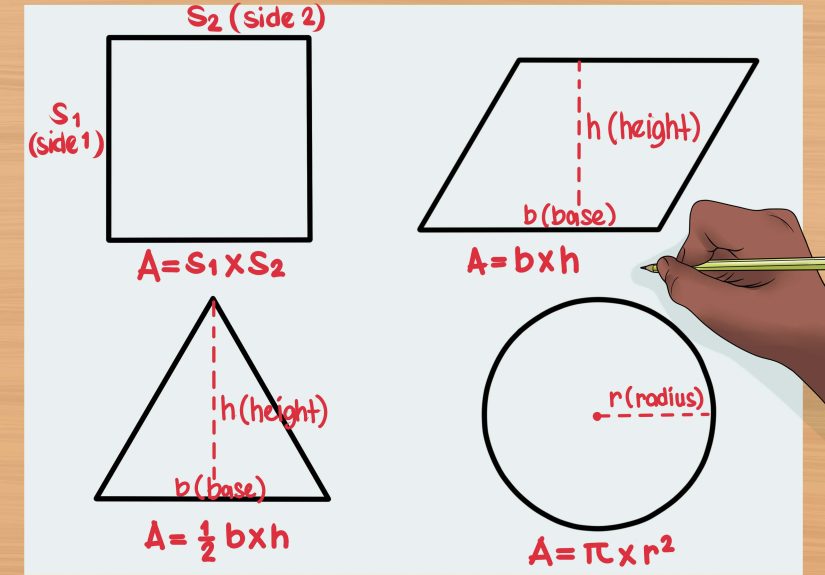
Rectangle
- Perimeter: P = 2l + 2w
- Area: A = l × w
Square
- Perimeter: P = 4s
- Area: A = s2
Triangle
- Perimeter: P = a + b + c
- Area: A = 1/2 × b × h
Parallelogram
- Perimeter: P = 2(a + b)
- Area: A = b × h
Trapezoid
- Perimeter: P = a + b + c + d
- Area: A = 1/2 × (b1 + b2) × h
Circle
- Circumference (perimeter of a circle): C = 2πr or C = πd
- Area: A = πr2
Regular polygon (same side lengths)
- Perimeter: P = n × s
- Area: A = 1/2 × a × P (where a is apothem)
Step-by-Step Examples You Can Copy
Example 1: Rectangle
A rectangle has length 9 m and width 4 m.
Perimeter: P = 2l + 2w = 2(9) + 2(4) = 18 + 8 = 26 m
Area: A = l × w = 9 × 4 = 36 m2
Example 2: Square
A square has side length 7 in.
Perimeter: P = 4s = 4(7) = 28 in
Area: A = s2 = 72 = 49 in2
Example 3: Triangle
Triangle sides are 8 ft, 9 ft, and 12 ft. Base is 12 ft and height is 7 ft.
Perimeter: P = 8 + 9 + 12 = 29 ft
Area: A = 1/2 × b × h = 1/2 × 12 × 7 = 6 × 7 = 42 ft2
Example 4: Trapezoid
Bases are 10 cm and 6 cm, height is 5 cm, and non-parallel sides are 5 cm and 7 cm.
Area: A = 1/2 × (10 + 6) × 5 = 1/2 × 16 × 5 = 8 × 5 = 40 cm2
Perimeter: P = 10 + 6 + 5 + 7 = 28 cm
Example 5: Circle
Radius r = 6 cm.
Circumference: C = 2πr = 2π(6) = 12π ≈ 37.70 cm
Area: A = πr2 = π(62) = 36π ≈ 113.10 cm2
Example 6: Composite (L-Shaped) Figure
Imagine a 10 by 8 rectangle with a 4 by 3 corner cut out.
Area:
Big rectangle area = 10 × 8 = 80
Cut-out area = 4 × 3 = 12
L-shape area = 80 − 12 = 68 square units
Perimeter:
Add outside edges: 10 + 5 + 4 + 3 + 6 + 8 = 36 units
Composite figures are where many students level up fast: split complex shapes into simple ones, solve each, then combine.
Same Perimeter, Different Area (and Vice Versa)
Same perimeter, different areas
Keep perimeter at 24 units:
- 1 × 11 rectangle: area 11
- 2 × 10 rectangle: area 20
- 3 × 9 rectangle: area 27
- 4 × 8 rectangle: area 32
- 5 × 7 rectangle: area 35
- 6 × 6 square: area 36
Same perimeter, wildly different areas. The square gives the largest area among these rectangles.
Same area, different perimeters
Keep area at 36 square units:
- 1 × 36 rectangle: perimeter 74
- 2 × 18 rectangle: perimeter 40
- 3 × 12 rectangle: perimeter 30
- 4 × 9 rectangle: perimeter 26
- 6 × 6 square: perimeter 24
Same area, but perimeter changes a lot. This is huge in design, farming, architecture, and materials planning.
Units, Conversions, and Rounding Rules
Use consistent units first
Never mix units without converting. If one side is in meters and another in centimeters, convert first.
Example: rectangle with 2 m and 80 cm.
Convert 80 cm to 0.8 m.
Area = 2 × 0.8 = 1.6 m2
Perimeter = 2(2) + 2(0.8) = 4 + 1.6 = 5.6 m
Round at the end when possible
For circles, keep π in symbolic form until the final step. This reduces rounding error. Report answers with
reasonable precision for your class or project (for example, nearest tenth or hundredth).
Top Mistakes and How to Dodge Them
- Mixing up area and perimeter: one is inside space, one is boundary distance.
- Forgetting square units: area must be in units squared.
- Using the wrong “height” in triangles: height must be perpendicular to the base.
- Ignoring missing sides: in composite figures, find unknown lengths before perimeter.
- Premature rounding: especially with π, round only at the end.
- Unit mismatch: cm + m in one formula is a math trap. Convert first.
How to Solve Word Problems Fast
Word problem workflow
- Underline what is given (length, width, radius, base, height).
- Circle what is asked (area, perimeter, or both).
- Draw a quick sketch and label everything.
- Choose formula and substitute.
- Check units and sanity-check the number.
If the number looks impossible (like a tiny garden with a giant area), retrace your formula and units.
Why This Skill Matters in Real Life
- Home improvement: flooring, paint coverage, trim, tiles, wallpaper, turf.
- Landscaping: fencing uses perimeter; sod and mulch use area.
- Construction: estimating materials and labor.
- Packaging and design: labels, wraps, and layout optimization.
- Budgeting: cost per square foot or cost per linear foot.
Master area and perimeter once, and you unlock dozens of practical decisions with confidence. That’s not just good mathit’s good life admin.
Experience Section: Real Stories and Patterns People Notice (500+ Words)
Across classrooms, tutoring sessions, and everyday projects, one pattern keeps showing up: people think they understand
area and perimeter until a problem changes shape. Give someone a rectangle, and they’re confident. Give them an L-shaped room,
a triangle with a missing height, or a circle with only diameter information, and suddenly calculators get dramatic.
The good news is that nearly every “I’m stuck” moment comes from a small set of habits that can be fixed quickly.
In school settings, students often report that perimeter feels easier at first because it looks like basic addition:
just add the sides. But then teachers introduce unknown side lengths, and students realize they need structure, not guesswork.
A helpful classroom move is to color-code edges: all horizontal edges in one color, all vertical edges in another.
This visual trick helps students spot missing lengths and prevents the classic mistake of forgetting an interior corner in a composite shape.
Once students do that a few times, accuracy jumps.
Another common experience appears when students compare shapes with the same perimeter. Many are surprised that area can vary so much.
When they build rectangles from tiles (for example, perimeter 24), they physically see that a long skinny rectangle traps less space
than a near-square one. That moment tends to be a turning point. Instead of memorizing formulas mechanically, they begin reasoning:
“If I redistribute side lengths, I can change interior space without changing boundary length.” That is deep mathematical thinking in action.
Adults doing DIY projects describe a similar learning curve. A homeowner planning baseboards might correctly compute perimeter,
then accidentally buy paint using that same number, forgetting paint depends on area. Or someone estimates floor tile from room area
but forgets extra tiles for cuts and waste. In real project workflows, the best practice is to separate measurements into two lists:
“linear materials” (trim, fencing, edging) and “surface materials” (paint, flooring, sod, wall panels). That simple two-column method
cuts expensive mistakes dramatically.
People also talk about unit confusion as the sneakiest trap. A contractor-style plan may show feet for large dimensions and inches for details.
Students and DIYers alike report that converting all dimensions firstbefore any formulaprevents most errors.
One practical routine is to write a “unit checkpoint” line right above the formula: “All lengths converted to feet” or “all to meters.”
It feels small, but it acts like a safety lock.
Circle problems create their own stories. Learners often remember circumference and area formulas but mix them under pressure.
A memorable tip that people keep using is this: circumference has one “r” (C = 2πr), area has “r squared” (A = πr²) because area is two-dimensional.
For many, this phrase sticks better than pure memorization.
In middle and high school, the biggest confidence boost comes from decomposition.
When students learn they can split complex figures into rectangles and triangles, complex diagrams stop feeling scary.
Teachers often say, “If the shape looks impossible, cut it into familiar pieces.” Students who adopt that mindset solve more problems,
explain their logic better, and make fewer random arithmetic mistakes because each part is manageable.
A final theme from real experiences: people become faster when they always include a reasonableness check.
If a bedroom perimeter comes out smaller than one wall length, something is wrong. If a tiny circular table has an area larger than a garage,
something is wrong. Estimation before and after calculation creates a “math smell test.” It catches errors without redoing everything.
So whether you’re a student, teacher, parent, designer, or weekend DIY hero, the experience is usually the same:
once you stop treating formulas like magic spells and start treating them like tools, area and perimeter become reliable, practical, and even fun.
Yes, fun. Math fun. The rare kind where your answer also helps you buy the correct amount of tile.
Conclusion
Learning how to find area and perimeter of a shape is one of the highest-value geometry skills you can build.
Perimeter tells you how far around. Area tells you how much inside. With the right formula, consistent units, and a quick reasonableness check,
you can solve classroom problems and real-life measurements with confidence. Start with simple shapes, practice composite figures,
and keep your units clean. Your future selfstanding in a hardware aisle with a tape measurewill thank you.