Table of Contents >> Show >> Hide
- What Is Scientific Notation?
- The Rule for Dividing Scientific Notation
- Step-by-Step Method: How to Divide Scientific Notation
- Example 1: Dividing Scientific Notation with Positive Exponents
- Example 2: Dividing Scientific Notation with a Negative Exponent
- Example 3: Dividing When Both Exponents Are Negative
- Example 4: When the Coefficient Is Too Small
- Example 5: When the Coefficient Is Too Large
- How to Check Your Answer
- Common Mistakes When Dividing Scientific Notation
- Practice Problems with Answers
- Real-Life Uses of Dividing Scientific Notation
- Tips for Dividing Scientific Notation Faster
- Experience-Based Advice: Learning How to Divide Scientific Notation
- Conclusion
Dividing scientific notation may look like math wearing a tiny lab coat, but it is much friendlier than it first appears. Scientific notation is simply a shortcut for writing very large or very small numbers without dragging a parade of zeros across the page. Instead of writing 6,500,000,000, you can write 6.5 × 10⁹. Instead of writing 0.00000042, you can write 4.2 × 10⁻⁷. Cleaner, faster, and much less likely to make your notebook look like a barcode.
The good news is that dividing numbers in scientific notation follows a simple pattern: divide the front numbers, subtract the exponents, and then adjust the answer so it is in proper scientific notation. Once you understand those three moves, the process becomes almost automatic.
In this guide, you will learn how to divide scientific notation step by step, how to handle negative exponents, how to fix answers that are not yet in correct scientific notation, and how to avoid the most common mistakes students make. We will also walk through plenty of examples, because math is much easier when it stops waving from a distance and actually sits down at the table.
What Is Scientific Notation?
Scientific notation is a way to write a number as the product of two parts:
a × 10n
In this format, a is a number greater than or equal to 1 and less than 10, and n is an integer exponent. The exponent tells you how many places the decimal point moves.
Examples of Scientific Notation
- 45,000 = 4.5 × 10⁴
- 7,200,000 = 7.2 × 10⁶
- 0.0038 = 3.8 × 10⁻³
- 0.00000091 = 9.1 × 10⁻⁷
Positive exponents usually represent large numbers. Negative exponents usually represent small numbers between 0 and 1. That one sentence solves a surprising number of scientific notation mysteries.
The Rule for Dividing Scientific Notation
To divide numbers in scientific notation, use this formula:
(a × 10m) ÷ (b × 10n) = (a ÷ b) × 10m – n
In plain English, that means:
- Divide the coefficients, or the numbers in front.
- Subtract the exponent in the denominator from the exponent in the numerator.
- Rewrite the answer in proper scientific notation if needed.
The most important part is remembering that division means subtract the exponents. Multiplication adds exponents. Division subtracts them. Think of division as the math version of cleaning out your closet: something is getting removed.
Step-by-Step Method: How to Divide Scientific Notation
Step 1: Divide the Decimal Numbers
Start by dividing the numbers that appear before the multiplication signs. These are called coefficients, decimal factors, or significands. For example, in 8.4 × 10⁶, the coefficient is 8.4.
Step 2: Subtract the Exponents
Next, divide the powers of 10. When the base is the same, you subtract the exponents:
10m ÷ 10n = 10m – n
For example:
108 ÷ 103 = 108 – 3 = 105
Step 3: Combine the Results
Put the divided coefficient and the new power of 10 together.
Step 4: Convert to Proper Scientific Notation
Your final coefficient must be at least 1 but less than 10. If your coefficient is too small or too large, move the decimal point and adjust the exponent.
Example 1: Dividing Scientific Notation with Positive Exponents
Divide:
(6.4 × 10⁸) ÷ (2 × 10³)
Step 1: Divide the coefficients.
6.4 ÷ 2 = 3.2
Step 2: Subtract the exponents.
8 – 3 = 5
Step 3: Combine the answer.
3.2 × 10⁵
Final answer: 3.2 × 10⁵
This answer is already in proper scientific notation because 3.2 is between 1 and 10.
Example 2: Dividing Scientific Notation with a Negative Exponent
Divide:
(9.6 × 10⁴) ÷ (3.2 × 10⁻²)
Step 1: Divide the coefficients.
9.6 ÷ 3.2 = 3
Step 2: Subtract the exponents carefully.
4 – (-2) = 4 + 2 = 6
Step 3: Combine the answer.
3 × 10⁶
Final answer: 3 × 10⁶
Here is the key detail: subtracting a negative exponent turns into addition. This is where many students trip, usually because the minus signs start multiplying like rabbits. Slow down, rewrite the subtraction, and the answer becomes much clearer.
Example 3: Dividing When Both Exponents Are Negative
Divide:
(4.8 × 10⁻⁵) ÷ (1.2 × 10⁻⁸)
Step 1: Divide the coefficients.
4.8 ÷ 1.2 = 4
Step 2: Subtract the exponents.
-5 – (-8) = -5 + 8 = 3
Step 3: Combine.
4 × 10³
Final answer: 4 × 10³
Even though both original numbers were very small, the quotient can be large. That makes sense because you are dividing one tiny number by an even tinier number. Tiny divided by tinier can suddenly become surprisingly big. Math enjoys these plot twists.
Example 4: When the Coefficient Is Too Small
Divide:
(2.4 × 10⁶) ÷ (8 × 10²)
Step 1: Divide the coefficients.
2.4 ÷ 8 = 0.3
Step 2: Subtract the exponents.
6 – 2 = 4
Step 3: Combine.
0.3 × 10⁴
This is not proper scientific notation because 0.3 is less than 1. We need to rewrite it.
0.3 × 104 = 3 × 10³
Final answer: 3 × 10³
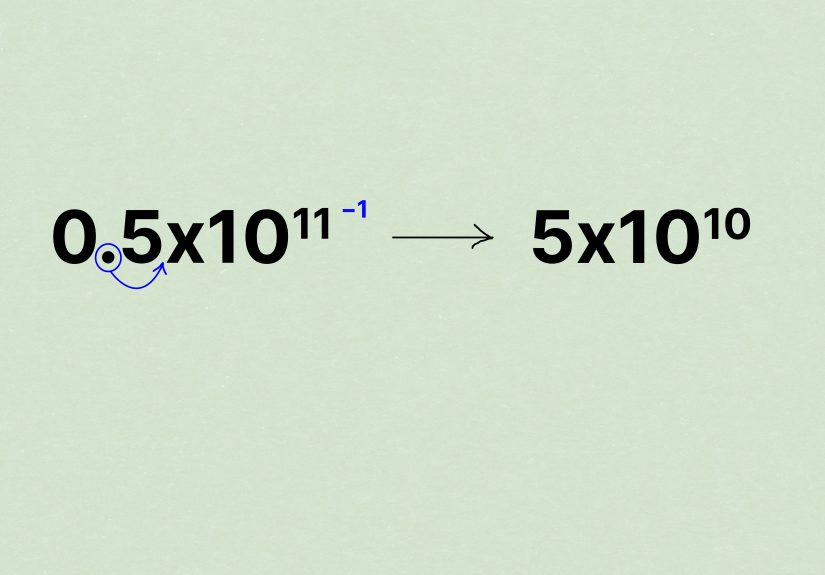
When you move the decimal point one place to the right, the coefficient gets 10 times larger. To keep the value the same, you decrease the exponent by 1.
Example 5: When the Coefficient Is Too Large
Divide:
(8.4 × 10⁷) ÷ (0.2 × 10³)
Step 1: Divide the coefficients.
8.4 ÷ 0.2 = 42
Step 2: Subtract the exponents.
7 – 3 = 4
Step 3: Combine.
42 × 104
This is not proper scientific notation because 42 is greater than 10. Rewrite it:
42 × 104 = 4.2 × 10⁵
Final answer: 4.2 × 10⁵
When you move the decimal point one place to the left, the coefficient gets 10 times smaller. To keep the value the same, you increase the exponent by 1.
How to Check Your Answer
A simple way to check your answer is to estimate. Suppose you are dividing 6.4 × 108 by 2 × 103. The coefficient 6.4 divided by 2 is a little more than 3, and 108 divided by 103 gives 105. So an answer around 3 × 10⁵ makes sense.
You can also convert the answer back to standard form. For example, 3.2 × 10⁵ equals 320,000. If the original division is roughly 640,000,000 divided by 2,000, then 320,000 is reasonable.
Common Mistakes When Dividing Scientific Notation
Mistake 1: Adding Exponents Instead of Subtracting
This is the classic error. When multiplying scientific notation, add exponents. When dividing scientific notation, subtract exponents. If you only remember one thing from this article, make it that. Well, that and maybe do not eat cereal with a fork.
Mistake 2: Subtracting Negative Exponents Incorrectly
When you see something like 5 – (-3), rewrite it as 5 + 3. The answer is 8. Many wrong answers happen because students rush through this tiny but powerful sign change.
Mistake 3: Leaving the Coefficient Outside the Correct Range
Proper scientific notation requires the coefficient to be at least 1 and less than 10. So 0.42 × 10⁶ and 42 × 104 need to be adjusted.
Mistake 4: Forgetting That the Denominator Exponent Is Subtracted
In the expression (a × 10m) ÷ (b × 10n), the exponent in the denominator is subtracted. The order matters. Use top exponent minus bottom exponent.
Practice Problems with Answers
Problem 1
(5.6 × 10⁹) ÷ (2.8 × 10⁴)
5.6 ÷ 2.8 = 2
9 – 4 = 5
Answer: 2 × 10⁵
Problem 2
(7.5 × 10⁻³) ÷ (2.5 × 10²)
7.5 ÷ 2.5 = 3
-3 – 2 = -5
Answer: 3 × 10⁻⁵
Problem 3
(1.2 × 10⁸) ÷ (4 × 10⁵)
1.2 ÷ 4 = 0.3
8 – 5 = 3
0.3 × 103 = 3 × 10²
Answer: 3 × 10²
Problem 4
(9 × 10⁻⁶) ÷ (3 × 10⁻²)
9 ÷ 3 = 3
-6 – (-2) = -4
Answer: 3 × 10⁻⁴
Real-Life Uses of Dividing Scientific Notation
Scientific notation is not just a school worksheet invention designed to keep pencils employed. It is used in science, engineering, astronomy, chemistry, biology, medicine, and computer science. Whenever numbers become extremely large or extremely small, scientific notation helps people calculate without drowning in zeros.
For example, astronomers may compare distances between planets, stars, and galaxies. Chemists may calculate the mass of tiny particles or the concentration of molecules in a solution. Biologists may compare microscopic cell measurements. Engineers may divide large energy values by time to calculate power. In each case, scientific notation keeps the calculation readable.
Tips for Dividing Scientific Notation Faster
Use Parentheses
Write the division problem as two separate fractions: one for coefficients and one for powers of 10. This makes the structure easier to see.
(6.4 ÷ 2) × (108 ÷ 103)
Circle the Exponents
If you are working on paper, circle the exponents before subtracting. This helps prevent accidentally subtracting the coefficients or mixing up the order.
Check the Coefficient Last
Do not worry too early about whether the coefficient is in perfect scientific notation. First divide, then subtract, then adjust. One task at a time keeps the math from turning into a spaghetti situation.
Estimate Before You Finalize
A quick estimate can catch many mistakes. If you divide a huge number by a small number, your answer should usually get larger. If you divide a tiny number by a huge number, your answer should usually get smaller.
Experience-Based Advice: Learning How to Divide Scientific Notation
One of the best ways to learn how to divide scientific notation is to stop treating it like a completely new topic. It is really a combination of skills you already know: dividing decimals, using exponent rules, and adjusting decimal placement. When students struggle, it is often not because the full topic is impossible. It is usually because one of those smaller skills is shaky.
From experience, the biggest breakthrough comes when students separate the problem into two lanes. The first lane is the coefficient lane. The second lane is the exponent lane. For example, in (8.1 × 10⁷) ÷ (2.7 × 10³), do not stare at the whole expression as if it is a locked vault. Divide 8.1 by 2.7 first. That gives 3. Then handle the powers of 10: 7 – 3 = 4. The answer is 3 × 10⁴. Suddenly, the monster has become two small puppies wearing fake mustaches.
Another useful habit is saying the exponent rule out loud: “When dividing powers with the same base, subtract the exponents.” It may feel silly at first, but verbal repetition helps. Many math errors happen because students remember the idea vaguely but not the exact action. Saying the rule forces the brain to slow down just enough to prevent automatic mistakes.
Negative exponents deserve extra patience. A problem like 104 ÷ 10-2 is not 102. It is 106, because 4 – (-2) equals 6. When practicing, rewrite every subtraction of a negative number as addition. Do not try to do it mentally until it feels natural. There is no trophy for doing sign rules in your head and getting them wrong with confidence.
It also helps to check whether the answer makes real-world sense. Suppose you divide 5 × 106 by 5 × 102. The coefficient part becomes 1, and the exponent part becomes 104. So the answer is 1 × 10⁴, or 10,000. If you accidentally wrote 1 × 10⁸, you would know something went wrong because dividing by 500 should not make 5,000,000 explode into 100,000,000.
For students preparing for tests, practice mixed examples instead of only easy ones. Include problems with positive exponents, negative exponents, coefficients less than 1 after division, and coefficients greater than 10 after division. This prepares you for the little twists that appear on quizzes. Scientific notation is not trying to trick you, exactly, but it does enjoy checking whether you are paying attention.
Finally, write neatly. Scientific notation depends on small symbols, especially exponents and negative signs. A tiny missing minus sign can change the answer dramatically. Keep exponents raised, line up your work, and avoid squeezing calculations into the corner of the page like they owe you rent. Clear writing leads to clearer thinking, and clearer thinking leads to fewer math surprises.
Conclusion
Dividing scientific notation is much easier when you follow a reliable process. Divide the coefficients, subtract the exponents, and adjust the result so the coefficient is between 1 and 10. That is the whole recipe. The only ingredients that need extra attention are negative exponents and decimal adjustments, but both become easier with practice.
Scientific notation helps make giant and tiny numbers manageable, especially in science, engineering, medicine, astronomy, and technology. Once you master division, you can work with massive distances, microscopic measurements, and advanced calculations without getting buried under zeros. In other words, scientific notation is not just math homeworkit is a very practical tool with excellent zero-control skills.