Table of Contents >> Show >> Hide
- What POLYWOOD Actually Makes
- From Plastic Waste to Patio Chair: How the Process Works
- Why Recycled HDPE Works So Well Outdoors
- POLYWOOD’s Real Trick: Making Recycled Plastic Feel Premium
- What Makes the Model More Credible Than a Typical Green Claim
- The Catch: It Is Not Magic, and It Is Not Cheap
- Why This Matters Beyond One Brand
- Experience Section: What This Looks Like in Real Life
- Conclusion
- SEO Tags
Most outdoor furniture has a dramatic life cycle. First, it looks fabulous on the patio. Then it fades, splinters, rusts, wobbles, and eventually gets demoted to “that sad chair by the grill.” POLYWOOD built its reputation by trying to break that cycle. Instead of treating outdoor furniture like a short-term seasonal fling, the company treats it like a long-haul relationshipone that starts with discarded plastic and ends with chairs, tables, swings, and loungers designed to sit outside for years without throwing a weather-related tantrum.
That idea sounds simple enough: take plastic waste and make furniture. But the reason POLYWOOD stands out is that it does not stop at a clever recycling slogan. The company has spent decades turning recycled high-density polyethylene, or HDPE, into a branded all-weather lumber that looks more polished than bargain-bin plastic furniture and behaves more predictably than natural wood in rough weather. In other words, it is not trying to make trash look charming. It is trying to make waste useful, durable, and surprisingly good-looking.
And that matters. In the United States, plastic recycling remains stubbornly low overall, while HDPE bottles such as milk jugs are among the more commonly recovered streams. A company that can take those materials, process them on-site, and lock them into a long-lived product is operating in a lane that makes practical sense. POLYWOOD’s story is not just about sustainability theater. It is about using recovered plastic in a product category where durability, moisture resistance, and low maintenance are real advantages, not marketing wallpaper.
What POLYWOOD Actually Makes
POLYWOOD was founded in 1990, and what began as an Indiana garage idea grew into a vertically integrated outdoor furniture business with manufacturing in Indiana and North Carolina. That “vertically integrated” part is important. It means the company is not simply buying finished boards from somewhere else and assembling chairs in a warehouse. It is deeply involved in the recycling and material-processing side of the operation, which gives it more control over consistency, quality, and waste reduction.
The brand is best known for classic American outdoor silhouettes: Adirondack chairs, porch swings, rockers, dining sets, benches, and deep seating. But the bigger story is the material. POLYWOOD’s proprietary lumber is made from HDPE, the same family of plastic used in items like milk jugs and detergent bottles. The company says the majority of the HDPE it uses comes from recycled post-consumer and post-industrial plastics, and it reuses nearly all manufacturing scrap in its own process.
That is one reason POLYWOOD occupies an interesting position in the market. To some buyers, it is a furniture brand. To others, it is a materials story disguised as a furniture brand. Honestly, it is both. The chairs may get the glory shots on porches and pool decks, but the real hero is the material system humming behind the scenes.
From Plastic Waste to Patio Chair: How the Process Works
Step 1: The waste stream arrives
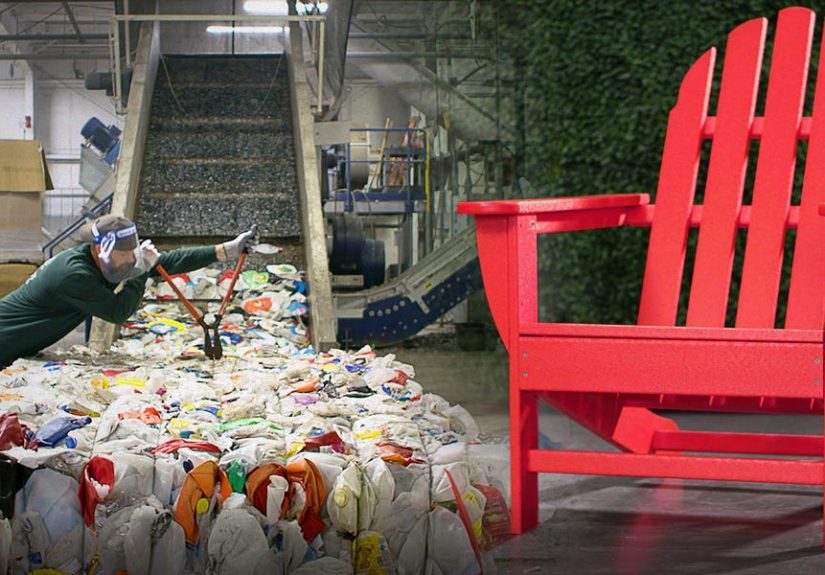
POLYWOOD starts with bales of recovered plastic, including materials that would otherwise be headed toward landfills and, in some cases, plastic described as ocean-bound. This is the part where yesterday’s milk jug begins its glow-up. Instead of being treated like disposable packaging with no second act, the plastic becomes feedstock.
Step 2: Shredding, washing, and sorting
Once inside the recycling operation, the plastic is pre-shredded, washed, and cleaned of unwanted heavy materials such as bits of glass or rock that may have snuck into the stream. Then it is sorted again so the resulting material is cleaner and more controlled. If you are imagining a glamorous makeover montage, this is the less photogenic but absolutely essential part. Furniture-grade consistency does not come from wishful thinking; it comes from aggressively boring process control.
Step 3: Pelletizing and extrusion
After sorting, the plastic is pelletized. Those pellets are then sent to extrusion lines, where they are transformed into solid lumber profiles. This is where waste stops looking like waste and starts behaving like a building material. The company also regrinds scrap from its own production floor and routes it back into the system, which supports its circular, low-waste manufacturing pitch.
Step 4: Assembly into finished furniture
Once the lumber is formed, it is cut, machined, and assembled into finished products. Color is integrated into the material rather than applied like a surface-level afterthought, which helps explain why POLYWOOD leans so heavily on its fade-resistance message. The point is not just to mimic painted wood on day one. The point is to keep the piece from looking exhausted after years of sun, rain, snow, and salty air.
Why Recycled HDPE Works So Well Outdoors
Not every recycled product is automatically a smart product. Some recycled goods sound noble but perform like a compromise. POLYWOOD’s success comes from the fact that HDPE is a genuinely sensible material for outdoor living. It does not rot like untreated wood. It does not need repainting every time the weather gets moody. It is easy to clean, and it is not prone to the same splintering drama that makes aging wood furniture feel like a minor medical risk.
POLYWOOD also builds its identity around durability claims that speak directly to homeowner pain points: moisture resistance, UV resistance, low maintenance, and year-round usability. The company backs much of that positioning with a 20-year warranty on its lumber, which is not a casual promise in a category where plenty of patio purchases are lucky to survive a few hard seasons looking respectable.
This is where recycled plastic becomes more than an environmental talking point. It becomes a performance material. That is an important distinction. Consumers do not just want to feel virtuous; they want to stop replacing outdoor furniture every few years. Recycled content becomes much more persuasive when it also means fewer headaches, fewer weekends spent sanding and sealing, and fewer muttered phrases that cannot be repeated in polite company while dragging cracked chairs to the curb.
POLYWOOD’s Real Trick: Making Recycled Plastic Feel Premium
For a long time, “plastic furniture” called to mind flimsy stackable chairs, faded white resin, and the visual charisma of a folding banquet table. POLYWOOD has worked hard to move the category somewhere else entirely. The brand sells traditional silhouettes, modern pieces, and collaborations that lean into design rather than apologizing for the material. That matters because recycled products only scale when people want them, not when they buy them out of guilt.
Recent collaborations with names such as Martha Stewart, Country Living, and Draper James help show how the company wants to be perceived: not as the eco option tucked into a corner, but as a legitimate design brand with sustainable credentials. That strategy is smart. It expands the conversation from “Is this made from recycled plastic?” to “Wait, that porch swing is made from recycled plastic?” That little shift is marketing gold.
Third-party home and lifestyle outlets have helped reinforce the message. Editors at major U.S. publications have repeatedly highlighted POLYWOOD pieces for comfort, weather resistance, low maintenance, and durability in testing or roundups. In other words, the brand is not relying only on its own product pages to make the case. It is increasingly being treated as a benchmark in the all-weather patio category.
What Makes the Model More Credible Than a Typical Green Claim
It uses a practical plastic stream
HDPE is one of the more recoverable and more useful plastics in the recycling system. That does not mean the broader recycling system is flawlessfar from itbut it does mean POLYWOOD is not building its story around fantasy chemistry. It is working with a material stream that already has real-world recovery potential.
It pairs recycled content with long product life
Using recycled material in a flimsy product would be a weak victory lap. Using it in furniture designed to last for years is more compelling. Long-lived products stretch the value of recycled inputs and reduce replacement frequency, which can make the environmental math more meaningful over time.
It keeps processing close to production
Because POLYWOOD processes material at its own facilities and reuses scrap internally, it has a tighter loop than brands that outsource the messy parts and merely market the clean parts. The company has said its on-site recycling operations handle an average of roughly 400,000 milk jugs per day. That scale gives the sustainability narrative some muscle.
It acknowledges the material-performance equation
One of the reasons this model works is that recycled plastic is not being forced into a job it hates. Outdoor furniture asks for moisture resistance, dimensional stability, and low maintenance. Recycled HDPE happens to be well suited to those demands. This is not a gimmick. It is a case of the material and the application actually liking each other.
The Catch: It Is Not Magic, and It Is Not Cheap
Let’s be adults for a second. Recycled plastic furniture is not a miracle wand for the global waste crisis, and POLYWOOD furniture is not bargain-basement patio gear. The pieces are often heavy, which many owners and reviewers see as a plus in windy conditions, but it also means they are not as breezy to move as ultra-light resin furniture. The up-front price can be noticeably higher than budget alternatives too.
But that is where the value proposition becomes interesting. POLYWOOD is effectively asking buyers to stop thinking in sticker price and start thinking in cost per year of use. If a chair made from recycled HDPE survives years of summer sun, winter storms, muddy dogs, sticky kids, backyard parties, and neglect with nothing more dramatic than soap and water, the economics begin to look less outrageous. You are not just buying a chair. You are buying your way out of recurring maintenance and replacement.
There is also a broader lesson here. Sustainable products win when they are better products, not merely worthier ones. POLYWOOD does not really sell sacrifice. It sells relief: relief from repainting, from rotting, from rusting, from splitting, and from the annual ritual of pretending a furniture cover is a personality trait.
Why This Matters Beyond One Brand
POLYWOOD’s rise says something bigger about American manufacturing and circular design. Consumers are more open than ever to products made from recovered materials, but only when those products deliver on comfort, appearance, and longevity. That is why this company has become such a useful case study. It demonstrates that recycled plastic does not have to end up as a flimsy tote, a park bench cliché, or a corporate sustainability footnote. It can become a premium consumer product people actively seek out.
It also highlights the importance of designing for the full product journey. POLYWOOD’s messaging focuses not only on recycled inputs but also on reusable scrap, domestic manufacturing, and a circular mindset. Whether every piece finds its way back into that loop later depends on collection systems and end-of-life realities, of course. Still, the design intent is clear: build furniture from reusable material, make it last a very long time, and waste as little as possible in the process.
That is a far more mature sustainability story than the usual “made with recycled stuff” badge slapped onto a forgettable product. It is process, performance, and positioning working together. And when that happens, people do not feel like they are buying a compromise. They feel like they are buying something smarter.
Experience Section: What This Looks Like in Real Life
The following is a composite, experience-based portrait drawn from common themes in editor testing, homeowner feedback, and the way POLYWOOD products are typically used.
A front porch that stops feeling temporary
One of the most common experiences tied to POLYWOOD furniture is the feeling that an outdoor space finally becomes part of the home instead of a seasonal afterthought. A porch swing or rocker made from recycled HDPE changes the mood quickly. It feels sturdier than lightweight patio furniture, sits with a kind of planted confidence, and does not make you wonder whether a summer thunderstorm is about to shorten its life expectancy. Homeowners often talk less about “saving the planet” in that moment and more about finally having something that looks permanent. That emotional shift matters. Recycled plastic stops sounding like a materials lecture and starts feeling like peace of mind with armrests.
A backyard that survives weather without becoming a weekend project
Another recurring theme is relief. Real relief. The kind that shows up after a hard rain when you walk outside expecting furniture casualties and instead find everything looking basically fine. No swelling wood, no peeling paint, no rust panic, no frantic dragging of chairs into the garage because the weather app got dramatic again. For busy families, that is a huge part of the appeal. The experience is not flashy; it is practical. The furniture becomes one less thing to babysit. That may not sound romantic, but anyone who has ever sanded a weathered outdoor table in August will tell you practicality can be deeply beautiful.
A design upgrade without the “eco product” look
There is also the surprise factor. People expect recycled plastic furniture to look obvioustoo synthetic, too glossy, too “municipal park meets break room patio.” POLYWOOD’s better lines tend to challenge that assumption. The color feels integrated, the silhouettes are familiar, and the styling often lands closer to classic American outdoor living than to recycled novelty. That is why the material can work across different settings: coastal decks, suburban patios, lake houses, farmhouse porches, and even tighter urban balconies. The experience is often less “Wow, I bought a recycled product” and more “Wait, this is the piece everyone keeps asking about?” That is an important difference because it shows sustainability entering everyday taste instead of standing outside it.
Living with the tradeoff and deciding it is worth it
Of course, the experience is not perfect. POLYWOOD pieces can be heavy, and the initial price can cause a brief moment of staring at the screen like your wallet just coughed politely. But many buyers seem to come to the same conclusion: the heft reads as durability, and the higher price feels easier to justify once the furniture survives season after season. That is especially true in places with harsh sun, coastal air, heavy rain, or cold winters. Over time, the product experience becomes less about recycled plastic as a concept and more about consistency. It still looks good. It still feels solid. It still does not demand much. For many households, that combination is exactly what turns a sustainability story into a repeat purchase story.
Conclusion
POLYWOOD turns plastic waste into outdoor furniture by doing something a lot of “green” products fail to do: it pairs environmental logic with material logic. Recycled HDPE is not just a feel-good ingredient here. It is the reason the furniture can resist moisture, avoid splintering, shrug off rough weather, and require very little maintenance. The company’s on-site processing, closed-loop scrap reuse, and long-lived product design give the story more credibility than a simple recycled-content label ever could.
In the end, POLYWOOD’s real achievement is not that it makes furniture from old milk jugs. It is that it makes people see old milk jugs differently. Instead of disposable plastic at the end of a short life, the material becomes something durable, useful, stylish, and worth keeping around for years. That is how waste stops being waste. It gets redesigned into something people actually want on the porch.