Table of Contents >> Show >> Hide
- How This Coffee Affordability Ranking Was Calculated
- Quick Answer: The Best and Worst States for Coffee Affordability
- How Long You Have to Work for a Coffee in Every State
- What the Numbers Tell Us
- Why Coffee Prices Vary So Much by State
- Most Affordable States for Minimum-Wage Coffee Drinkers
- Least Affordable States for Minimum-Wage Coffee Drinkers
- How Much Does a Daily Coffee Habit Cost?
- Tips to Make Your Coffee Habit More Affordable
- Real-Life Experiences: What Coffee Affordability Feels Like Across States
- Conclusion: Coffee Is Small, But the Math Is Big
- SEO Tags
There are two kinds of people in America: people who drink coffee, and people who say they “don’t need coffee” while somehow looking like a Wi-Fi router that lost power. For millions of workers, a cup of coffee is not just a beverage. It is a morning ritual, a tiny reward, a social excuse, a productivity button, and occasionally the only reason Monday gets to keep its job.
But that little cup has become a surprisingly useful way to understand the cost of living. A coffee may cost only a few dollars, but those dollars feel very different depending on where you live and what you earn. A $3 coffee in a high-wage state may take about 11 minutes of minimum-wage work. A similar cup in a lower-wage state can take 25 to 31 minutes. Same caffeine. Very different math.
This guide looks at how long you have to work to afford a coffee in each state, using published state-level coffee prices and the applicable state or federal minimum wage. The result is a practical, slightly caffeinated snapshot of coffee affordability across America.
How This Coffee Affordability Ranking Was Calculated
To keep the comparison simple and useful, this article uses three key inputs:
- Average coffee price by state: Based on a national menu-price analysis of coffee drinks such as Americano, espresso, cappuccino, mocha, latte, and macchiato.
- Minimum wage by state: Based on the applicable state minimum wage as of January 1, 2026. In states with no state minimum wage, or a state rate below the federal level, the federal minimum wage of $7.25 per hour is used.
- Work time formula: Coffee price divided by hourly wage, multiplied by 60 minutes.
In plain English: if a cup of coffee costs $3.00 and the minimum wage is $15.00 per hour, that coffee takes 12 minutes of work before taxes. If the wage is $7.25, the same $3.00 coffee takes almost 25 minutes. The coffee has not changed. The worker’s buying power has.
This calculation does not include sales tax, tips, delivery fees, payroll taxes, or the dangerous “just add oat milk” button that turns a normal coffee into a financial plot twist. It also does not account for city minimum wages, which can be higher than state minimums in places such as Seattle, New York City, Los Angeles, Denver, Chicago, and several California cities.
Quick Answer: The Best and Worst States for Coffee Affordability
The most affordable state in this analysis is Maine, where the average cup costs about $2.60 and the state minimum wage is $15.10 per hour. That means a minimum-wage worker needs to work about 10.3 minutes to buy a coffee.
At the other end of the ranking is Wyoming. The average cup is higher than in many states at about $3.75, while the applicable wage baseline used here is $7.25 per hour for federally covered workers. That means one coffee takes about 31 minutes of work.
The pattern is not simply “expensive states are bad” or “cheap states are good.” California coffee costs more than Maine coffee, but California’s higher minimum wage helps keep the work-time burden relatively low. Meanwhile, some lower-cost states still rank poorly because wages are much lower.
How Long You Have to Work for a Coffee in Every State
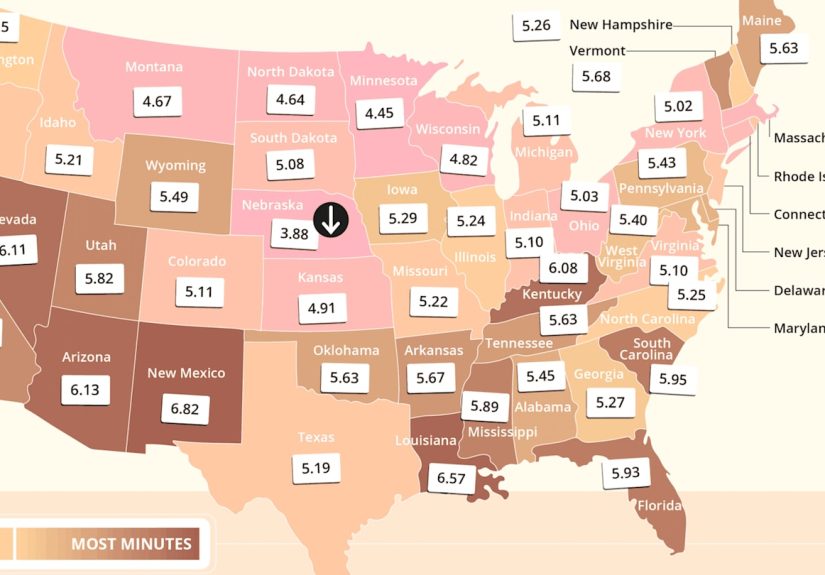
The table below ranks states from the least work time needed to the most work time needed. Prices are rounded to the nearest cent, wages are listed as hourly minimum wage, and work time is rounded to one decimal place.
| Rank | State | Average Coffee Price | Minimum Wage Used | Minutes of Work Needed |
|---|---|---|---|---|
| 1 | Maine | $2.60 | $15.10 | 10.3 min |
| 2 | Washington | $3.13 | $17.13 | 11.0 min |
| 3 | Connecticut | $3.10 | $16.94 | 11.0 min |
| 4 | Rhode Island | $3.00 | $16.00 | 11.2 min |
| 5 | California | $3.20 | $16.90 | 11.4 min |
| 6 | Nebraska | $2.87 | $15.00 | 11.5 min |
| 7 | New Jersey | $3.05 | $15.92 | 11.5 min |
| 8 | Arizona | $2.96 | $15.15 | 11.7 min |
| 9 | New York | $3.15 | $16.00 | 11.8 min |
| 10 | Massachusetts | $3.01 | $15.00 | 12.0 min |
| 11 | Maryland | $3.01 | $15.00 | 12.0 min |
| 12 | Illinois | $3.05 | $15.00 | 12.2 min |
| 13 | Delaware | $3.07 | $15.00 | 12.3 min |
| 14 | Michigan | $2.86 | $13.73 | 12.5 min |
| 15 | Missouri | $3.15 | $15.00 | 12.6 min |
| 16 | Florida | $2.97 | $14.00 | 12.7 min |
| 17 | Colorado | $3.22 | $15.16 | 12.7 min |
| 18 | Vermont | $3.14 | $14.42 | 13.1 min |
| 19 | Hawaii | $3.63 | $16.00 | 13.6 min |
| 20 | Oregon | $3.51 | $15.05 | 14.0 min |
| 21 | Virginia | $3.06 | $12.77 | 14.4 min |
| 22 | Arkansas | $2.85 | $11.00 | 15.5 min |
| 23 | Alaska | $3.38 | $13.00 | 15.6 min |
| 24 | Minnesota | $3.01 | $11.41 | 15.8 min |
| 25 | New Mexico | $3.23 | $12.00 | 16.1 min |
| 26 | Ohio | $2.99 | $11.00 | 16.3 min |
| 27 | Montana | $3.13 | $10.85 | 17.3 min |
| 28 | Nevada | $3.47 | $12.00 | 17.4 min |
| 29 | South Dakota | $3.79 | $11.85 | 19.2 min |
| 30 | West Virginia | $3.16 | $8.75 | 21.7 min |
| 31 | Louisiana | $2.79 | $7.25 | 23.1 min |
| 32 | Oklahoma | $2.91 | $7.25 | 24.1 min |
| 33 | Kentucky | $2.94 | $7.25 | 24.3 min |
| 34 | Indiana | $2.95 | $7.25 | 24.4 min |
| 35 | Pennsylvania | $2.96 | $7.25 | 24.5 min |
| 36 | North Carolina | $3.00 | $7.25 | 24.8 min |
| 37 | Kansas | $3.00 | $7.25 | 24.8 min |
| 38 | Georgia | $3.02 | $7.25 | 25.0 min |
| 39 | Tennessee | $3.03 | $7.25 | 25.1 min |
| 40 | Texas | $3.04 | $7.25 | 25.2 min |
| 41 | Alabama | $3.11 | $7.25 | 25.7 min |
| 42 | Wisconsin | $3.13 | $7.25 | 25.9 min |
| 43 | Idaho | $3.14 | $7.25 | 26.0 min |
| 44 | Utah | $3.22 | $7.25 | 26.6 min |
| 45 | Mississippi | $3.30 | $7.25 | 27.3 min |
| 46 | North Dakota | $3.40 | $7.25 | 28.1 min |
| 47 | Iowa | $3.41 | $7.25 | 28.2 min |
| 48 | New Hampshire | $3.50 | $7.25 | 29.0 min |
| 49 | South Carolina | $3.59 | $7.25 | 29.7 min |
| 50 | Wyoming | $3.75 | $7.25 | 31.0 min |
What the Numbers Tell Us
Higher wages can beat higher coffee prices
One of the biggest lessons from the ranking is that the sticker price is only half the story. Hawaii, Oregon, California, and Washington all have relatively expensive coffee compared with many states. Yet they do not all land at the bottom because minimum wages are higher.
California is a perfect example. A $3.20 average coffee might sound pricier than a $2.91 coffee in Oklahoma. But California’s higher wage means the cup takes about 11.4 minutes of minimum-wage work, while Oklahoma’s lower wage pushes the work time to about 24.1 minutes. That is the difference between a quick break and nearly half an hour of labor for one drink.
Low coffee prices do not always mean good affordability
Louisiana has one of the cheaper average coffee prices in the dataset at about $2.79, but the state still ranks in the lower half because the applicable wage baseline is $7.25. At that rate, a cup takes about 23.1 minutes of work. The cup is cheap, but the paycheck is doing push-ups with ankle weights.
The same issue appears in states such as Kentucky, Indiana, Pennsylvania, North Carolina, Kansas, Tennessee, Texas, Alabama, Wisconsin, Idaho, and Utah. Their average coffee prices are not outrageous, but the lower wage baseline makes each cup feel more expensive in terms of time.
The “coffee tax” on workers is really a wage story
When people complain that coffee has become expensive, they are not wrong. National coffee prices have been affected by higher bean costs, foodservice inflation, rent, packaging, labor, and supply-chain pressures. But this ranking shows something more specific: affordability is not just what the cup costs. It is what the cup costs compared with what people earn.
That is why a coffee can feel like a harmless habit in one state and a small luxury in another. The difference is not only geography. It is purchasing power.
Why Coffee Prices Vary So Much by State
Coffee may look simple, but its price is built from many ingredients that never appear on the menu board. Beans are only one part of the cost. A café also pays for wages, rent, equipment, utilities, insurance, cups, lids, napkins, payment processing, maintenance, and the mysterious disappearing supply of tiny stir sticks.
Local wages and rent matter
In high-cost metros, cafés often pay more for labor and rent. That pressure can show up in the menu price. A shop in San Francisco, Seattle, Honolulu, Boston, or New York City may charge more because every part of operating the business costs more. Even so, workers in those areas may also earn more, especially where state or city wage floors are higher.
Coffee culture changes the average
Some states have a stronger specialty coffee culture, which can push average prices upward. A simple drip coffee is one thing. A single-origin pour-over made by someone who can explain altitude, roast date, and tasting notes of “stone fruit and responsible adulthood” is another. Specialty coffee is often more expensive because it involves higher-quality beans, smaller batches, skilled preparation, and a café experience people are willing to pay for.
Inflation has not skipped the coffee counter
Food-away-from-home prices have risen faster than many household grocery categories in recent years. Coffee shops sit directly in that restaurant and foodservice world. When wages, rent, dairy, paper goods, utilities, and wholesale coffee costs rise, cafés usually have three choices: raise prices, shrink margins, or quietly hope customers do not notice that a “medium” cup has started doing yoga and become smaller.
Most Affordable States for Minimum-Wage Coffee Drinkers
The top states in this ranking share a simple formula: moderate coffee prices plus stronger minimum wages. Maine, Washington, Connecticut, Rhode Island, California, Nebraska, New Jersey, Arizona, New York, Massachusetts, and Maryland all keep the work time close to 10 to 12 minutes.
Maine stands out because its average coffee price is the lowest in the dataset while its wage floor is much higher than the federal minimum. Washington and Connecticut rank near the top because their minimum wages are among the highest in the country. California also performs well despite a higher cost of living because the wage floor offsets the higher menu price.
For a minimum-wage worker, this matters. A daily coffee in Maine equals about 52 minutes of work per five-day workweek. In Wyoming, the same habit equals about 155 minutes of work per week. Over a month, that difference becomes large enough to notice in a budget.
Least Affordable States for Minimum-Wage Coffee Drinkers
The least affordable states in this ranking are Wyoming, South Carolina, New Hampshire, Iowa, North Dakota, Mississippi, Utah, Idaho, Wisconsin, and Alabama. In these states, a minimum-wage worker needs roughly 26 to 31 minutes to buy one average coffee.
Wyoming ranks last because it combines one of the highest coffee prices in the dataset with the federal wage baseline. South Carolina is close behind, with an average cup near $3.59 and a $7.25 wage baseline. New Hampshire also ranks poorly because its average coffee price is relatively high while the wage baseline remains low.
This does not mean every coffee shop in those states is expensive. A gas-station coffee, diner refill, workplace coffee pot, or home-brewed cup may cost far less. But for a café coffee, the time-cost gap is real. If your wage is low, even ordinary purchases start acting like VIP experiences.
How Much Does a Daily Coffee Habit Cost?
A single cup is small. A habit is not. If a worker buys one average coffee every workday, the monthly cost can easily reach $55 to $80 depending on the state. Add a second cup, a larger size, a tip, a breakfast sandwich, or a syrup that sounds like it was named by a candle company, and the monthly total climbs fast.
Here is a simple example. In Maine, one $2.60 coffee every weekday costs about $52 over a four-week work month. In South Dakota, one $3.79 coffee every weekday costs about $75.80. That difference is not life-changing by itself, but it is part of a bigger pattern. Small daily expenses become meaningful when wages, rent, groceries, transportation, and utilities are already stretching the budget.
That does not mean coffee is “bad spending.” Personal finance advice can sometimes make people feel guilty for enjoying anything that costs more than tap water and a motivational quote. A better approach is to understand the trade-off. If the coffee improves your morning, helps you focus, gives you a social ritual, or keeps you from becoming a workplace goblin, it may be worth it. Just know what it costs in time.
Tips to Make Your Coffee Habit More Affordable
Use the “work minutes” test
Before buying coffee, ask: how many minutes did I work for this? That question is more useful than only looking at dollars. A $5 latte may feel small, but if it takes 40 minutes of work at your wage, it becomes a different decision.
Mix café coffee with home brewing
You do not have to quit café coffee completely. Try a hybrid routine. Buy café coffee two or three days a week and brew at home the other days. This keeps the treat feeling special while cutting the total monthly cost.
Choose simpler drinks
Plain hot coffee, Americano, and drip coffee are usually cheaper than flavored lattes, cold brew, blended drinks, and seasonal specials. The more a drink sounds like dessert wearing a business suit, the more likely it is to cost extra.
Watch add-ons
Plant-based milk, extra shots, flavor syrups, cold foam, delivery, and tips can turn a modest coffee into a small invoice. None of those are wrong, but they should be intentional.
Real-Life Experiences: What Coffee Affordability Feels Like Across States
Imagine two workers starting their day at 7:30 a.m. One is in Maine, where an average cup takes just over 10 minutes of minimum-wage work. The other is in Wyoming, where the same basic ritual can take about 31 minutes. Both walk into a café half-awake. Both want caffeine, warmth, and maybe five quiet minutes before the world starts sending emails. But financially, they are not buying the same thing. One is buying a quick comfort. The other is trading nearly half an hour of work.
That difference changes the emotional experience of coffee. In higher-affordability states, stopping for a cup may feel casual. You might grab one before work, meet a friend, or sit with your laptop without mentally calculating whether the purchase has betrayed your grocery budget. In lower-affordability states, the same stop can feel more deliberate. You may think twice, check your bank balance, skip the tip even though you feel bad, or order the smallest size while pretending you “prefer” it.
For students, hourly workers, retail employees, foodservice staff, caregivers, and gig workers, coffee is often less about luxury and more about stamina. A cashier on an early shift, a warehouse worker before sunrise, a home health aide driving between clients, or a parent heading to a second job may rely on coffee as a practical tool. The irony is that the people who may need the energy boost most are often the people for whom the purchase takes the biggest slice of work time.
Travel also makes the contrast obvious. A visitor from a $7.25-wage state may land in Seattle or Boston and feel shocked by café prices. But a local worker earning a higher minimum wage may experience that price differently. Meanwhile, a traveler from a high-wage state may pass through a lower-wage state, see a $3 cup, and think it is a bargain, without realizing that for local minimum-wage workers, it may require twice as many minutes of labor.
Remote work has added another twist. Many people now make coffee at home on weekdays and save café visits for meetings, weekends, or “I need to leave the house before I start naming the houseplants” moments. Home brewing is usually cheaper, but cafés still offer something a kitchen counter cannot always provide: atmosphere, social contact, a place to focus, and the tiny thrill of someone else making your drink.
The smartest coffee habit is not necessarily the cheapest one. It is the one that fits your life. If a weekday café stop helps you feel human and does not strain your budget, enjoy it without guilt. If it is quietly draining your money, try setting a coffee budget, brewing at home more often, or saving café drinks for the days when they truly make a difference. Coffee should wake you up, not financially jump-scare you.
Conclusion: Coffee Is Small, But the Math Is Big
The question of how long you have to work to afford a coffee in each state reveals more than coffee prices. It shows how wages, local costs, and daily habits interact. A cup of coffee may be one of the smallest purchases in a person’s day, but it is also one of the most repeated. That makes it a surprisingly powerful symbol of affordability.
In states such as Maine, Washington, Connecticut, Rhode Island, and California, a minimum-wage worker can earn enough for an average coffee in about 10 to 11 minutes. In states such as Wyoming, South Carolina, New Hampshire, Iowa, and North Dakota, that same purchase can take close to half an hour.
The takeaway is not that everyone should stop buying coffee. Life is too short, and mornings are too rude. The real takeaway is that affordability depends on both price and pay. When wages rise with living costs, small pleasures stay small. When wages lag behind, even a humble cup of coffee starts to feel like a luxury.