Table of Contents >> Show >> Hide
English has many gifts. It gave us Shakespeare, sarcasm, and the phrase an embarrassment of pandas, which sounds less like formal language and more like the title of a very specific indie film. But that is exactly what makes animal collective nouns so delightful. They sit at the crossroads of history, humor, poetry, and pure linguistic chaos. One minute you are talking about a normal flock of birds, and the next you are explaining why a group of owls is called a parliament and why jellyfish apparently travel around in a smack.
If you have ever suspected these names were invented by someone who had too much coffee and too much free time, you are not entirely wrong. Many of the strangest collective nouns for animals trace back to old hunting traditions, medieval wordplay, and later literary revival. That means they are real, but not always the terms biologists use in the field. Scientists are still far more likely to say herd, flock, school, or colony. Still, the weirder names have stuck because they are memorable, oddly descriptive, and honestly much more fun at dinner parties.
So let us celebrate the grand, bizarre world of animal group names. Below are 50 quirky collective nouns that sound made up, feel slightly mischievous, and are absolutely part of the English-language tradition.
Why These Animal Group Names Exist At All
Many funny animal group names belong to a long tradition sometimes called terms of venery. These expressions became fashionable centuries ago, especially in texts about hunting, hawking, and courtly life. Some were practical. Others were poetic. A few appear to have been invented because human beings, even in the Middle Ages, could not resist being a little dramatic.
That is why the world ended up with a murder of crows, an ostentation of peacocks, and an unkindness of ravens. These phrases were never all equally common in daily speech, but they survived because they are vivid. They create instant mental pictures. You do not just hear them. You see them.
A Small Reality Check Before We Dive In
Yes, these names are real. No, your local zookeeper is probably not walking around saying, “Please move the flamboyance of flamingos before lunch.” Think of these terms as part dictionary entry, part trivia gold, and part linguistic treasure chest. They are real enough to count, but whimsical enough to make English feel like it was designed by a committee of poets, birdwatchers, and pranksters.
50 Real Animal Group Names That Sound Like A Joke
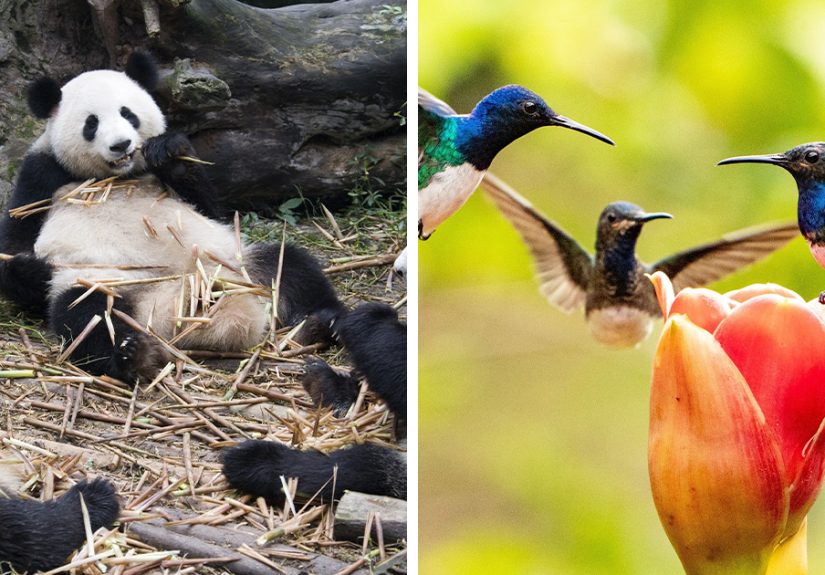
- An embarrassment of pandas — The headline act. This famous phrase is one of the most charming examples of a collective noun that feels playful, theatrical, and almost suspiciously perfect.
- A murder of crows — Dark, dramatic, and impossible to forget. It is probably the best-known odd animal group name in English, and it still wins every goth spelling bee.
- A parliament of owls — Because nothing says wisdom, solemnity, and disapproving silence quite like a row of owls looking as though they are debating tax policy.
- A flamboyance of flamingos — If any bird earned a fabulous collective noun, it was always going to be the tall pink one standing around like it owns the runway.
- A crash of rhinoceroses — Loud, heavy, and beautifully on-brand. If rhinos had a soundtrack, it would probably begin with percussion.
- A smack of jellyfish — One of the most descriptive names on the list, because nobody forgets the feeling of swimming into jellyfish by surprise.
- A kaleidoscope of butterflies — Graceful, colorful, and almost too pretty for ordinary grammar. This one sounds like poetry and behaves like confetti.
- A dazzle of zebras — A sharp visual term for animals already wearing nature’s boldest optical illusion.
- A bloat of hippopotamuses — Rude? Maybe. Memorable? Absolutely. Hippos somehow manage to look both sleepy and deeply intimidating at the same time.
- A conspiracy of lemurs — This sounds like the title of a streaming thriller, which feels appropriate for wide-eyed primates that always look like they know something you do not.
- A business of ferrets — Ferrets already move like tiny overcaffeinated executives. The name fits almost too well.
- A prickle of porcupines — Efficient, accurate, and just pokey enough to be satisfying.
- An unkindness of ravens — Ravens have been cast as ominous, clever, and slightly eerie for centuries. English responded with full dramatic flair.
- A gaze of raccoons — If raccoons have ever stared at your trash can like they pay the mortgage, this one makes perfect sense.
- A romp of otters — One of the happiest collective nouns ever created. Otters do not move through life so much as joyfully improvise it.
- A tower of giraffes — Tall animals, tall name, excellent results. Sometimes English actually behaves itself.
- An ostentation of peacocks — There may never have been a more honest phrase in the language.
- An ambush of tigers — Given how solitary and stealthy tigers are, even imagining several at once feels like a strategic error.
- A cackle of hyenas — Their vocalizations practically wrote the label themselves.
- A scurry of squirrels — Tiny feet, frantic motion, maximum acorn ambition.
- A shrewdness of apes — A surprisingly flattering term once you think about intelligence, social behavior, and the strong possibility that the apes are judging us.
- A wake of vultures — Morbid, yes, but also weirdly elegant. It captures the bird’s reputation in one clean, unforgettable stroke.
- A muster of storks — This has the crisp, organized feel of a military roll call, which is unexpectedly fitting.
- A walk of snails — Ironically speedy by snail standards and delightfully absurd by human standards.
- A covey of quail — Soft, traditional, and one of the most established bird-group terms still heard outside trivia night.
- A charm of hummingbirds — This name feels less invented than observed. Hummingbirds are tiny airborne jewelry with attitude.
- A fever of stingrays — Slightly alarming, very memorable, and definitely not the phrase you want to hear before a beach swim.
- A skein of geese — Used especially for geese in flight, this one has a graceful, old-fashioned sound that somehow makes honking feel literary.
- A convocation of eagles — Formal, majestic, and serious enough to sound like the eagles are receiving honorary degrees.
- A congregation of alligators — This phrase has wonderful rhythm and just enough menace to keep things interesting.
- A quiver of cobras — A name that practically moves when you say it.
- An army of caterpillars — Not militarily intimidating, exactly, but definitely committed to the mission of eating every leaf in sight.
- A coterie of prairie dogs — Prairie dogs already seem social, chatty, and community-minded, so this one lands surprisingly well.
- A battery of barracudas — Sleek, fast, and just aggressive enough to justify the hardware vocabulary.
- A bale of turtles — Strange at first, then oddly visual once you picture a cluster of shells gathered together.
- A rhumba of rattlesnakes — It sounds like a dance class nobody should ever attend.
- A hover of trout — Calm, watery, and unexpectedly elegant.
- A scold of jays — If you have heard jays yelling across a yard, you know English absolutely nailed this one.
- A siege of herons — A quiet bird gets a surprisingly aggressive group name, which makes it even better.
- A memory of elephants — A lyrical alternative to herd, and one of the rare collective nouns that sounds tender rather than teasing.
- A mob of kangaroos — Bouncy, busy, and slightly chaotic. Accurate.
- A shiver of sharks — Possibly named for the observer rather than the fish, which feels fair.
- A sleuth of bears — Somehow both lumbering and detective-adjacent, this one has excellent mystery-novel energy.
- An implausibility of gnus — The wildebeest version of, “Surely that cannot be correct,” except it is.
- An exaltation of larks — One of the most beautiful collective nouns in English, sounding more like a hymn than a field note.
- A family of sardines — Less flashy than some entries, but charming in its own tightly packed way.
- A barrel of monkeys — Yes, like the toy. Also yes, a real group name.
- A rout of wolves — Far older and more dramatic than the modern default of pack.
- A destruction of wild cats — Specifically tied to wild or feral cats, and about as subtle as a shattered flowerpot at 3 a.m.
- A lounge of lizards — Sunbathing reptiles were never going to receive a stressed-out name.
What Makes These Funny Animal Group Names So Sticky?
The best animal collective nouns work because they do more than label a group. They create a scene. Flamboyance tells you what flamingos look like. Scold tells you what jays sound like. Crash tells you how rhinos feel. These names endure because they compress observation into one vivid word.
They also reveal something charming about the English language: not every useful word has to be practical. Sometimes language survives because it is too entertaining to lose. Nobody needs the phrase an implausibility of gnus, and yet humanity is richer for having it.
Are These Terms Still Used Today?
Sort of. In everyday American English, the plain terms usually win. People say a herd of elephants, a flock of geese, or a school of fish. But the quirky versions remain alive in dictionaries, educational materials, crosswords, zoos, children’s books, word columns, nature writing, and the part of the internet that loves strange facts more than sleep.
That is why these names still matter. They turn language into entertainment. They make wildlife more memorable. And they offer proof that long before memes existed, English speakers were already making lists just for the joy of saying ridiculous things out loud.
Final Thoughts
If you came here wondering whether an embarrassment of pandas was real, the answer is yes. If you stayed long enough to develop opinions about whether a rhumba of rattlesnakes is hilarious or terrifying, you are among friends. These collective nouns may not all be field-science essentials, but they are undeniably part of the language’s quirky heritage.
And honestly, that is the real fun of animal group names. They remind us that language does not always have to march in straight lines. Sometimes it can strut like a peacock, hover like a trout, or stroll into the room like a lounge of lizards and expect applause.
Experience Section: Why People Love Discovering These Weird Animal Group Names
There is a very specific kind of joy that comes from learning unusual collective nouns for animals. It usually starts innocently. Someone says, “Did you know a group of crows is called a murder?” The room changes instantly. Even people who were pretending not to listen suddenly look up. The phrase is too strange, too theatrical, and too perfect to ignore. From there, the rabbit hole opens. Soon somebody is saying parliament of owls, another person is defending flamboyance of flamingos like it is a constitutional right, and someone in the corner is whispering, “An embarrassment of pandas cannot possibly be real.”
That experience is part of what makes this topic so sticky online and in real life. These names invite reaction. They spark laughter, disbelief, and immediate fact-checking. They are the kind of language facts that people do not just read. They repeat them. They text them to friends. They bring them up at family dinners, trivia nights, classrooms, and office chats that were supposed to be about something else entirely. In a world full of forgettable information, animal group names have staying power because they are both educational and absurd.
There is also a fun social experience tied to them. Once people learn a few of these names, they start collecting them like souvenirs. Suddenly a normal zoo visit becomes a game. Children point at flamingos and proudly announce, “That’s a flamboyance!” Adults at aquariums find themselves muttering, “Wow, a smack of jellyfish,” with the satisfaction of people who know a secret password. Birdwatchers, crossword fans, teachers, and curious readers all get the same little thrill from using a word that feels half scholarly and half mischievous.
Another memorable part of the experience is the tension between what sounds official and what sounds completely invented. A school of fish feels normal. A sleuth of bears feels like a cartoon detective agency. A romp of otters feels adorable. A wake of vultures feels like a metal band. That contrast is exactly why the topic works so well. It sits between language history and comedy. The names are real enough to teach, but weird enough to entertain.
For many people, these phrases also become a gateway to broader curiosity. A person who starts by laughing at a coterie of prairie dogs may end up reading about prairie dog social structure. Someone charmed by a memory of elephants may go on to learn about elephant behavior. In that way, quirky collective nouns do something surprisingly useful: they turn attention into interest. They make wildlife feel vivid, approachable, and memorable.
And maybe that is the best experience of all. These names remind us that learning does not have to be dry to be meaningful. Sometimes the fastest route into nature, history, and language is through delight. You arrive for the punchline, stay for the etymology, and leave with 50 new facts you cannot wait to repeat. That is a pretty good return on one small phrase about pandas and their apparently embarrassing social life.