Table of Contents >> Show >> Hide
- What the “9 New Nuclear Submarines” Deal Actually Means
- Virginia-Class 101: Why These Submarines Are the Navy’s Undersea Backbone
- The Big Upgrade: Virginia Payload Module (VPM)
- Cost, Schedule, and Delivery: What the Navy Expected vs. Reality
- Why Multi-Year Procurement Is a Big Deal
- Strategic Context: Why the Navy Wants More Submarines (and More Capability Per Sub)
- What These Submarines Can Do (Without Getting Into Sensitive Details)
- The Submarine Industrial Base: The Quiet “10th Submarine” Behind the Deal
- How This Deal Intersects With Bigger U.S. Defense Priorities
- What to Watch Next
- FAQ: Quick Answers About the 9 New Nuclear Submarines
- Experiences From the Real World: What This “9-Sub” Decision Feels Like on the Ground (and Near the Water)
- 1) The apprentice who discovers that “measure twice” is a lifestyle
- 2) The supplier who realizes their tiny component is not “tiny” at all
- 3) The sailor who hears “Block V” and thinks: more capability, more expectations
- 4) The planner who lives inside spreadsheets so the fleet can live at sea
- 5) The community that becomes a “submarine town” (whether it planned to or not)
- Conclusion: A Big Commitment to Undersea Powerand to the People Who Build It
The Navy doesn’t do “limited drops.” When it decides it needs more undersea muscle, it doesn’t add one shiny new toy to the cart and check out. It buys in bulklike a warehouse club run by admirals.
That’s essentially what happened when the U.S. Navy “signed up” for nine new nuclear-powered submarines under a blockbuster contract tied to the Virginia-class program, specifically the Block V boats that add a major new section called the Virginia Payload Module (VPM).
If you’ve seen headlines that sound like the Navy just subscribed to a premium streaming service (“Nine new nuclear subs, ad-free!”), here’s what’s really going on: a multi-year procurement deal designed to keep a steady build rate, stabilize the industrial base, and expand the fleet’s strike capacity as older platforms retire.
What the “9 New Nuclear Submarines” Deal Actually Means
In public reporting and official announcements, this “nine-submarine” headline refers to a major multi-year procurement contract for Virginia-class nuclear-powered attack submarines (SSNs)the workhorse submarines built to hunt, surveil, deter, and (when ordered) strike targets from the sea.
A record-sized shipbuilding contract (and why that matters)
The deal was notable not just for the number of submarines, but for the scale: roughly $22 billion for the nine boats, structured as a multi-year procurement with incentives aimed at controlling costs and improving production efficiency.
In Pentagon terms, that’s not a “purchase,” it’s a strategic commitmentmoney, materials, workforce planning, and supplier coordination locked in for years.
Who builds them: the two-yard team
U.S. nuclear submarines aren’t assembled like furniture with a missing Allen key. They’re built by a specialized industrial ecosystem, anchored by two primary shipyards:
General Dynamics Electric Boat and Huntington Ingalls Industries’ Newport News Shipbuilding.
They share construction work, move massive modules between facilities, and ultimately deliver completed submarines to the Navy.
Virginia-Class 101: Why These Submarines Are the Navy’s Undersea Backbone
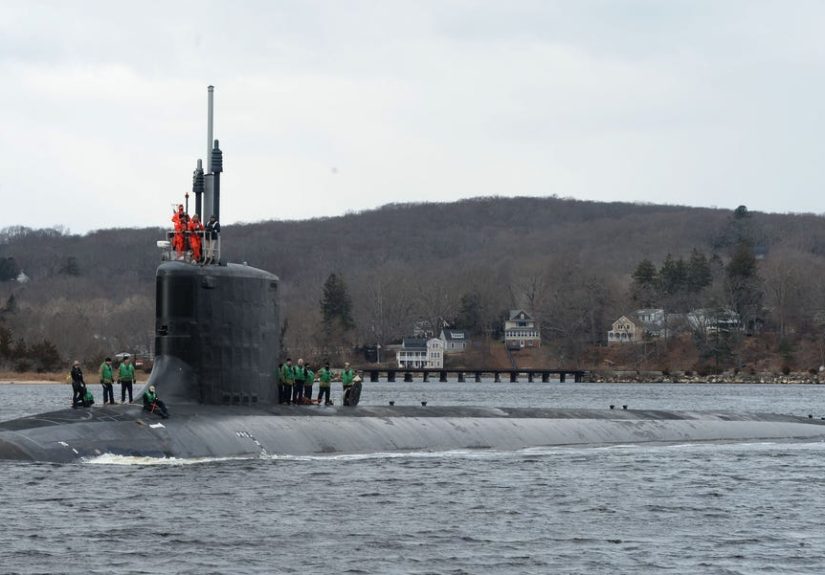
The Virginia-class is the Navy’s modern fast-attack submarine designbuilt for missions that range from quiet intelligence collection to launching precision strike weapons.
“Nuclear-powered” in this context refers to propulsion: the reactor provides power for long endurance, sustained speed when needed, and fewer logistical constraints than conventional submarines.
Attack submarine vs. ballistic missile submarine
It’s easy to lump all “nuclear submarines” together, but the Navy fields different types with different jobs:
- SSNs (attack submarines) like Virginia-class: multi-mission, stealthy, flexible, and typically armed with torpedoes and cruise missiles.
- SSBNs (ballistic missile submarines) like the future Columbia-class: strategic deterrence platforms carrying ballistic missiles. Different mission, different design priorities.
The nine-sub deal is about SSNsthe submarines you can task to a wide menu of missions, on short notice, in multiple theaters.
The Big Upgrade: Virginia Payload Module (VPM)
Here’s the feature that turns “new submarines” into “new submarines with a serious upgrade”:
most boats in this nine-sub package were designed to include the Virginia Payload Module, an added hull section with large-diameter launch tubes.
More payload capacity, more options
VPM is often discussed in terms of cruise missile capacitybecause that’s easy to understand.
But the real value is broader: those tubes are about creating a flexible “payload space” for a changing world of maritime capabilities.
In plain English: VPM helps the Navy carry more of the right stufftoday and tomorrowwithout redesigning the entire submarine every time technology evolves.
Why now: replacing retiring strike capacity
A major strategic driver is the planned retirement of older guided-missile submarine capacity over time.
As legacy platforms leave service, the Navy wants to preserve (and modernize) its ability to hold targets at risk from the seaquietly, credibly, and with fewer “tells” than many other force options.
Cost, Schedule, and Delivery: What the Navy Expected vs. Reality
Submarine contracting is where long-term strategy meets hard physics: industrial capacity, skilled labor, supplier health, and the reality that very specific parts cannot be conjured from thin air.
What the schedule looked like in public plans
When the nine-sub contract was announced, deliveries were projected to begin in the mid-to-late 2020s, with multiple sources describing delivery windows running roughly from 2025 through 2029 for the boats covered under the agreement.
Production delays and the industrial base squeeze
In the years after the contract, public watchdog reporting and defense coverage highlighted delays tied to workforce shortages and supply chain challenges in the submarine industrial base.
This matters because the Navy’s demand signal has to be matched by the nation’s ability to produce at rateand submarine construction is one of the most specialized manufacturing efforts in the country.
Put differently: ordering nine submarines is the easy part (financially painful, yes, but administratively straightforward).
Building nine submarines on time is the part that requires a national ecosystem to work like a Swiss watchexcept the watch is 377+ feet long and filled with the world’s most regulated welds.
Why Multi-Year Procurement Is a Big Deal
The Navy didn’t choose this approach because it loves paperwork. Multi-year procurement is meant to:
- Reduce cost per boat through stable ordering and economic buying of materials.
- Stabilize the workforce by supporting predictable hiring and training pipelines.
- Strengthen the supplier base so smaller manufacturers can invest in tooling and quality systems.
- Keep production cadence (often framed as a two-per-year rhythm) to preserve shipyard efficiency.
In human terms, this is the Navy trying to prevent the submarine equivalent of a restaurant that’s slammed on Saturday, empty on Monday, and can’t keep cooks because the schedule whiplash is unbearable.
Strategic Context: Why the Navy Wants More Submarines (and More Capability Per Sub)
Submarines are prized because they complicate adversary planning. They are hard to detect, hard to track, and can operate without broadcasting their presence.
In an era of high-end competition at sea, the Navy is investing in platforms that can survive, persist, and contribute in contested environments.
Deterrence isn’t just about weaponsit’s about uncertainty
A credible submarine force doesn’t have to be loud. In fact, its value often increases the less anyone knows about where it is.
That uncertainty shapes how competitors allocate ships, aircraft, sensors, and timeoften at significant cost.
More capability per hull: a practical response to fleet math
The VPM-equipped Block V Virginias reflect a simple calculus: if submarines are in high demand and constrained supply, then making each one more capable can partially offset the gap.
It’s not a magic wand, but it’s one way to get more mission value from each deployment cycle.
What These Submarines Can Do (Without Getting Into Sensitive Details)
Publicly available descriptions of Virginia-class missions typically include:
- Anti-submarine warfare: tracking and deterring adversary submarines.
- Anti-surface warfare: holding ships at risk when required.
- Intelligence, surveillance, reconnaissance (ISR): quiet collection and monitoring.
- Precision strike: launching conventional cruise missiles.
- Special operations support: enabling certain operations in maritime environments.
The important takeaway is that the Navy isn’t buying nine identical “tubes with reactors.”
It’s buying nine high-end, multi-mission platformsmany with extra payload space designed to keep pace with evolving needs.
The Submarine Industrial Base: The Quiet “10th Submarine” Behind the Deal
Submarine construction is as much about people and suppliers as it is about naval strategy.
The U.S. submarine industrial base includes thousands of suppliersmany of whom produce highly specialized components with strict quality requirements.
When that supply chain strains, everything strains.
Workforce realities: the talent pipeline is part of national security
Shipyards have invested heavily in training, apprenticeships, and facility upgrades to expand capacity.
Public contract announcements and business reporting show continued investments in long-lead materials and supplier developmentbecause you can’t surge-build nuclear submarines like you can surge-order office chairs.
Why delays ripple into strategy
When submarines deliver late, the Navy has fewer hulls available for deployments, training, and maintenance rotations.
That affects everything from operational presence to maintenance backlogsand it can complicate allied commitments that assume certain production rates.
How This Deal Intersects With Bigger U.S. Defense Priorities
The nine-sub contract sits inside a broader defense reality: the Navy is simultaneously trying to
(1) sustain attack submarine output,
(2) recapitalize the ballistic missile submarine fleet,
and (3) modernize shipyard infrastructure and maintenance throughput.
That’s a lot of “at once” for an industrial base that has finite skilled labor and long lead timesespecially for nuclear-qualified work.
So this deal is both a procurement story and a capacity story.
What to Watch Next
1) Delivery performance and workforce growth
The most meaningful metric isn’t the headline contract valueit’s whether submarines arrive when the fleet needs them.
Watch for public updates about schedule performance, shipyard hiring, and supplier throughput improvements.
2) Continued funding for supplier development and long-lead materials
Submarine parts often require years of planning. Contract modifications for long-lead materials are a signal that the Navy and industry are trying to keep the pipeline moving, even under strain.
3) How payload flexibility evolves
VPM is about modularity and adaptability. Over time, what goes into that payload spaceand how quickly it can be updatedwill shape how “future-proof” these boats really are.
FAQ: Quick Answers About the 9 New Nuclear Submarines
Are these nuclear-armed submarines?
They are nuclear-powered attack submarines. Public descriptions of Virginia-class emphasize conventional mission sets and payloads, distinct from ballistic missile submarines designed for nuclear deterrence.
Are all nine boats identical?
They are part of the Virginia-class family, but the deal is widely described as centered on Block V boats, with most including the Virginia Payload Module.
Even within a block, configuration details can vary across hulls as technology and integration plans evolve.
Why buy nine at once?
Multi-year procurement aims to reduce costs and stabilize productionvital benefits when you’re building complex submarines with long lead times and specialized suppliers.
Experiences From the Real World: What This “9-Sub” Decision Feels Like on the Ground (and Near the Water)
Strategy papers talk about deterrence, capacity, and payload volume. But a nine-submarine commitment is also a story made of ordinary Tuesdayspeople learning, building, testing, and supporting something extraordinary.
Here are a few “experience snapshots” that capture what this kind of decision looks like beyond the headline.
1) The apprentice who discovers that “measure twice” is a lifestyle
In a submarine yard, an apprentice’s first lesson isn’t about speed; it’s about precision. A mentor points out that tolerances here don’t tolerate excuses.
You learn to read drawings like they’re a second language, and you learn that quality isn’t a departmentit’s the job.
The “nine-sub” deal matters because it creates stability: more predictable hiring, more consistent training cohorts, and fewer stop-and-start cycles that make people wonder if they picked the right career.
And yes, someone will still tape a meme to a locker that says, “I build the quietest thing you’ll never see.”
2) The supplier who realizes their tiny component is not “tiny” at all
Somewhere far from the coast, a supplier produces a specialized part that might not look impressive to anyone outside the industry.
No dramatic hull, no photogenic sailjust a piece of hardware with strict standards, documentation, and inspection requirements.
The “experience” here is accountability: the understanding that a small manufacturer is part of a national capability.
The nine-sub commitment helps suppliers justify investmentsnew machines, better QA systems, additional staffbecause demand looks real, not hypothetical.
It’s less glamorous than a launch ceremony, but it’s how submarines become deliverable reality.
3) The sailor who hears “Block V” and thinks: more capability, more expectations
For sailors, new boats don’t just mean new equipmentthey mean new training pipelines, new qualifications, and new maintenance rhythms.
The idea of expanded payload capacity often translates into a simple feeling: “We’re being asked to do more, and leadership is trying to give us the tools.”
There’s pride in serving on advanced platforms, but also a practical awareness that readiness is built through repetitiondrills, inspections, and procedures that can feel boring until the day you’re grateful they’re second nature.
The funny part? Even among professionals, someone will inevitably call a multi-year procurement “the Navy’s long-term relationship with shipbuilders.”
4) The planner who lives inside spreadsheets so the fleet can live at sea
Not everyone connected to this deal wears a hard hat or a uniform.
Some people experience the “nine-sub” commitment as a constant balancing act: budgetA decision here shifts dollars there; a delay in one line item creates consequences across years.
The experience is less cinematic and more relentlessbriefings, budget justification, milestone tracking, and the kind of stress that comes from knowing that a single late delivery can cascade into fleet availability problems.
When multi-year procurement works, it’s like a well-tuned engine. When it doesn’t, the same planner is answering tough questions with a polite face and a very tired coffee.
5) The community that becomes a “submarine town” (whether it planned to or not)
Big submarine contracts reshape communities around shipyards and major suppliers.
Restaurants get busier, housing gets tighter, and local schools suddenly talk more about skilled trades and engineering pathways.
People feel the pride“we build something that matters”but also the pressure of growth: traffic, training capacity, and the challenge of keeping experienced workers while onboarding thousands of new ones.
The nine-sub deal feels like opportunity and obligation at the same time.
It’s not just national security. It’s paychecks, apprenticeships, and a shared identity built around doing an incredibly difficult job well.
Conclusion: A Big Commitment to Undersea Powerand to the People Who Build It
“The U.S. Navy signs up for 9 new nuclear submarines” sounds like a dramatic headlineand it is.
But the deeper story is a long, practical commitment: to sustaining the Virginia-class build line, expanding payload capacity through VPM, and investing (directly and indirectly) in the industrial base that makes undersea dominance possible.
These submarines represent years of planning, billions of dollars, and a national workforce that has to be trained, retained, and supported.
The contract is a strategic bet that the United States can keep building some of the world’s most complex machineson schedule, at quality, and at a rate that matches real-world demands.
In the end, the most important question isn’t whether the Navy “signed up.”
It’s whether the fleetand the shipyards behind itcan deliver what the strategy requires.