Table of Contents >> Show >> Hide
- The Discovery: A Woody Wagon in the Deep Pacific
- Meet the USS Yorktown: A Carrier With a Giant Shadow
- Why Is a Car on an Aircraft Carrier So Weird?
- The Real Mystery: Why Wasn’t It Thrown Overboard?
- A Time Capsule With Whitewalls and Saltwater
- The Other Finds: A Mural, Aircraft, and a Living Reef of Memory
- Why Deep-Sea Technology Keeps Changing History
- Respecting a War Grave
- What the Mystery Car Tells Us About WWII History
- Possible Explanations, Ranked From Sensible to Slightly Cinematic
- Experience Section: What This Mystery Feels Like to Anyone Who Loves History
- Conclusion: The Car That Turned a Warship Into a Question Mark
Note: This article is written for clean web publishing and is based on publicly reported historical and exploration information from reputable U.S. sources, including ocean exploration, naval history, museum, and mainstream reporting references. No source links are inserted in the body.
Some mysteries arrive wearing a fedora. Others arrive with a chrome bumper, a split windshield, and a spare tire on the back. In April 2025, deep-sea explorers examining the wreck of the USS Yorktown, one of America’s most famous World War II aircraft carriers, spotted something that looked wildly out of place: a car sitting inside the hangar deck of a ship that sank in 1942.
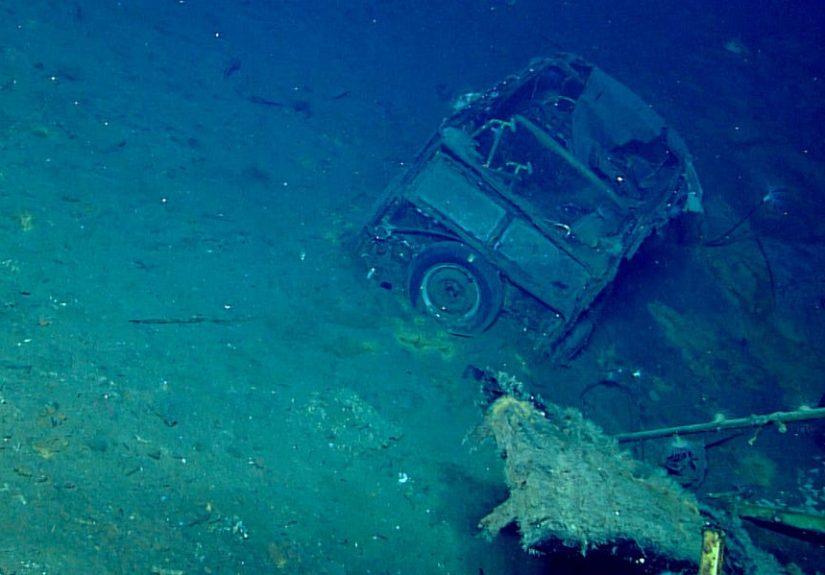
Not a toy car. Not a modern prank. Not a Hollywood prop accidentally dropped from a careless submarine with a flair for drama. It appeared to be a 1940-41 Ford Super Deluxe “Woody,” a wood-paneled station wagon more associated with coastal roads, family trips, and later surf culture than with a three-mile-deep WWII aircraft carrier wreck in the Pacific.
The discovery instantly raised the kind of question that makes historians lean closer to the screen: why was there a car on an aircraft carrier during the Battle of Midway, and why did it go down with the ship?
The Discovery: A Woody Wagon in the Deep Pacific
The strange find happened during NOAA Ocean Exploration’s 2025 mission to study the final resting place of USS Yorktown (CV-5). Using a remotely operated vehicle, or ROV, the team explored areas of the wreck that had never been documented in such detail. On April 19, researchers noticed a faint outline of an automobile inside the aft hangar deck. The next day, they returned for a closer look.
What they saw was astonishing. The vehicle was upright, recognizable, and still carrying enough design clues for experts to make a tentative identification. Its boxy shape, canvas-style top, split windshield, chrome details, rear-mounted spare tire, and rectangular rear windows pointed toward a Ford Super Deluxe “Woody,” likely from 1941.
Even more intriguing was the front plate. Part of it appeared to read “SHIP SERVICE,” while the lower portion was too corroded to interpret with certainty. Researchers suggested it might have included “CV-5 NAVY” or “US NAVY.” That small plate is the automotive equivalent of a half-burned treasure map: enough to prove there is a story, not enough to tell us the ending.
Meet the USS Yorktown: A Carrier With a Giant Shadow
To understand why this discovery matters, the car cannot be separated from the ship. USS Yorktown was not just any vessel. She was a Yorktown-class aircraft carrier, commissioned before the United States entered World War II and heavily involved in the early Pacific War. She fought at the Battle of the Coral Sea in May 1942, where she was damaged but survived. Then came Midway.
The Battle of Midway, fought in June 1942, is widely considered one of the decisive turning points of World War II in the Pacific. Japan aimed to draw out and destroy what remained of the U.S. Pacific Fleet after Pearl Harbor. But American codebreakers helped reveal the plan, allowing U.S. forces to prepare an ambush of their own.
Yorktown entered the battle after rushed repairs at Pearl Harbor. She had been damaged at Coral Sea badly enough that full repairs should have taken far longer, but wartime does not wait politely in the lobby. Yard workers patched her up with remarkable speed, and the carrier returned to action.
During Midway, Japanese aircraft attacked Yorktown repeatedly. Bombs struck her flight deck and damaged vital systems. Torpedoes followed. Salvage crews worked to save the ship, but a Japanese submarine later delivered the final blow. USS Yorktown sank on June 7, 1942, taking her place in history and on the deep Pacific seafloor.
Why Is a Car on an Aircraft Carrier So Weird?
At first, a car aboard a ship may not sound impossible. Ships carry all kinds of equipment: aircraft, tractors, carts, boats, spare parts, tools, and supplies. But an aircraft carrier at war is not a floating parking garage. Space is valuable. Weight matters. Everything on board must justify its presence.
That is why this Ford Woody is such a head-scratcher. The Yorktown was an aircraft carrier designed around flight operations. Hangar space was for aircraft, aircraft parts, weapons, fuel systems, and maintenance. A station wagon is not exactly the first item one imagines next to SBD Dauntless dive bombers.
Researchers and historians have floated several possibilities. One theory is that the car served as a ship’s service vehicle, perhaps used when the carrier was in port. Large naval vessels often conducted official business at foreign ports, and senior officers needed transportation ashore. A staff car would make sense in that context.
Another possibility is that the vehicle was associated with Rear Admiral Frank Jack Fletcher, Captain Elliott Buckmaster, or another senior officer. The car might have been carried for official travel, port errands, or administrative duties. If so, the vehicle was less “family vacation wagon” and more “naval business with a varnished-wood personality.”
A third theory is more practical: the car may have been aboard for repairs, storage, or transfer. During wartime, ships moved all kinds of cargo under urgent conditions. A car could have been loaded for a reason that made perfect sense in 1942 and looks delightfully baffling eight decades later.
The Real Mystery: Why Wasn’t It Thrown Overboard?
The biggest question may not be why the car was aboard, but why it stayed aboard. After Yorktown was damaged, salvage crews worked frantically to reduce the carrier’s list and keep her afloat. Heavy items were jettisoned. Aircraft and anti-aircraft guns were pushed overboard or removed to lighten the ship. That makes the Ford even more puzzling.
If a car was sitting in the hangar deck, why not roll it off the side? It sounds easy until you remember this was not a calm dealership lot with complimentary coffee. The carrier had been bombed, torpedoed, abandoned, reboarded, and struck again. The ship was listing. Decks were damaged. Fires, flooding, debris, and time pressure shaped every decision.
The car may have been blocked by wreckage or aircraft. It may have been too dangerous to move. The hangar deck may not have offered a practical path to push it overboard. The crew may simply have had bigger problems, such as saving lives, stabilizing the ship, and dealing with battle damage. In a crisis, even a mysterious station wagon can drop to the bottom of the to-do list.
There is also a human explanation: the salvage crew could not save everything. The men trying to save Yorktown were operating under extreme stress, after a major naval battle, in a war zone, with enemy submarines still a threat. The car survived not because it was important, but perhaps because no one had the time, access, or reason to move it.
A Time Capsule With Whitewalls and Saltwater
The car is more than a quirky discovery. It is a time capsule. A 1941 Ford Super Deluxe Woody was already a distinctive vehicle in its day. These station wagons used real wood as part of their body construction and carried a stylish, upscale image. The Super Deluxe line had chrome trim, improved interior details, and the elegant look of prewar American car design before civilian auto production was transformed by World War II.
Finding such a vehicle inside a sunken warship connects two very different worlds: the polished optimism of early 1940s American automotive design and the brutal urgency of the Pacific War. One belongs to driveways and ferry docks. The other belongs to codebreaking, dive bombers, torpedo attacks, and sailors fighting to keep a wounded carrier alive.
That contrast is why the discovery feels so cinematic. The Ford Woody does not rewrite the Battle of Midway, but it changes how we imagine the ship. It reminds us that a warship was not only steel, guns, and aircraft. It was also an operating community full of routines, errands, personalities, jokes, tools, paint, signs, murals, and apparently at least one very misplaced-looking car.
The Other Finds: A Mural, Aircraft, and a Living Reef of Memory
The car may have grabbed headlines, but it was not the only remarkable discovery. During the same 2025 exploration, NOAA and partners documented a large hand-painted mural inside the ship’s No. 2 elevator shaft. Known as “A Chart of the Cruises of the USS Yorktown,” it measured approximately 42 feet by 12 feet and showed the ship’s travels around the world.
That mural matters because it preserves the sailors’ own sense of identity. It was not a formal plaque or a command document. It was art made inside a working warship, a visual brag board of where Yorktown had been and what she meant to the crew. After more than 80 years underwater, the mural still spoke.
The exploration also revealed aircraft remains, including SBD Dauntless dive bombers associated with the battle. One aircraft was reportedly still armed with a 500-pound bomb. Those aircraft are not just debris. They are evidence of the carrier’s final hours and of the intense combat that defined Midway.
Then there is the biology. Shipwrecks become artificial reefs, especially in the deep sea where hard surfaces are precious real estate. Researchers observed marine life on and around Yorktown, including tubeworms, anemones, and even a red jellyfish that may represent a new species. History and ecology now share the same address.
Why Deep-Sea Technology Keeps Changing History
USS Yorktown was discovered in 1998 during an expedition associated with Robert Ballard, the oceanographer famous for locating the wreck of the RMS Titanic. Earlier documentation revealed that the ship was surprisingly well preserved. More recent missions, including 2023 surveys by the Ocean Exploration Trust and the 2025 NOAA dives, have added fresh detail.
The difference is technology. Modern ROVs can descend thousands of meters, stream high-resolution video, hold position near fragile structures, and allow historians, archaeologists, biologists, and naval experts to collaborate in real time. Instead of a single diver’s notebook, researchers now get detailed imagery, photogrammetry models, and live commentary from specialists watching from shore.
This matters because the deep ocean is not a static museum shelf. Wrecks change. Corrosion continues. Currents shift sediment. Marine organisms colonize surfaces. Each expedition captures a moment in a long transformation. The Ford Woody, the mural, and the aircraft are not just “found objects.” They are clues in an ongoing archaeological record.
Respecting a War Grave
It is easy to get caught up in the fun of the mystery car. After all, a Woody wagon on a sunken aircraft carrier is the kind of phrase that sounds like a rejected movie pitch. But the site is also solemn. USS Yorktown is a protected sunken military craft and a final resting place for sailors who died in service.
That is why the 2025 dives were non-disturbance dives. The goal was documentation, not recovery. The car was not hauled to the surface for a museum display or polished up for a collector auction. It remains where it is, inside the wreck, part of the ship’s story.
This approach reflects a broader shift in underwater archaeology. The best question is not always “Can we bring it up?” Sometimes it is “What can we learn without touching it?” In the case of Yorktown, leaving the site undisturbed preserves context. A car on the hangar deck means more when it stays exactly where history left it.
What the Mystery Car Tells Us About WWII History
The Ford Woody does not change the outcome of Midway. It does not explain Japanese strategy, American codebreaking, or carrier aviation tactics. But it does something subtler. It adds texture.
History often becomes too clean after enough time passes. Battles turn into maps. Ships become silhouettes. Sailors become numbers. Discoveries like this push back against that flattening. A car in the hangar deck reminds us that people lived and worked aboard these vessels. They needed transportation, painted murals, maintained equipment, argued over logistics, and made practical choices that later generations may find completely mysterious.
The discovery also shows that even heavily studied events can still surprise us. World War II has been documented in books, archives, photographs, oral histories, and film. Yet the ocean still holds details that no historian has fully explained. Sometimes the missing piece is not a secret weapon or a classified order. Sometimes it is a station wagon with a corroded plate.
Possible Explanations, Ranked From Sensible to Slightly Cinematic
1. It was a ship service or staff vehicle
This is the most practical theory. The “SHIP SERVICE” marking suggests official use. The car may have transported officers or supplies during port visits. Large ships had complicated administrative needs, and a reliable vehicle ashore would have been useful.
2. It belonged to a senior officer
Because Yorktown served as a flagship, the car may have been connected to high-ranking personnel. A staff car for Rear Admiral Fletcher, Captain Buckmaster, or another officer is plausible, though not proven.
3. It was being repaired or transported
The Ford may have been damaged, stored, or carried for transfer. Wartime logistics often created odd cargo situations. A vehicle might be aboard because someone had a very ordinary reason that simply never made it into surviving records.
4. It was left because moving it was not worth the risk
Once the ship was damaged, moving the car may have been impractical or dangerous. Salvage teams focused on survival and stabilization, not tidying up the hangar deck like it was a garage before guests arrived.
5. It was part of a secret spy plot involving a haunted station wagon
This one is not supported by evidence, but the internet is probably already warming up. For now, historians should keep the haunted-car theory parked firmly in the fiction lot.
Experience Section: What This Mystery Feels Like to Anyone Who Loves History
There is a particular feeling that comes with seeing an object where it “should not” be. Anyone who has wandered through an old battlefield, opened a dusty family trunk, or found a forgotten photograph in a used book knows the sensation. The mind pauses. The ordinary world gets a little wider. Suddenly, the past is not a chapter heading. It is a physical thing sitting in front of you, asking questions.
The car inside USS Yorktown creates that feeling on a grand scale. Imagine watching the ROV feed as the lights move slowly through the darkness. The camera passes twisted metal, sediment, aircraft remains, and the enormous interior of a warship lost since 1942. Then the shape appears: fenders, windshield, spare tire, bumper. For a second, your brain refuses to cooperate. A car? Here? Inside this ship? Three miles below the Pacific?
That moment is why underwater archaeology grips the public imagination. It combines discovery with restraint. The researchers cannot simply walk over, open the door, check the glove box, and see whether someone left behind a registration card and a stale peppermint. The deep sea keeps its secrets behind pressure, darkness, and time. Every answer has to be earned through careful observation.
For history lovers, the Ford Woody also makes the USS Yorktown feel more human. Warships can seem abstract because they are so large and mechanical. We talk about tonnage, armament, aircraft capacity, and battle damage. Those details are important, but they can make the people disappear. A car brings them back. Someone used it. Someone knew why it was there. Someone may have walked past it on the hangar deck without imagining that, 83 years later, strangers would be staring at it through a robot camera and asking, “Who parked that there?”
The experience is also humbling. Modern audiences are used to instant answers. We tap a screen and expect a result. But the Yorktown car resists that habit. It reminds us that some historical questions remain open not because experts are careless, but because records are incomplete, memories are gone, and the evidence sits in a protected war grave at crushing depth.
That uncertainty is not a failure. It is part of the value. The mystery invites people into history without reducing it to trivia. It encourages curiosity about Midway, naval logistics, wartime life, classic cars, deep-sea exploration, and preservation ethics. In one strange object, the story connects sailors, scientists, engineers, historians, mechanics, and everyday readers who just enjoy a good “wait, what?” discovery.
And perhaps that is the best experience the car offers. It does not need to be recovered to matter. It does not need a perfectly tidy explanation to be meaningful. Sitting silently in the dark, the Ford Woody has become a reminder that the past is never as finished as we think. Sometimes history still has a spare tire on the back and a license plate we cannot quite read.
Conclusion: The Car That Turned a Warship Into a Question Mark
The appearance of a likely 1941 Ford Super Deluxe Woody inside the wreck of USS Yorktown is one of those discoveries that feels almost too strange to be real. Yet it is real, and that is what makes it powerful. The car sits at the intersection of naval history, classic American automotive design, deep-sea science, and unsolved mystery.
Researchers can make educated guesses. It may have been a ship service vehicle. It may have carried officers during port calls. It may have been stored, repaired, or simply forgotten during the chaos of battle damage and salvage efforts. But for now, no one knows exactly who put it there, why it remained aboard, or what final purpose it served.
That unanswered question is not a loose end to be dismissed. It is an invitation. The USS Yorktown still has stories to tell, and thanks to modern ocean exploration, we are hearing them in new ways. Some arrive as aircraft wreckage. Some arrive as murals. And one, unexpectedly, arrived as a wood-paneled car resting in the dark.