Table of Contents >> Show >> Hide
- Introduction: Why Citing a Book Chapter Feels Trickier Than Citing a Whole Book
- What Information Do You Need Before Citing a Book Chapter?
- 1. How to Cite a Book Chapter in APA Style
- 2. How to Cite a Book Chapter in MLA Style
- 3. How to Cite a Book Chapter in Chicago Notes and Bibliography Style
- 4. How to Cite a Book Chapter in Harvard Style
- 5. How to Cite a Book Chapter in IEEE Style
- Book Chapter Citation Examples at a Glance
- Common Mistakes When Citing a Book Chapter
- How to Choose the Right Citation Style
- Practical Experience: What I Learned from Citing Book Chapters the Hard Way
- Conclusion: Citing a Book Chapter Is Mostly About Knowing the Parts
Note: This article synthesizes current citation guidance from major academic style resources, including APA Style, Purdue OWL, MLA Style Center, The Chicago Manual of Style, IEEE-focused citation guidance, and university library guides. Always follow your instructor, publisher, or department requirements when they differ from general style rules.
Introduction: Why Citing a Book Chapter Feels Trickier Than Citing a Whole Book
Citing a book chapter sounds simple until the book starts acting like a literary apartment building. One author wrote Chapter 3, two editors managed the whole collection, the publisher changed names, the pages run from 117 to 139, and suddenly your Works Cited page looks like it needs a building permit.
The good news is that citing a book chapter is not hard once you know what each citation style wants. The key is understanding whether you are citing a chapter from an edited collection, a chapter from a single-author book, an anthology, a translated work, or an academic handbook with multiple contributors. Most citation mistakes happen because writers cite the entire book when they should cite the chapteror cite the chapter when the style guide expects the whole book.
This guide explains five common ways to cite a book chapter: APA, MLA, Chicago Notes and Bibliography, Harvard, and IEEE. Each section includes the basic format, an example, and practical notes to help you avoid the tiny formatting traps that make citation pages such excellent producers of eye twitching.
What Information Do You Need Before Citing a Book Chapter?
Before choosing a citation style, gather the source details. A complete book chapter citation usually needs the chapter author, chapter title, book title, editor name, edition if relevant, publisher, publication year, page range, and DOI or URL if the chapter is online. For print books, the title page and copyright page are your best friends. They may not be exciting friends, but they are reliable.
Basic citation details to collect
- Chapter author’s full name
- Chapter title
- Book title
- Editor or editors of the book
- Publisher name
- Year of publication
- Chapter page range
- Edition, volume, or series information if included
- DOI or stable URL for digital chapters when required
A smart rule: cite the smallest source unit you actually used. If you read one chapter written by one contributor inside an edited book, cite that chapter. If the entire book was written by the same author, many styles treat the whole book as the source, even if you only discuss one chapter.
1. How to Cite a Book Chapter in APA Style
APA style is common in psychology, education, nursing, business, and many social sciences. In APA 7th edition, the format for a chapter in an edited book highlights the chapter author first, then the chapter title, then the editors and book title. Purdue OWL’s APA guidance gives the chapter-in-edited-book pattern as: author, year, chapter title, editors, book title, page range, publisher, and DOI if available.
APA format for a chapter in an edited book
Format: Chapter Author, A. A. (Year). Title of chapter. In E. E. Editor & F. F. Editor (Eds.), Title of book: Subtitle if included (pp. xx–xx). Publisher. DOI
APA example
Nguyen, T. M. (2022). Digital reading habits in first-year composition. In L. Carter & J. M. Lewis (Eds.), New approaches to college literacy (pp. 45–68). Academic Press.
APA in-text citation
Parenthetical: (Nguyen, 2022)
Narrative: Nguyen (2022) argues that digital reading habits shape how students evaluate sources.
APA is especially clear about one important issue: if all chapters are written by the same author or authors, cite the whole book instead of creating a separate chapter reference. If the book is an edited collection with different chapter authors, cite the individual chapter you used.
2. How to Cite a Book Chapter in MLA Style
MLA style is widely used in literature, language studies, cultural studies, and the humanities. MLA treats a chapter, essay, short story, or poem inside a larger book as a work inside a container. That “container” is usually the edited book or anthology. Purdue OWL lists the basic MLA pattern for a work in an anthology or collection as author, title of the work, title of the collection, editor, publisher, year, and page range.
MLA format for a chapter in an edited book
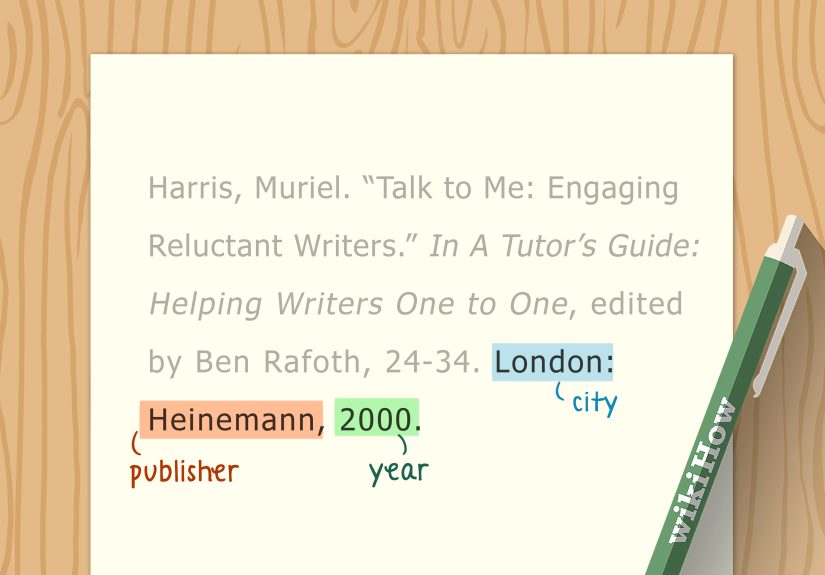
Format: Chapter Author Last Name, First Name. “Title of Chapter.” Title of Book, edited by Editor First Name Last Name, Publisher, Year, pp. xx–xx.
MLA example
Johnson, Rebecca. “Memory, Place, and the Modern Essay.” Writing the American City, edited by Daniel Brooks, Beacon Academic, 2021, pp. 112–130.
MLA in-text citation
Example: Johnson describes urban memory as “a map written twice” (118).
MLA loves page numbers. If you quote or paraphrase a specific idea, include the page number in your parenthetical citation. If the author’s name appears in your sentence, place only the page number in parentheses. If the chapter appears in an anthology or collection, do not forget the phrase “edited by.” It may look small, but in MLA land, small formatting words carry large academic luggage.
3. How to Cite a Book Chapter in Chicago Notes and Bibliography Style
Chicago style is popular in history, literature, philosophy, religious studies, and the arts. The Chicago Manual of Style has two major systems: Notes and Bibliography, and Author-Date. Chicago’s quick guide explains that Notes and Bibliography uses numbered footnotes or endnotes, while Author-Date uses parenthetical author-year citations.
For a chapter in an edited book, Chicago Notes and Bibliography usually gives full source details in the first note and a bibliography entry at the end. This style is excellent when writers need room for commentary, archival details, or extra source explanation.
Chicago footnote format
Format: First Name Last Name, “Title of Chapter,” in Title of Book, ed. Editor First Name Last Name (Publisher, Year), page number.
Chicago bibliography format
Format: Last Name, First Name. “Title of Chapter.” In Title of Book, edited by Editor First Name Last Name, page range. Publisher, Year.
Chicago example
Footnote: 1. Marcus Hill, “Public Libraries and Civic Memory,” in Archives of Everyday Life, ed. Linda Park (North River Press, 2020), 74.
Bibliography: Hill, Marcus. “Public Libraries and Civic Memory.” In Archives of Everyday Life, edited by Linda Park, 63–82. North River Press, 2020.
Chicago Notes and Bibliography gives readers a clean trail from the footnote to the bibliography. The first note is detailed; later notes can often be shortened. This makes Chicago perfect for long research papers where the sources are important enough to deserve a little stage lighting.
4. How to Cite a Book Chapter in Harvard Style
Harvard referencing is common in universities, especially in business, social sciences, education, and international academic writing. Unlike APA, MLA, and Chicago, Harvard is not controlled by one single official manual, so exact punctuation can vary by institution. Still, the core structure is consistent: chapter author, year, chapter title, editor, book title, publisher, place of publication if required, and page range.
Harvard format for a chapter in an edited book
Format: Chapter Author Last Name, Initial(s). (Year) ‘Title of chapter’, in Editor Initial(s). Last Name (ed.) Title of book. Place of publication: Publisher, pp. xx–xx.
Harvard example
Martinez, A. (2023) ‘Citation habits in digital classrooms’, in P. Roberts (ed.) Teaching Research in the Modern University. Boston: Harbor Academic, pp. 91–108.
Harvard in-text citation
Example: Digital citation habits often improve when students learn to identify source parts before using a generator (Martinez, 2023, p. 96).
The biggest Harvard tip is simple: check your institution’s version. Some Harvard guides include place of publication; others omit it. Some use single quotation marks around chapter titles; others allow double quotation marks. When in doubt, use your school library guide as the final boss.
5. How to Cite a Book Chapter in IEEE Style
IEEE style is often used in engineering, computer science, electrical engineering, and technical fields. Instead of author-date citations, IEEE uses numbered references in square brackets. Scribbr’s IEEE guidance explains that a chapter from an edited book should start with the chapter author and chapter title, then include the book title, editor, publication information, year, and page range.
IEEE format for a chapter in an edited book
Format: [#] A. A. Author, “Title of chapter,” in Title of Book, E. E. Editor, Ed. City, State/Country: Publisher, Year, pp. xx–xx.
IEEE example
[1] D. R. Chen, “Ethical design in autonomous systems,” in Human-Centered Artificial Intelligence, M. Patel, Ed. New York, NY, USA: Meridian Academic, 2024, pp. 143–160.
IEEE in-text citation
Example: Chen explains that ethical design must be tested before deployment [1].
IEEE is wonderfully direct. The in-text citation is just a number, which makes technical writing cleaner and less crowded. The challenge is keeping the reference list in the order sources first appear in the paper. If you move paragraphs around during revision, check your numbers before submission. Nothing says “academic chaos” quite like reference [7] appearing before reference [2].
Book Chapter Citation Examples at a Glance
APA
Nguyen, T. M. (2022). Digital reading habits in first-year composition. In L. Carter & J. M. Lewis (Eds.), New approaches to college literacy (pp. 45–68). Academic Press.
MLA
Nguyen, T. M. “Digital Reading Habits in First-Year Composition.” New Approaches to College Literacy, edited by Laura Carter and James M. Lewis, Academic Press, 2022, pp. 45–68.
Chicago
Nguyen, T. M. “Digital Reading Habits in First-Year Composition.” In New Approaches to College Literacy, edited by Laura Carter and James M. Lewis, 45–68. Academic Press, 2022.
Harvard
Nguyen, T.M. (2022) ‘Digital reading habits in first-year composition’, in L. Carter and J.M. Lewis (eds.) New approaches to college literacy. Academic Press, pp. 45–68.
IEEE
[1] T. M. Nguyen, “Digital reading habits in first-year composition,” in New Approaches to College Literacy, L. Carter and J. M. Lewis, Eds. Academic Press, 2022, pp. 45–68.
Common Mistakes When Citing a Book Chapter
Mistake 1: Citing the editor as the chapter author
If a chapter has its own author, that person goes first. The editor belongs later in the citation. The editor organized the book; the chapter author wrote the specific material you used.
Mistake 2: Forgetting the page range
Book chapter citations usually need the full page range of the chapter, not just the page you quoted. In-text citations may use the exact page number, but reference entries normally show where the entire chapter appears.
Mistake 3: Mixing styles
APA punctuation in an MLA Works Cited page is like wearing one sneaker and one dress shoe. Technically possible, visually alarming. Choose one style and stay loyal to it.
Mistake 4: Trusting citation generators without checking
Citation generators are helpful, but they are not magical librarians living in your laptop. They often miss editors, edition numbers, capitalization rules, and page ranges. Use them as a starting point, then compare the output with a trusted style guide.
Mistake 5: Ignoring the difference between a chapter and a whole book
If a book is written entirely by one author, cite the whole book in many styles. If the book is edited and each chapter has a different author, cite the chapter. This single distinction solves a surprising number of citation headaches.
How to Choose the Right Citation Style
The right citation style depends on your field, assignment, journal, or publisher. APA is common in social sciences and education. MLA is common in humanities and literature. Chicago Notes and Bibliography is common in history and arts. Harvard is common across many universities, especially outside the United States, but appears in American academic contexts too. IEEE is the standard choice for many technical and engineering papers.
If you are writing for a class, use the style your instructor assigns. If you are writing for a journal, follow the author guidelines. If you are publishing online for a general audience, choose the style that best matches your topic and keep it consistent. Search engines do not reward messy references, and readers do not enjoy playing “guess the citation system.”
Practical Experience: What I Learned from Citing Book Chapters the Hard Way
The first practical lesson about citing a book chapter is that the citation does not begin when you write the bibliography. It begins when you find the source. If you save only a screenshot of the page you quoted and forget the editor, publisher, or page range, you have created a tiny academic scavenger hunt for your future self. Future you will not send flowers.
A better habit is to record complete source details immediately. When reading an edited book, write down the chapter author, chapter title, book title, editor, year, publisher, and page range before taking notes. If the chapter is from an ebook database, save the DOI or stable link as well. This five-minute routine can save an hour later, especially when deadlines start breathing dramatically over your shoulder.
Another useful experience is learning to identify the title page and copyright page. Students often grab publication details from the cover, but covers can be incomplete. The title page usually gives the formal title and editor information. The copyright page gives the publisher, year, edition, and sometimes Library of Congress details. These pages may look boring, but they are citation gold mines wearing plain clothes.
I have also learned that book chapters require extra attention because they sit inside larger works. A journal article usually has one obvious title and one obvious source. A book chapter has two titles: the chapter title and the book title. It may also have two different sets of people: the chapter author and the book editor. Mixing those up is the most common citation problem. The easiest fix is to ask, “Who wrote the exact chapter I used?” Put that person first.
Page ranges are another small detail with big consequences. Many writers cite only the page where a quote appears, but the reference list usually needs the full span of the chapter. For example, if a chapter runs from pages 45 to 68 and you quote page 52, your reference entry should include 45–68, while your in-text citation may point to page 52. Think of the reference entry as the address of the whole apartment, while the in-text citation is the exact room where the quote is sitting.
One more experience: citation style changes depending on audience. A literature professor may expect MLA and care deeply about punctuation and container order. A history journal may prefer Chicago footnotes. An engineering conference may want IEEE numbers. The same chapter can look completely different in each style, and that is normal. Citation is not about decorating sources; it is about helping readers locate them quickly using the rules of a particular academic community.
Finally, the best citation workflow is boring in the most beautiful way. Keep a running reference list as you research. Use a citation manager if you like, but review every entry manually. Compare your final citations with an official or university guide. Make sure the in-text citations match the reference list. Alphabetize when the style requires it. Number in order when the style requires it. Then, with great dignity, close the twenty browser tabs you opened while looking for one missing editor name.
Conclusion: Citing a Book Chapter Is Mostly About Knowing the Parts
Learning how to cite a book chapter becomes much easier once you understand the structure. A chapter citation is built from smaller pieces: chapter author, chapter title, book editor, book title, publisher, year, and pages. APA, MLA, Chicago, Harvard, and IEEE arrange those pieces differently, but the goal is always the same: give credit clearly and help readers find the original source.
The best approach is to collect source details early, choose the required citation style, and check your formatting before submission. Whether you are writing a research paper, article, thesis, or online guide, accurate citations make your work more trustworthy. They also prevent your bibliography from looking like it was assembled during a thunderstorm. That alone is worth celebrating.