Table of Contents >> Show >> Hide
- Why glove size matters more than you think
- Method 1: Measure hand circumference (the “knuckle loop” method)
- Method 2: Measure hand length (the “wrist crease to fingertip” method)
- Method 3: Use a brand chart + a real-world “fit test” (because charts can’t feel your hands)
- Why brand charts differ (and why it’s not your fault)
- The quick fit test (works at home, in-store, or during the return window)
- Special cases: choosing size by glove type
- 1) Disposable gloves (nitrile, latex, vinyl)
- 2) Work gloves (construction, gardening, mechanics)
- 3) Winter gloves and mittens
- 4) When you can’t measure with a tape
- Common glove-fit problems (and how to fix them)
- Quick cheat sheet: the 30-second glove sizing routine
- Experience-based tips: things people learn the hard way (so you don’t have to)
- Conclusion
Gloves are one of those “small” purchases that can dramatically improve (or ruin) your day. A good fit makes you feel like a capable superhero.
A bad fit makes you feel like you’re wearing two sad, floppy tortillas. The good news: figuring out your glove size is surprisingly simple once you
know what to measureand which “rules” matter depending on the glove type.
Below are three reliable ways to determine glove size, plus practical tips for when charts don’t agree, your fingers are longer than average,
or you’re shopping online and can’t do a try-on. By the end, you’ll be able to buy gloves with confidence instead of “hope and free returns.”
Why glove size matters more than you think
Glove sizing isn’t just about comfort. It affects grip, dexterity, warmth, and even safety. Too small and you can feel pinched, restricted,
and fatigued faster. Too large and the glove can bunch up, reduce control, and make simple tasks feel clumsylike trying to pick up a coin with
oven mitts.
The tricky part is that “glove size” is not one universal system. Some brands use letter sizing (S–XL), some use numbers (6–11),
and some rely on measurements like palm width. Different glove categories also fit differently: a thin nitrile glove should fit like a second
skin, while insulated winter gloves may need room for liners and warm air.
That’s why the best approach is to measure your hand first, then use a brand’s chart to translate that measurement into a size. Think of your
measurements as the truth, and the size label as the brand’s interpretation of that truth (with a little wiggle room).
Method 1: Measure hand circumference (the “knuckle loop” method)
If you only do one measurement, do this one. Most glove sizing charts use hand circumference taken around the widest part of the palm,
typically around the knuckles, with the thumb excluded.
What you need
- A flexible measuring tape (tailor’s tape is ideal)
- If you don’t have tape: a piece of string + a ruler
- 30 seconds and a hand that agrees to sit still
Step-by-step
-
Pick your dominant hand. Many guides recommend measuring the hand you use most (right hand for right-handed folks, and vice versa),
because it’s often slightly larger. - Relax your hand. Keep it open and naturaldon’t splay your fingers like you’re auditioning for a jazz-hands musical.
-
Wrap the tape around your knuckles. Measure around the widest part of your palm, just below the knuckles, and
do not include your thumb. - Read the measurement. Note it in inches or centimeters. Keep the tape snug but not tightthink “comfortable bracelet,” not “tourniquet.”
How to use your circumference measurement
Once you have your hand circumference, go to the glove brand’s size chart and match your measurement to the recommended size. If a chart gives a range
(like 7.5–8 inches), you’re looking for the range your measurement falls into.
Example: If your hand circumference is 8.5 inches, some charts may place you in a men’s Medium, while others may push you toward Large
especially if the glove is insulated or designed for layering. The chart is the tie-breaker, but your intended use is the referee.
Pro tip: When you’re between sizes, decide what “fit” you want
If your measurement lands between sizes, choose based on purpose:
- Dexterity-first (work, tools, driving): a snugger fit usually feels more precise.
- Warmth-first (winter gloves): a little extra room can improve comfort and allow liners.
- Disposable gloves (nitrile/latex): snug is good, but too tight can tear or cause hand fatigue.
Method 2: Measure hand length (the “wrist crease to fingertip” method)
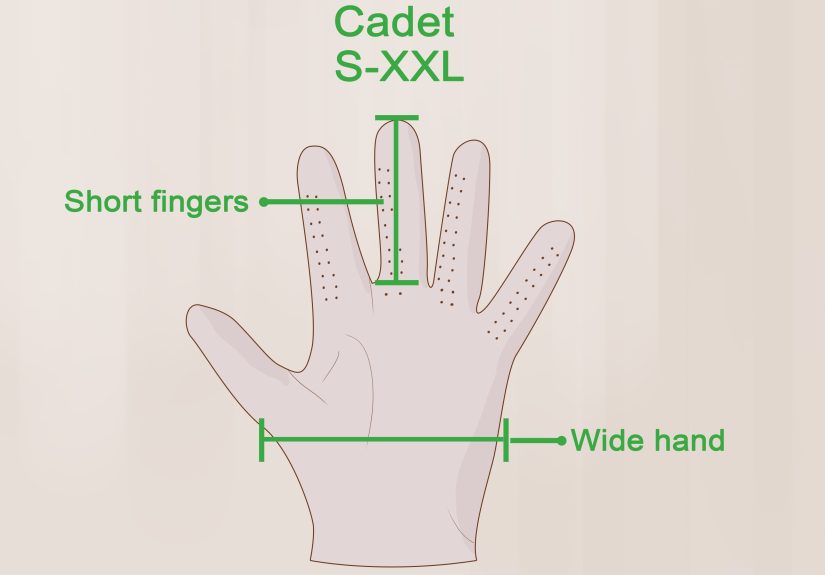
Hand circumference is the most common measurement, but it doesn’t tell the full storyespecially if you have long fingers or a shorter palm.
That’s where hand length comes in. Many size charts for outdoor and winter gloves include both circumference and length for a better match.
Step-by-step
- Turn your palm up. Find the crease at the base of your palm where it meets your wrist.
- Measure to your longest fingertip. For most people, that’s the middle finger, but use whichever finger is actually the longest.
- Record the length. Measure in inches or centimeters and write it down.
When length matters most
Hand length is especially important if you’ve ever had this experience:
you buy gloves that fit your palm perfectly… and the fingers feel like they stop halfway up your digits.
That’s not you being “picky.” That’s a real sizing mismatch.
Some brands explicitly recommend choosing your glove size using the larger of your two measurements (circumference vs. length).
That guidance is particularly helpful for people whose hands don’t match “average proportions.”
Example: Let’s say your circumference suggests Medium, but your hand length suggests Large. If you do tasks requiring full finger reach
(ski poles, shoveling, gripping handles), sizing up may prevent fingertip pressure and improve comfort.
Common length-related fit problems
- Fingers feel tight or pull when you make a fist: your glove length is likely too short.
- Fingertips feel empty and floppy: your glove length is likely too long (or the glove is designed for longer fingers).
- Thumb feels cramped even if fingers feel fine: look for gloves with a “pre-curved” or ergonomic pattern, or try another brand.
Method 3: Use a brand chart + a real-world “fit test” (because charts can’t feel your hands)
Measurements get you close. The brand chart gets you closer. But the final stepespecially when you care about performanceis confirming fit
based on how gloves behave when you actually use your hands.
Why brand charts differ (and why it’s not your fault)
Glove fit changes with materials and construction:
- Leather can stretch and break in over time.
- Knits may flex and conform more easily than stiff materials.
- Insulated gloves have bulk that can make a “perfect” size feel snug.
- Impact/technical gloves may use more complex patterning and protective elements that alter fit.
Some companies even design gloves using more measurement points than just “length and width,” aiming for a tailored feel by style.
Translation: your size might differ across glove models in the same brand.
The quick fit test (works at home, in-store, or during the return window)
Once you put the gloves on, run through these checks:
-
Fingertip check: Your fingertips should reach near the end without being jammed into it. A tiny bit of space is fine.
A lot of empty fingertip space is not. - Pinch-and-grip test: Pick up a coin, turn a key, or pinch fabric. If you can’t do small movements, the glove is too bulky or too loose.
- Fist test: Make a fist and open your hand several times. If you feel pulling across the knuckles or fingertips, it may be too small.
- Wrist seal: For cold weather gloves, check if the cuff seals well (especially if you’ll be in wind or snow).
Special cases: choosing size by glove type
1) Disposable gloves (nitrile, latex, vinyl)
Disposable gloves should feel snug but not painfully tight. You want full finger control with no excess material at the fingertips.
If they’re too tight, they can tear or feel restrictive. If they’re too loose, dexterity drops and tasks feel clumsy.
Use your hand circumference measurement and the manufacturer’s letter-size chart as your starting point.
2) Work gloves (construction, gardening, mechanics)
For work gloves, fit is often a balancing act between protection and control. If you use hand tools, a closer fit typically improves grip and precision.
Some brands even recommend sizing down if you’re between sizes for a snug fitespecially for technical or mechanic-style gloves.
But if your work involves vibration, cold, or extended wear, a slightly roomier fit can reduce fatigue.
3) Winter gloves and mittens
Warmth depends partly on insulation and partly on trapped air. If your insulated gloves are too tight, you can reduce circulation and lose warmth.
If you plan to wear liners, try the fit test with liners on. In many cases, sizing up makes sense for comfort and layeringjust don’t size up so far
that you lose control of poles, zippers, or steering wheels.
4) When you can’t measure with a tape
No measuring tape? No problem. Wrap a string around your knuckles the same way you would with tape, mark where it overlaps, then measure the string length
with a ruler. It’s old-school, but accurate enough to choose a size chart range.
Common glove-fit problems (and how to fix them)
Even with good measurements, glove fit can go sideways. Here are the issues people run into most oftenand what to do about them.
Problem: “The palm fits, but the fingers are too long.”
This can happen with certain brands or glove models designed for longer fingers. If you’re doing detailed work, excess fingertip length can feel sloppy.
Look for gloves that provide both hand length and circumference sizingor try a different brand whose fit profile matches your hand shape.
Problem: “The fingers fit, but the knuckles feel tight.”
Your circumference measurement likely points to a larger size. If you size up and the fingers get too long, try a glove style with more stretch
(knit back, spandex panels) or a different cut.
Problem: “My glove slips when I grip something.”
That’s usually a sign the glove is too large, especially around the palm and knuckles. Slipping can reduce dexterity and safety. Consider sizing down
or selecting a glove with a better wrist closure (elastic cuff, hook-and-loop strap, gauntlet with cinch).
Problem: “My hands get cold even though the gloves are ‘warm.’”
If gloves are too tight, circulation can suffer, making your hands feel colder. Try a half size or a full size up in insulated styles,
and make sure your fingers aren’t compressed at the tips.
Quick cheat sheet: the 30-second glove sizing routine
- Measure dominant hand circumference around knuckles (thumb excluded).
- Measure hand length from wrist crease to longest fingertip.
- Use the brand’s size chart (not a random “universal” chart).
- If measurements disagree, consider choosing based on the larger measurementespecially for gloves where finger reach matters.
- Do the fit test (fingertip check, pinch/grip, fist test, wrist seal).
Experience-based tips: things people learn the hard way (so you don’t have to)
The measurements are straightforward. The “real life” part is where glove sizing turns into a tiny adventure. Below are common experiences people report
when they start taking glove fit seriouslyand what those experiences teach you.
1) The “I measured… but I measured the wrong spot” moment
A lot of people wrap the tape around their entire hand, including the thumb, then wonder why the glove fits like a windsock. The thumb adds extra
circumference that doesn’t translate into glove sizing for most charts. The fix is simple: measure around the knuckles and palm while keeping the thumb out
of the loop. Once people switch to the correct spot, their sizing becomes far more consistent across brandsand the “why is everything too big?” mystery
disappears overnight.
2) The “same size, different brand, totally different fit” surprise
Someone buys a Medium in one brand, nails it, and then confidently buys Medium in another brand… and ends up wearing finger puppets stitched onto a sail.
That’s because glove sizing isn’t standardized the way you might expect. Materials, insulation, and patterning change fit, and brands interpret “Medium”
differently. People who stop relying on the letter and start relying on their measurements (plus the brand’s chart) usually find the whole process gets
calmerand their return labels get lonely.
3) The “my fingers are the problem (they are innocent)” realization
If you have longer fingers, circumference-only sizing can be misleading. Many people discover their palm fits one size, but their fingers need another.
The result is fingertip pressure that feels annoying at first, then becomes a deal-breaker when you’re driving, skiing, or holding tools for an hour.
Measuring hand length solves this. People often end up choosing the size that accommodates finger reach, then picking a glove style with enough stretch or
a better cut so the palm doesn’t feel baggy.
4) The winter glove paradox: tighter is not warmer
This one catches a lot of shoppers: you try on insulated gloves and choose the snug pair because it feels “secure,” then your hands get colder outside.
A too-tight insulated glove can reduce circulation and compress the insulation, both of which work against warmth. Many people report that sizing up
slightlyespecially if they wear linersfeels warmer and more comfortable, even though it seems counterintuitive. The goal is a secure fit without
squeezing, plus enough room for insulation to do its job.
5) The “dexterity tax” when gloves are too big
Oversized gloves don’t just look a little sloppythey can make tasks harder. People notice it when picking up screws, using touchscreen features,
operating zippers, or handling tools. The glove material bunches, fingertips collapse, and suddenly your hands feel like they’re working through a thick
curtain. The lesson: for precision tasks, it’s usually better to choose a snugger fit (or a glove designed for dexterity) than to size up “just in case.”
If you’re between sizes, consider your use case firstbecause your hands will absolutely hold a grudge during small, fiddly tasks.
Conclusion
Determining glove size doesn’t require guessworkjust a quick measurement and a little common sense about how you’ll actually use the gloves.
Start with hand circumference around the knuckles, add hand length if finger fit matters, and always confirm with the brand’s sizing chart.
Finally, use a simple fit test so your gloves match your real life, not just a number on a page.
When gloves fit correctly, you’ll notice it immediately: better grip, easier movement, warmer hands (when it counts), and fewer “why is this annoying?”
moments. And that’s the kind of quiet victory your hands deserve.