Table of Contents >> Show >> Hide
- What the Type 75 Is (and Why People Care)
- The Anglepoise DNA: A Springy Origin Story
- Design Breakdown: Form, Materials, Movement
- Light Quality: Pick Your Bulb Like You Pick Your Coffee
- The Type 75 Family: Desk, Mini, Floor, Wall
- Special Editions: When the Type 75 Gets a Wardrobe Upgrade
- Why Designers (and Normal Humans) Keep Choosing It
- Buying Guide: How to Choose the Right Type 75 for Your Space
- Care and Longevity: Keeping It Looking Sharp
- Sustainability Note: The “Buy Once” Philosophy (Now With Receipts)
- Quick FAQs
- Real-World Experiences With the Type 75 Anglepoise Lamp (The Extra You Asked For)
- Conclusion
If you’ve ever owned a bargain desk lamp, you know the moment. You aim the light at your keyboard, turn around to grab coffee,
and by the time you’re back the shade has slowly drooped like it just remembered student loans exist. The Type 75 Anglepoise lamp
was basically invented to prevent that exact tragedyby being the kind of task light that stays where you put it, then politely
goes back to minding its business.
The Type 75 is one of those objects that feels “obviously right” the first time you use it: balanced arms, steady base, smooth
adjustments, and a silhouette that looks at home everywhere from a minimalist home office to a chaotic art studio. In this guide,
we’ll break down what makes the Type 75 special, how to choose the right version (desk, mini, floor, wall), and what it’s like
to live with one day after daywithout turning this into a lamp infomercial where someone screams, “But wait, there’s more!”
What the Type 75 Is (and Why People Care)
The Type 75 is a modern interpretation of the classic spring-balanced “architect lamp” ideabuilt for focused, adjustable
task lighting. It was created by industrial designer Sir Kenneth Grange and introduced as part of Anglepoise’s
contemporary lineup, pairing clean modernist lines with the brand’s signature balance-and-springs engineering.
Translation: it’s the desk lamp equivalent of a well-designed kitchen knife. Not flashy for the sake of flashy. Just excellent
at the job, with a form that happens to look great while doing it.
The Anglepoise DNA: A Springy Origin Story
Anglepoise’s “thing” has long been balancespecifically, a spring-and-lever system that lets you move a lamp into position and
have it hold that position without fuss. The origin story starts in the early 1930s, when engineer George Carwardine
developed a spring mechanism that could suspend objects and “stay put,” then applied the idea to an adjustable task lamp.
That design lineage became iconic in studios, workshops, and offices, and helped define what people expect an adjustable lamp
to feel like: steady, responsive, and practical.
The Type 75 inherits that philosophy. It’s not trying to reinvent the idea of a desk lamp; it’s trying to perfect the experience
of using onemoving the light exactly where you need it, then having it remain there like a loyal assistant.
Design Breakdown: Form, Materials, Movement
At a glance, the Type 75 looks simplealmost modest. But the details are doing a lot of work: a smoothly shaped shade, tidy
proportions, and an arm system engineered for repeatable positioning. Anglepoise describes the desk version as having a shade
that moves into multiple positions and a constant-tension spring mechanism designed to make it “a pleasure to use.”
Materials that feel “real” (because they are)
The Type 75 family commonly uses an aluminum shade and arms, chrome-plated fittings, and a
cast iron base (often with an aluminum cover). That mix matters: aluminum keeps the structure nimble, while cast iron
gives the lamp the low center of gravity that prevents wobble or tipping when you adjust it. In other words, it’s built like a tool,
not a toy.
Size and reach: the numbers that actually matter
Measurements vary slightly by market and version, but here’s the practical takeaway: the standard desk model is sized to cover
a real workspace. For example, one Anglepoise product spec lists the desk lamp around H52 × W43 × D19.5 cm with a weight
around 3.1 kg, emphasizing stability and full adjustability.
U.S. retail listings commonly describe a maximum reach around the mid-20-inch range (roughly “comfortably reaches across a laptop
and notebook” territory), and provide shade and base dimensions that help you judge fit on a desk, nightstand, or side table.
Controls and usability
Many Type 75 desk versions place the switch right where you want iton or near the shadeso you aren’t hunting down an inline
cord switch in the dark like you’re playing a low-stakes escape room. Different configurations (especially wall and floor) may use
different switch styles, so it’s worth checking the exact version you’re buying.
Light Quality: Pick Your Bulb Like You Pick Your Coffee
A lamp’s mechanics get the attention, but the bulb decides the mood. The Type 75 is typically designed around standard
screw-base bulbs (E26 in the U.S.; E27 in many other markets). You’ll often see warm-white options around 2700K, which is
flattering for living spaces and comfortable for evening work.
Included bulb specs can vary (and that’s normal)
-
One published product spec for the Type 75 desk lamp lists an included E27 LED at 6W with output around
470 lumens at 2700K. -
U.S. listings for certain Type 75 desk editions describe included E26 LED bulbssome around 2700K and
anywhere from roughly 600 to 900 lumens, depending on the retailer and configuration.
The good news: you’re not locked in. If you want a brighter, crisper work light, you can choose a higher-lumen bulb or a cooler
temperature (say 3000K or 3500K) for daytime productivity. If you want a softer bedside glow, stick with warm 2700K and moderate
brightness so your brain doesn’t think it’s noon.
Dimming: possible, but check your setup
Some Type 75 listings describe the lamp as dimmable, but dimming typically depends on the bulb and the electrical setup
(especially if you’re using a wall dimmer or smart dimming). If dimming is a must-have, choose a dimmable bulb and confirm your
version supports it the way you expect. “Dimmable” can mean anything from “works with certain dimmers” to “sure, if you’re an electrician.”
The Type 75 Family: Desk, Mini, Floor, Wall
“Type 75” isn’t one lampit’s a family. Think of it like a well-dressed group photo where everyone shares the same jawline but
has a different job title.
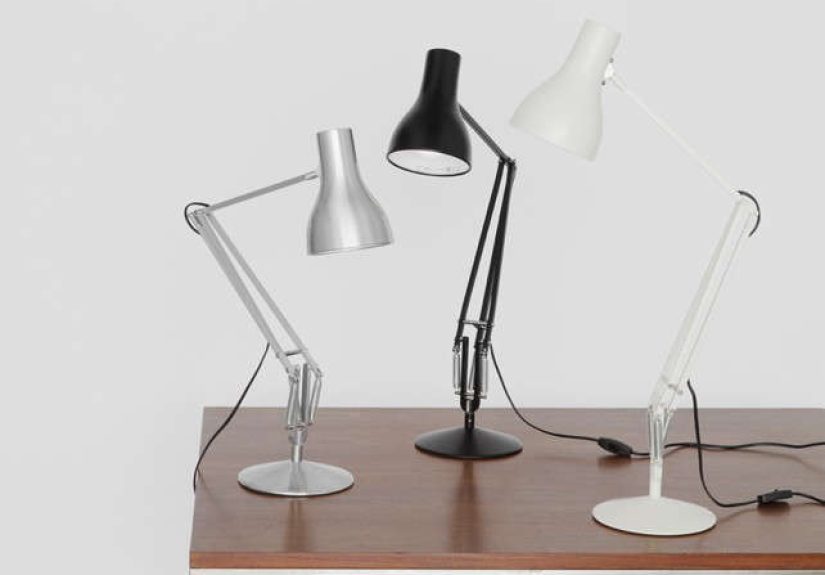
Type 75 Desk Lamp
The classic: a weighted base, spring-balanced arm, adjustable shade, and a footprint that works on a desk without eating your
entire workspace. It’s ideal for home office lighting, drafting, reading, and any activity where “light precisely here” is the assignment.
Type 75 Mini Desk Lamp
The mini version is designed for tighter spacesbedside tables, small desks, shelves, cozy reading cornerswhile keeping the
signature spring mechanism and aiming flexibility. If you love the Type 75 vibe but your furniture is the size of a city apartment,
the Mini is often the sweet spot.
Type 75 Floor Lamp
Floor versions stretch the concept into a reading-light powerhouse: the reach lets you place the base beside a chair or behind
a side table and arc the light where you want it. One retail description notes that the Type 75 floor lamp was inspired by a 1970s
version of an earlier Anglepoise design (Apex 90) and reinterpreted in 2004, keeping modernist lines and straightforward functionality.
Type 75 Wall Light / Wall Mounted
Wall versions are great when you want to reclaim desk space or create a tidy bedside setup. A U.S. wall-light listing specifies
practical details like UL listing, an E26 socket, dimming capability, and compact dimensions designed to bring the light close
without dominating the room.
Special Editions: When the Type 75 Gets a Wardrobe Upgrade
The Type 75’s clean form makes it a perfect canvas for collaborations and color editions. Two popular directions show up repeatedly:
Margaret Howell Editions
These editions often focus on restrained, design-forward color palettessmart, earthy tones that feel architectural rather than loud.
If your aesthetic is “calm competence,” this is your lane.
Paul Smith Editions
These are for people who want their desk lamp to look like it has a favorite playlist. The Paul Smith editions are known for
color playbright accents, stripes, and combinations that turn the lamp into a functional statement piece. If your workspace needs
personality (or you just want to smile when you turn the light on), these are the most “fun” versions of the Type 75.
Why Designers (and Normal Humans) Keep Choosing It
The Type 75 keeps winning people over because it nails the fundamentals:
- Adjustability: You can reposition it quickly and precisely for keyboard work, sketching, reading, or fine detail tasks.
- Stability: The heavy base helps it stay put when you move the arms and shade.
- Targeted illumination: It’s built to place light exactly where you need ituseful for reducing glare and improving focus.
- Design that ages well: It looks modern, but not trendy. (A key difference.)
It also has a reputation for being the kind of product you buy once and then stop thinking aboutbecause it simply does its job.
That sounds boring until you remember how much time you’ve wasted fighting with inferior desk lamps.
Buying Guide: How to Choose the Right Type 75 for Your Space
1) Start with placement and reach
If you need light over a broad desk area, go standard desk lamp or floor lamp. If you’re lighting a nightstand, a narrow shelf, or
a small workstation, the Mini or wall version usually fits better.
2) Decide what “good light” means for you
- For deep focus work: Consider higher lumens and a neutral-warm temperature (2700K–3000K).
- For cozy reading: Warm 2700K is your friend, and you may not need high brightness.
- For art and color-sensitive work: Look for higher CRI bulbs and stable color output.
3) Confirm socket type (U.S. shoppers)
In the U.S., you’ll typically want E26 compatibility. Many U.S. listings explicitly specify E26. If you’re reading global
specs, you may see E27very similar physically, but always follow the version sold for your market to avoid annoying surprises.
4) Check warranty and support
Warranty terms can vary by retailer and product category (and sometimes by whether a purchase is residential or contract).
Still, the brand messaging across multiple retailers emphasizes longevity and durable constructionthis is not positioned as a
disposable product.
Care and Longevity: Keeping It Looking Sharp
Maintenance is refreshingly low drama. One official support spec recommends cleaning with a soft, dry cloth, which is the
lamp-care equivalent of “drink water and get enough sleep.” Avoid harsh cleaners that can dull finishes, and you’re basically set.
Sustainability Note: The “Buy Once” Philosophy (Now With Receipts)
Durable products can be a sustainability strategy all on their ownbecause replacing cheap stuff repeatedly creates waste.
Anglepoise is listed as a Certified B Corporation (certified since January 2024 in one public listing), which signals third-party
assessment around social and environmental standards. That doesn’t magically make every product perfect, but it does provide a
more concrete framework than “trust us, we’re nice.”
Quick FAQs
Is the Type 75 good for a home office setup?
Yesespecially if you want adjustable, focused light that doesn’t glare on screens. Pair it with a warm-to-neutral LED bulb and
aim the beam slightly off-axis from your monitor to reduce reflections.
Does it work as a bedside reading lamp?
Absolutely. The Mini or wall-mounted versions are often the most space-friendly. Use a warm bulb and, if possible, dimming so you
don’t blast your retinas before sleep.
Is it more “design object” or “tool”?
It’s both, which is why people love it. It’s practical enough for real work and handsome enough to feel intentional in a room.
Real-World Experiences With the Type 75 Anglepoise Lamp (The Extra You Asked For)
Living with a Type 75 is less like owning a lamp and more like adopting a very polite mechanical assistant who refuses to be
impressed by your chaos. The first thing you notice is the movement: you don’t “fight” it. You guide it. The arm swings where
you want, the shade rotates, and then everything settles into place with that satisfying sense of balancelike the lamp is saying,
“Yes, that’s a reasonable request. I will now hold this position indefinitely.”
On a typical workday, that adjustability becomes a tiny productivity cheat code. Morning emails? Aim the beam at the keyboard.
Midday paperwork? Pull the shade lower and tighten the focus so the light stays on the page instead of washing the whole room.
Late-night “why did I agree to this deadline” session? Angle the light slightly forward so it brightens your workspace without
reflecting in your monitor like a ghostly rectangle of doom. Small change, big comfort.
The Type 75 also excels at the awkward moments that defeat lesser lamps. You know the ones: the desk is crowded, the lamp base is
wedged behind a speaker, and you’re trying to direct light onto a notebook without knocking over your coffee. A heavy base helps.
So does an arm system that doesn’t require two hands and a prayer. You can reposition the light one-handed while the other hand
continues doing whatever you’re doingwriting, soldering, sketching, assembling a model, or pretending you’re “just going to tidy
this cable” and then losing 40 minutes to cable management.
It’s also surprisingly good at “mood work.” Swap in a warm 2700K bulb, aim the shade at a wall, and the Type 75 becomes a soft
ambient glow for reading or winding down. This is where the lamp’s design restraint pays off: it doesn’t feel precious. You don’t
worry about it looking out of place if your room style changes from “minimalist calm” to “maximalist bookshelf renaissance.”
It still looks rightbecause it was designed to be useful first.
If you’re the kind of person who rotates between hobbies, the Type 75 can quietly follow along. For artists, a slight adjustment
gives clean light on a sketchbook without a ton of spill. For crafters, it can get close enough to brighten detail work. For readers,
it can hover over a shoulder and put light directly on the page. For gamers (yes, gamers), it can illuminate a keyboard or desk
surface without turning the room into an interrogation scene. And for anyone working from home, it has the rare talent of feeling
“professional” without feeling sterile.
The most telling experience is what doesn’t happen: you don’t constantly readjust it because it sagged. You don’t tap the shade
to keep it from drooping. You don’t develop a strange habit of bracing the arm with a stapler. The lamp simply behaves. And after
you’ve lived with that kind of reliability, it’s genuinely hard to go back to a bargain lamp that treats gravity like a personal hobby.
In short: the Type 75 isn’t exciting in the loud way. It’s exciting in the “my workspace is finally working with me” wayand that’s
the kind of excitement that actually lasts.
Conclusion
The Type 75 Anglepoise lamp earns its reputation by doing the basics exceptionally well: stable balance, smooth adjustability,
and focused task lighting wrapped in a clean modern form. Whether you choose the standard desk version, the compact Mini, the
floor lamp for reading, or a wall-mounted setup for space-saving convenience, you’re buying into a design tradition built around
one simple idealight exactly where you need it, staying exactly where you put it.