Table of Contents >> Show >> Hide
- What “Tiny Bubbles In The Clock” Actually Means
- How a Bubble Clock Displays Time
- Why the Liquid Matters (And Why Thick Wins)
- The Hardware: How You Physically Make Tiny Bubbles On Command
- The Control System: Keeping the Bubbles Honest
- Design Challenges (And the Fixes That Usually Work)
- Fun Variations That Makers Keep Building
- Why Watching Bubbles Tell Time Feels So Good
- FAQ: Quick Answers Before You Go Down the Bubble Rabbit Hole
- Conclusion
- Real-World Experiences With “Tiny Bubbles In The Clock” (About )
You’ve seen clocks that glow, flip, tick, chime, and occasionally scream at you before you’ve had coffee.
But a clock that breathesthat quietly releases tiny bubbles like it’s trying to relax the room on purpose?
That’s where things get weird in the best way.
This article unpacks the mesmerizing idea behind an air-bubble clock: time displayed as a slow, drifting dot-matrix made from bubbles rising through a liquid.
It’s part engineering, part aquarium craft, and part “why is this so calming?” science.
What “Tiny Bubbles In The Clock” Actually Means
The phrase sounds like a poetic metaphorand honestly, it kind of isbut it’s also a very literal description of a real, buildable concept:
a clock that forms digits using bubble “pixels”. Each bubble is released on a schedule so that, as it rises, it occupies a specific spot in an invisible grid.
Think of it as a digital display that traded LEDs for physics. Instead of turning lights on and off, you time the release of air.
The bubbles climb, the next row gets written underneath, and the whole display refreshes continuously like a gentle, liquid “reverse Tetris.”
How a Bubble Clock Displays Time
At the core, an air-bubble clock is a controlled air-injection system plus a viewing chamber.
The chamber is typically divided into vertical lanes (columns) so bubbles don’t drift sideways and “photobomb” the wrong digit.
The bubble “pixel” grid
Imagine eight vertical columns. At the bottom of each column is a tiny outlet connected to air.
If you release one bubble in column 3, and thenmilliseconds laterrelease one in column 4, you’ve just created a two-pixel “row.”
Repeat that row pattern several times as earlier bubbles rise, and you can build a digit.
Timing is everything (yes, even more than on a normal clock)
Bubble pixels need to be spaced so the pattern stays readable while drifting upward.
That means controlling:
- Bubble size (air pressure + valve-open duration)
- Bubble spacing (timing between releases)
- Rise speed (liquid choice + temperature)
- Column stability (mechanical guides that keep bubbles in their lane)
If your bubble timing is off, your “8” becomes a “mostly 8-ish cloud situation,” which is not a recognized time format in any timezone.
Why the Liquid Matters (And Why Thick Wins)
Many early experiments start in water because it’s convenient. The problem: bubbles rise fast, wobble, and disappear before your brain finishes saying,
“Waitwas that a 3 or a very enthusiastic 7?”
A thicker liquidcommonly glycerin (glycerol) or a glycerin-heavy mixtureslows the rise, keeps bubbles more consistent, and makes the display readable.
It also makes the motion more “meditation app” and less “soda bottle shake.”
Temperature: the silent troublemaker
Viscosity changes with temperature. If the room gets warmer, bubbles can rise faster and spacing changes.
Builders often compensate by measuring temperature and adjusting timing in software, keeping the bubble pixels aligned as conditions shift.
The Hardware: How You Physically Make Tiny Bubbles On Command
1) Air source
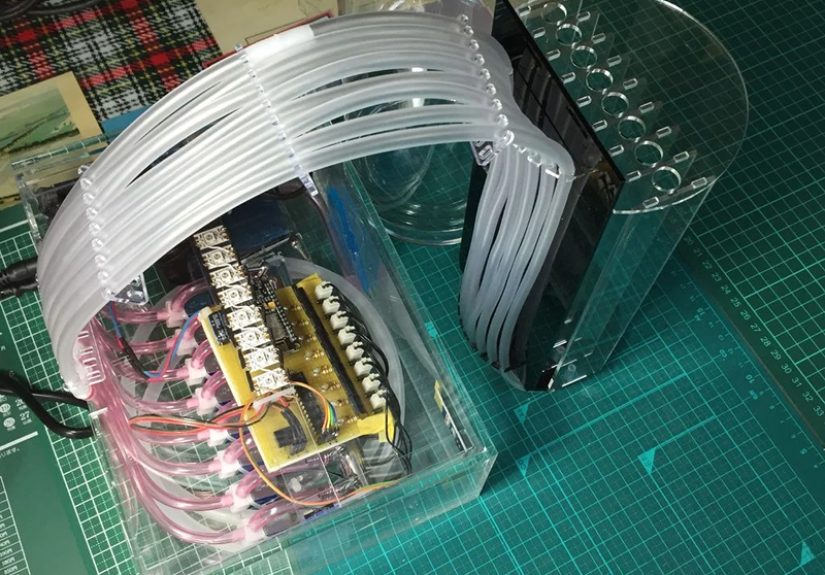
Most designs use a small air pump feeding a splitter/manifold.
The pump provides constant pressure, and the valves decide when each column gets its bubble.
2) Solenoid valves: the bubble gatekeepers
Each column typically has a valve that stays closed until energized. When power is applied, the valve opens briefly, letting a small burst of air through.
The shorter the pulse, the smaller the bubble (assuming pressure stays steady).
Electrically, solenoids are inductive loads, so proper drivers matter. In practice, that means:
- A transistor/MOSFET driver per valve (or a dedicated driver board)
- Flyback protection (to prevent voltage spikes when the coil switches off)
- A power supply sized for inrush and sustained current
3) A stable “bubble lane” structure
The bubble chamber usually includes internal partitions or individual tubes per column.
That way, bubbles rise where they’re supposed to rise, not where they feel like exploring.
This is where the project quietly becomes part fabrication project, part waterproofing trial, and part “I didn’t know I’d need this many clamps.”
4) Lighting: making bubbles readable (and gorgeous)
Bubbles are transparent, so lighting is what makes them pop. Many builds use individually addressable RGB LEDs behind or alongside the chamber
so bubbles glow as they rise. That turns the display into a kinetic light sculpture that also happens to know what time it is.
The Control System: Keeping the Bubbles Honest
Bubble clocks typically rely on a microcontroller that can handle precise timing and manage multiple outputs.
A Wi-Fi capable board is popular here because it can:
- Sync time over the internet (NTP)
- Enable easy updates (because timing tweaks are inevitable)
- Let you add fun modes (animations, color shifts, day-of-week indicators)
Why an I/O expander shows up in bubble clocks
Driving multiple valves can require more pins than you want to spare.
An I/O expander adds extra controllable outputs over a simple bus, letting the microcontroller focus on timing logic rather than running out of pins.
Timekeeping backup: when Wi-Fi isn’t feeling social
Many builders pair the controller with a dedicated real-time clock module so the device keeps accurate time even if power cycles or Wi-Fi drops.
Some RTC modules include temperature sensing, which is handy because bubble timing can benefit from temperature-aware adjustment.
Design Challenges (And the Fixes That Usually Work)
Challenge: bubbles aren’t identical
Tiny variations in valve timing, pump pressure, or outlet geometry can cause bubble sizes to drift.
The fix is boring but effective: make pressure as stable as possible, keep outlets consistent, and tune pulse durations in software.
Challenge: sideways drift ruins “pixels”
Without separation, bubbles wiggle into neighboring columns, turning digits into abstract art.
Most successful builds use lanes, tubes, or partitions that physically prevent cross-column travel.
Challenge: viscosity changes with temperature
This is the one that surprises people because it’s subtle.
A clock tuned in a cool workshop may look different on a warm desk.
Using temperature-aware timing helps keep the display consistent across seasons (or across the daily cycle of your HVAC making up its mind).
Challenge: “aquarium problems” in a non-aquarium project
Sealing, filling, avoiding trapped air pockets, and keeping the liquid clean become part of the build.
It’s a reminder that the clock is half electronics and half fluid containment.
If you don’t respect both halves, the bubbles will unionize.
Fun Variations That Makers Keep Building
Once you can render digits, people naturally start asking, “What else can I make it say?”
That’s when bubble clocks grow from timepieces into displays.
More columns, more characters
Add columns and you can display multiple digits at once, show a full HH:MM readout, or widen the matrix for clearer fonts.
Bigger arrays can also support simple icons or animations.
Color as information
RGB lighting means the same digits can carry extra meaning:
blue at night, warmer tones in the morning, or color shifts as a “soft alarm.”
(Yes, it’s still an alarm clockjust one that doesn’t hate you.)
Relaxation mode
Plenty of builders add a non-time mode that simply makes patterns: waves, pulses, slow gradients.
It’s basically a desk fountain for people who like firmware updates.
Why Watching Bubbles Tell Time Feels So Good
Traditional displays are binary: on/off, now/not-now. Bubble displays are continuous.
You see the motion, the spacing, the driftthe system is always “becoming.”
That gentle continuity matters. A bubble clock doesn’t just show time; it illustrates time passing.
The digits are literally carried upward, which is about as on-the-nose a metaphor as physics will allow.
And yes, part of the charm is the sound: the subtle clicking of valves, the quiet mechanical rhythm.
It’s the opposite of a loud tick. More like a polite reminder that time exists, but it’s not here to yell at you.
FAQ: Quick Answers Before You Go Down the Bubble Rabbit Hole
Is this a “beginner” project?
It’s beginner-friendly in spirit, but it crosses disciplines: electronics, timing logic, fabrication, and fluid handling.
If you like learning by building (and don’t mind redoing a seal once or twice), it’s a fantastic challenge.
Do you have to use glycerin?
Not strictly, but a thicker medium helps readability and timing.
Water can work for proofs of concept, but thick liquid is what makes the “clock” part practical instead of purely artistic.
What makes the digits readable?
A combination of stable lanes, consistent bubbles, and lighting.
If any of those are sloppy, the digits get fuzzy fast.
Could you scale it up?
Yesbigger tanks, more columns, more valves. The concept scales, but plumbing, pressure stability, and alignment get harder as you go larger.
The good news is: bigger versions look spectacular in public spaces.
Conclusion
“Tiny Bubbles In The Clock” is more than a clever phrase. It describes a style of timekeeping that swaps instant digits for a living display:
bubbles rising through liquid in a controlled, timed pattern that your brain reads as numbers.
The secret sauce is balance: stable air control, careful timing, and a liquid medium thick enough to slow the motion into something readableand beautiful.
Done right, it’s a clock that doesn’t just report time. It performs it.
If you’ve ever wanted a project that feels equal parts engineering demo and desk-zen sculpture, this is it.
Your reward is a display that’s always moving, always changing, and somehow always on schedulelike time itself, but prettier.
Real-World Experiences With “Tiny Bubbles In The Clock” (About )
People who build bubble clocks tend to describe the experience the same way you’d describe training a stubborn but lovable pet:
it’s not hard because it’s impossibleit’s hard because it’s alive in a way normal electronics aren’t.
A LED matrix does exactly what you tell it. A bubble display does what you tell it… plus whatever fluid dynamics feels like doing today.
One of the first “aha” moments builders report is realizing that the clock is really two projects wearing one trench coat.
The electronics side is familiar: microcontroller, outputs, drivers, clean timing, a reliable time source.
Then you get to the liquid side and suddenly your shopping list includes things like seals, spacers, tubing alignment, and the emotional resilience to drain and refill a chamber.
The first fill is rarely perfect. The second fill is better. By the third fill, you’ve developed a personal philosophy about bubbles you didn’t ask for.
Another common experience: the obsession with bubble consistency.
Builders start out thinking “a bubble is a bubble.” Two test runs later, they’re timing valve pulses like a barista pulling espresso shots.
Too long and you get fat bubbles that smear the digit. Too short and bubbles vanish, leaving your “2” looking like it forgot leg day.
When you finally find a timing window that produces crisp dots, it feels like unlocking a cheat code.
Temperature is the sneaky one. People often tune the display during an evening build session, proud of their perfectly spaced rows,
then come back the next afternoon and wonder why the digits look stretched.
The clock didn’t “break.” The liquid just warmed up, thinned out a bit, and the bubbles started climbing faster.
Builders who add temperature-aware timing talk about it like leveling up: the display becomes stable across seasons,
and you stop chasing calibration like it’s a moving target.
The most repeated “pleasant surprise” is how the finished clock changes the feel of a space.
Even when it’s showing the same time as your phone, it draws attention in a different way.
People glance at it not just to know the hour, but to watch the pattern assemblelike reading a number slowly written in the air.
A lot of makers add a “just vibes” mode: gentle bubble patterns, slow color fades, no urgent information.
That mode gets used more than anyone expects.
And finally: the sound. Builders mention the soft clicking as unexpectedly satisfyingmechanical feedback that feels deliberate and calm.
It’s not the aggressive tick of a cheap wall clock. It’s more like a tiny metronome for your desk.
The end result is a timepiece you don’t just ownyou live with.
In a world full of instant, sharp screens, a bubble clock is a reminder that time can be displayed softly, patiently, and with a little bit of wonder.