Table of Contents >> Show >> Hide
- The Pole That Became A Local Celebrity
- Why The Story Went Viral
- What Those 14 Photos Really Show
- Why Parking Lot Accidents Happen More Than People Think
- The Pole Is Actually Doing Its Job
- What Drivers Can Learn From The Walmart Pole
- The Internet’s Favorite Punchline Has A Serious Point
- Real-World Experiences That Make This Story Feel So Familiar
- Conclusion
Every town has that one local legend. Sometimes it’s a diner that never closes. Sometimes it’s a cat that somehow keeps sneaking into City Hall. And sometimes, for reasons no traffic engineer could possibly explain without rubbing their temples, it’s a bright yellow pole in a Walmart parking lot.
That is exactly what happened in Osceola, Arkansas, where one stubborn little post in a Walmart lot became a minor internet celebrity after drivers kept smacking into it. Not once. Not twice. Repeatedly. So repeatedly, in fact, that a satirical Facebook page sprang up around it, turning a fixed object into a folk hero with the kind of fame most of us only achieve after doing something ridiculous at a family barbecue.
The story is funny on the surface, and the photos are the kind of chaos that make people stare, laugh, and immediately send them to a friend with the caption, “You have got to see this.” But underneath the jokes is a surprisingly useful lesson about parking lot accidents, distracted driving, low-speed collisions, and why the most embarrassing crash of your life often happens five feet from a shopping cart return.
So yes, this article is about a Walmart parking lot pole. But it is also about human nature, bad turns, false confidence, and the humbling truth that a bright yellow bollard can apparently outsmart a shocking number of drivers.
The Pole That Became A Local Celebrity
The now-famous pole sits in the Osceola Walmart parking lot, where it has earned a reputation for being the world’s least mobile troublemaker. According to coverage of the story, the pole became so notorious that someone created a parody Facebook page for it during the pandemic, partly to inject some humor into an otherwise stressful time. And somehow, that tiny act of local comedy worked. The page grew into a running community joke, complete with photos, captions, and an ongoing celebration of the pole’s resilience.
That last part is important: the pole did not go looking for trouble. It did not leap into traffic. It did not challenge a sedan to mortal combat. It simply stood there, painted bright yellow, doing the job it was installed to do. Drivers, meanwhile, kept approaching it with the confidence of people who say, “I’ve got this,” right before proving they absolutely do not.
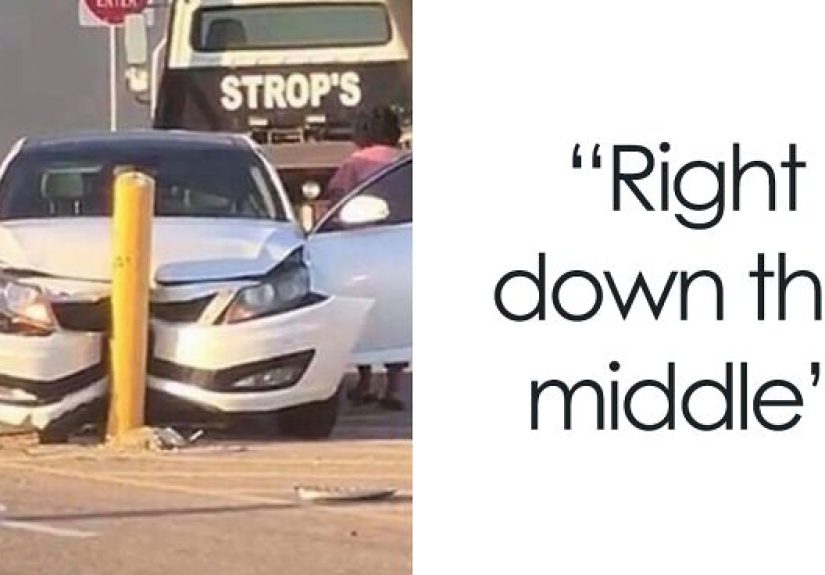
The photos that circulated online are a mix of painful and hilarious. One shows a car practically wrapped around the post like it was trying to hug it. Another shows a truck perched in a way that makes you wonder whether physics briefly left the parking lot in protest. A few look like textbook examples of a driver cutting a turn too tightly, misjudging space, or trying to glide through a lane with all the finesse of a shopping cart with one bad wheel.
And that is what makes the story stick. It is oddly relatable. Almost everyone who has driven through a crowded retail lot has had at least one tiny moment of panic: the too-fast turn, the hidden curb, the surprise pedestrian, the cart that appears as if summoned by dark magic. Most people recover. Some become a photo on a Facebook page.
Why The Story Went Viral
The internet loves three things: local weirdness, visual proof, and a joke that writes itself. This story had all three.
First, there is the object itself. A pole is not supposed to be interesting. It is literally the background of modern life. Yet this particular pole became funny because of repetition. Once a fixed object keeps appearing in crash photos, it stops being ordinary and starts feeling mythic. Suddenly it is not just a pole. It is the pole.
Second, the images do the heavy lifting. A photo of a car awkwardly pinned against a bright yellow bollard needs almost no explanation. It is visual comedy with a side of secondhand embarrassment. Even people who know nothing about Osceola, Arkansas, can understand the gag in two seconds flat.
Third, the Facebook page gave the whole thing a voice. Instead of just sharing accident photos, the page turned the pole into a character. That kind of community-driven storytelling is internet gold. It transforms a local running joke into shareable folklore. It also helps that the tone is playful rather than cruel. The humor is aimed less at disaster and more at the absurdity of losing a battle against an object that has not moved since installation.
In other words, the viral appeal comes from contrast. The setting is mundane. The object is boring. The result is ridiculous. The internet, naturally, said, “Perfect. Post all of it.”
What Those 14 Photos Really Show
At first glance, the famous images look like random bad luck. Look closer, and they start to tell a more consistent story. Most appear to involve low-speed mistakes rather than dramatic high-speed wrecks. That matters because parking lot crashes are rarely cinematic in the Hollywood sense. They are usually clumsy, rushed, and weirdly preventable.
The photos suggest several common scenarios. One is the overconfident corner-cutter: a driver trying to turn just a little tighter than the vehicle geometry would prefer. Another is the distracted driver, whose eyes or brain are somewhere other than the lane in front of the bumper. Another is the “I swear I had more room than that” miscalculation, which is basically the unofficial slogan of parking lot mishaps everywhere.
These are not glamorous accidents. They are the kind that leave people standing beside their cars in broad daylight, silently staring at a stationary object as though betrayal has occurred. And that is exactly why the story resonates. It captures the uniquely humbling nature of parking lot mistakes. No one feels cool after losing a duel with painted steel.
Why Parking Lot Accidents Happen More Than People Think
Here is where the joke bumps into reality. Parking lots feel slow and familiar, which tricks drivers into relaxing at the exact moment they should be paying attention. They are full of unpredictable movement: cars backing out, pedestrians cutting across lanes, children darting beside carts, delivery vehicles stopping in odd places, and drivers hunting for open spaces like bargain-seeking hawks.
The False Sense Of Safety Problem
Many drivers mentally downgrade a parking lot from “real driving” to “basically done driving.” That is the mistake. A parking lot is not a break from traffic. It is traffic with tighter spaces, more visual clutter, more blind spots, and worse behavior packed into a smaller area.
You are not cruising in open road conditions. You are navigating a maze designed around parked cars, pedestrian flow, curbs, painted lanes, islands, signs, carts, and protective posts. That is a lot of information for a brain that is already thinking about shopping lists, kids in the back seat, phone notifications, or whether the rotisserie chicken will still be warm.
Distraction Does Not Magically Shrink At Low Speeds
A huge reason these crashes keep happening is distraction. People assume low speed means low risk, so they let their attention wander. They glance at a phone. They adjust navigation. They think about where to park. They wave at somebody. They fiddle with the radio. Then boom: the pole wins again.
That is not just common sense; it lines up with broader safety guidance. Parking lots are full of behaviors people would recognize as risky on regular roads but somehow excuse in retail settings. The irony is almost painful. Drivers know better, but familiarity makes them casual.
Why Bright Yellow Bollards Still Get Hit
Let’s address the obvious question: how do people miss a bright yellow pole?
Because visibility is not the same thing as attention. A bollard can be physically obvious and still go mentally unseen if a driver is focused on the wrong thing. The human eye may pass over it. The human brain may fail to rank it as urgent. Add a sharp turn, a large vehicle, glare, shadows, nearby traffic, and a split-second bad judgment call, and suddenly a very visible object becomes a very expensive surprise.
Also, many drivers cut corners in parking lots. Literally. The shortest path feels efficient until your front fender introduces itself to reinforced steel.
The Pole Is Actually Doing Its Job
This is the part the memes don’t always mention: that pole is not there for decoration. It is a protective barrier. In plain English, it is supposed to stop vehicles from entering places they should not enter. It helps shield lanes, storefront-adjacent areas, pedestrian zones, or nearby traffic paths from exactly the kind of mistakes shown in those photos.
So while the internet treats the Walmart parking lot pole like an undefeated champion, its real role is far less theatrical and much more practical. It absorbs bad decisions. It redirects force. It takes the hit so something else does not.
That makes the whole saga a strange compliment to the pole’s design. Yes, it keeps getting nailed. But the repeated impacts also suggest it is positioned where driver error actually happens. In that sense, the pole is less a villain than a blunt reminder that parking lots need protection because drivers are, on occasion, wildly optimistic about their turning radius.
What Drivers Can Learn From The Walmart Pole
If a single yellow post can become a local legend, it can also become a decent driving instructor. Not a friendly instructor, maybe, but an effective one.
Slow Down More Than Feels Necessary
Parking lots reward patience. If you feel silly driving that slowly, good. That probably means you are finally going an appropriate speed. Low speed gives you more time to see pedestrians, read lane markings, and correct sloppy turns before your bumper starts making poor life choices.
Look Where The Car Is Actually Going
Drivers often steer toward the spot they want rather than tracking the path their vehicle body is taking. That is how you clip posts, curbs, carts, and neighboring cars. Watch your front corners. Watch your rear swing. Watch the lane, not just the destination.
Do Not Trust Technology Like It Is A Babysitter
Backup cameras, parking sensors, and automatic braking features can help, but they are assistants, not miracle workers. They improve awareness; they do not replace it. If lighting is bad, angles are awkward, or your view is partially blocked, technology has limits. A camera is useful. Your eyeballs are still invited to the meeting.
Expect Pedestrians To Appear Out Of Nowhere
Because they often do. Parking lots are shared spaces, not driver kingdoms. People push carts, unload kids, change direction suddenly, and cross where it is convenient rather than where it is beautifully marked by paint. The safest assumption is that someone may step into your path when you least expect it.
After A Minor Parking Lot Crash, Act Like An Adult
If you do hit something or someone hits you, the basics matter: stay calm, document the scene, take photos, exchange information, and report it properly. A low-speed accident may look minor, but handling it responsibly saves major headaches later.
The Internet’s Favorite Punchline Has A Serious Point
The reason this story has lasted is not just because people enjoy laughing at bizarre crash photos. It is because the joke hides a recognizable truth. Most parking lot accidents do not come from dramatic recklessness. They come from everyday sloppiness: a quick glance away, a turn taken too sharply, a belief that “it’s only a parking lot.”
That is what makes the Osceola Walmart pole such a strangely effective symbol. It is funny, yes, but it also exposes how easily routine driving becomes careless driving. Nobody leaves home thinking, “Today I will become content.” Yet that is exactly what happens when attention slips in a place that feels harmless.
And maybe that is why the pole has become more than a meme. It is a yellow-painted monument to the small mistakes people make when they stop respecting simple spaces. Not a haunted object. Not a cursed landmark. Just a steel post standing there like a disappointed hall monitor while another bumper approaches with misplaced confidence.
Real-World Experiences That Make This Story Feel So Familiar
What makes the Walmart pole story hit home is that it does not feel like some impossible, once-in-a-lifetime event. It feels like the exaggerated version of a moment almost every driver has had. Maybe not the full “car wrapped around a bollard and immortalized on Facebook” experience, but definitely the stomach-drop second where you realize you turned too early, backed up too fast, or drifted a little too close to something solid and embarrassingly well-painted.
Anyone who has driven in a busy retail parking lot knows the atmosphere. You are not on a highway, but you are not relaxed either. You are scanning for an open space, dodging carts, watching for people crossing between SUVs, and trying not to get boxed in by someone who has apparently decided to stop in the middle of the lane to answer a text or contemplate the mysteries of existence. It is organized chaos, minus the organized part.
Then there is the visual clutter. Big trucks block sightlines. Cart corrals appear right where you wanted to swing wide. Sun glare bounces off windshields. A child pops out from behind a minivan. Somebody reverses without warning. Another driver cuts across the row because patience has left the chat. In that kind of environment, even a careful driver can feel overloaded. A careless one, unfortunately, becomes an origin story.
There is also a very human tendency to rush in places that seem low-stakes. People crawl through storms with white knuckles but somehow breeze through parking lots like the laws of motion have been temporarily suspended for errands. That is why the Osceola pole feels less like an isolated oddity and more like a public service announcement wearing a clown nose.
Many drivers have their own private version of this story. Maybe it was the curb you swore was lower. Maybe it was the concrete base you never saw. Maybe it was the shopping cart that rolled in from stage left like it had a union contract and perfect comedic timing. Maybe it was the awful scrape against a post that sounded much too expensive for a trip that was only supposed to involve paper towels and cereal.
And of course, after the fact comes the ritual. You get out. You stare. You look at the object as if it betrayed you by remaining in the exact place where it was installed. You check the damage. You hope no one saw. Then you notice three people definitely saw, one person is pretending not to look, and somewhere in the distance a phone is absolutely being raised.
That shared experience is why this story keeps getting traction. The Walmart parking lot pole is funny because it turns a common driving failure into a recurring character. It gives form to the little mistakes people make when they are tired, distracted, impatient, or just too confident for a cramped lot full of hazards. It is a joke, but it is also a mirror. And honestly, that is the funniest part of all.
Conclusion
The famous Walmart parking lot pole in Osceola is internet comedy at its finest: weirdly specific, visually absurd, and built on the kind of local humor that spreads because it feels instantly understandable. But beyond the laughs, it also offers a useful reminder. Parking lots are not harmless little zones between “real” drives. They are active, unpredictable spaces where distraction, poor visibility, rushed turns, and overconfidence can create expensive results in a heartbeat.
So the next time you roll through a crowded lot feeling like a parking genius, maybe think of the pole. The undefeated yellow guardian. The Facebook celebrity. The steel therapist for reckless turning habits. It has already taught the internet one lesson: when a fixed object keeps winning, it might be time for drivers to change strategy.