Table of Contents >> Show >> Hide
- A quick refresher: two materials, two approaches, one brutal deadline
- Meet Thin Man: the plutonium gun-type bomb that looked good on paper
- The plot twist: plutonium-240 and the problem of “starting too soon”
- How Thin Man’s failure created the bomb you have heard of
- The secret supporting character: Jumbo, the “just in case this goes terribly” container
- The “practice nukes” that were very real: Pumpkin bombs
- So why haven’t you heard of Thin Man?
- What Thin Man teaches us about innovation (and human limits)
- Experiences: at the Edges of the Story
- Conclusion
Ask most people about the Manhattan Project and you’ll hear the same greatest hits: Little Boy and Fat Man. Two bombs, two cities, one history lesson that ends with everyone quietly staring at their shoes.
But the Manhattan Project didn’t go from “science fair” to “nuclear age” in a straight line. It zigzagged. It improvised. It occasionally yelled, “Wait, the material does what now?” And along the way it built (and then abandoned) a weapon design that rarely makes it into the pop-history retellingsdespite the fact that it helped force the project’s biggest pivot.
Meet the bomb you probably haven’t heard of: Thin Manthe long, awkward, plutonium-based design that seemed sensible at first, until physics walked into the room and flipped the table.
A quick refresher: two materials, two approaches, one brutal deadline
The Manhattan Project was racing to build a workable atomic weapon before World War II endedwithout knowing which technical path would pay off first. Two fissile materials were in play:
- Uranium-235, which could work in a relatively straightforward “gun-type” assembly approach.
- Plutonium (primarily plutonium-239), which looked promisingbut turned out to be… moody.
In broad terms, the “gun-type” idea is conceptually simple: bring two subcritical pieces together fast enough to become supercritical. That approach ultimately powered the uranium bomb. But plutonium complicated the story, and the Manhattan Project ended up developing an entirely different methodimplosionto make plutonium usable in a weapon.
That fork in the road is where Thin Man enters the chat.
Meet Thin Man: the plutonium gun-type bomb that looked good on paper
Why the gun-type approach was tempting
If you’re managing a secret wartime megaproject (as one does), “simple” has a certain glow to it. A gun-type weapon doesn’t require exquisitely synchronized compression of a core. It doesn’t demand a perfectly shaped inward shockwave. It’s more like: “What if we used extremely precise violence to solve a very precise physics problem?”
Early on, planners assumed plutonium could be used the same way uranium couldassembled rapidly into a supercritical mass. That assumption spawned the Thin Man concept: a plutonium-fueled gun-type bomb intended to fire a subcritical “projectile” into a target assembly.
Why it was… called Thin Man (and why it mattered)
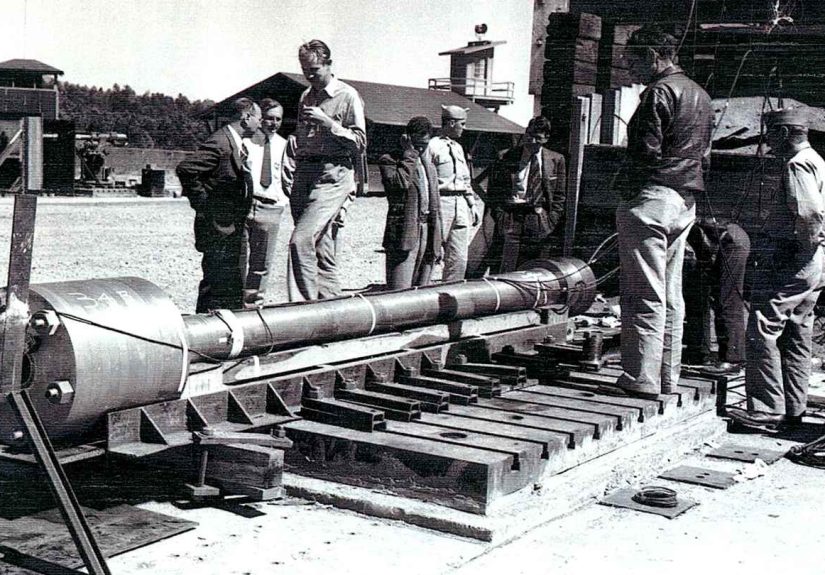
The name wasn’t just a vibe. “Thin Man” described the design’s defining feature: it was long. The length wasn’t for style points; it was driven by timing and speed. To reduce the risk of a premature chain reaction, the assembly had to happen extremely fastfast enough that the weapon’s internal “gun” concept pushed the design toward a stretched-out shape.
Even the naming culture reflected how secrecy and misdirection were baked into the program. Declassified Manhattan Project histories note that “Thin Man” and “Fat Man” also worked as plausible decoys in conversationnames that could be shrugged off as nicknames rather than weapons. In other words, it wasn’t just a codename; it was a social engineering tool.
The uncomfortable reality: Thin Man was an engineering headache
A long bomb is not automatically a deliverable bomb. The more Thin Man’s requirements stretched, the more the real world pushed back: aircraft constraints, handling constraints, and the basic wartime reality that you can’t simply request a larger bomb bay from the universe.
Still, the project pressed forwarduntil plutonium itself delivered the bad news.
The plot twist: plutonium-240 and the problem of “starting too soon”
Plutonium produced in reactors isn’t “pure” plutonium-239. It includes other isotopes, and one of them is the troublemaker that changed everything: plutonium-240.
Here’s the key issue, explained without turning this article into a graduate exam: plutonium-240 has a much higher rate of spontaneous fission than plutonium-239. That means it can spit out neutrons unpredictablyneutrons that can kick off the chain reaction before a gun-type assembly finishes bringing the mass together.
In a weapon context, that’s catastrophic. Instead of a full-yield detonation, you risk a premature initiationa “fizzle” event where the device begins reacting at the wrong moment and blows itself apart before reaching optimal conditions. The Manhattan Project’s own historical accounts describe this as the moment the plutonium gun concept became unworkable in practice.
The discovery that reactor-produced plutonium contained enough plutonium-240 to cause serious pre-initiation risk forced a major reorientation at Los Alamos. Suddenly, the “simpler” plan wasn’t a plan at all. Thin Man didn’t just have a bug; it had a built-in self-sabotage feature.
How Thin Man’s failure created the bomb you have heard of
Implosion becomes a necessity, not a science experiment
Once Thin Man was effectively off the table, the project had to make plutonium work another way. The answer was implosion: compress the plutonium core rapidly and symmetrically so it becomes supercritical through density increase rather than gun-style assembly.
This was not the “easy mode” option. Implosion demanded extremely precise timing and geometry. The National Park Service description of the Trinity device (nicknamed “the Gadget”) emphasizes that it relied on explosive “lenses” and specialized detonators to produce the uniform inward squeeze needed to start a nuclear explosion.
Translation: the project swapped “build a very intense cannon inside a bomb” for “invent a brand-new way to choreograph a perfectly timed, perfectly shaped inward collapse.” Totally normal pivot. Happens all the time. (Ask any startup.)
Why Trinity had to happen
Because implosion was so complex, leaders didn’t want to bet everything on an untested design. That’s why the Manhattan Project conducted the Trinity Test in July 1945detonating the world’s first nuclear device and validating the implosion approach that would later be used in the bomb dropped on Nagasaki.
Trinity wasn’t just a test of “does it go boom.” It was a test of whether the implosion conceptborn from Thin Man’s collapsecould be made reliable enough to stake history on.
The secret supporting character: Jumbo, the “just in case this goes terribly” container
Here’s another Manhattan Project object that feels like it belongs in a dark comedy: Jumbo.
When Trinity was being planned, there was real fear that the implosion device might fail in a way that scattered valuable plutonium across the desert. So the project ordered a massive steel containment vesselJumbointended to help recover plutonium if the test produced a low-yield detonation or otherwise didn’t perform as expected.
According to Manhattan Project historical materials, Jumbo was transported to the Trinity site but ultimately wasn’t used in the test because it would interfere with data collection and posed practical risks of its own. In the end, the test went forward without it. Jumbo survived the blast at a distance, becoming a physical reminder of just how uncertain the project leaders felt in the weeks before the nuclear era began.
If Thin Man is the “bomb you haven’t heard of,” Jumbo is the “insurance policy you definitely haven’t heard of”a giant metal admission that even the world’s smartest people sometimes say, “Let’s bring a backup plan the size of a small building.”
The “practice nukes” that were very real: Pumpkin bombs
One more almost-forgotten chapter: pumpkin bombs.
The 509th Composite Groupthe unit tasked with delivering the atomic bombscouldn’t exactly rehearse with real nuclear weapons. So they practiced with special high-explosive bombs shaped to mimic the unique size, weight, and drop characteristics of the implosion weapon.
These weren’t just training props. Historical accounts note that pumpkin bombs were used in combat missions as well, dropped on targets in Japan in the weeks surrounding the atomic attacks. Same aircraft. Similar mission profiles. Same tensionminus the nuclear yield.
Pumpkin bombs are a reminder that the Manhattan Project wasn’t only a laboratory story. It was logistics, air crews, rehearsals, modifications, and repeated practice under intense secrecy. The iconic “two bombs” narrative hides the reality that an entire shadow campaign of preparation happened right beside it.
So why haven’t you heard of Thin Man?
Thin Man has a branding problem: it’s the bomb that never got its dramatic finale. It wasn’t used in combat. It didn’t get a headline moment. It didn’t even get a clean endingjust a quiet cancellation and a massive pivot that made other devices famous.
History also tends to compress complicated development timelines into a simpler story arc: uranium bomb, plutonium bomb, end of war. Thin Man is a detour, and detours get edited out of the movie version.
But if you care about how big science actually workshow projects adapt when reality refuses to cooperateThin Man is one of the most revealing artifacts of the entire Manhattan Project. It represents a moment when material science and nuclear physics overruled planning assumptions and forced an urgent reinvention.
What Thin Man teaches us about innovation (and human limits)
1) Nature always gets a vote
Thin Man failed because the plutonium available at scale behaved differently than the idealized plutonium people had first modeled. That gap between theory and production realityis where many ambitious projects stumble.
2) “Harder” can become “necessary” overnight
Implosion wasn’t chosen because it was fun. It was chosen because the alternative stopped being viable. The Manhattan Project’s pivot shows how rapidly “nice-to-have” research becomes “we must solve this immediately” when constraints change.
3) The unglamorous work is often the most consequential
Thin Man doesn’t have a mushroom cloud attached to its name. But it helped shape the engineering path that led to Trinity and to the implosion weapon used in war. Sometimes the biggest impact comes from what didn’t happen.
Experiences: at the Edges of the Story
You don’t need a time machine to feel the weight of Thin Man’s “almost-history.” You just need to stand in the right places and let the gaps in the narrative do their work.
Start with the Manhattan Project National Historical Park, which is split across three communities that still carry the project’s DNA: Los Alamos, Oak Ridge, and Hanford. There’s something quietly unsettling about that setuphow a story this enormous is scattered across everyday American landscapes. You’re not entering a single grand monument; you’re tracing a trail of decisions made behind fences, in offices, in converted classrooms, and in hastily built industrial cities.
In Los Alamos, a visit to the Bradbury Science Museum (free, public-facing, and surprisingly approachable) can make the Manhattan Project feel less like a myth and more like a workplace that ran out of whiteboard markers. You’ll see how the story is told through models, diagrams, and the careful language of interpretationhow institutions explain world-changing technology without turning it into a do-it-yourself guide. That framing is part of the experience: you can sense the tension between transparency and restraint, between education and responsibility.
The most visceral experience, though, is the Trinity sitebecause it’s not always accessible. Public open houses have historically been limited, which gives the place an eerie “briefly borrowed from the present” feeling. If you ever go, you’re driving into a landscape that looks too wide and too quiet for what happened there. People talk less. You notice the sky more. You catch yourself doing the math on distance: how far you are from the center, how far the blast was visible, how far a decision can travel.
And then there’s Jumbo. Seeing (or even reading about) a gigantic containment vessel built for a test that might fail can change the emotional temperature of the Trinity story. It’s the physical manifestation of doubtproof that confidence came later, after the data. Jumbo turns the narrative from “inevitable breakthrough” into “we hoped this wouldn’t turn into a disaster.”
Finally, Thin Man itself can feel like an experience you have with your own brain: you notice what’s missing. You realize how stories get simplified. You start spotting the places where history is shaved down to fit a familiar shape. Thin Man is the rough draft that never became a final paragraph, but once you know it existed, the whole Manhattan Project reads differentlyless like a straight march toward destiny, and more like a frantic, brilliant scramble to solve problems no one had ever solved before.
Conclusion
Thin Man is the Manhattan Project bomb you haven’t heard of because it never became a weapon the world could point to. But it mattered anyway. Its failurerooted in the messy reality of reactor-produced plutoniumforced Los Alamos to embrace implosion, validate it at Trinity, and ultimately build the plutonium device that entered history.
If you want the Manhattan Project to feel less like a legend and more like a human endeavorfull of wrong turns, rethinks, and last-minute geniusThin Man is the chapter you’ve been missing.