Table of Contents >> Show >> Hide
- Quick Eclipse Safety Cheat Sheet (Print This in Your Brain)
- Why Eclipses Are Sneaky: Your Eye Can’t “Feel” the Damage
- What Counts as Real Eye Protection?
- How to Avoid Fake or Counterfeit Eclipse Glasses
- How to Watch the Eclipse Safely: Phase by Phase
- Safe Ways to Watch Without Looking at the Sun
- Binoculars, Telescopes, Cameras, and Phones: The “Oops” Zone
- Special Tips for Kids, Families, and Groups
- After the Eclipse: Signs You Should Call an Eye Doctor
- FAQ: The Questions Everyone Asks Five Minutes Before the Eclipse
- Extra: 500+ Words of Real-World Eclipse Experience (So You Don’t Learn the Hard Way)
- Conclusion: Enjoy the Eclipse, Keep Your Vision
The April 8, 2024 total solar eclipse was the kind of sky event that makes grown adults
suddenly remember they own a lawn chair. But the Sunbeautiful, dramatic, and absolutely not your friend
if you stare at itdoesn’t hand out souvenirs. It hands out eye damage.
This guide walks you through exactly how to watch a solar eclipse safely, how to avoid sketchy “eclipse glasses”
(yes, counterfeits are a thing), and what to do if you didn’t plan ahead. We’ll keep it practical, science-based,
and only mildly dramaticbecause your retinas already have enough drama.
Quick Eclipse Safety Cheat Sheet (Print This in Your Brain)
- During partial phases: Always use certified eclipse glasses or a handheld solar viewer.
-
During totality (only if you’re in the path of totality): You may remove eclipse glasses
only when the Sun is completely covered. - As soon as any bright Sun returns: Glasses back on. No negotiation.
-
Never look at the Sun through a camera, binoculars, or telescope without a proper solar filter
attached to the front of the device. - If you don’t have eclipse glasses, use indirect viewing (like a pinhole projector).
Why Eclipses Are Sneaky: Your Eye Can’t “Feel” the Damage
The biggest eclipse myth is: “If it hurts, I’ll look away.” Unfortunately, the part of your eye that gets damaged
mostthe retinadoesn’t have pain receptors. So you can injure it without any immediate “Ow!”
warning. The result can be solar retinopathy, sometimes called “eclipse blindness,” which may cause
blurred vision, distorted vision, or blind spots that can be temporary or permanent.
During an eclipse, the sky gets darker and the Sun looks less intense, which tricks your brain into thinking it’s safer.
But even a thin crescent of Sun is still powerful enough to harm your eyes. Translation: a solar eclipse is not a
“free sunglasses upgrade.” It’s the same Sun with better stage lighting.
What Counts as Real Eye Protection?
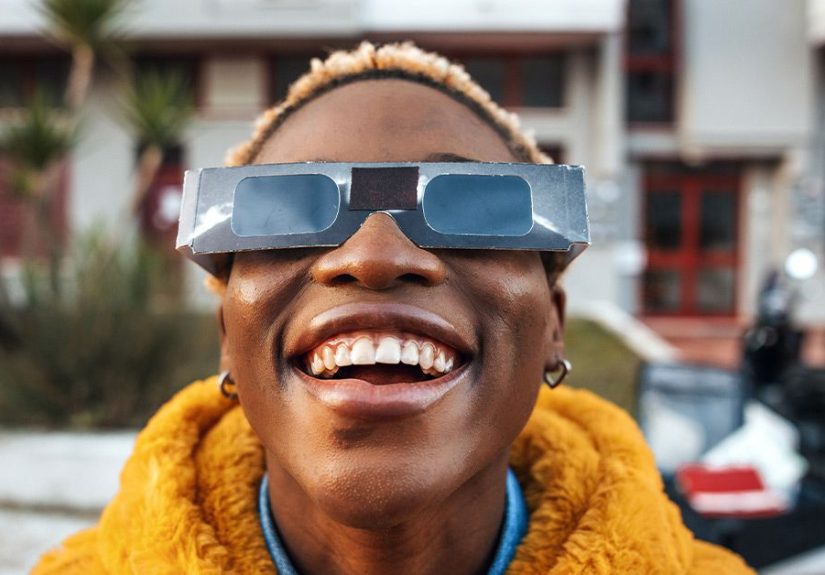
For direct viewing, you need solar viewerscommonly called eclipse glassesthat meet the
ISO 12312-2 international safety standard for solar viewing. These are not regular sunglasses.
Not even “super dark” sunglasses. Not even “I paid a lot for these” sunglasses.
Eclipse Glasses vs. Sunglasses (A Short, Sad Story)
Sunglasses reduce brightness. Eclipse glasses use special solar filters designed to block the Sun’s intense visible light
and harmful radiation to safe levels. Sunglasses, no matter how dark, let through far too much light for solar viewing.
If sunglasses were enough, eclipse warnings wouldn’t existand eye doctors would be a lot less busy after major eclipses.
Other Safe Options (When Used Correctly)
- Handheld solar viewers made for eclipse viewing (also should meet ISO 12312-2).
- Welder’s filter shade 14 (or darker). Anything below that is not safe for viewing the Sun.
- Solar filters for telescopes/binoculars/cameras that mount to the front of the device.
How to Avoid Fake or Counterfeit Eclipse Glasses
Here’s the frustrating part: some unsafe glasses are labeled as ISO-compliant even when they aren’t properly tested.
So instead of playing “ISO detective,” the safer move is to buy from reputable sellerslike science museums,
planetariums, well-known manufacturers, or vendors listed by credible astronomy organizations.
Red Flags That Scream “Nope”
- They’re sold by a random third-party seller with a keyboard-smash store name.
- No manufacturer info (or it’s vague, misspelled, or suspiciously incomplete).
- The glasses arrive scratched, creased, wrinkled, or damaged.
- They came bundled with something unrelated (because nothing says “eye safety” like a free phone ring stand).
- You can see bright household lights clearly through them (more on the quick test below).
A Simple “Sanity Check” (Not a Certification Test)
Put on eclipse glasses indoors. You should see almost nothing. Bright lamps may appear dimly, and that’s it.
If you can casually read a text message, admire your kitchen backsplash, and judge your roommate’s life choices through the lenses,
those are not safe eclipse glasses.
Important: this is only a common-sense check. It does not replace buying from reputable sources.
How to Watch the Eclipse Safely: Phase by Phase
1) Partial Phases (Before and After Totality)
During the partial eclipse, the Moon covers only part of the Sun. This is when most eye injuries happenbecause people
look “just for a second,” then the second becomes a bunch of seconds, and the retina quietly files a complaint.
- Use eclipse glasses or a handheld solar viewer every time you look at the Sun.
- If you want to look away, look away. Then look back only after glasses are properly on again.
- Supervise kids closely. Kids are brave and curious and also not known for following “boring safety rules.”
2) Totality (Only If You’re in the Path of Totality)
During a total solar eclipse, people in the path of totality experience the brief period when the Moon
completely covers the Sun’s bright face. Only then is it safe to view the eclipse directly without eye protection.
How to do it safely:
- Keep eclipse glasses on while the Sun is still even slightly visible.
-
When totality begins, look through your eclipse glasses first. If you can’t see the Sun at all, it’s a sign totality has started.
(You’ll also notice the world looks like twilight and the crowd suddenly becomes emotional.) - You may remove eclipse glasses during totality to see the solar corona.
- The instant totality ends and bright sunlight returns, put the glasses back on immediately.
If you’re not in the path of totality, you won’t experience true totality. That means:
you should not remove eye protection at any point.
3) Annular or Partial-Only Viewing
In an annular eclipse, a “ring of fire” remains visible. That ring is still the Sun. It is never safe to view an annular eclipse
without proper eye protection. In a partial-only location (most of the country during some eclipses), the same rule applies:
glasses stay on for every direct glance.
Safe Ways to Watch Without Looking at the Sun
If you don’t have eclipse glasses, don’t panicjust don’t improvise with random materials.
Use indirect viewing instead.
Pinhole Projector (Cheap, Fun, Surprisingly Effective)
- Take a piece of cardstock or an index card and poke a small, clean hole in it.
- Stand with your back to the Sun.
- Hold the card so sunlight passes through the hole onto a flat surface (like another card or the ground).
- Watch the projected image of the Sun change shape as the eclipse progresses.
Key rule: Do not look through the pinhole at the Sun. The pinhole is for projection, not peeking.
Nature’s Pinhole: Crescent Shadows Under Trees
During a partial eclipse, sunlight filtering through small gaps in leaves can create multiple crescent-shaped images on the ground.
It’s one of the coolest “free” eclipse effectsno gear required.
Binoculars, Telescopes, Cameras, and Phones: The “Oops” Zone
Anything that magnifies the Sun also magnifies the danger. Binoculars and telescopes concentrate sunlight into a much smaller, hotter beam,
which can damage eyes quickly and can even damage equipment.
Use This Rule
If it magnifies, it needs a solar filter on the front.
Eclipse glasses alone are not enough if you’re also looking through binoculars or a telescope.
What About Taking Photos?
- During partial phases, use a proper solar filter on your camera lens if you’re photographing the Sun.
-
During totality (in the path of totality), it’s possible to photograph the eclipsed Sun briefly without a solar filter,
but timing matters. If you’re not experienced, it’s easy to miss the moment and accidentally point unfiltered gear at the returning Sun. -
If your goal is to remember the eclipse, consider photographing the people and the changing light instead.
Your future self will appreciate the vibe shots.
Special Tips for Kids, Families, and Groups
- Practice first: Show kids how to put on glasses before the eclipse starts.
- Use a “look, then rest” rhythm: Short viewing moments with breaks reduce the temptation to stare.
- Bring backups: Glasses get dropped, smudged, and mysteriously vanish like socks in a dryer.
- Choose a clear viewing plan: Who holds the pinhole projector? Who calls out timing? Who’s responsible for snacks? (This is crucial.)
After the Eclipse: Signs You Should Call an Eye Doctor
Eye damage from solar viewing doesn’t always show up immediately. If you looked at the Sun without proper protection,
watch for symptoms that can appear hours to days later, including:
- Blurred vision or trouble focusing
- A dark or gray spot in the center of your vision
- Distorted lines (straight lines look wavy)
- Increased light sensitivity
- Colors looking “off”
If you notice any of these symptomsor if you’re worried about exposurecontact an eye care professional promptly.
Don’t try to “walk it off.” This is your vision we’re talking about.
FAQ: The Questions Everyone Asks Five Minutes Before the Eclipse
Are eclipse glasses safe over prescription glasses?
Yes. In fact, that’s often the easiest way. Just make sure the eclipse glasses fit securely and fully cover your eyes.
Can I use eclipse glasses from a previous eclipse?
Possiblyif they’re from a reputable source and they’re not scratched, torn, punctured, creased, or otherwise damaged.
If they look questionable, treat them like expired milk: do not “taste test.”
What if I’m only seeing a partial eclipse where I live?
Then you never get a “glasses-off” moment. You must use certified eclipse glasses or indirect viewing any time you look at the Sun.
What about homemade filters, smoked glass, or “life hacks”?
No. Homemade filters and random materials are not reliable for solar viewing. Stick with certified solar viewers or indirect viewing methods.
Extra: 500+ Words of Real-World Eclipse Experience (So You Don’t Learn the Hard Way)
If you’ve never watched a major eclipse before, here’s what the “day-of” experience is usually likeplus the tiny mistakes
people make when excitement takes over and common sense temporarily leaves the group chat.
First, the vibe sneaks up on you. During the early partial phase, someone always says, “Wait… is anything happening?”
Yes. The Sun is slowly turning into a cosmic cookie with a bite taken out of it. But because the change is gradual,
people get impatient and start doing the dangerous thing: lifting the glasses “just to check.” Don’t do that.
Instead, do quick, intentional viewing momentslook through the glasses for a few seconds, then look away and enjoy
how the light changes around you.
About 20–30 minutes before totality (if you’re in the path), you’ll notice the world looks… weird. Shadows sharpen.
Colors feel slightly muted. It’s like nature turned down the brightness slider. This is when a pinhole projector becomes
the star of the show for families and classrooms: kids can see the crescent shape without anyone staring at the Sun.
Bonus: it keeps hands busy, which reduces the urge to peek.
Then comes the emotional parttotality. People who don’t care about astronomy suddenly care a lot.
The temperature can drop. Birds may act confused. Someone in the crowd will whisper “Whoa” like they just discovered gravity.
When totality hits, it’s breathtaking: the corona, the 360-degree sunset glow near the horizon, the sudden twilight feeling.
This is the moment that makes eclipse chasers plan road trips years in advance.
But totality is also where timing matters. The biggest real-world mistake is forgetting that totality ends fast.
People get so locked into the view that they don’t put the glasses back on in time. A smart trick is to assign one person
as the “glasses-on coach.” Their job is to watch for the first bright bead of sunlight returning and call out, “GLASSES ON!”
like it’s a fire drill. Nobody thinks they need this role… until they do.
Another experience-based tip: don’t try to do everything. If you spend totality fiddling with camera settings, you’ll miss
the actual eclipse. Many seasoned viewers take a few quick photos, then put the phone down and just watch.
Your memory of that eerie, beautiful sky will last longer than a slightly overexposed photo anyway.
Finally, if you’re traveling for an eclipse (like many people did in 2024, from Texas up through the Northeast),
your best safety plan is boring but effective: buy certified eclipse glasses early, bring a backup pair,
and pack a pinhole projector kit. Because nothing ruins a once-in-a-generation sky moment faster than realizing your eye protection
came from a suspicious online listing titled “SUPER SUN GLASSES 4 ECLIPSE!!!”
Conclusion: Enjoy the Eclipse, Keep Your Vision
A solar eclipse is an unforgettable eventprovided you can still see afterward. The good news is that eclipse eye safety
is simple: use certified solar viewers during partial phases, remove protection only during true totality (if you’re in it),
and use indirect viewing when you don’t have proper gear. Do that, and you’ll walk away with the best kind of souvenir:
a memory, not a medical bill.