Table of Contents >> Show >> Hide
- What experts actually recommend (the “it depends” answermade useful)
- Why this decision matters more than people think
- When painting both doors the same color looks amazing
- When matching is a mistake (and why it looks “off”)
- The designer-approved alternatives to “perfect matching”
- A simple 5-step method to decide (without spiraling at the paint store)
- Specific color strategies that work (with real-life examples)
- Practical paint advice (so it looks good longer than one season)
- FAQ: Quick answers homeowners actually need
- So… should you paint your front door and garage door the same color?
- Real-World Experiences: What happens after the paint dries (the stuff people don’t tell you at checkout)
- 1) “We matched them… and the garage suddenly looked enormous.”
- 2) “We didn’t test the undertone… and now it looks weirdly purple at sunset.”
- 3) “Our bright white garage door looked amazing for… two weeks.”
- 4) “We went super dark and loved it… but the south-facing door faded sooner than we expected.”
- 5) “The color was finethe hardware made it look expensive.”
- 6) “We stopped trying to match perfectlyand it finally looked right.”
Your front door is your home’s handshake. Your garage door is… your home’s giant forehead. So when people ask,
“Should I paint them the same color?” what they’re really asking is: Do I want a coordinated first impressionor do I want my garage to become the main character?
Designers, real estate pros, and paint experts tend to agree on one thing: there’s no single rule that works for every house.
The best choice depends on your home’s style, the visual weight of the garage door, your exterior palette, and how bold you want your entry to feel.
Let’s break it down in a way that won’t make your eyes glaze over like a badly rolled coat of semi-gloss.
What experts actually recommend (the “it depends” answermade useful)
- Matching can look sharp when your home is modern, symmetrical, or has a simple exterior palette.
- Contrasting often works better when the garage door is large and front-facing (aka most suburban reality).
- The safest pro move: let the garage door blend with the house color or trim, and let the front door carry the personality.
- If you do match: choose a color that’s meant to be repeated (usually a neutral) rather than forcing a loud “statement color” onto a massive garage door.
Why this decision matters more than people think
On a typical home, the garage door can be one of the largest visual elements on the entire facade. That means color decisions
here don’t whisperthey project. A coordinated scheme can make a house look polished, intentional, and updated. A mismatched scheme
can make the front feel busy or awkward, like your house got dressed in the dark.
Curb appeal and resale aren’t just buzzwords
Real estate research and staging pros consistently point to curb appeal as a meaningful factor in buyer interest. And color choicesespecially at the entrycan influence perception.
There’s even data suggesting certain front door colors (hello, black) can be associated with higher offers in some markets.
Does that mean you should paint everything black? No. (Please don’t.) But it does mean these details can carry real weight.
Scale changes everything
If your garage door faces the street, it often takes up more “face time” than the front door. That’s why many designers advise
not giving it the same attention-grabbing color as your entry doorunless you want the garage to be the focal point.
If your garage is side-loaded, recessed, or detached, you have more freedom to match without overpowering the facade.
When painting both doors the same color looks amazing
Yes, matching can be gorgeous. It’s just not the default best option for every home. Here are the situations where experts often
like the “same color” approach.
1) Modern and contemporary homes with clean lines
Modern exteriors tend to look best with fewer competing colors. A unified door color can create a sleek, architectural vibeespecially
with simple trim and a restrained palette. Think: warm white stucco, black-framed windows, and a deep charcoal on both the front and garage doors.
2) Symmetrical facades that benefit from repetition
If your front door and garage door feel balanced on the elevation (or your garage isn’t visually dominant), repeating a color can reinforce symmetry.
This is especially true for some Colonial-inspired or updated traditional homes where consistency reads as “classic” rather than “cookie-cutter.”
3) You’re choosing a neutral meant for “supporting actor” duty
Matching works best when the shared color isn’t screaming for attention. Deep navy, charcoal, warm black, soft greige, and muted forest green
can look intentional on both doors without turning your driveway into a stage.
4) Your exterior is already busy (brick, stone, mixed materials)
Brick + stone + multiple rooflines + contrasting trim can become a lot. Matching your doors can simplify the visual story and keep your facade from looking
like it’s trying to do five trends at once.
When matching is a mistake (and why it looks “off”)
Matching can go sideways when it ignores proportion, climate realities, or the role each door plays.
1) The garage door dominates the front of the house
If the garage door is the biggest element facing the street, painting it the same bold color as your front door can make the whole front feel heavy.
That statement color you loved on a 3-foot-wide entry door can look like a billboard on a 16-foot-wide garage door.
2) Your front door is a “statement” color
Bright red, sunny yellow, vivid tealthese can be fantastic on a front door because it’s a small, welcoming focal point.
On a garage door, those same colors can feel jarring (and some pigments fade faster in intense sun).
If you love a bold entry, keep the garage door more subdued so the eye lands where you want it: the entrance.
3) You live somewhere brutally hot or intensely sunny
Very dark colors absorb heat. Depending on your door material and exposure, that can contribute to faster wear, warping risks (for certain materials),
and quicker fadingespecially on a large garage door that bakes in the afternoon sun.
This doesn’t mean “never go dark.” It means “choose dark thoughtfully, with the right paint and prep, and respect your climate.”
4) Your doors are different materialsand you expect them to look identical
A smooth steel garage door and a wood (or faux wood) front door will reflect light differently. Even the same paint color can look different across textures.
If you’re chasing an “exact match,” you may end up frustrated. If you’re aiming for “coordinated,” you’ll be happier.
The designer-approved alternatives to “perfect matching”
If you want a cohesive exterior without turning the garage into a focal point, these approaches are widely recommended by pros.
They create harmony while still giving the front door its moment.
Option A: Let the garage door blend in with the siding/body color
This is one of the most common expert recommendations. Painting the garage door to match the main house color minimizes its visual size.
Result: your home looks larger, calmer, and more intentional.
Option B: Match the garage door to the trim (or a trim-adjacent neutral)
If your trim is a soft white, warm cream, or greige, repeating that on the garage door can look crisp and classicespecially on traditional homes.
It’s a clean way to “connect” the garage to the overall palette without making it the star.
Option C: Use the same color family, different depth
Want coordination without copy-paste? Choose the same undertone (warm vs. cool) and go one or two shades lighter or darker for the garage door.
Example: a deep navy front door with a smoky blue-gray garage door. From the curb, it reads coordinated, not identical.
Option D: Repeat the front door color in small accents instead of the garage
This is a favorite trick: keep the garage door subtle, then echo the front door color in planters, house numbers, a porch ceiling,
a bench cushion, or even a wreath ribbon. You get a pulled-together look without a giant colored rectangle stealing attention.
A simple 5-step method to decide (without spiraling at the paint store)
Step 1: Identify what can’t change
Roof color, stone/brick, driveway tone, hardscapingthese fixed elements matter. Your door colors should harmonize with them,
not fight them like siblings on a road trip.
Step 2: Pick your exterior “role assignments”
- Body color: the main backdrop
- Trim color: the frame
- Accent color: the personality (often the front door)
- Garage door: blend in or stand out (choose one)
Step 3: Decide what you want to notice first
If you want people to naturally find the entrance, don’t make the garage door the boldest color on the front.
If you love a dramatic, modern look and your architecture supports it, matching can workbut do it intentionally.
Step 4: Test in real life, not under fluorescent lights
Exterior light changes everything. Tape up large swatches and look at them morning, midday, and dusk.
Stand across the street. If you can’t see a difference from the curb, it doesn’t matter how poetic the paint name is.
Step 5: Consider maintenance and wear
Garage doors collect dust, splash marks, and fingerprints. Very bright white shows grime fast.
Super-dark colors may show fading or heat stress faster in harsh sun.
Choose a finish and color depth that fits your tolerance for touch-ups.
Specific color strategies that work (with real-life examples)
Below are proven approaches designers use across a range of American home styles.
Use these as templates, then tailor them to your materials and neighborhood.
1) The “Front Door Pop, Garage Door Calm” strategy
Best for: homes with front-facing garages, most suburban layouts, busy facades.
How it looks: The garage door matches the siding or trim; the front door is the only strong accent.
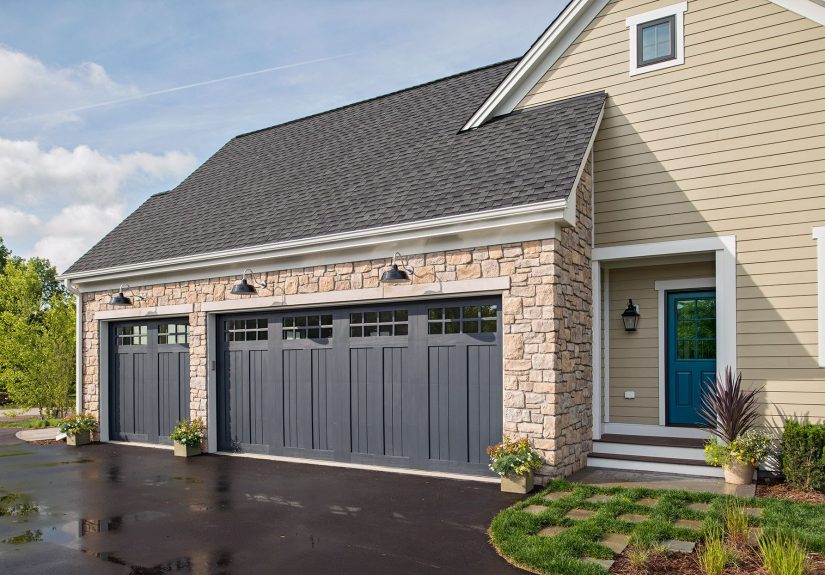
Example: Light gray siding + white trim + a bold front door in deep teal or classic red.
Garage door stays light gray (body color) so the entry is the focal point.
2) The “Cohesive Neutral” strategy (matching done right)
Best for: modern, farmhouse, updated traditional exteriors.
How it looks: Both doors share a deep neutral that repeats other elements (window frames, lighting, hardware).
Example: Warm white exterior + black windows + both doors in a warm black (not a harsh blue-black),
finished with matte black hardware and lantern lights. Clean, confident, timeless.
3) The “Same Undertone, Different Shade” strategy
Best for: homeowners who like coordination but fear “matchy-matchy.”
How it looks: Front door is deeper or richer; garage door is a softened version.
Example: Front door in a saturated navy; garage door in a smoky blue-gray; trim in creamy white.
The house reads calm and curated, not like it’s wearing a uniform.
4) The “Natural Wood Moment” strategy
Best for: Craftsman, modern, midcentury, and homes with stone/brick accents.
How it looks: Front door is wood or wood-look for warmth; garage door blends into the body color or repeats a quiet neutral.
Example: Tan stone facade + black accents + a walnut-toned entry door.
Garage door in a warm greige that recedes, allowing the entry to feel welcoming.
Practical paint advice (so it looks good longer than one season)
Even the perfect color can fail if the prep is sloppy. Door paint gets handled, sunbaked, and weatheredso durability matters.
Prep like you mean it
- Clean thoroughly: remove grime, pollen, and oils so paint bonds properly.
- Sand where needed: especially on glossy surfaces or peeling areas.
- Prime smart: use an exterior-grade primer; consider tinting primer under dark colors for better coverage.
- Choose the right weather window: mild, dry conditions help paint cure evenly.
Pick a finish that hides flaws but still looks “door-worthy”
Many pros recommend satin or semi-gloss for exterior doors because it’s cleanable and crisp without highlighting every imperfection.
Super-high gloss can look stunning, but it’s less forgivinglike HD lighting for your paint job.
Think about sun exposure
If your garage door faces intense afternoon sun, be realistic about very dark colors. They can look incredible, but they may demand higher-quality paint,
more careful prep, and occasional refreshes. If your goal is low maintenance, medium tones and warmed-up neutrals are your friends.
FAQ: Quick answers homeowners actually need
Should the garage door match the front door or the house?
In most cases, experts lean toward matching the garage door to the house color or trim, not the front doorespecially if the front door is bold.
Match both doors when you’re using a neutral and your architecture benefits from repetition.
What if I have two garage doors?
Treat them as one big design element. Keep the color cohesive and calm unless your home is intentionally modern and you’re committed to a bold statement.
Can I paint the garage door the same color as the shutters?
Yesthis can be a great way to repeat a color without turning the garage into the focal point, especially if the shutters are already a strong visual feature.
Does door color affect energy efficiency?
Color can affect surface temperature (dark colors absorb more heat), which may matter for door materials and longevity. For insulation and efficiency,
the door’s construction matters far more than paint colorbut sun and heat can still influence wear over time.
So… should you paint your front door and garage door the same color?
Here’s the most expert-aligned takeaway:
You can, but you don’t have toand you shouldn’t unless the color and architecture support it.
If your home is modern, symmetrical, or built for a clean, minimal palette, matching can look high-end and intentional.
If your garage door is prominent, letting it blend (with siding or trim) usually creates better curb appealand lets your front door do the welcoming.
The goal isn’t “same” or “different.” The goal is balanced.
Real-World Experiences: What happens after the paint dries (the stuff people don’t tell you at checkout)
The internet loves a dramatic before-and-after, but homeowners often learn the most from the weeks and months after the glow-up. Here are the
most common real-world lessons pros hear again and againplus what people wish they’d done before committing to “Door Color Destiny.”
1) “We matched them… and the garage suddenly looked enormous.”
This is the classic surprise. A bold color that feels charming on a front door can feel overpowering on a garage door, simply because of scale.
Homeowners often describe the result as “the garage is shouting” even when the color itself is objectively nice. The fix, in many cases, isn’t repainting
everythingjust reassigning roles: keep the front door as the accent, and repaint the garage door to match the house color or a soft trim-adjacent neutral.
Suddenly, the facade feels calmer, and the entry becomes the focal point again.
2) “We didn’t test the undertone… and now it looks weirdly purple at sunset.”
Exterior paint is a shape-shifter. Many homeowners learn (the hard way) that “charcoal” can lean blue, green, or purple depending on light, landscaping,
and nearby materials like brick. The most practical takeaway: test a large sample, not a tiny swatch. Tape it up, live with it for a few days,
and view it from the curb. If it still looks good when your neighbor’s tree casts a shadow across it at 6:30 p.m., you’re probably safe.
3) “Our bright white garage door looked amazing for… two weeks.”
Garage doors get dirty. Fast. Dust, pollen, road spray, and fingerprints collect in a way most people don’t notice until the door becomes the brightest
thing on the blockliterally. Homeowners who want a clean look but less maintenance often end up happiest with off-white, warm gray, taupe, or a softened
greige. Those shades still look crisp, but they don’t highlight every speck of grime like a spotlight on a dusty stage.
4) “We went super dark and loved it… but the south-facing door faded sooner than we expected.”
Dark colors are gorgeous and popular for a reason: they feel modern, confident, and architectural. But in high sun, especially on a wide garage door,
fading can appear earlier than people anticipate. Many homeowners who choose dark paint long-term are the ones who plan for it: they use higher-quality
exterior paint, follow prep rules carefully, and accept that a refresh coat down the road is part of the deal. If you want a similar look with less risk,
a deep mid-tone (like smoky navy or charcoal-gray) can deliver drama with fewer “why does this look dusty already?” moments.
5) “The color was finethe hardware made it look expensive.”
This one is underrated. Homeowners often report the biggest visual upgrade wasn’t just the paintit was pairing the paint with cohesive hardware:
matching finishes on the front door handle set, house numbers, garage lights, and even faux strap hinges (if your style supports it).
The result reads intentional, like a designer touched it, even if the whole project was a weekend DIY with a playlist and a slightly unhinged amount of
painter’s tape.
6) “We stopped trying to match perfectlyand it finally looked right.”
A lot of people start with the idea of an exact match, then discover the best-looking homes are often simply coordinated.
Different materials reflect differently. Sun exposure varies. And your eyes can detect “close but not quite” more than you’d expect.
In practice, homeowners often end up with a front door that’s a richer, deeper version of the paletteand a garage door that blends.
That slight separation creates depth and balance, and it prevents the garage from stealing the spotlight.
The bottom line from these real-world outcomes is simple: the best exterior color decisions aren’t about strict rules.
They’re about choosing where you want attention to land, then supporting that choice with smart coordination, good prep, and realistic maintenance expectations.
If you do that, whether your doors match or not, your curb appeal will look deliberateand that’s what people notice.