Table of Contents >> Show >> Hide
- What Exactly Did Scientists Find in the Rhino Ancestor’s Teeth?
- Why DNA Usually Can’t Compete (and Why Enamel Can)
- How Do You Read Proteins From a 24-Million-Year-Old Tooth Without Fooling Yourself?
- So What Did the Tooth Reveal About Rhino Evolution?
- Why This Matters Beyond Rhinos (Yes, Even for Humans)
- What This Discovery Doesn’t Mean (Let’s Keep It Honest)
- What Comes Next: From “Oldest Proteins” to New Questions
- Conclusion: A Tooth That Turned Into a Time Machine
- Experiences Related to “Scientists Found the Oldest Surviving Proteins in a Rhino Ancestor’s Teeth” (Extra )
If you’ve ever looked at a fossil tooth in a museum and thought, “Cool rock, zero gossip,” scientists would like a word.
It turns out teeth aren’t just durablesometimes they’re downright chatty. In a breakthrough for paleoproteomics (that’s “studying ancient proteins,”
not a new yoga class), researchers recovered protein sequences from the tooth enamel of an extinct rhinoceros relative dating to roughly
21–24 million years ago. That’s not “old for biology.” That’s “older than your favorite mountain range’s childhood photos.”
The headline-worthy twist: these are among the oldest surviving proteins ever confidently sequenced from an animal fossil.
And they weren’t rescued from amber like a blockbuster plot device. They were preserved inside the hardest tissue most mammals ever make:
tooth enamela natural vault that can protect biomolecules long after DNA has tapped out.
What Exactly Did Scientists Find in the Rhino Ancestor’s Teeth?
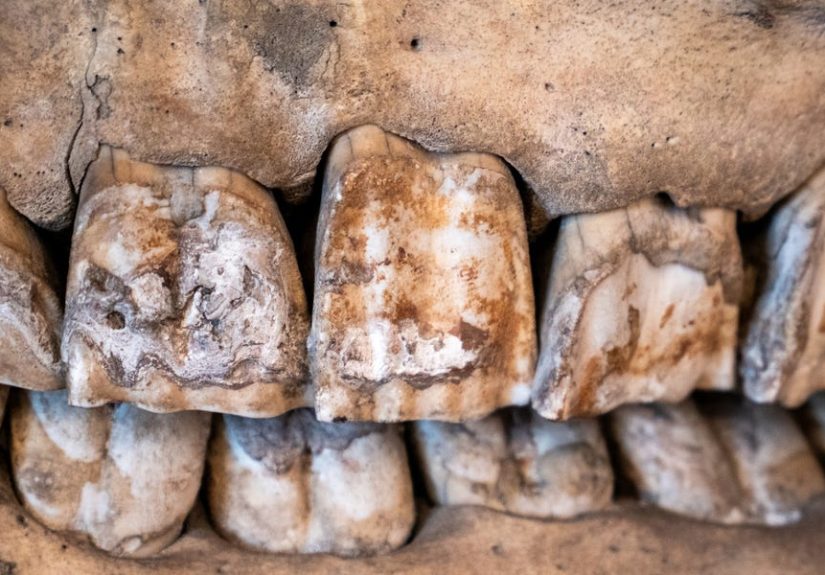
The star of the story is a fossil tooth (or tooth fragment) from an early Miocene rhinocerotidreported in the research as
Epiaceratherium sp.found in Canada’s High Arctic. Within the enamel, scientists recovered
partial sequences from seven enamel proteins and logged 1,000+ peptide-spectrum matches,
yielding enough molecular signal to place the animal on the rhino family tree with real statistical muscle.
Important nuance: these aren’t whole, pristine proteins sitting there like they just came out of the oven.
They’re fragmentspeptidesshowing chemical wear-and-tear expected after millions of years. But even degraded fragments can be hugely informative,
because amino-acid sequences still carry evolutionary “accent marks” that reveal relatedness, divergence, and lineage splits.
Why DNA Usually Can’t Compete (and Why Enamel Can)
Ancient DNA is the celebrity of molecular archaeology, but it’s also the diva: sensitive, fragile, and quick to break down.
Under the best natural conditions, DNA typically doesn’t last beyond about a couple million years on Earth.
Proteins, by comparison, are more durableespecially when they’re bound up in mineral structures.
Tooth enamel is mostly mineral (hydroxyapatite), formed with the help of specialized proteins during development.
Some of those proteins become trapped, tightly associated with the mineral as enamel matures.
Think of it like pouring concrete around a handful of tiny notesexcept the notes are molecular fragments and the concrete is tooth enamel.
This matters because paleontologists have plenty of fossils far older than the “DNA window.”
For many extinct animals, DNA is simply gone. Enamel proteins offer a different path: not as information-rich as DNA,
but resilient enough to survive in deep time and still answer big evolutionary questions.
How Do You Read Proteins From a 24-Million-Year-Old Tooth Without Fooling Yourself?
When scientists claim they’ve pulled biological information from something older than many geological features,
the first question is: “How do we know it’s real and not contamination?”
The teams working on these fossils used multiple lines of evidence to support authenticity:
the chemical “damage patterns” expected from long-term decay, the match quality in mass spectrometry,
and independent checks on amino-acid preservation.
Step 1: Target the right tissue
Bones can preserve proteins, but enamel is especially promising because it’s hard, dense, and mineral-bound.
Enamel also tends to be less porous than many other tissues, reducing the chance that younger molecules seep in and impersonate the ancient ones.
Step 2: Extract and sequence peptides with mass spectrometry
In modern proteomics, mass spectrometry identifies peptides by measuring their masses and fragmentation patterns.
For ancient samples, scientists look for peptide matches consistent with known enamel proteins in related species.
Even if sequences are partial, enough overlapping fragments can still reveal evolutionary placement.
Step 3: Look for chemical aging “fingerprints”
Over long timescales, proteins accumulate spontaneous chemical changessome irreversible.
These modifications (for example, specific forms of deamidation or oxidation) can support the claim that peptides are truly ancient.
The rhino enamel sequences showed damage consistent with deep-time diagenesis rather than modern contamination.
Step 4: Cross-check with independent preservation tests
Researchers also used approaches such as chiral amino acid analysis to evaluate how amino acids had degraded over time.
The goal is not to make the sample look “perfect,” but to demonstrate the decay story matches an ancient timeline.
So What Did the Tooth Reveal About Rhino Evolution?
The fun part isn’t only that proteins survived. It’s what the proteins say.
Using phylogenetic modeling (including Bayesian tip-dating), scientists inferred where this early Miocene rhinocerotid
fits among rhino relatives and when key branches likely split.
One headline implication: the data supported a later divergence for major rhino subfamilies than some alternative models had suggested,
helping refine a long-debated portion of the rhino family tree. In other words, enamel proteins didn’t just survive
they showed up to the family reunion with receipts.
There’s also a geographic twist. Fossils from places like Devon Island’s Haughton Crater have long puzzled researchers
because the fauna shows both endemism and surprising similarities to distant Eurasian faunas.
Molecular clues from enamel can help test hypotheses about ancient dispersal routes and timing
including when rhino relatives moved across northern land bridges.
Why This Matters Beyond Rhinos (Yes, Even for Humans)
This rhino-tooth discovery isn’t a one-off party trick; it’s part of a broader push to extend the molecular record deeper into time.
In parallel work, scientists have recovered enamel protein fragments from fossils in very different environments,
including the East African Rift’s Turkana Basin, with samples reaching back many millions of years.
Why should anyone outside a proteomics lab care? Because enamel is common in the fossil record, and many fossil-rich regions
especially those important for understanding mammal diversification and human evolutioncontain teeth by the truckload.
If enamel proteomics keeps improving, it could help resolve evolutionary relationships for fossils too old for DNA,
including some hominin-adjacent contexts where molecular data has been frustratingly scarce.
What This Discovery Doesn’t Mean (Let’s Keep It Honest)
Even the most exciting molecular headline has boundaries. A few key reality checks:
-
Proteins aren’t DNA. You won’t get a full genome, eye color predictions, or a “Jurassic Park” reboot script from enamel peptides.
Protein sequences can clarify relatedness and divergence patterns, but they carry less total information than DNA. - Preservation is picky. Cold, dry environments help; enamel helps; luck helps. Not every fossil tooth will cooperate.
-
Older isn’t always better. As fossils get older, peptide detection often drops.
The trick is finding enough usable fragments to make strong evolutionary claims.
What Comes Next: From “Oldest Proteins” to New Questions
The immediate impact is clear: paleoproteomics can now reach dramatically deeper into time than previously demonstrated for
evolutionary-informative sequences. That opens up a buffet of new research directions:
- Rebuilding mammal family trees where fossils are abundant but DNA is absentespecially for groups with messy evolutionary histories.
- Testing migration and diversification hypotheses with molecular evidence instead of relying solely on bone shape and tooth size.
-
Expanding fieldwork strategies: if certain environments act as biomolecular vaults,
museum drawers and remote sites could contain overlooked “molecular time capsules.” -
Method upgrades: improved extraction chemistry, cleaner workflows, and better reference protein libraries
could push the approach even further back.
And yes, someone will inevitably ask: “Could this work for dinosaurs?”
The responsible answer is: maybe someday, if preservation conditions and methods alignbut it’s not a promise.
For now, the rhino tooth is a convincing demonstration that enamel can preserve meaningful protein information for
tens of millions of years under the right conditions.
Conclusion: A Tooth That Turned Into a Time Machine
Scientists didn’t just find an old fossil. They found a way to make it talk.
By extracting ancient enamel proteins from a rhino ancestor’s teethdating to roughly 21–24 million years ago
researchers extended the molecular record far beyond DNA’s practical reach and sharpened our understanding of rhino evolution.
The bigger takeaway is almost poetic: the hardest tissues in our bodies can outlast civilizations, continents, and climate eras
and still carry a whisper of biological identity. Sometimes the past doesn’t need a full genome to tell its story.
Sometimes it only needs a tooth… and a lab stubborn enough to listen.
Experiences Related to “Scientists Found the Oldest Surviving Proteins in a Rhino Ancestor’s Teeth” (Extra )
There’s a specific kind of awe that comes from realizing a tooth can be both a fossil and a data drive. If you’ve ever wandered through a natural
history museum, you’ve probably had the “big skeleton moment”standing under something massive and extinct and feeling pleasantly tiny.
But this discovery invites a different experience: the “small thing, huge story” moment. A tooth fragment doesn’t look like a revolution.
It looks like a pebble with ambition. And yet it can carry enough molecular information to rewrite timelines and tighten the branches of an
evolutionary tree.
For science fans, one of the most relatable experiences here is the slow shift from thinking of fossils as objects to thinking of them as
archives. A fossil tooth isn’t just proof an animal existedit’s a record of biology, chemistry, and environment. You start noticing how
paleontology is basically detective work with worse lighting and better hats. The rhino-tooth protein story highlights that the “evidence”
isn’t limited to bones and shapes. It can include molecular fragmentstiny sequences that behave like biological fingerprints.
If you’re a student or a curious reader, there’s also the experience of learning how science actually earns confidence. It’s rarely one dramatic test.
It’s layers: careful sampling, contamination controls, damage-pattern checks, cross-validation, and models that show their math.
The coolest part isn’t that scientists found proteinsit’s that they found them in a way that convinces other skeptics who also own lab coats.
That’s the unglamorous heart of discovery: the paperwork, the repetition, the “run it again,” the “try a different extraction,” the “let’s not
accidentally sequence somebody’s lunch.”
And then there’s the emotional experience of time. Twenty-plus million years is so far beyond everyday imagination that your brain tries to convert it
into something manageablelike “a lot of birthdays,” which is scientifically unhelpful but emotionally accurate. Reading about an early Miocene rhino
living in a very different Arctic can make modern climate feel less abstract, too. Landscapes change. Ecosystems reshuffle. Species adapt or disappear.
A single tooth can remind you that Earth’s story is long, wild, and not obligated to stay familiar.
Finally, there’s the practical experience of curiosity multiplying. Once you accept that enamel can preserve proteins for tens of millions of years,
you start looking at questions differently. What other museum specimens are quietly waiting for modern methods? Which “boring” fragments in storage
could become the centerpiece of a new evolutionary insight? It’s a reminder that breakthroughs aren’t always about finding something new in the ground.
Sometimes they’re about finding a new way to read what we already havelike discovering a hidden chapter in a book you thought you’d finished.