Table of Contents >> Show >> Hide
- Roboto.NYC: Where Brooklyn Maker Culture Met Serious Fabrication
- From MakerBot DNA to a Brooklyn Fabrication Studio
- What Roboto.NYC Actually Did
- Notable Projects and Creative Collaborations
- Roboto.NYC and the Brooklyn Navy Yard Ecosystem
- Why Roboto.NYC Still Matters
- Roboto.NYC, Studio Roboto, and the Evolution of a Brand
- Lessons Businesses Can Learn from Roboto.NYC
- Experience-Based Insights: What Working Around a Studio Like Roboto.NYC Feels Like
- Conclusion
Note: This article is written for web publishing and synthesizes publicly available information about Roboto.NYC, Studio Roboto, Brooklyn’s maker economy, additive manufacturing, 3D scanning, rapid prototyping, and New York’s creative technology scene.
Roboto.NYC: Where Brooklyn Maker Culture Met Serious Fabrication
Roboto.NYC was not the kind of studio where ideas politely waited in a folder named “Someday.” It was the kind of place where sketches, scans, prototypes, sculptures, awards, architectural details, and oddball creative problems could walk in as digital files and leave as physical objects. In other words: a dream kitchen for designers, artists, engineers, and anyone who has ever stared at a 3D model and said, “Cool, but can we actually make this?”
Headquartered in Brooklyn, New York, Roboto.NYC became known as a design and light fabrication studio specializing in product development, rapid prototyping, 3D printing, 3D scanning, laser cutting, model making, and low-volume production. The studio was co-founded by Rob Steiner and Aljosa Kemperle, both connected to the earlier MakerBot era that helped put desktop 3D printing on the cultural map. Their background gave Roboto.NYC an unusual mix of hands-on machine knowledge, startup energy, and old-school fabrication patiencethe kind of patience required when a print fails at hour eleven and everyone pretends not to cry into the PLA spool.
What made Roboto.NYC interesting was not just that it owned 3D printers. Plenty of shops have machines. Roboto.NYC stood out because it understood the messy middle between concept and finished object. That middle is where files need cleanup, scans need repair, materials need testing, tolerances need adjustment, and clients need honest guidance before a “simple” idea becomes a tiny plastic tragedy. Roboto.NYC operated in that practical, creative space where digital design meets dust, heat, resin, calibration, and coffee.
From MakerBot DNA to a Brooklyn Fabrication Studio
To understand Roboto.NYC, it helps to understand the maker wave that rolled through Brooklyn in the 2010s. MakerBot, founded in Brooklyn in 2009, was one of the companies that made desktop 3D printing feel accessible to schools, designers, hobbyists, and startups. The hype around consumer 3D printing eventually cooled, but the skills developed during that era did not vanish. They matured.
That is where Roboto.NYC fits beautifully. Instead of selling the fantasy that everyone would soon print their own forks, phone cases, and emergency replacement dishwasher knobs at home, Roboto.NYC focused on something more durable: professional fabrication services. The studio served people who needed quality, speed, design judgment, and technical execution. That meant artists preparing complex installations, engineers iterating prototypes, startups testing early hardware, and organizations needing custom objects that could not be pulled off a shelf.
The studio’s work reflected a simple but powerful idea: 3D printing is not magic, but in skilled hands it can look suspiciously close. Additive manufacturing builds objects layer by layer from digital models, allowing shapes that would be difficult, expensive, or impossible with traditional subtractive methods. But the machine is only part of the story. Good results require design preparation, material selection, print orientation, finishing, assembly, and sometimes a backup plan with a backup plan wearing a helmet.
What Roboto.NYC Actually Did
Roboto.NYC offered a practical menu of digital fabrication services, but the real value was how those services worked together. A client might arrive with a sculpture, a CAD file, a rough napkin sketch, or an object that needed to be duplicated. The studio could scan, model, refine, print, cut, fabricate, finish, and manage the project from fuzzy idea to tangible result.
3D Printing and Rapid Prototyping
At the center of Roboto.NYC’s work was 3D printing. The studio reportedly used a fleet that included multiple FDM printers for small production runs and SLA machines for more detailed prototypes. FDM, or fused deposition modeling, is often useful for strong, functional, lower-cost parts. SLA, or stereolithography, uses resin and is popular when fine details and smooth surfaces matter. In plain English: FDM is the dependable pickup truck; SLA is the detail-obsessed pastry chef.
For startups and product teams, rapid prototyping can shorten the distance between “we think this works” and “we know this does not work yet, but now we know why.” That is progress. Physical prototypes reveal problems that screens hide: bad ergonomics, weak mounting points, awkward proportions, strange textures, and the deeply humbling truth that a button can look perfect in CAD and feel like a raisin in real life.
3D Scanning and Digital Cleanup
Roboto.NYC also worked with 3D scanning, an essential tool for capturing real-world objects and converting them into digital geometry. Scanning is especially useful for art reproduction, restoration, reverse engineering, custom-fit parts, and projects where the original form is too complex to model from scratch.
But scanning is not a one-click miracle. Raw scans often include holes, noise, rough surfaces, and extra geometry. A skilled team must clean up the file, rebuild details, smooth problem areas, and prepare the model for production. This is where Roboto.NYC’s experience mattered. Anyone can buy a scanner; fewer people can turn scan data into something printable, castable, paintable, or presentable without making it look like it escaped from a low-budget video game.
Laser Cutting and Light Fabrication
Laser cutting expanded the studio’s capabilities beyond printed objects. With laser cutting, flat materials such as acrylic, wood, paper, cardboard, and certain fabrics can be cut or engraved with precision. For artists and designers, this opens the door to signage, patterns, panels, templates, layered artwork, architectural models, and mixed-media pieces.
Laser cutting also pairs well with 3D printing. A project might need printed sculptural elements, laser-cut panels, engraved surfaces, and hand finishing. Roboto.NYC’s strength was not treating each tool as a separate island. It approached fabrication as a toolbox, choosing the process that best served the object rather than forcing every idea through one machine.
Notable Projects and Creative Collaborations
One of the most widely discussed Roboto.NYC projects involved the fabrication process for a heroic-scale statue of late Supreme Court Justice Antonin Scalia. The project reportedly began with a smaller model by sculptor Greg Wyatt. Roboto.NYC used 3D scanning and digital cleanup before producing a large-scale version that could move toward bronze casting. This kind of work shows how digital fabrication can support traditional sculpture rather than replace it. The sculptor’s hand remains central, while technology helps scale, translate, and prepare the work for production.
Roboto.NYC also became associated with artist Ashley Zelinskie, whose work often blends code, mathematics, digital systems, and physical sculpture. Her practice includes 3D printing and computer-guided laser cutting, making her a natural fit for a studio comfortable at the intersection of art and engineering. When digital artists need physical output, they need more than a printer; they need collaborators who understand how concept, material, and process shape the final experience.
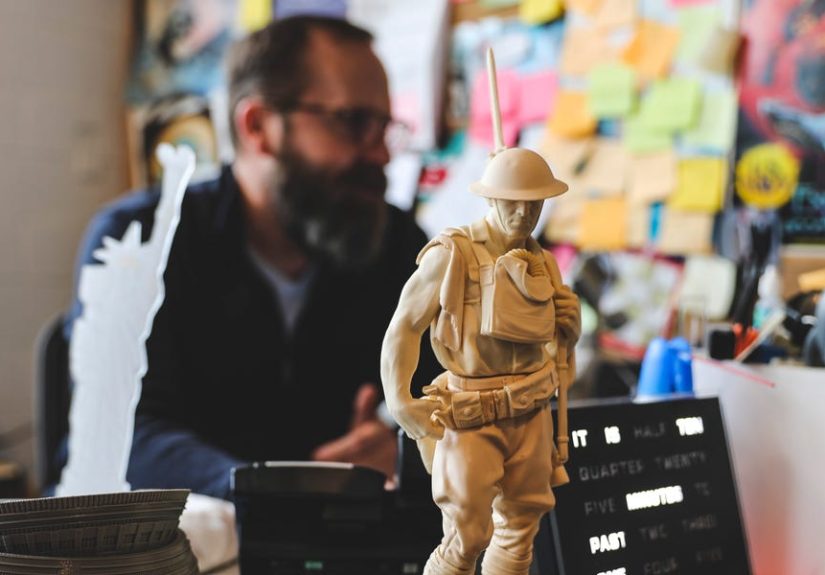
The studio’s later gallery materials under Studio Roboto show a wide range of fabrication work: the Apollo 11 Project Egress hatch, Oscar-style statues, ZBrush sculpting, bronze casting workflows, corporate awards, scale models, laser-cut canvas, figurines, diving suit models, and 3D-printed installation art. That portfolio tells a story of range. Roboto.NYC was not locked into one industry. It was a bridge between many: art, aerospace culture, product design, awards, restoration, sculpture, and architectural experimentation.
Roboto.NYC and the Brooklyn Navy Yard Ecosystem
Roboto.NYC’s Brooklyn Navy Yard chapter matters because the Yard has become one of New York City’s most important symbols of modern urban manufacturing. Once known primarily for shipbuilding, the Brooklyn Navy Yard has evolved into a home for advanced manufacturing, creative production, design firms, fabrication shops, robotics-adjacent companies, and technology-driven businesses.
This context is important for SEO readers searching “Roboto.NYC” because the name is tied not only to one studio but also to a larger story about New York’s maker economy. The city is not just finance, fashion, media, and pizza arguments. It is also a place where people build physical things: prototypes, furniture, robotics components, installation art, film sets, medical models, lighting, and custom hardware. Roboto.NYC belonged to that practical creative class.
New York City’s manufacturing ecosystem benefits from density. Designers, engineers, artists, founders, fabricators, museums, schools, and investors can be surprisingly close to one another. In a single week, a fabrication studio might serve a startup founder from a hardware accelerator, an artist preparing a gallery show, a museum team solving a display challenge, and an architect testing a scale model. That variety keeps a shop sharp. It also prevents the workday from becoming boring, which is helpful when your machines make repetitive humming noises for a living.
Why Roboto.NYC Still Matters
Even if someone discovers Roboto.NYC years after its Brooklyn heyday, the studio remains a useful case study in how fabrication businesses survive beyond hype cycles. The early 3D printing boom promised a future where homes would become miniature factories. That future arrived only partially. The bigger, more realistic opportunity has been professional additive manufacturing, specialized prototyping, custom production, education, medical modeling, aerospace parts, art fabrication, and local manufacturing services.
Roboto.NYC’s story shows that machines alone do not build a business. The business is built on judgment. Should a part be printed in FDM or SLA? Should it be split into pieces? Does the model need wall-thickness changes? Will the finish require sanding, priming, painting, plating, or casting? Is the client asking for a prototype, a production-ready component, or a beautiful object that only needs to survive one exhibition opening and three people saying, “Wait, can I touch it?”
That kind of decision-making is where experienced fabrication studios earn trust. They reduce uncertainty. They help clients avoid expensive mistakes. They translate between creative ambition and material reality. In an age of AI-generated images and instant digital mockups, Roboto.NYC’s core lesson feels more relevant than ever: making something real is still a serious craft.
Roboto.NYC, Studio Roboto, and the Evolution of a Brand
Public information connected to Studio Roboto indicates a later presence in White Plains, New York, offering 3D printing, 3D scanning, laser cutting, prototype development, large-format FDM, SLA, SLS additive manufacturing, project management, procurement strategy, and fabrication services. The gallery also references an “old shop at the Brooklyn Navy Yard” from 2016 to 2020. That suggests the Roboto.NYC identity was part of a broader professional journey rather than a frozen moment in Brooklyn maker history.
This evolution makes sense. Fabrication studios often shift locations, equipment, specialties, and client bases as their work matures. A shop that begins with desktop 3D printers may later add larger machines, scanning tools, production management, materials consulting, or more advanced manufacturing services. The brand may change, but the central promise remains: bring difficult physical projects into the world with fewer headaches and better results.
Lessons Businesses Can Learn from Roboto.NYC
1. Niche Expertise Beats Generic Tool Ownership
Anyone can list “3D printing services” on a website. Roboto.NYC showed the value of deeper expertise: scanning, cleanup, material choices, finishing, assembly, and project coordination. For clients, that full-stack capability is far more useful than a printer farm with no guidance.
2. Creative Clients Need Technical Translation
Artists and designers often think in visual, emotional, or conceptual terms. Engineers and fabricators think in tolerances, materials, files, and constraints. A strong studio translates between those languages without making either side feel silly. That is a rare and valuable skill.
3. Local Manufacturing Still Has Power
In a globalized world, local fabrication can feel almost rebellious. But when deadlines are tight, revisions are frequent, and quality matters, being able to meet, review, adjust, and remake quickly is a huge advantage. Roboto.NYC benefited from being close to New York’s creative and startup communities.
4. Hype Fades, Craft Remains
The 3D printing industry has seen waves of excitement, disappointment, reinvention, and growth. Roboto.NYC’s work reminds us that durable businesses are not built on hype alone. They are built on useful results, repeat customers, and the ability to say, kindly but firmly, “That will not print the way you think it will.”
Experience-Based Insights: What Working Around a Studio Like Roboto.NYC Feels Like
Spending time around a fabrication studio like Roboto.NYC changes how you look at objects. A chair is no longer just a chair. It becomes a stack of decisions: material, joinery, tolerance, finish, strength, cost, and whether someone had the wisdom to measure twice before cutting once. A sculpture is no longer just a beautiful form. It becomes a chain of scanning, mesh repair, scaling, printing, sanding, casting, painting, shipping, and praying that the delivery truck driver treats the crate like it contains more than “some weird art thing.”
The first experience that stands out in a shop like this is the sound. 3D printers create a soft mechanical rhythm, laser cutters add a sharper industrial personality, and finishing tools provide the percussion section. It is not exactly a spa soundtrack, unless your spa offers safety goggles and smells faintly like acrylic. But the atmosphere is energizing. Every machine suggests motion. Something is becoming something else.
The second experience is the constant negotiation between imagination and reality. Clients often arrive with big ideas, and good fabricators do not crush those ideas; they reshape them. Maybe the part needs to be printed in sections. Maybe resin is too brittle. Maybe the model has non-manifold geometry. Maybe the surface finish will require more labor than expected. These conversations are not obstacles. They are where the project becomes real. A skilled studio protects the client’s vision by challenging the weak points before they become expensive failures.
The third experience is watching digital work become physical. There is a special moment when a file that existed only on a screen turns into an object someone can hold. It feels simple, but it is not. Behind that moment are calibration, software settings, material behavior, support structures, machine maintenance, and human judgment. A successful print can look effortless, but fabrication is full of invisible labor. The best shops make hard things look calm.
The fourth experience is learning that finishing matters. Many people think 3D printing ends when the machine stops. In reality, that is often when the real work begins. Supports must be removed. Resin parts need washing and curing. FDM parts may need sanding, filling, priming, or painting. Large objects may need assembly. Pieces intended for casting require additional preparation. The raw print is the rough draft. The finish is what makes people stop saying “prototype” and start saying “wow.”
The fifth experience is the joy of unusual projects. A studio like Roboto.NYC might work on a product prototype in the morning, a sculpture after lunch, and a museum-adjacent replica before closing. That variety creates a culture of problem-solving. The team cannot rely on one recipe. Each project asks new questions: How strong does it need to be? How accurate? How smooth? How light? How fast? How expensive? How likely is it that someone will try to stand on it even though they absolutely should not?
For clients, the best experience is confidence. When a fabrication partner understands both design ambition and production limits, the process feels less mysterious. You do not need to become an expert in every machine. You need a team that can explain options clearly, flag problems early, and deliver a result that respects the original idea. That is the experience Roboto.NYC represented: practical creativity with a Brooklyn accent, a maker’s patience, and enough technical muscle to turn strange requests into finished objects.
Ultimately, Roboto.NYC is more than a name from New York’s 3D printing scene. It represents a useful model for modern fabrication: local, collaborative, technically fluent, and comfortable working across art, engineering, design, and production. In a world drowning in digital concepts, studios like Roboto.NYC remind us that the final test is wonderfully old-fashioned: Can you hold it in your hand?
Conclusion
Roboto.NYC earned attention because it sat at the crossroads of Brooklyn maker culture, professional 3D printing, digital fabrication, and creative problem-solving. Its story connects MakerBot-era experience, Brooklyn Navy Yard manufacturing energy, artist collaborations, rapid prototyping, 3D scanning, laser cutting, and the larger growth of additive manufacturing. More importantly, it shows that great fabrication is not just about machines. It is about judgment, collaboration, and the ability to guide an idea from “interesting” to “installed, shipped, tested, or proudly displayed.”
For artists, engineers, startups, and designers, Roboto.NYC offers a clear lesson: the future of making belongs to people who can move fluently between digital tools and physical reality. The printers matter. The scanners matter. The lasers definitely matter. But the real magic is the human expertise that knows when to print, when to cut, when to redesign, and when to say, “Yes, we can build thatbut let’s make it smarter first.”