Table of Contents >> Show >> Hide
- Who Is Inez Janiak, and Why Does Her Work Stand Out?
- What Makes Sketch Tattoos Different From Traditional Tattoo Styles?
- What the 101-Pic Gallery Reveals About Her Artistic Vision
- Why the Beauty of Imperfection Feels So Modern
- Why This Style Is Harder Than It Looks
- Why People Connect With Inez Janiak’s Tattoos
- The Experience of Sketch Tattoos: What It Feels Like Beyond the Screen
- Conclusion
Some tattoos try to look polished enough to belong in a museum gift shop. Others swagger in wearing a leather jacket, smudged eyeliner, and the artistic confidence of a half-finished notebook page. The sketch tattoos of Polish artist Inez Janiak belong firmly in the second camp, and that is exactly why they hit so hard.
At first glance, her work can feel almost accidental, like somebody captured a fleeting pencil drawing before the eraser arrived to tidy everything up. But look again and the magic becomes obvious. Those broken lines are intentional. The scratchy textures are deliberate. The negative space is doing just as much storytelling as the ink. Instead of chasing flawless symmetry or sterile perfection, Janiak’s tattoos embrace movement, mood, and the wild beauty of something that still feels alive.
That is what makes the gallery so memorable. Across image after image, you are not just looking at tattoos. You are looking at a philosophy of art: the idea that imperfection is not a defect to be corrected, but a feature that gives a piece soul. In an internet age obsessed with smoothing, filtering, and sanding every creative edge into submission, that feels refreshingly rebellious.
Who Is Inez Janiak, and Why Does Her Work Stand Out?
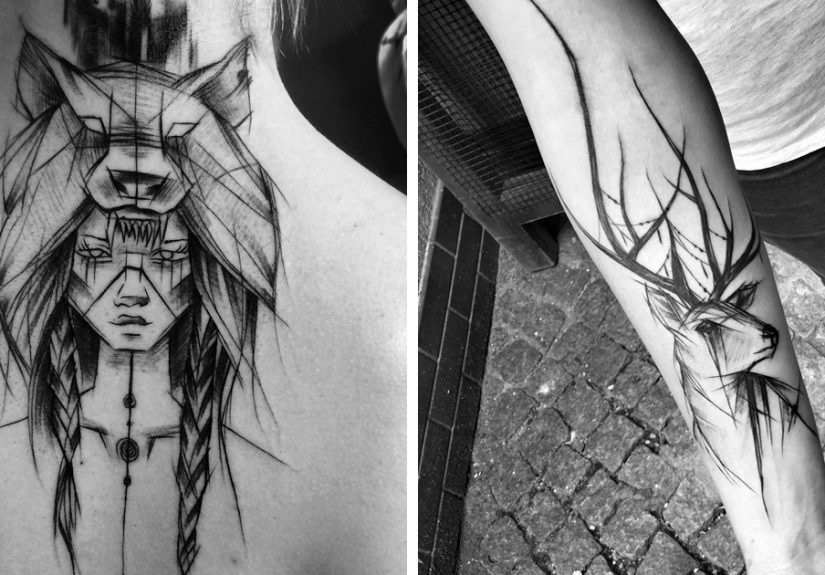
Inez Janiak is part of a vibrant Polish tattoo scene known for artists who take body art seriously as an expressive visual medium rather than a rigid set of rules. Her specialty is what many people call sketch-style tattooing, a look that mimics the energy of a pencil or charcoal drawing transferred directly onto skin. She works primarily in black ink, and that restriction turns out to be a superpower. Without the distraction of color, every line, smudge, hatch mark, and unfinished contour has to earn its place.
Her designs often revolve around animals, plants, feminine figures, surreal fragments, and darkly poetic compositions. Wolves appear not as simple wildlife studies, but as emotional characters. Deer look fragile and fierce at the same time. Birds, insects, and branches feel less like decorative extras and more like extensions of a mood. Even when the subject is familiar, the execution makes it feel new, almost as if the tattoo is still in the process of becoming itself.
And that is the hook. These tattoos do not pretend to be slick digital renderings. They keep the evidence of the artist’s hand. They preserve the chaos that usually gets erased from the final version. In other words, they let the viewer see the thought process, not just the result.
What Makes Sketch Tattoos Different From Traditional Tattoo Styles?
They look unfinished on purpose
In classic drawing, sketch lines are often temporary. They are scaffolding. They help build the final image and then get wiped away before the “real” artwork is revealed. Sketch tattoos flip that logic on its head. Here, the scaffolding stays. The overlaps stay. The rough edges stay. The result is a tattoo that feels immediate, raw, and in motion.
That unfinished quality is not laziness. It is strategy. Janiak uses incomplete outlines, quick directional strokes, crosshatching, and tonal variation to create depth without making the work feel heavy. The tattoo breathes. It flickers. It looks like it could keep moving after you stop staring at it.
They trade perfection for personality
Traditional tattooing often celebrates bold outlines, clean fills, and high contrast built for long-term readability. Sketch tattoos, by contrast, thrive on nuance. They invite asymmetry. They make room for looseness. They allow an image to feel emotional rather than merely accurate.
That matters because tattoos live on skin, not on perfectly flat paper. Bodies bend. Muscles shift. Time leaves its fingerprints on everything. A sketch-style tattoo acknowledges that reality instead of fighting it. It feels more human because it already contains tension, softness, and imperfection. Frankly, it is the visual equivalent of hearing a singer’s voice crack at exactly the right moment and realizing the crack made the song better.
What the 101-Pic Gallery Reveals About Her Artistic Vision
The beauty of a large gallery is that patterns start to emerge. One piece might impress you, but dozens of pieces show you the artist’s mind at work. In Janiak’s case, several themes rise to the surface again and again.
Animals with emotional weight
Many tattoo artists can make an animal look realistic. Janiak makes animals look haunted, noble, protective, restless, or strangely tender. A wolf is never just a wolf. A bird is never just a bird. The sketch marks around the subject create atmosphere, and that atmosphere changes how the image feels. It is illustration with attitude.
Nature without the sugar rush
Floral and botanical tattoos are everywhere, but Janiak’s approach avoids turning nature into generic wallpaper. Her branches can feel windblown. Her petals can look bruised, shadowed, or unfinished in a way that makes them more compelling. She finds drama in the organic world without making it look overly precious. Think less “cute wildflower Pinterest board,” more “forest at dusk with excellent taste.”
Faces, fragments, and suggestion
Some of the strongest pieces in this style do not explain everything. A face may dissolve into loose marks. A body may blend into abstract texture. A composition may be part portrait, part dream sequence. That sense of suggestion is key to the appeal. The tattoos do not overstate themselves. They leave room for interpretation, which is often what keeps people coming back for a second look.
Why the Beauty of Imperfection Feels So Modern
For all the buzzwords attached to design trends, the core appeal here is pretty simple: people are tired of art that looks overprocessed. We live in a visual culture where everything can be sharpened, filtered, color-corrected, and polished until it stops feeling human. Sketch tattoos move in the opposite direction. They preserve spontaneity. They make visible the hand of the artist. They remind us that emotion often lives in the rough draft.
That is also why Janiak’s work connects beyond tattoo culture. The broader art world has long been fascinated by the beauty of incompleteness, damage, and visible process. In tattoo form, that idea becomes especially powerful because the body itself is imperfect, changing, and personal. A sketch tattoo does not merely decorate the skin. It collaborates with it.
There is also something quietly liberating about choosing a tattoo that does not aim for machine-made precision. It says you are comfortable with complexity. It says you do not need every story tied into a neat bow. It says beauty can be found in the marks that look a little wild around the edges. Honestly, that is a message more art could stand to borrow.
Why This Style Is Harder Than It Looks
Now for the reality check: sketch tattoos may look casual, but they are technically demanding. When a design relies on delicate lines, subtle hatching, and controlled irregularity, there is very little room for error. “Messy on purpose” is much harder than messy by accident. A strong sketch tattoo requires an artist who understands drawing, composition, skin placement, and how fine details will age over time.
That is especially important because more delicate linework can need more thoughtful placement and upkeep. If a design is too tiny or overcrowded, the sketch effect can flatten out as the tattoo heals and ages. Anyone inspired by this style should choose an experienced artist, follow proper aftercare, protect the tattoo from sun exposure, and prioritize a licensed, hygienic studio. Great art deserves better than reckless decision-making and a bottle of mystery lotion from the back of a bathroom cabinet.
Why People Connect With Inez Janiak’s Tattoos
The obvious answer is that they look cool. They absolutely do. But the deeper reason is that they feel emotionally honest. Not every tattoo has to shout its meaning from a rooftop. Janiak’s work often captures something more elusive: memory, vulnerability, instinct, movement, melancholy, desire, and a little darkness around the corners.
That emotional openness matters. More people now see tattoos not as rebellious accessories, but as legitimate art and identity markers. Within that shift, artists like Janiak stand out because they are not just giving clients a design; they are giving them a visual language. It is a language built from rough lines, layered marks, and incomplete edges, yet somehow it says more than many perfectly rendered images ever could.
And maybe that is the real lesson of the gallery. Imperfection is not the opposite of beauty. Sometimes it is the thing that makes beauty believable.
The Experience of Sketch Tattoos: What It Feels Like Beyond the Screen
Seeing sketch tattoos online is one thing. Seeing them in real life is another experience entirely. On a phone screen, you notice the composition first. In person, you notice the energy. The lines do not sit there politely like framed wall art; they interact with the body. A shoulder roll changes the angle of a bird’s wing. A wrist turn shifts the drama of a branch or the gaze of an animal. The tattoo feels alive in a way that polished studio photography only hints at.
There is also a strange emotional effect that happens when you stand close enough to examine one of these pieces. Because the style resembles a drawing still in progress, your brain reads it differently than a heavily saturated traditional tattoo. It feels intimate, almost private, as if you are seeing an artist’s notebook rather than a final commercial image. That can make the work more affecting. You are not just impressed by technical skill; you feel invited into the creative process.
Collectors are often drawn to that sense of honesty. A sketch tattoo can mirror the way memories actually work. We do not remember everything in crisp outlines and perfect color balance. We remember fragments, pressure points, motion, and feeling. We remember the shape of a face before we remember the exact details. We remember the atmosphere of a place before we remember the furniture. Janiak’s style taps into that psychology beautifully. Her tattoos often look like recollections made visible.
The experience of getting a sketch tattoo can be meaningful for the same reason. Instead of choosing a design that looks sealed off and final, many collectors choose a piece that feels open-ended. That openness can be comforting. Life is rarely neat. People change. Stories evolve. A sketch-style tattoo leaves room for mystery, and sometimes that mystery is what makes the tattoo feel personal rather than generic.
There is a social experience around this style, too. Sketch tattoos tend to spark better conversations than more obvious designs. People ask what the piece means, but they also ask how it was made, why it looks like a drawing, or what inspired the texture. The tattoo becomes a doorway into a discussion about art, aesthetics, and the beauty of things that do not fit perfectly into categories. That is a pretty impressive job description for a few lines of black ink.
And then there is the long-term experience: living with the tattoo. The best sketch tattoos continue to reveal little details over time. A hatch mark you barely noticed on day one starts to matter more. A soft break in a line begins to look intentional in a new way. The tattoo settles into the body and becomes part of your visual identity without losing its edge. It does not scream for attention every second, but it rewards attention whenever you give it.
That might be the most compelling part of all. In a world that keeps telling us to clean everything up, straighten every line, and present only the finished version of ourselves, sketch tattoos offer a gentler truth. The unfinished can still be beautiful. The imperfect can still be powerful. And sometimes the marks that look the least controlled are the ones that feel the most real.
Conclusion
Inez Janiak’s sketch tattoos are memorable not because they reject skill, but because they use skill to make room for feeling. Her work shows that roughness can be elegant, incompleteness can be expressive, and black ink can carry a remarkable amount of atmosphere when it is handled by the right artist. Across the 101-pic gallery, the takeaway is clear: imperfection is not a flaw to hide. In the right hands, it becomes the whole point.
That idea lands especially well in tattooing, where the canvas is human and the meaning is rarely one-size-fits-all. Janiak’s art does not ask the body to become perfect. It asks the body to become interesting. That is a much better deal.