Table of Contents >> Show >> Hide
- Why Falcon Heavy Felt Bigger Than a Normal Rocket Launch
- The Launch Day Delivered Everything a Rocket Fan Could Ask For
- The Tesla Roadster Was a Stunt, but It Was Also Smart
- Why the Launch Mattered Technically
- Why It Still Felt Incredible One Year Later
- Falcon Heavy’s Cultural Legacy Was Almost as Important as Its Payload Capacity
- Experiences Related to the Topic: What Falcon Heavy Felt Like a Year Later
- Conclusion
A year after Falcon Heavy thundered off the pad, the launch still feels a little unreal. Not “we watched a rocket launch” unreal. More like “did a triple-core rocket really blast off from the same ground used for Apollo, toss a cherry-red Tesla into solar orbit, and then have two boosters come back to Earth like synchronized stunt performers?” unreal. The answer, somehow, is yes.
That is why the Falcon Heavy debut remains one of the most unforgettable moments in modern spaceflight. It was not just big. It was not just loud. It was not just weird in the very Elon-Musk way of putting a sports car in space. It was a rare event that managed to be technically meaningful, historically symbolic, commercially important, and wildly entertaining at the exact same time.
One year later, that first Falcon Heavy mission still looked incredible because it changed expectations. It made heavy-lift rocketry feel less like a government-only cathedral project and more like something a private company could build, fly, and partially recover with style. It turned engineering into spectacle without turning the engineering into a sideshow. And it reminded the public that spaceflight can still make people stop scrolling, step outside, and stare at the sky like kids.
Why Falcon Heavy Felt Bigger Than a Normal Rocket Launch
Plenty of rocket launches matter. Very few feel like cultural events. Falcon Heavy’s first flight did, because it arrived after years of buildup and delay. By the time launch day finally came around, the rocket had become one of those almost-mythical machines people talked about as much for what it might do as for what it had actually done. It had the reputation of a blockbuster stuck in production hell, except the blockbuster was about orbital mechanics and RP-1 fuel.
That long wait built tension, but it also built doubt. Big rockets are hard. Triple-core rockets are especially hard. Synchronizing 27 first-stage engines, managing structural loads across three strapped-together boosters, and recovering hardware afterward was not a casual Tuesday project. Even SpaceX played down certainty ahead of the launch. That helped make the eventual success feel less like a routine milestone and more like a genuine engineering cliffhanger.
Then there was the stagecraft. Falcon Heavy lifted off from historic Launch Complex 39A at Kennedy Space Center, a site with enough spaceflight history to make even a parking lot feel dramatic. Apollo missions launched from there. Space shuttle missions launched from there. So when Falcon Heavy rose from that same ground, it connected private-sector ambition with the grand old mythology of American launch history. It felt new, but it also felt like it belonged.
The Launch Day Delivered Everything a Rocket Fan Could Ask For
The Liftoff Was the Easy Part to Explain
On paper, Falcon Heavy was a beast: three Falcon 9-derived first-stage cores strapped together, 27 Merlin engines firing at liftoff, and enough muscle to become the most powerful operational rocket of its day. On camera, however, “beast” almost seemed too polite. The vehicle rose slowly, almost stubbornly, as if gravity had filed an official complaint and the rocket was choosing to ignore it.
The visuals were spectacular, but the sound mattered too. People near the Florida Space Coast described the pressure and rumble as something they felt as much as heard. That physicality is part of why Falcon Heavy left such an imprint. It was not a neat little flame darting into the distance. It was a full-body event. The rocket announced itself with the subtlety of a marching band driving a bulldozer.
Then Came the Scene Everyone Still Replays
If the launch alone had gone right, Falcon Heavy would already be remembered as a success. But the moment that burned itself into public memory came minutes later, when the two side boosters turned around and descended back toward Cape Canaveral for nearly simultaneous landings. It looked choreographed, almost too clean to be real. Two giant rocket boosters dropping from the sky and touching down side by side should feel absurd. Instead, it felt like the future had shown up early and decided to be flashy about it.
The center core did not stick its landing on the drone ship, which kept the mission from becoming a clean sweep. Oddly, that may have made the whole thing more believable. Falcon Heavy was not magic. It was hard engineering, flown in public, with real risk and real imperfection. That mix of triumph and limitation made the success feel earned rather than polished for a marketing poster.
The Tesla Roadster Was a Stunt, but It Was Also Smart
Let’s address the red car in the vacuum: yes, putting a Tesla Roadster on top of a giant rocket was outrageous. It was funny, theatrical, meme-friendly, and just self-aware enough to avoid feeling completely ridiculous. In a world where first test flights often carry blocks of concrete or other uninspiring mass simulators, SpaceX picked a payload that the public could instantly understand.
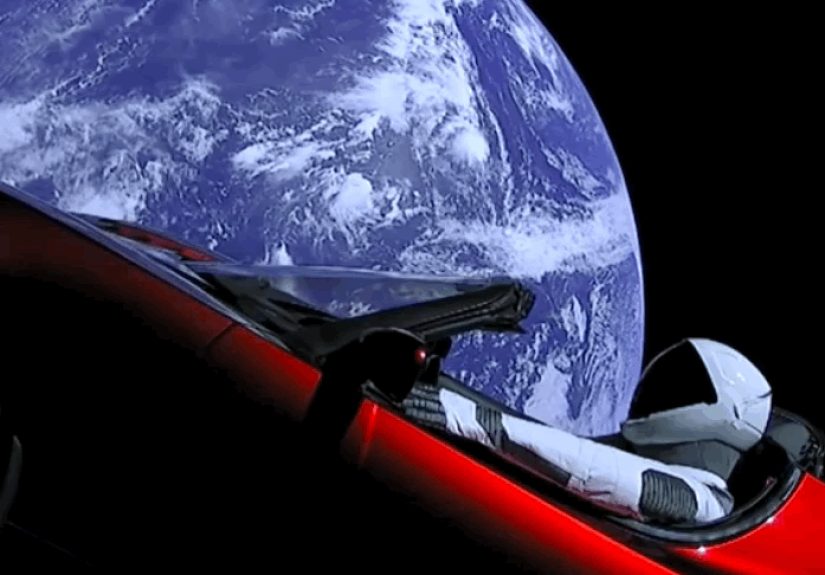
But the Roadster was not memorable simply because it was weird. It worked because it transformed an abstract test mission into a vivid story. Instead of “a mass simulator was inserted into heliocentric orbit,” people got a convertible, a mannequin named Starman, and dashboard-level imagery that looked like science fiction with suspiciously good camera work. The mission became shareable to non-engineers without losing its underlying seriousness.
That balance mattered. Falcon Heavy’s first flight was still a real demonstration mission. The upper stage performed a lengthy coast phase and a later burn designed to show the sort of mission profile that matters for more demanding national security and deep-space work. So while the Roadster grabbed headlines, the engineering underneath it was doing exactly what it needed to do: proving that the vehicle was more than a publicity machine.
Why the Launch Mattered Technically
Reusable Thinking Scaled Up
Falcon Heavy was impressive not just because it was large, but because it extended an idea SpaceX had already been proving with Falcon 9: rockets do not have to be disposable fireworks. The debut mission showed that heavy-lift capability could be built around reusable architecture rather than in spite of it. That mattered because the economics of launch are shaped not only by raw performance, but by how often hardware can fly and how quickly a company can learn from repeated missions.
In other words, Falcon Heavy was not only a bigger rocket. It was a bigger argument. It argued that the future of launch might belong to systems that combine high performance with partial reusability, operational repetition, and commercial pragmatism. That idea may sound obvious now, but it felt much bolder when Falcon Heavy first flew.
Heavy Lift Opens More Than One Door
Large payload capacity matters because space missions are full of brutal tradeoffs. Mass limits force designers to shrink satellites, reduce shielding, compromise fuel reserves, or split ambitious goals across multiple launches. A heavier-lift rocket eases some of that pressure. It gives governments, scientists, and commercial operators more room to think bigger, whether that means larger spacecraft, more energetic trajectories, or more flexible mission design.
Falcon Heavy also mattered because it arrived at a moment when deep-space missions, national security payloads, and commercial demand were all evolving. A rocket capable of lifting serious mass while drawing on a reusable family design had obvious appeal. The debut mission was not just a showpiece. It was the opening argument in a larger case for private heavy-lift launch services.
Why It Still Felt Incredible One Year Later
One year after the launch, Falcon Heavy still looked incredible for a simple reason: the footage had not aged into normalcy. That happens with technology sometimes. The first time you see it, you gasp. A year later, it feels ordinary. Falcon Heavy resisted that effect. Watching the twin booster landings still felt absurdly futuristic. Watching the car drift against the blackness of space still felt delightfully unnecessary in the best possible way. Watching the rocket clear the tower still felt like seeing industrial ambition at full volume.
There was also a broader emotional reason the mission lingered in memory. Falcon Heavy made spaceflight feel optimistic again. Not easy. Not solved. Not cheap in some magical fairy-tale sense. Just optimistic. It suggested that progress could still arrive with drama, style, and visible momentum. At a time when many people had grown used to incremental updates and abstract technical achievements, Falcon Heavy delivered an unmistakable image of forward motion.
And perhaps that is the heart of it: Falcon Heavy was not incredible only because it worked. It was incredible because it let millions of people feel the scale of the achievement. It gave the public something to remember that was bigger than a spec sheet. Plenty of important engineering milestones are appreciated mainly by specialists. Falcon Heavy managed to be appreciated by specialists and by people who only casually follow space news but know a jaw-dropping moment when they see one.
Falcon Heavy’s Cultural Legacy Was Almost as Important as Its Payload Capacity
Space history is full of missions that matter deeply to experts but barely register outside the industry. Falcon Heavy broke through that barrier. It generated headlines, memes, reaction videos, editorials, and endless replay clips because it gave modern spaceflight the kind of visual grammar that sticks in popular culture. You did not need to know how a Merlin engine works to understand that two boosters landing in unison is cool. Very cool. “Call your neighbor outside and point at the screen” cool.
The launch also helped normalize the idea that commercial companies were no longer side characters in the space story. They were shaping the story. Falcon Heavy did not replace NASA’s role, and it did not suddenly solve every launch challenge in existence. What it did do was make private heavy-lift capability look real, visible, and consequential. That mattered for public perception, for customers, and for the larger sense of where spaceflight was heading.
Even the humor of the mission contributed to that legacy. Space can be serious business, because it is serious business. Hardware fails. Missions are expensive. Physics does not care about hype. Yet Falcon Heavy showed that seriousness and playfulness do not have to cancel each other out. A rocket can demonstrate demanding flight operations and still launch a sports car into solar orbit. Engineering does not become less legitimate because it has personality. Sometimes personality is exactly what helps people pay attention long enough to appreciate the engineering.
Experiences Related to the Topic: What Falcon Heavy Felt Like a Year Later
A year after Falcon Heavy’s debut, the experience of that launch still lived in several different ways at once. For the people who stood on the Space Coast and watched it in person, it remained a physical memory. Accounts from launch day emphasized the delay between sight and sound, the way the rocket climbed first and the thunder arrived after, and the strange mix of distance and force that only a major launch can create. It was the kind of event people do not merely remember; they replay it in their bodies. They remember where they were standing, who was next to them, and the exact second the two side boosters came back and made everyone lose their minds at once.
For viewers who watched the livestream, the experience was different but no less powerful. Falcon Heavy was built for the internet age as much as it was built for the launch pad. The camera angles, onboard views, booster tracking shots, and the now-famous image of Starman with Earth hanging in the background turned the mission into a global event. Millions of people did not just hear that a rocket launched. They watched the story unfold in real time with cinematic clarity. One year later, those images still circulated because they looked like the kind of scenes usually reserved for expensive movies that end with the credits and a sequel tease.
For engineers, students, and hardcore space enthusiasts, the experience had another layer: validation. Falcon Heavy represented a moment when reusable launch concepts stopped feeling experimental and started feeling extensible. The mission did not prove that every future rocket would follow the same path, but it strongly suggested that large-scale reusable operations were not fantasy. One year later, that mattered as much as the spectacle. People interested in propulsion, mission architecture, manufacturing, and launch economics could look back on the test flight and see not only a viral event, but a serious technical marker.
There was also the experience of surprise, which is easy to underestimate. Modern audiences are hard to impress. We are overfed on visuals, trailers, hype campaigns, countdown clocks, and social media declarations that something will “change everything.” Most of the time, the thing in question changes maybe one medium-sized thing and then quietly goes home. Falcon Heavy was one of those rare cases where the real event actually felt bigger than the buildup. That is probably why the launch held its power a year later. It survived the replay test. It survived the internet joke cycle. It survived the inevitable wave of “okay, but what now?” skepticism.
Most of all, Falcon Heavy created the experience of renewed wonder. That sounds soft, maybe even corny, but it matters. Space exploration depends on budgets, contracts, fuel loads, and mission assurance reviews, yet it also depends on public imagination. People support big efforts when they can picture why those efforts matter. Falcon Heavy gave them something vivid to picture. One year later, the launch still felt incredible because it had done what great space moments always do: it combined machinery and meaning. It gave us a giant machine doing a difficult thing in a way that reminded us progress can still be thrilling.
Conclusion
One year on, Falcon Heavy’s successful launch was still incredible because it delivered on multiple levels at once. It was a major engineering achievement. It was a turning point for reusable heavy-lift launch. It was a public spectacle with unforgettable imagery. And it was a reminder that spaceflight, when done boldly, can still surprise people who thought surprise was in short supply.
Some launches are important. Some are memorable. Falcon Heavy’s first flight managed to be both. That is rare. That is why people kept talking about it a year later. And that is why, even now, those twin booster landings still feel like a scene from the future that somehow escaped into real life.