Table of Contents >> Show >> Hide
- What Are the “Spiders” on Mars, Exactly?
- Why the New Satellite Images Look So Unsettling
- How Mars Makes “Spiders” Without Any Actual Spiders
- Why Scientists Care So Much About a Planet Full of Nightmare Scribbles
- Inca City Makes the Whole Scene Even Wilder
- The 2024 Lab Breakthrough Made the Story Even Better
- Why the “Horrifying” Headline Is Funny, but the Real Story Is Better
- The Human Experience of Seeing Mars “Spiders” for the First Time
- Conclusion
If you needed one more reason to be glad you do not commute on Mars, here it is: the Red Planet has once again been spotted crawling with what look like giant black spiders. Thankfully, no space exterminator is required. The so-called “spiders” seen in newly released orbital images are not living creatures, alien monsters, or the setup for a very expensive sci-fi horror movie. They are one of the strangest and coolest seasonal geologic phenomena in the solar system.
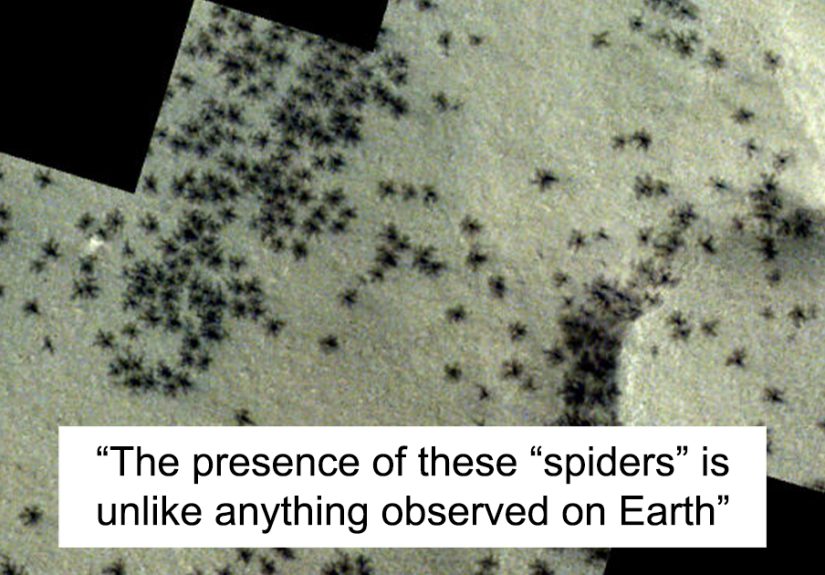
The recent images that sent the internet into a mild panic show dark, spider-like markings scattered across a region near Mars’ south pole, close to an area nicknamed Inca City. From orbit, the patterns look eerie enough to make even brave people whisper, “Nope.” But behind the nightmare fuel is a very real science story involving carbon dioxide ice, trapped gas, dust eruptions, and the kind of weather that would absolutely ruin a beach vacation.
In other words, Mars is not being overrun by space arachnids. It is being gloriously, weirdly, and very scientifically Mars-like.
What Are the “Spiders” on Mars, Exactly?
The scientific name for these features is araneiform terrain, which is a fancier way of saying “ground patterns that look suspiciously spider-ish.” They are branching, radial trough systems carved into the Martian surface, mostly in the planet’s southern polar regions. Some are relatively small, while others can stretch to impressive sizes and appear in clusters that make the landscape look like it got doodled on by a cosmic goth with a very steady hand.
These formations are unusual because they do not have a direct Earth equivalent. That is a big deal. Planetary scientists love a good comparison, but araneiforms are one of those rare features that force Mars to stand on its own and say, “No, seriously, I do things differently here.”
That difference matters. The “spiders” are not just creepy-looking stains in a photograph. They preserve evidence of active seasonal processes on modern Mars, showing that the planet is not a dead, frozen display case. It still changes. It still breathes, in its own dusty, carbon-dioxide-powered way.
Why the New Satellite Images Look So Unsettling
The newest widely shared images highlighted hundreds of dark blotches and tendril-like forms near Mars’ south pole and around the outskirts of Inca City, also known more formally as Angustus Labyrinthus. That area is already visually dramatic because of its geometric ridges and maze-like terrain. Add dark seasonal markings that resemble spiders, and the result is basically “ancient alien wallpaper meets haunted winter desert.”
Part of the reason the imagery feels so intense is scale. From high above, you are not looking at a single odd shape. You are seeing an entire landscape dotted with these forms. The black spots appear sprinkled across hills, plains, and plateaus, and in higher-detail views, some reveal the branching tendrils that gave them their nickname in the first place.
Also, let’s be honest, the word “spiders” is doing a lot of heavy lifting. Scientists may use “araneiform” in papers, but once the public sees something that looks like a spider army on another planet, subtle language usually leaves the chat. The headlines practically write themselves.
Still, there is an important clarification here: what many outlets loosely called “satellite footage” was not video in the usual sense. These were high-resolution orbital images collected by spacecraft instruments and released publicly. The phrase sounds dramatic, but the science is dramatic enough on its own.
How Mars Makes “Spiders” Without Any Actual Spiders
The answer comes down to seasonal carbon dioxide ice, sunlight, trapped gas, and a process that sounds almost fake until you realize Mars has been pulling this trick for ages.
The Step-by-Step Science
- Winter lays down a carbon dioxide ice layer. In the Martian south polar region, carbon dioxide from the atmosphere freezes onto the surface during winter. That means Mars grows seasonal caps of dry ice, not just water ice.
- Spring sunshine starts the trouble. When sunlight returns, it passes through translucent slabs of carbon dioxide ice and warms the darker ground underneath.
- The bottom of the ice turns to gas. Instead of melting into liquid, the carbon dioxide sublimates, changing directly from solid to gas. Mars skips the messy puddle stage and goes straight to pressure problems.
- Gas builds under the ice. Because the ice above still acts like a cap, gas becomes trapped below it.
- The gas finally erupts. When the pressure gets high enough, the ice cracks. Gas bursts upward, carrying dark dust and sand with it, then drops that material back onto the surface. Over time, the escaping gas scours branching channels into the ground below, leaving the spider-like pattern behind.
This process also creates the dark spots seen in the imagery. Those blotches are basically surface evidence that the gas-and-dust escape act is underway. In short, the black marks are Mars saying, “Spring is here, and I would like to explode a little.”
Even better for science, these features can help researchers understand the seasonal carbon dioxide cycle on Mars, the mechanical behavior of Martian ice, and how surface materials erode under conditions that simply do not exist on Earth.
Why Scientists Care So Much About a Planet Full of Nightmare Scribbles
The public reaction to Mars spiders is usually some version of “absolutely not,” but scientists see something else: a rare window into active planetary change.
Araneiforms matter because they are tied to today’s Martian climate, not just the ancient past. A lot of Mars science focuses on what the planet used to be like when it had rivers, lakes, and maybe conditions friendlier to life. The spiders, by contrast, tell us that modern Mars still has dynamic seasonal processes strong enough to reshape the surface.
They also help researchers study how carbon dioxide moves between the surface and atmosphere. On Mars, that exchange is not some background detail. It is a major part of how the planet’s weather and polar behavior work. If you want to understand Mars as a living planetary system, you need to understand how this dry-ice cycle behaves.
There is also the delicious scientific bonus that araneiforms have no direct terrestrial analog. That makes them valuable test cases for planetary geology. Scientists cannot simply hike out to a desert on Earth and say, “Yep, same thing.” They have to combine orbital imagery, modeling, lab work, and seasonal monitoring to figure out what is happening.
In other words, Mars spiders are not just creepy eye candy. They are one of the best examples of how strange environments produce strange landforms, and how patient science turns “What on Earth is that?” into “What on Mars is that, and how exactly does it work?”
Inca City Makes the Whole Scene Even Wilder
Part of the fascination comes from where the spiders were seen. Inca City is one of the weirdest-looking places on Mars, famous for a network of linear ridges that look oddly geometric from orbit. The name is informal, but once you see the pattern, it sticks. It really does resemble the outlines of ancient ruins.
Scientists still debate exactly how this region formed. Possibilities include ancient dune fields that hardened over time, material that moved through fractured crust, glacially related features, or the structural aftermath of an impact crater. The ridges appear to trace part of a large circular structure, which has led researchers to suspect that the “city” may sit inside an old crater around 86 kilometers across.
Now add the spider features around the outskirts of that already mysterious terrain and you get a near-perfect storm of visual drama. It is Mars serving architectural oddity, seasonal geyser scars, and unnerving black markings all in one shot. Frankly, the planet understands branding.
The 2024 Lab Breakthrough Made the Story Even Better
For years, the leading explanation for Mars spiders was the Kieffer model, which proposed that sunlight penetrates seasonal carbon dioxide ice, warms the soil below, and creates pressurized gas that eventually bursts out. It was a strong idea, but like many strong ideas in planetary science, it became much more powerful once researchers could reproduce key parts of it experimentally.
That happened in 2024, when NASA scientists reported that they had successfully recreated spider-forming processes in a lab for the first time using simulated Martian conditions. Inside JPL’s delightfully named DUSTIE chamber, researchers cooled Martian soil simulant, lowered the air pressure, condensed carbon dioxide ice, and then warmed the setup enough to produce an erupting plume.
That is huge. It means scientists were not just pointing at weird shapes on Mars and saying, “Pretty sure gas did this.” They were able to produce plume behavior that supports the process believed to carve the terrain. The experiments also revealed extra complexity, including cracking between grains in the simulant, which suggests the real Martian process may be a little messier than the cleanest textbook version.
And honestly, that is classic science. The better we get at testing a theory, the more nature reminds us that it enjoys plot twists.
Why the “Horrifying” Headline Is Funny, but the Real Story Is Better
Yes, the images are creepy. Yes, “Mars Covered in Hundreds of Spiders” is the sort of headline designed to make coffee spill across keyboards. But the truth is more interesting than the scare factor.
These features show Mars in motion. They connect orbital photography, climate science, surface physics, dust transport, and seasonal ice behavior in one weird little package. They also highlight how much modern Mars still has going on, even though it looks barren at first glance.
And perhaps most importantly, they remind us that alien worlds do not need alien animals to be astonishing. Sometimes a layer of dry ice, a burst of gas, and a little dark dust are enough to create one of the most unforgettable landscapes in planetary science.
Mars does not have to be alive to feel dramatic. It just has to be itself.
The Human Experience of Seeing Mars “Spiders” for the First Time
There is something uniquely powerful about the first time you see one of these images and realize that the black forms are not random marks. They are patterned. Intent-looking. Disturbingly organized. Your brain goes straight to biology because humans are wired to recognize shapes, faces, and threats. On Earth, if you see dark branching forms scattered across a landscape, your imagination tends to get loud very quickly.
That reaction is part of what makes the Mars spider story such a memorable one. It is not just a scientific curiosity. It is a reminder that planetary exploration is also a human experience shaped by emotion, surprise, and sometimes a tiny burst of cosmic dread. The public sees the pictures and thinks horror movie. Scientists see the same pictures and think seasonal sublimation. Both reactions, in their own way, are signs that the images are doing their job: they stop people in their tracks.
For researchers, the experience is different but no less thrilling. Imagine spending years studying strange marks on a distant planet, building models, comparing images across seasons, and trying to prove that trapped carbon dioxide gas is the culprit. Then, after repeated attempts, you finally watch a plume erupt inside a laboratory chamber built to imitate Martian conditions. That moment is not just exciting. It is personal. It is the kind of breakthrough that makes years of tedious setup, failed runs, and recalibrated assumptions suddenly worth it.
There is also a quieter human story in how these features are studied. Citizen scientists helped identify possible spider terrain in broader Mars imagery, guiding follow-up work and showing that scientific discovery is not limited to people in lab coats standing next to million-dollar hardware. Sometimes it also involves thousands of volunteers staring at images on laptops and saying, “Hang on, that patch looks weird.” Space science can be grand, but it can also be wonderfully democratic.
For the rest of us, the experience of Mars spiders lands somewhere between awe and discomfort. The features are beautiful in a dark, severe way. They make Mars look active, strange, and almost emotionally charged. You are reminded that other worlds are not just dots in the sky or textbook diagrams. They are places with seasons, textures, landscapes, and weather patterns so foreign that they produce phenomena with no real Earth counterpart.
That is why the spider images linger in the mind. They compress a huge idea into a single visual shock: another planet can still surprise us. Not with little green men or giant monsters, but with unfamiliar natural processes that look uncannily familiar to our pattern-hungry brains. The result is a strange blend of fear, delight, curiosity, and humility.
And maybe that is the best experience of all. You look at a picture from millions of miles away, feel weirdly unsettled for a second, then learn the science and come away even more impressed. Mars gets your attention with the spooky stuff, then keeps it with geology. That is a pretty good trick for a cold desert world.
Conclusion
The so-called spiders in the latest Mars imagery are not evidence of extraterrestrial life, but they are proof that the Red Planet still knows how to put on a show. These dark, branching features form through a seasonal cycle of carbon dioxide ice, trapped gas, dust eruptions, and surface erosion unlike anything found on Earth. That makes them spooky enough for headlines, but far more valuable as scientific clues.
So yes, the pictures are a little horrifying. But they are also a spectacular reminder that some of the universe’s best “monster stories” turn out to be geology wearing a very dramatic costume.