Table of Contents >> Show >> Hide
- Why NASA Built Perseverance the Way It Did
- Step 1: Start With the Science Questions
- Step 2: Build Around Survival, Not Comfort
- Step 3: Assemble It in a Clean Room Like It’s Going to Another Planet
- Step 4: Learn From the Rover That Came Before
- Step 5: Test It Like Mars Is Actively Trying to Ruin Your Day
- Step 6: Package It for Launch and Trust the Rocket
- Step 7: Design for the Mission After This Mission
- What the Mars 2020 Rover Teaches Us About NASA Engineering
- Experience and Reflections: What This Topic Feels Like Up Close
- Conclusion
If you have ever looked at NASA’s Mars 2020 rover and thought, “That’s a very expensive six-wheeled science toaster with a laser,” you are not entirely wrong. But Perseverance is much more than a glorified metal bug on Mars. It is the result of years of engineering, testing, arguing, redesigning, testing again, and then testing the test equipment just to be safe. Building a rover is not like assembling a car, and it is definitely not like putting together furniture with one mysterious leftover screw. It is more like building a mobile laboratory that has to survive launch, space travel, a terrifying landing, freezing nights, dust, radiation, and rocks that seem personally offended by wheels.
The Mars 2020 mission, better known by the name of its rover, Perseverance, was designed to explore Jezero Crater, study Mars’ geology, search for signs of ancient microbial life, and collect carefully sealed samples for possible return to Earth. That scientific ambition shaped every design decision. NASA did not just need a rover that could drive around and snap pretty pictures. It needed a robot geologist, chemist, camera operator, weather observer, sample collector, and future mission pathfinder all in one machine.
Why NASA Built Perseverance the Way It Did
NASA did not start from scratch with Mars 2020, because that would be the engineering equivalent of saying, “What if we make everything harder for fun?” Instead, the agency built Perseverance on the proven architecture of the Curiosity rover. That heritage approach mattered. Curiosity had already shown that a large nuclear-powered rover could land safely, survive on Mars, and perform long-term science. By using that successful foundation, NASA reduced risk while making room for important upgrades.
That does not mean Perseverance is just Curiosity in a fresh coat of white paint. The chassis is slightly longer, the rover is heavier, the instruments are more advanced, and the mission goals are more ambitious. Curiosity was designed to assess habitability. Perseverance was designed to go a step further by seeking signs of ancient life and caching rock and regolith samples for future return. In other words, Curiosity asked, “Could Mars once have supported life?” Perseverance follows up with, “Okay, but where are the best clues, and can we package them neatly for later?”
Step 1: Start With the Science Questions
NASA does not build a rover and then wonder what to do with it. It starts with the science. For Mars 2020, the big questions were clear: Was Jezero Crater once habitable? Did it preserve signs of ancient microbial life? Which rocks are worth collecting for eventual analysis on Earth? Those questions dictated the tools, the mobility system, the landing strategy, and even the way the rover stores samples.
That science-first mindset is why Perseverance carries such a sophisticated instrument suite. Cameras like Mastcam-Z help scientists examine terrain in stereo and zoom in on distant features. SuperCam uses imaging, lasers, and spectrometers to study rocks from a distance. PIXL analyzes chemical elements at fine scales. SHERLOC looks for organics and minerals linked to past watery environments. MEDA monitors weather and atmospheric conditions. RIMFAX peers underground. MOXIE, meanwhile, tested technology for turning Martian carbon dioxide into oxygen, which sounds like science fiction until NASA casually does it.
Every instrument had to earn its spot. Space missions are ruthless about mass, power, thermal constraints, and complexity. If a tool cannot justify its ride to Mars, it stays home. In Perseverance’s case, the payload reflects a carefully balanced science strategy: study the surface, inspect targets up close, understand environmental conditions, and preserve the most compelling samples.
Step 2: Build Around Survival, Not Comfort
Mars is not welcoming. It has dust, cold, radiation, thin atmosphere, rough terrain, and absolutely zero roadside assistance. So NASA builds rovers with survival in mind from the first sketch. Perseverance uses a Multi-Mission Radioisotope Thermoelectric Generator, or MMRTG, which converts heat from decaying plutonium into electricity. That gives the rover dependable power and warmth without relying on sunlight. Solar panels are wonderful, but Mars has a habit of throwing dust around like it is decorating for a very bleak holiday party.
The rover’s body protects computers, electronics, and key systems from punishing conditions. Its suspension system helps all six wheels stay in contact with uneven ground. The robotic arm must be strong, precise, and stable enough to place instruments against rock surfaces and collect cores. The mast must carry cameras and sensors high enough to survey the landscape while surviving vibration, cold, and repeated use.
This is the hidden truth of rover engineering: the glamorous science only happens because thousands of unglamorous engineering details work perfectly. Cables must tolerate temperature swings. Fasteners must stay secure after launch vibrations. Moving parts must function after months of travel through space. Software must anticipate problems that humans cannot fix with a quick service call. On Mars, every bolt is a commitment.
Step 3: Assemble It in a Clean Room Like It’s Going to Another Planet
Because it is.
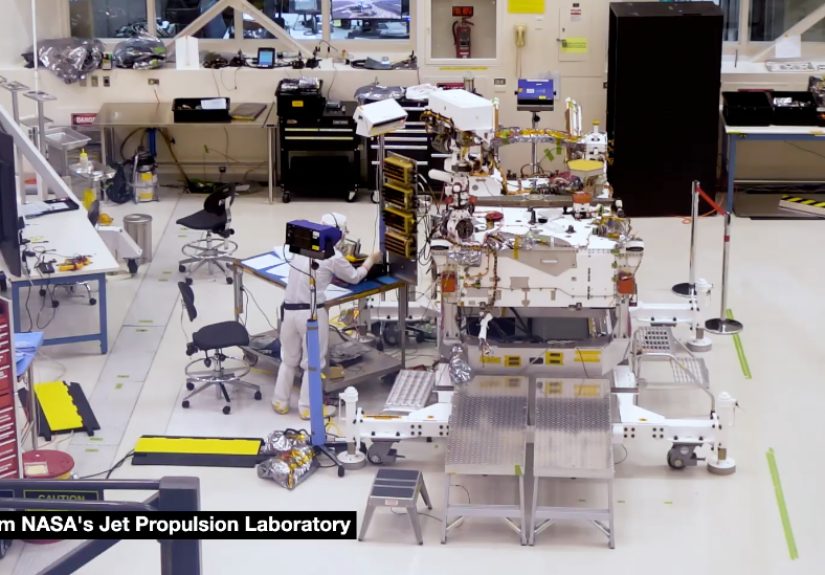
Perseverance was assembled at NASA’s Jet Propulsion Laboratory in a clean-room environment with strict contamination controls. Engineers and technicians wore protective suits, masks, gloves, and coverings to reduce particles and microbes. That cleanliness matters for two major reasons. First, Earth contaminants could interfere with delicate hardware and instruments. Second, NASA wants to avoid carrying as much terrestrial biology as possible to Mars, especially on a mission that is specifically hunting for signs of ancient life. Finding proof of life is exciting. Finding proof that someone sneezed in the clean room is less so.
Assembly is not one dramatic moment when a crane lowers the rover body and everyone applauds. It is a long campaign of subsystem integration. The mobility system, power source, avionics, instruments, cameras, arm, sample tubes, and communications hardware all have to be installed, checked, rechecked, and tested as a complete system. Engineers do not just ask, “Does this part work?” They ask, “Does it still work when attached to all the other parts, under thermal stress, after vibration, with flight software, and while operating on schedule?”
That is especially important for a rover like Perseverance because the sample caching system is astonishingly complex. It is one of the most intricate robotic subsystems NASA has ever sent to another planet. The rover has to core rock, handle tubes, assess sample condition, seal those tubes, store them, and eventually deposit some on the surface. That requires precision closer to surgical handling than to casual drilling. Mars gets all the headlines, but the tube management deserves a standing ovation.
Step 4: Learn From the Rover That Came Before
NASA’s rover-building philosophy is refreshingly humble for an organization that lands robots on other worlds. Engineers study what worked and what did not on previous missions. Curiosity, for example, taught valuable lessons about wheel wear. Sharp, embedded Martian rocks turned out to be much tougher on aluminum wheels than expected. So Perseverance received redesigned wheels that are slightly larger, somewhat narrower, with thicker skins and a revised tread pattern intended to better withstand rough terrain.
Autonomy also improved. Perseverance can think through navigation tasks faster than Curiosity, which helps it cover more ground with less human micromanagement. Since Mars is far away and signals take time, rover driving is less like using a remote-control car and more like sending a patient, very intelligent intern a detailed memo and waiting for the next status update. The smarter the rover, the more science it can do between human instructions.
NASA also improved the camera suite, audio capability, sampling hardware, and landing technology. Perseverance carried more cameras than earlier interplanetary missions of its kind, along with microphones that helped capture sounds from Mars and from rover operations. Each addition turned the mission into a better scientific platform and a better engineering demonstrator for future exploration.
Step 5: Test It Like Mars Is Actively Trying to Ruin Your Day
Because Mars will absolutely try.
Before launch, NASA subjects rover hardware to brutal testing. Components and integrated systems face vibration tests to simulate the violence of launch. Thermal tests expose hardware to extreme temperatures. Vacuum chambers mimic space-like conditions. Mobility systems are tried on rock fields and Mars-yard terrain. Software is validated again and again because once a rover leaves Earth, there is no patch cable long enough to save you.
Landing hardware gets especially intense scrutiny. Perseverance used a daring entry, descent, and landing sequence that built on Curiosity’s sky-crane approach while adding Terrain Relative Navigation. That system compares onboard images with mapped terrain during descent, helping the spacecraft determine where it is and steer away from hazards. In plain English, NASA taught the spacecraft to look down, realize “that area seems terrible,” and aim somewhere less awful. That capability mattered because Jezero Crater is scientifically rich but also riskier than a nice, flat, boring patch of Mars.
Testing is where engineering optimism meets engineering reality. Ideas that look beautiful in design reviews can fail under vibration, heat, timing constraints, or integration. Good teams expect that. NASA’s culture around rover development is not about pretending perfection exists. It is about finding failure modes on Earth, where failure is embarrassing, instead of on Mars, where failure becomes a documentary.
Step 6: Package It for Launch and Trust the Rocket
After assembly and testing comes another truth about rover building: eventually your masterpiece has to ride a giant controlled explosion. Perseverance launched on a United Launch Alliance Atlas V 541 rocket from Cape Canaveral on July 30, 2020. By that point, the rover was no longer just a rover. It was part of a larger spacecraft system that included the cruise stage and the entry vehicle needed to survive the trip and reach the Martian surface.
Launch configuration changes the engineering challenge. Hardware must be protected during transport, encapsulation, ascent, and interplanetary cruise. Deployment mechanisms have to remain dormant at the right times and then wake up exactly when needed. The spacecraft has to tolerate long-duration travel in deep space before attempting one of the hardest landings in robotic exploration.
That is one reason NASA relies so heavily on disciplined systems engineering. Building a rover is not simply about making a good robot. It is about integrating a robot into a launch system, a cruise system, an entry system, a landing system, and a mission operations system. The rover is the star, but the whole ensemble has to hit every cue.
Step 7: Design for the Mission After This Mission
One of the smartest things NASA does is build rovers that answer today’s science questions while opening doors for tomorrow. Perseverance is a perfect example. Its sample tubes were designed for possible return to Earth, where laboratories far larger and more capable than anything sendable to Mars could analyze them in detail. MOXIE tested oxygen production from the Martian atmosphere as a step toward future human exploration. Ingenuity, which flew with Perseverance as a technology demonstration, proved powered flight on another planet and expanded how NASA thinks about robotic scouting.
That future-facing approach is central to how NASA builds rovers. A rover is not just a one-off gadget. It is part of a larger exploration strategy. Engineers ask not only what this rover must do, but what it can teach the next rover, the next lander, the next helicopter, and eventually the next human crew. Every mission becomes both a scientific expedition and a rehearsal for the future.
What the Mars 2020 Rover Teaches Us About NASA Engineering
Perseverance shows that NASA builds rovers through an elegant mix of caution and audacity. The caution comes from reusing proven architecture, obsessing over contamination control, and testing relentlessly. The audacity comes from targeting an ancient river delta, deploying advanced autonomy, collecting samples for possible return, and carrying experiments aimed at future astronauts.
In other words, NASA does not confuse “reliable” with “boring.” It builds on what works so it can attempt what has never been done.
That is the real story behind the Mars 2020 rover. It is not merely a machine on another world. It is a lesson in disciplined innovation. NASA begins with science, borrows wisely from past success, designs for survival, tests without mercy, and plans years ahead. The result is a rover that can drive, drill, analyze, cache, adapt, and inspire.
And yes, it still looks a little like a six-wheeled science toaster with a laser. But now you know just how much genius it takes to build one.
Experience and Reflections: What This Topic Feels Like Up Close
There is something uniquely fascinating about following a story like the Mars 2020 rover because it makes engineering feel human. On paper, Perseverance is a machine made of aluminum, titanium, software, instruments, cables, seals, motors, and power systems. But when you study how NASA builds rovers, you start to see the fingerprints of thousands of decisions made by real people. One team worries about a wheel tread pattern. Another debates contamination limits for sample tubes. Another checks whether an instrument can survive vibration. Another rehearses landing sequences until the process feels less like a mission plan and more like a high-stakes symphony. The rover becomes a kind of collective autobiography written in hardware.
That experience is what makes the topic so compelling for readers. It is easy to admire the dramatic moments, like launch day or touchdown in Jezero Crater, but the deeper emotional pull comes from everything hidden beneath those milestones. There is patience in the clean-room work. There is humility in redesigning wheels after Curiosity’s wear patterns taught hard lessons. There is imagination in building a machine that can look for signs of ancient life in rocks no human has touched. And there is nerve, a breathtaking amount of nerve, in trusting years of work to survive seven months in space and a landing sequence that unfolds in minutes millions of miles away.
For many people, reading about rover development creates a strange but wonderful mix of feelings: curiosity, pride, suspense, and perspective. Curiosity because the mission is full of clever solutions to impossible-seeming problems. Pride because it is a reminder that human beings can still build things that aim higher than convenience and profit. Suspense because every system has to work together with almost no room for error. Perspective because Mars has a way of making everyday worries feel smaller for a moment. You start the article thinking about a rover and end up thinking about what disciplined collaboration can actually achieve.
There is also an almost cinematic quality to NASA rover stories. The clean room feels like a backstage area before opening night. The launch vehicle is the dramatic exit. The cruise stage is the long quiet journey between acts. The landing is the scene where everyone in the audience forgets to breathe. Then the rover arrives and begins the slow, methodical work that matters most. Unlike a movie, though, there is no magic trick hiding behind the curtain. The wonder comes from process, not illusion. That may be the most inspiring part of all.
If you spend enough time with this topic, you also realize that rovers are excellent teachers. They teach systems thinking. They teach respect for iteration. They teach that “innovation” is rarely one giant leap and more often a thousand carefully verified steps. They teach that failure data is valuable, that precision matters, and that big dreams need boring checklists. Perseverance is a glamorous mission, but its success rests on unglamorous excellence. That is a lesson with value far beyond planetary science.
Ultimately, writing or reading about how NASA builds rovers feels like standing at the intersection of science, engineering, and storytelling. The machines are technical, but the mission is deeply emotional. We send rovers because we want answers, but also because we want to know that we are still the kind of species that asks big questions and builds brave tools to chase them. Perseverance is a rover, yes, but it is also a reminder that exploration is not an abstract ideal. It is a practiced craft, built piece by piece, tested step by step, and carried forward by people willing to solve one hard problem after another until a robot can roll across another planet and send the story back home.
Conclusion
The Mars 2020 rover is one of the clearest examples of how NASA builds world-class robotic explorers: start with the science, rely on proven architecture, improve what past missions taught, control contamination, test relentlessly, and design every subsystem for survival and discovery. Perseverance did not appear because NASA had a cool robot idea. It exists because engineers and scientists translated mission goals into a machine capable of exploring Jezero Crater, collecting precious samples, and preparing the way for future Mars exploration.
That is why the story of Perseverance matters. It is not just about Mars. It is about method. NASA builds rovers by combining imagination with discipline, ambition with redundancy, and bold exploration with incredibly careful engineering. That is how a concept becomes hardware, how hardware becomes a spacecraft, and how a spacecraft becomes a working laboratory on another world.