Table of Contents >> Show >> Hide
- What Is the Perimeter of a Shape?
- How to Find the Perimeter of a Shape: 9 Steps
- Step 1: Identify the type of shape
- Step 2: Make sure you only care about the outside edge
- Step 3: Write down every side length
- Step 4: Fill in missing side lengths when possible
- Step 5: Choose the best perimeter formula, if there is one
- Step 6: Add the side lengths carefully
- Step 7: Keep the units consistent
- Step 8: Double-check that you found perimeter, not area
- Step 9: Test your answer for reasonableness
- Examples of Finding the Perimeter of Different Shapes
- Common Mistakes When Finding Perimeter
- Why Perimeter Matters in Real Life
- of Real-World Experience With Perimeter
- Conclusion
If geometry had a greatest-hits album, perimeter would absolutely make the track list. It is simple, useful, and sneaky enough to show up in homework, construction, landscaping, interior design, sports fields, and that one craft project you thought would take “maybe 20 minutes.” In plain English, perimeter is the total distance around the outside of a shape. That is it. No smoke, no mirrors, no dramatic violin soundtrack.
Still, plenty of people get tripped up when the shape is irregular, when a side is missing, or when a circle rolls into the conversation and starts insisting on being called circumference. This guide breaks the whole thing down into nine easy steps, so you can find the perimeter of almost any 2D shape without breaking into a cold sweat or accidentally calculating the area instead.
Whether you are helping a student, brushing up for a test, or trying to figure out how much fence, trim, ribbon, or edging you need, this step-by-step guide will help you find the perimeter of a shape with confidence.
What Is the Perimeter of a Shape?
The perimeter of a shape is the total length of its outer boundary. Imagine placing a string around the edge of a figure, then stretching that string into a straight line and measuring it. That length is the perimeter. For polygons, you usually find perimeter by adding the lengths of all the sides. For some common shapes, there are shortcut formulas that make the math faster.
One quick note before we begin: for a circle, the distance around the outside is usually called circumference rather than perimeter. Same idea, different name, because circles like to be special.
How to Find the Perimeter of a Shape: 9 Steps
Step 1: Identify the type of shape
Before you touch a calculator, figure out what you are looking at. Is it a triangle, rectangle, square, pentagon, regular polygon, irregular polygon, composite figure, or circle? This matters because the shape tells you whether you should add every side one by one or use a formula.
A regular polygon has equal side lengths, so life gets easier. A rectangle has opposite sides equal. A square has four equal sides. An irregular shape usually means you need to slow down, label carefully, and add the outside edges only.
Think of this step as geometry’s version of reading the room. If you misidentify the shape, the rest of the calculation can go sideways in a hurry.
Step 2: Make sure you only care about the outside edge
This sounds obvious until it is not. Perimeter only includes the outer boundary. Interior lines, diagonals, split sections, and decorative doodles do not count unless they are part of the outside edge.
For example, if you have an L-shaped figure made from two rectangles, do not add the lines inside where the rectangles meet. Only trace the path you would follow if you were walking around the shape without cutting across the middle like a rule-breaking squirrel.
Step 3: Write down every side length
Now label every outside side. If the shape is simple, the side lengths may already be given. If not, measure them with a ruler or use the information provided in the problem. This step is especially important for irregular polygons, where each side may be different.
If you are working on graph paper, count the units carefully. If the shape is drawn to scale, measure each side and use the correct unit. If the problem gives lengths in mixed units, like inches and feet, do not add them until you convert everything to the same unit.
That last point matters more than people think. Adding 12 inches to 3 feet without converting is a math version of putting orange juice in your coffee. Technically possible, emotionally upsetting.
Step 4: Fill in missing side lengths when possible
Many perimeter problems leave out one or more sides on purpose. That is not cruelty. It is “critical thinking.” Fortunately, geometry gives you clues.
If you have a rectangle and one vertical side is 4 inches, the opposite vertical side is also 4 inches. If one horizontal side is 9 inches, the opposite horizontal side is 9 inches too. In a square, if one side is 6 feet, all four sides are 6 feet. In a regular hexagon, if one side is 3 centimeters, every side is 3 centimeters.
For composite figures, you can often find missing sides by comparing full lengths and partial lengths. For instance, if a total horizontal stretch is 12 units and one visible section is 5 units, the missing section may be 7 units. The key is to use the geometry of the figure instead of guessing wildly and hoping the universe approves.
Step 5: Choose the best perimeter formula, if there is one
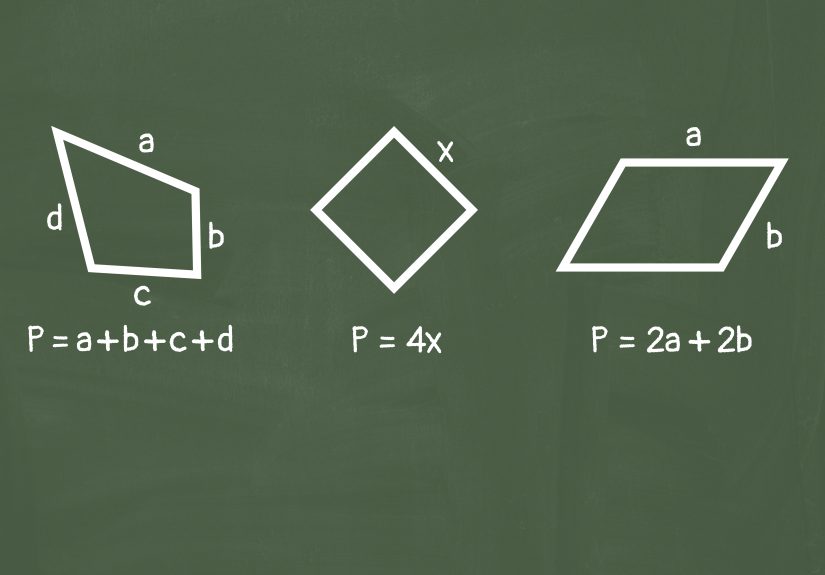
Some shapes deserve a shortcut. Here are the most common perimeter formulas:
Triangle: P = a + b + c
Square: P = 4s
Rectangle: P = 2l + 2w, or 2(l + w)
Regular polygon: P = n × s, where n is the number of sides and s is the side length
Circle: C = 2πr or C = πd
These formulas save time and reduce mistakes. If a shape does not have a neat formula, no problem. You can always go back to the golden rule: add all the outside side lengths.
Step 6: Add the side lengths carefully
This is the moment of truth. Add every outside side once, and only once. Work in an organized way, such as clockwise around the shape, so you do not skip a side or count one twice.
Here is a simple example with a rectangle:
Length = 8 feet, width = 5 feet
Perimeter = 2(8) + 2(5) = 16 + 10 = 26 feet
Here is an example with an irregular pentagon:
Side lengths = 3 in, 5 in, 4 in, 6 in, 2 in
Perimeter = 3 + 5 + 4 + 6 + 2 = 20 inches
And a regular octagon example:
8 sides, each 7 cm
Perimeter = 8 × 7 = 56 cm
Nothing fancy here. Just patient addition. Perimeter is often more about accuracy than complexity.
Step 7: Keep the units consistent
Your final answer should always include a unit, such as inches, feet, meters, or centimeters. Perimeter is a linear measurement, so do not use square units. That is for area.
If your side lengths are given in different units, convert before adding. For example:
1 foot = 12 inches
100 centimeters = 1 meter
Suppose two sides are 24 inches each and two sides are 3 feet each. Convert first:
3 feet = 36 inches
Perimeter = 24 + 24 + 36 + 36 = 120 inches
Could you convert to feet instead? Absolutely. Just do not mix units mid-problem like a chaotic cooking show.
Step 8: Double-check that you found perimeter, not area
This is one of the most common mistakes in geometry. Perimeter measures the distance around a shape. Area measures the space inside a shape. They are not the same thing, even if they occasionally show up to the same party.
If your answer is in square inches or square feet, you probably found area instead of perimeter. If you multiplied length times width for a rectangle when the question asked for perimeter, you took a wrong turn. Turn around. The math police are not coming, but your teacher might notice.
A quick self-check helps:
- Did I add the outside edges?
- Did I use linear units, not square units?
- Did I include every outside side exactly once?
Step 9: Test your answer for reasonableness
Even correct-looking math can hide a careless mistake. Before you move on, ask whether your answer makes sense. If a side length is 10 and your total perimeter somehow ends up 6, something has gone deeply wrong. If a small sketch produces a perimeter of 9,000 miles, maybe check the unit conversion before alerting the cartographers.
Estimate mentally when possible. For a rectangle measuring about 8 by 5, the perimeter should be a little more than 20, not 200. For a regular hexagon with side length 4, the perimeter should be 24. A quick reasonableness check catches skipped sides, bad arithmetic, and sneaky calculator typos.
Examples of Finding the Perimeter of Different Shapes
Rectangle example
A backyard garden bed is 12 feet long and 7 feet wide.
Perimeter = 2(12 + 7) = 2(19) = 38 feet
If you are buying border fencing, 38 feet is your starting number. You would probably buy a little extra, because gardens never respect the original plan.
Square example
A square picture frame has side lengths of 15 inches.
Perimeter = 4 × 15 = 60 inches
Triangle example
A triangle has sides of 6 cm, 8 cm, and 11 cm.
Perimeter = 6 + 8 + 11 = 25 cm
Regular polygon example
A regular pentagon has side length 9 meters.
Perimeter = 5 × 9 = 45 meters
Composite shape example
An L-shaped floor border has outside side lengths of 8 ft, 3 ft, 5 ft, 4 ft, 3 ft, and 7 ft.
Perimeter = 8 + 3 + 5 + 4 + 3 + 7 = 30 feet
The trick is tracing only the outside path. No shortcuts through the middle, no bonus lines, no geometry freestyling.
Circle example
A circular table has radius 10 inches.
Circumference = 2πr = 2 × π × 10 = 20π ≈ 62.8 inches
Strictly speaking, this is circumference, but people often mention it when learning about perimeter because it serves the same “distance around” purpose.
Common Mistakes When Finding Perimeter
- Confusing perimeter with area. Perimeter is around; area is inside.
- Forgetting a side. Irregular shapes love to test your focus.
- Counting an interior line. Only the outside boundary counts.
- Ignoring missing-length clues. Rectangles, squares, and regular polygons give you built-in shortcuts.
- Mixing units. Convert first, then add.
- Leaving off the unit. A naked number is not a finished measurement.
Why Perimeter Matters in Real Life
Perimeter is not just a classroom concept. It helps people solve practical problems every day. Contractors use it to estimate trim, edging, and fencing. Homeowners use it when measuring rooms, gardens, patios, and walls. Coaches and field designers think about boundary distances. Crafters use perimeter when adding ribbon, lace, or borders. Even map reading and floor planning use perimeter thinking.
In other words, perimeter is one of those math skills that keeps showing up long after the worksheet disappears. It is the geometry equivalent of a reliable friend who owns a tape measure.
of Real-World Experience With Perimeter
Perimeter makes a lot more sense when it leaves the textbook and starts bumping into real life. One of the most relatable examples is setting up a garden. Imagine someone builds a small rectangular vegetable bed that measures 10 feet by 4 feet. At first, they might think they need 40 feet of edging because “ten plus four is fourteen, and maybe I should round up dramatically.” Then the math kicks in. The perimeter is 2(10 + 4) = 28 feet. That difference matters when you are paying for materials. Suddenly, perimeter is not an abstract vocabulary word. It is the reason you do not overspend on plastic edging and end up with twelve extra feet curling sadly in the garage.
Teachers often see the same lightbulb moment when students use masking tape on the floor to outline shapes. The minute students physically walk the boundary, perimeter stops being mysterious. They realize it is literally the distance around the edge. Not through the middle. Not all the space inside. Just the border. It is one thing to hear “add the side lengths.” It is another thing to walk a rectangle, count each stretch, and feel the measurement in your legs. Geometry gets a lot friendlier when your sneakers are involved.
Perimeter also sneaks into home projects. Picture someone redecorating a bedroom and wanting to install peel-and-stick trim around the top of the walls. They measure the room and get 12 feet by 11 feet. The perimeter is 46 feet. Easy enough. But then there is a closet cutout on one wall, and now the room is not a neat rectangle anymore. Suddenly the project turns into an irregular-shape perimeter problem. Every outside section needs to be measured and added carefully. This is exactly where people learn the hard way that “close enough” is a dangerous phrase in math and in home improvement.
Sports provide another great example. Think about a baseball diamond practice area or a soccer drill zone marked with cones. Coaches often need the total boundary distance to know how much tape, rope, or chalk to use. Students who think perimeter is boring tend to change their opinion once it becomes the difference between enough field-marking paint and a very awkward half-finished rectangle in the grass.
Even baking and crafts can bring perimeter to life. Suppose someone decorates a square cake with frosting rope along the edge or adds ribbon around a handmade sign. The question is not the area of the top. It is the distance around the edge. That is perimeter, wearing a party hat.
The biggest lesson from all these experiences is simple: perimeter works best when you treat it as a boundary problem. Trace the outside. Measure carefully. Keep units consistent. Use formulas when the shape allows it. Add everything once. Check that the answer makes sense. Once people see perimeter in gardens, floors, fields, and frosting, it stops feeling like school math and starts feeling like useful math. And useful math is the kind people actually remember.
Conclusion
Finding the perimeter of a shape is not complicated once you know the routine. Identify the shape, focus on the outside boundary, write down each side length, fill in any missing sides, choose a formula when it helps, add carefully, keep units consistent, check that you found perimeter instead of area, and make sure your answer is reasonable.
That is the whole game. Whether the shape is a triangle, rectangle, regular polygon, irregular figure, or circle with its fancy circumference label, the goal stays the same: measure the distance around the outside. Master that idea, and perimeter problems become much less intimidating and a lot more useful.