Table of Contents >> Show >> Hide
- What Is a Diagonal in a Polygon?
- How to Find How Many Diagonals Are in a Polygon: 11 Steps
- Step 1: Know what counts as a diagonal
- Step 2: Count the number of sides or vertices
- Step 3: Understand why a triangle has zero diagonals
- Step 4: See how many diagonals can come from one vertex
- Step 5: Multiply by the number of vertices
- Step 6: Divide by 2 to avoid double counting
- Step 7: Use the formula
- Step 8: Work through a full example
- Step 9: Learn the shortcut connection to combinations
- Step 10: Solve backward problems too
- Step 11: Watch out for common mistakes
- Examples by Polygon Type
- Why This Formula Makes Sense Geometrically
- When to Use This Method
- Conclusion
- Extra Section: Real Experiences Learning Polygon Diagonals
- SEO Tags
Polygons are one of those geometry topics that seem innocent at first. A triangle? Cute. A square? Friendly. A decagon? Suddenly it feels like math invited the whole neighborhood. But here is the good news: finding how many diagonals are in a polygon is much easier than it looks.
If you have ever stared at a many-sided shape and thought, “There is no way I am drawing every single diagonal by hand,” congratulations, you are thinking like a practical mathematician. The smart move is to use a pattern and a formula instead of turning your notebook into a spaghetti bowl of line segments.
In this guide, you will learn exactly how to find the number of diagonals in a polygon in 11 clear steps. We will cover the logic behind the formula, work through examples, show how to solve backward problems, and point out common mistakes that trip people up. By the end, polygon diagonals will feel a lot less mysterious and a lot more manageable.
What Is a Diagonal in a Polygon?
A diagonal is a line segment that connects two nonadjacent vertices of a polygon. In plain English, it joins two corners that are not already connected by a side.
For standard school geometry problems, the diagonal-count formula is used for convex polygons and regular polygons. That is the version most textbooks, worksheets, and exams mean when they ask for the number of diagonals in an n-sided polygon.
How to Find How Many Diagonals Are in a Polygon: 11 Steps
Step 1: Know what counts as a diagonal
Before you count anything, make sure you know what you are counting. A diagonal is not a side. It does not connect a corner to itself. It also does not connect to a neighboring corner, because that would just be one of the polygon’s sides.
This matters because many students overcount at the very beginning. If you can spot which line segments are sides and which ones are true diagonals, you are already ahead of the game.
Step 2: Count the number of sides or vertices
To find the number of diagonals, you need the number of sides in the polygon. This value is usually written as n.
- A triangle has 3 sides, so n = 3.
- A square has 4 sides, so n = 4.
- A pentagon has 5 sides, so n = 5.
- A decagon has 10 sides, so n = 10.
Because every polygon has the same number of sides and vertices, you can count either one. Just make sure you do not accidentally count your coffee mug as one of the sides if you are doing homework at breakfast.
Step 3: Understand why a triangle has zero diagonals
A triangle is the smallest polygon, and it has no diagonals at all. Why? Because every vertex is adjacent to the other two vertices. There are no nonadjacent corners available to connect.
This is a great reality check. If your formula or counting method gives a triangle even one diagonal, something has gone sideways.
Step 4: See how many diagonals can come from one vertex
Pick one vertex of a convex polygon. How many diagonals can you draw from that single corner?
You cannot draw a diagonal to:
- the vertex itself
- the vertex on one side
- the vertex on the other side
That means from one vertex, you can draw diagonals to n – 3 other vertices.
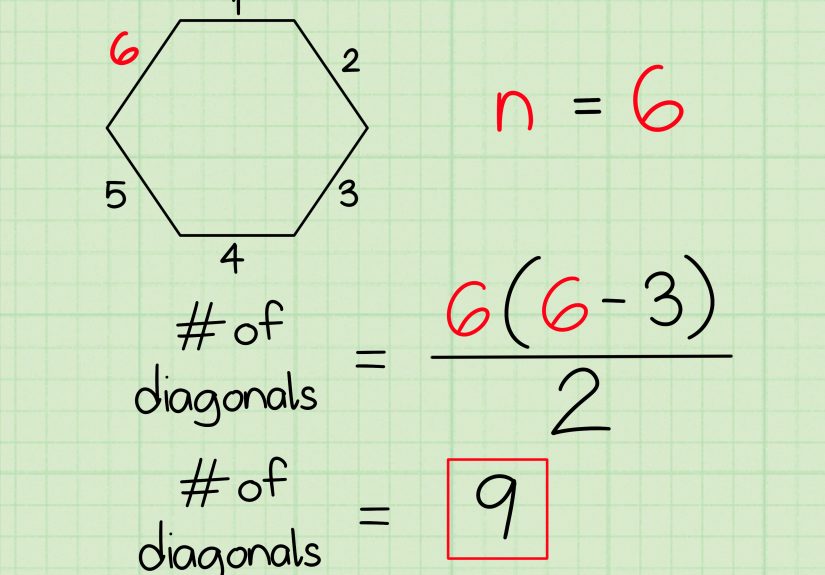
For example, in a hexagon where n = 6, one vertex can connect by diagonal to 6 – 3 = 3 nonadjacent vertices.
Step 5: Multiply by the number of vertices
If one vertex gives you n – 3 diagonals, then all n vertices together seem to give:
n(n – 3)
So far, so good. But there is one little hitch. Actually, it is a pretty big hitch wearing a fake mustache: double counting.
Step 6: Divide by 2 to avoid double counting
Every diagonal has two endpoints. That means each diagonal gets counted once from one end and again from the other end.
So after multiplying by n, you have counted every diagonal twice. To fix that, divide the result by 2.
This gives the standard formula:
D = n(n – 3) / 2
Here, D stands for the number of diagonals and n stands for the number of sides.
Step 7: Use the formula
Now the hard part is over. Once you know n, just plug it into the formula:
D = n(n – 3) / 2
Let’s try a few quick examples:
- Square: D = 4(4 – 3) / 2 = 4 / 2 = 2
- Pentagon: D = 5(5 – 3) / 2 = 10 / 2 = 5
- Hexagon: D = 6(6 – 3) / 2 = 18 / 2 = 9
- Octagon: D = 8(8 – 3) / 2 = 40 / 2 = 20
Once you do this a few times, the pattern becomes surprisingly friendly.
Step 8: Work through a full example
Suppose you are asked: How many diagonals are in a decagon?
A decagon has 10 sides, so n = 10.
Use the formula:
D = n(n – 3) / 2
D = 10(10 – 3) / 2
D = 10(7) / 2
D = 70 / 2
D = 35
So a decagon has 35 diagonals.
That is much faster than drawing 35 separate line segments and hoping your eyes still work afterward.
Step 9: Learn the shortcut connection to combinations
There is another neat way to think about the same formula. Any two vertices can be connected, so the total number of line segments between pairs of vertices is:
n(n – 1) / 2
But that total includes both sides and diagonals. Since a polygon has n sides, subtract those:
n(n – 1) / 2 – n
Simplify it:
[n(n – 1) – 2n] / 2 = [n² – 3n] / 2 = n(n – 3) / 2
Same answer, different route. This is especially useful if you like seeing where formulas come from instead of memorizing them like a robot with trust issues.
Step 10: Solve backward problems too
Sometimes the question is reversed. Instead of giving the number of sides, it gives the number of diagonals.
For example: A polygon has 35 diagonals. How many sides does it have?
Set up the equation:
n(n – 3) / 2 = 35
Multiply both sides by 2:
n(n – 3) = 70
Expand:
n² – 3n = 70
Move everything to one side:
n² – 3n – 70 = 0
Factor:
(n – 10)(n + 7) = 0
The solutions are n = 10 and n = -7. Since a polygon cannot have negative sides unless geometry has entered a very dramatic phase, the answer is:
10 sides
Step 11: Watch out for common mistakes
Even when the formula is simple, there are a few classic errors that show up again and again.
- Forgetting to divide by 2: This is the biggest one. If you skip that step, every diagonal gets counted twice.
- Using the wrong value for n: Make sure n is the number of sides or vertices, not the number of angles you think look interesting.
- Calling a side a diagonal: Adjacent vertices form a side, not a diagonal.
- Assuming triangles have diagonals: They do not. Triangles are all edges, no extras.
- Mixing up “number of diagonals” with “length of a diagonal”: Those are totally different problems.
Examples by Polygon Type
Here is a quick diagonal count reference list for common polygons:
- Triangle: 0 diagonals
- Quadrilateral: 2 diagonals
- Pentagon: 5 diagonals
- Hexagon: 9 diagonals
- Heptagon: 14 diagonals
- Octagon: 20 diagonals
- Nonagon: 27 diagonals
- Decagon: 35 diagonals
Notice how the number rises quickly. That is why drawing and counting works for small shapes, but the formula becomes your best friend once the polygon starts collecting too many sides.
Why This Formula Makes Sense Geometrically
There is a deeper geometry idea hiding behind this topic. When you draw all the diagonals from one vertex of a convex polygon, you split the polygon into n – 2 triangles. That is the same idea used to find the sum of interior angles in a polygon.
In other words, diagonals are not just random lines zigzagging around for decoration. They help break a complicated shape into simpler parts. And in geometry, simpler parts are where understanding usually begins.
That is one reason polygon diagonals show up so often in school math. They connect counting, algebra, shapes, and angle relationships all in one tidy package.
When to Use This Method
Use the diagonal formula when you are dealing with:
- convex polygons
- regular polygons
- classroom exercises asking for the total number of diagonals
- test questions that give the number of sides and ask for diagonals
- reverse problems that give diagonals and ask for the number of sides
It is efficient, reliable, and much cleaner than drawing fifty lines and whispering, “I hope that is all of them.”
Conclusion
Finding how many diagonals are in a polygon may sound like a tricky geometry challenge, but the process is actually straightforward once you break it down. First, identify the number of sides. Next, remember that each vertex can connect to n – 3 nonadjacent vertices. Then divide by 2 because every diagonal gets counted twice. That gives you the formula:
D = n(n – 3) / 2
That single formula can help you solve quick practice problems, larger polygon questions, and even reverse-engineering problems where the number of diagonals is given first. It is one of those rare math shortcuts that is not cheating. It is just smart.
So the next time a polygon shows up with an alarming number of sides, do not panic. Count the sides, plug in the formula, and let algebra do the heavy lifting. Geometry loves a dramatic entrance, but in this case, the ending is beautifully simple.
Extra Section: Real Experiences Learning Polygon Diagonals
One reason this topic sticks with students is that it often starts with confusion and ends with a surprisingly satisfying “Ohhh, I get it now.” At first, many people try to draw every diagonal by hand. That works for a square or maybe a pentagon, but by the time you reach an octagon or decagon, the page starts to look like a spider built a modern art exhibit. That moment of visual chaos is actually useful. It teaches why math formulas exist in the first place: not to make life harder, but to save us from counting line soup.
In classrooms, polygon diagonal problems are also a great example of how patterns lead to formulas. A student might list the first few results: triangle equals 0, quadrilateral equals 2, pentagon equals 5, hexagon equals 9. At first the numbers seem random, but then the differences begin to form a pattern. That is often the turning point. Instead of seeing geometry as a pile of shapes, students start seeing it as a system with structure. That shift is powerful.
Another common experience is realizing that the formula is not magic. When teachers explain that each vertex connects to n – 3 other vertices, students can suddenly see where the expression comes from. Then comes the second surprise: every diagonal was counted twice, so divide by 2. That little correction often feels like the plot twist in a detective movie. Once you notice it, the whole case makes sense.
There is also something satisfying about backward problems. If a polygon has 35 diagonals, how many sides does it have? Those questions feel more advanced, but they are really just the same idea wearing a fake mustache. You write an equation, solve the quadratic, ignore the silly negative answer, and move on feeling smarter than you did five minutes earlier. That is a pretty good return on investment for one geometry problem.
For many learners, polygon diagonals become a confidence-builder. They combine visual reasoning, arithmetic, algebra, and logic in one topic that is challenging without being impossible. Once students master this, they often become more comfortable with formulas in general because they see that formulas are usually compressed stories. The diagonal formula tells a whole story about vertices, adjacency, and double counting in a single line.
Even outside school, the experience can be useful. Designers, architects, engineers, programmers, and puzzle lovers all benefit from recognizing patterns inside shapes. You may never wake up in the middle of the night needing the diagonal count of a nonagon, but learning how to derive and trust a pattern is a skill that shows up everywhere. And honestly, there is a tiny thrill in being the person who can calmly say, “That decagon has 35 diagonals,” while everyone else is still trying to draw them.
So yes, polygon diagonals are a geometry topic. But they are also a memorable lesson in how math rewards clear thinking. You begin with corners and line segments, and you end with a formula that feels earned. That is the kind of math experience people actually remember.