Table of Contents >> Show >> Hide
- What Is a Divisor?
- The Big Idea: Prime Factorization Does the Heavy Lifting
- How to Determine the Number of Divisors of an Integer: 10 Steps
- Step 1: Decide Whether You Are Counting Positive or All Divisors
- Step 2: Know the Special Cases
- Step 3: Find the Prime Factorization
- Step 4: Write the Factorization in Prime-Power Form
- Step 5: Add 1 to Each Exponent
- Step 6: Multiply the New Numbers Together
- Step 7: Practice With a Simple Example
- Step 8: Try a Larger Number
- Step 9: Count Odd Divisors, Even Divisors, and Special Types
- Step 10: Check Your Work With a Quick Reasonableness Test
- Why the Divisor Formula Works
- Common Mistakes to Avoid
- More Worked Examples
- How This Skill Helps Beyond Homework
- Experience Notes: What Learners Usually Discover While Practicing
- Conclusion
Counting divisors may sound like the kind of math task that lives in a dusty textbook, wearing tiny spectacles and asking for silence. But once you know the trick, it becomes one of the cleanest, fastest, and most satisfying skills in number theory. Instead of listing every possible factor one by one, you can use prime factorization to determine the number of divisors of an integer in a few smart steps.
This guide breaks the process into 10 practical steps, with examples, shortcuts, and common mistakes to avoid. Whether you are solving homework, preparing for a math contest, building stronger arithmetic skills, or trying to understand why numbers behave the way they do, this method will save time and spare your calculator from emotional distress.
What Is a Divisor?
A divisor of an integer is a whole number that divides it evenly, leaving no remainder. For example, the positive divisors of 12 are 1, 2, 3, 4, 6, and 12. Each one fits perfectly into 12, like puzzle pieces that actually belong in the box.
When people ask for the “number of divisors,” they usually mean the number of positive divisors. Negative divisors also exist, because -2 divides 12 just as evenly as 2 does. However, most classroom and contest problems focus on positive divisors unless the problem says otherwise.
The Big Idea: Prime Factorization Does the Heavy Lifting
The most efficient way to count divisors is to start with the integer’s prime factorization. Prime numbers are numbers greater than 1 that have exactly two positive divisors: 1 and themselves. Examples include 2, 3, 5, 7, 11, and 13.
Every positive integer greater than 1 can be written as a product of prime numbers. This is the foundation of the method. Once a number is written in prime-power form, you can count its divisors without listing them all.
Here is the key formula:
If n = p1a × p2b × p3c, then the number of positive divisors of n is (a + 1)(b + 1)(c + 1).
In plain English: factor the number, look at the exponents, add 1 to each exponent, and multiply the results. That is the whole magic trick. No cape required.
How to Determine the Number of Divisors of an Integer: 10 Steps
Step 1: Decide Whether You Are Counting Positive or All Divisors
Before doing any calculations, check what the problem is asking. If it asks for “divisors” or “factors” in a standard math setting, it usually means positive divisors. If it asks for all integer divisors, then every positive divisor has a matching negative divisor.
For example, 6 has four positive divisors: 1, 2, 3, and 6. Its full set of integer divisors is -6, -3, -2, -1, 1, 2, 3, and 6, for a total of eight. So the all-integer count is double the positive-divisor count, except in unusual cases involving zero, which is a special situation.
Step 2: Know the Special Cases
The number 1 has exactly one positive divisor: itself. So the divisor count of 1 is 1. It is not prime, and it is not composite. It sits alone like the mysterious elder of the number kingdom.
The number 0 is different. Every nonzero integer divides 0 because 0 divided by any nonzero integer gives 0. That means 0 has infinitely many integer divisors. In most beginner divisor-counting problems, 0 is avoided for this reason.
For negative integers, count the divisors of the positive version first. For example, -24 has the same positive divisor count as 24, but if you count both positive and negative divisors, double the result.
Step 3: Find the Prime Factorization
To determine the number of divisors of an integer, break the number into prime factors. You can use a factor tree, repeated division, or divisibility rules.
Let’s factor 72:
72 = 2 × 36
36 = 2 × 18
18 = 2 × 9
9 = 3 × 3
So:
72 = 2 × 2 × 2 × 3 × 3
Written with exponents:
72 = 23 × 32
That exponent form is what you need for the divisor formula.
Step 4: Write the Factorization in Prime-Power Form
Prime-power form means grouping the same prime factors together with exponents. Instead of writing 2 × 2 × 2 × 3 × 3, write 23 × 32. It is shorter, cleaner, and much easier to use.
This step matters because the exponent tells you how many choices you have for that prime when building a divisor. For 23, a divisor can use 20, 21, 22, or 23. That gives four choices. For 32, a divisor can use 30, 31, or 32. That gives three choices.
Step 5: Add 1 to Each Exponent
Once the integer is in prime-power form, add 1 to each exponent. Why add 1? Because each prime can appear in a divisor from exponent 0 up to its highest exponent in the original number.
For 72 = 23 × 32:
The exponent of 2 is 3, so it gives 3 + 1 = 4 choices.
The exponent of 3 is 2, so it gives 2 + 1 = 3 choices.
Those choices include using none of that prime. For example, a divisor of 72 does not have to contain a factor of 2. The divisor 9 is simply 32, with 20 quietly doing its invisible job.
Step 6: Multiply the New Numbers Together
Now multiply the adjusted exponent values:
(3 + 1)(2 + 1) = 4 × 3 = 12
So 72 has 12 positive divisors.
Let’s check by listing them:
1, 2, 3, 4, 6, 8, 9, 12, 18, 24, 36, 72
That is 12 divisors. The formula works because every divisor is created by choosing a valid exponent for each prime factor. Multiply the number of choices together, and you get the total number of divisors.
Step 7: Practice With a Simple Example
Find the number of positive divisors of 100.
First, factor it:
100 = 10 × 10 = 2 × 5 × 2 × 5
So:
100 = 22 × 52
Add 1 to each exponent:
(2 + 1)(2 + 1) = 3 × 3 = 9
Therefore, 100 has 9 positive divisors.
The divisors are 1, 2, 4, 5, 10, 20, 25, 50, and 100. Notice how they come from mixing powers of 2 and powers of 5.
Step 8: Try a Larger Number
Now let’s determine the number of divisors of 360.
Start with prime factorization:
360 = 36 × 10
36 = 22 × 32
10 = 2 × 5
So:
360 = 23 × 32 × 51
Apply the formula:
(3 + 1)(2 + 1)(1 + 1) = 4 × 3 × 2 = 24
So 360 has 24 positive divisors.
This is much faster than trying to list every divisor from scratch. Listing is fine for small numbers, but with larger integers, it becomes a slow walk through arithmetic mud.
Step 9: Count Odd Divisors, Even Divisors, and Special Types
Sometimes a problem asks for only odd divisors or only even divisors. The same method still helps.
To count odd divisors, ignore the factor of 2 entirely. Odd divisors cannot include 2 as a factor.
For example, 360 = 23 × 32 × 51. To count odd divisors, use only 32 × 51:
(2 + 1)(1 + 1) = 3 × 2 = 6
So 360 has 6 odd divisors.
To count even divisors, subtract the odd divisors from the total divisors:
24 – 6 = 18
So 360 has 18 even divisors.
You can also count perfect-square divisors. A divisor is a perfect square only when all of its prime exponents are even. For each prime exponent in the original number, count how many even exponent choices are available.
Step 10: Check Your Work With a Quick Reasonableness Test
After using the formula, pause for a quick sanity check. If your number is prime, it must have exactly 2 positive divisors: 1 and itself. If your number is a perfect square, it should have an odd number of positive divisors. That is because one divisor pairs with itself at the square root.
For example, 36 has 9 positive divisors:
1, 2, 3, 4, 6, 9, 12, 18, 36
The middle divisor is 6, which is the square root of 36. That unpaired middle divisor is why perfect squares have an odd number of divisors.
If you get an even divisor count for a perfect square, something probably went sideways. Maybe an exponent was copied incorrectly, or a prime factor escaped your factor tree like a tiny mathematical raccoon.
Why the Divisor Formula Works
The formula works because every divisor of a number comes from choosing powers of its prime factors. Suppose:
n = 23 × 32
Any divisor of n must look like this:
2x × 3y
Here, x can be 0, 1, 2, or 3. That is four choices. And y can be 0, 1, or 2. That is three choices. For every choice of x, there are three choices of y. Therefore, the total number of combinations is 4 × 3 = 12.
This is an example of the multiplication principle: when one decision can be made in several ways and another independent decision can be made in several ways, multiply the number of choices.
Common Mistakes to Avoid
Mistake 1: Forgetting the Exponent of 1
If a prime appears only once, its exponent is 1. For example, in 30 = 2 × 3 × 5, the prime-power form is 21 × 31 × 51. The divisor count is:
(1 + 1)(1 + 1)(1 + 1) = 8
Mistake 2: Adding the Exponents Instead of Multiplying
For 72 = 23 × 32, the answer is not 3 + 2 = 5. It is not even 3 + 2 + 1 = 6. You add 1 to each exponent, then multiply: (3 + 1)(2 + 1) = 12.
Mistake 3: Using Non-Prime Factors
The formula only works with prime factorization. If you write 72 as 8 × 9, you cannot use the exponents from 8 and 9 unless you convert them into primes. Since 8 = 23 and 9 = 32, the correct prime factorization is still 23 × 32.
Mistake 4: Forgetting About 1
Every positive integer has 1 as a divisor. When students list divisors manually, 1 sometimes gets forgotten because it feels too obvious. In divisor counting, “too obvious” is exactly where mistakes like to hide.
More Worked Examples
Example 1: How Many Divisors Does 84 Have?
Factor 84:
84 = 2 × 42 = 2 × 2 × 21 = 22 × 3 × 7
So:
84 = 22 × 31 × 71
Apply the formula:
(2 + 1)(1 + 1)(1 + 1) = 3 × 2 × 2 = 12
Therefore, 84 has 12 positive divisors.
Example 2: How Many Divisors Does 1,000 Have?
Factor 1,000:
1,000 = 103 = (2 × 5)3 = 23 × 53
Apply the formula:
(3 + 1)(3 + 1) = 4 × 4 = 16
So 1,000 has 16 positive divisors.
Example 3: How Many Divisors Does 2,025 Have?
Factor 2,025:
2,025 = 45 × 45 = (32 × 5) × (32 × 5)
So:
2,025 = 34 × 52
Apply the formula:
(4 + 1)(2 + 1) = 5 × 3 = 15
Therefore, 2,025 has 15 positive divisors. Since 2,025 is a perfect square, the odd divisor count makes sense.
How This Skill Helps Beyond Homework
Knowing how to determine the number of divisors of an integer is useful in algebra, number theory, computer science, cryptography basics, contest math, and problem solving. It also helps with greatest common factors, least common multiples, simplifying fractions, and recognizing patterns in numbers.
In programming, divisor counting appears in algorithm challenges where listing every divisor might be too slow. In math competitions, it often appears in problems that look scary until you notice the prime factorization hiding underneath. In everyday math practice, it builds fluency with factors, multiples, primes, and exponents.
Experience Notes: What Learners Usually Discover While Practicing
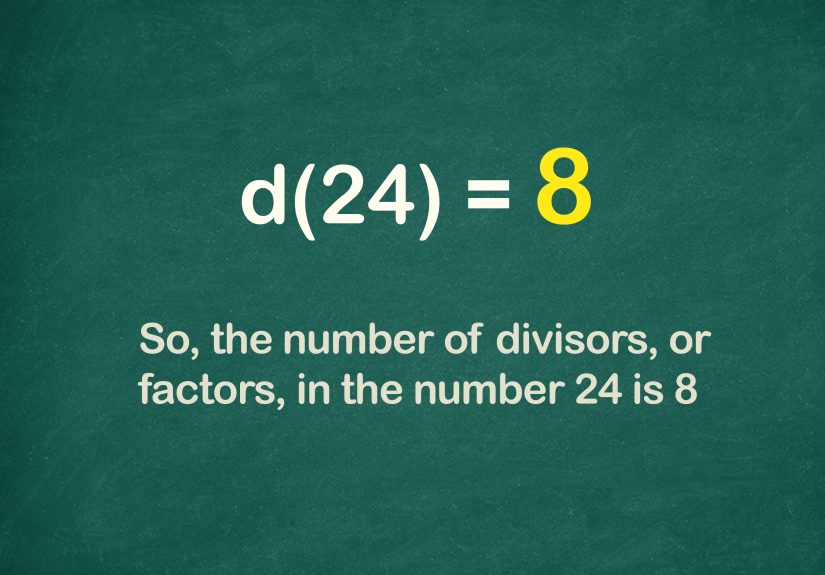
When people first learn how to determine the number of divisors of an integer, they often begin by listing factors manually. That is a healthy starting point. Listing helps you see what divisors actually are. For small numbers like 12, 18, or 24, writing out the divisors builds intuition. You notice that divisors often come in pairs: 1 and 24, 2 and 12, 3 and 8, 4 and 6. This pairing pattern is one of the first “aha” moments. It shows that divisors are not random; they are organized.
The next discovery is that manual listing becomes annoying very quickly. Counting the divisors of 24 is fine. Counting the divisors of 720 by hand feels like trying to organize a sock drawer during an earthquake. That frustration is actually useful because it makes the prime factorization method feel powerful rather than abstract. Once learners see that 720 = 24 × 32 × 51, the divisor count becomes (4 + 1)(2 + 1)(1 + 1) = 30. What looked messy suddenly becomes tidy.
A practical experience tip is to slow down during factorization. Most wrong answers come from factoring errors, not from misunderstanding the divisor formula. For example, students may factor 180 as 22 × 32 × 5, which is correct, but if they accidentally write 2 × 32 × 5, the divisor count changes. One missing exponent can ruin the whole calculation. The formula is loyal, but it only works with the information you give it.
Another helpful habit is to test answers with perfect squares. If the number is a square, the divisor count should be odd. For instance, 144 = 24 × 32, so the divisor count is (4 + 1)(2 + 1) = 15. That odd result is expected because 12 pairs with itself. This quick check catches many mistakes.
Students also improve faster when they practice with numbers that have different shapes. Try a prime number like 47, a prime power like 26, a product of distinct primes like 2 × 3 × 5 × 7, and a mixed number like 540. Each type teaches something slightly different. Prime numbers always have 2 divisors. A prime power pa has a + 1 divisors. A product of several distinct primes doubles the count with each new prime factor.
The best experience-based advice is this: do not memorize the formula like a mysterious spell. Understand the choices behind it. A divisor is built by choosing how many copies of each prime to include. Once that idea clicks, the formula feels obvious. And when math starts feeling obvious, that is usually a sign your brain has quietly upgraded its software.
Conclusion
To determine the number of divisors of an integer, start by finding its prime factorization. Then write the number in prime-power form, add 1 to each exponent, and multiply the results. This method works because every divisor is created by choosing allowable powers of each prime factor.
For example, if n = 23 × 32 × 51, then the number of positive divisors is (3 + 1)(2 + 1)(1 + 1) = 24. Once you understand the pattern, divisor counting becomes faster, cleaner, and much less intimidating.
Note: This article is based on established number theory concepts, including prime factorization, divisor counting, and the multiplication principle, synthesized into original web-ready educational content.