Table of Contents >> Show >> Hide
- Start Here: What the Browning Pattern Is Telling You
- The Most Common Cause: Leaf Scorch (AKA “Summer Burn”)
- Water Problems: Too Little and Too Much Can Look the Same
- Hot Sites Make Leaves Brown Faster
- Root Stress: The Hidden Cause People Miss
- Diseases That Can Cause Summer Browning
- Chemical Injury: When Leaves Brown After Lawn Care
- Fertilizer, Salt, and Nutrient Issues
- What to Do Right Now (Without Making It Worse)
- How to Prevent Summer Browning Next Year
- FAQ
- Real-Life Summer Experiences (and What They Usually Mean)
- The Vacation Surprise: “We were gone five days and now it’s crunchy.”
- The New Tree Panic: “I planted it this spring, and now the leaves are browning.”
- The Driveway Edge Mystery: “Only the side near the pavement is brown.”
- The Post-Lawn-Care Plot Twist: “Now the new growth looks twisted and weird.”
- The “It Happens Every Year” Tree: “Late summer always looks rough, but spring is fine.”
- SEO Tags
You step outside with your iced coffee, admire your yard… and then notice it: brown, crispy leaf edges.
Your tree looks like it tried to toast itself like a marshmallow. Before you panic-water it into oblivion,
know this: brown leaves in summer are common, and they usually come down to one thing
your tree is struggling to move enough water to its leaves fast enough.
The trick is figuring out why. Summer browning can be a harmless one-time “leaf scorch” event,
or it can be the tree’s way of waving a tiny brown flag that says, “Hey… something bigger is wrong down here.”
Let’s decode the clues.
Start Here: What the Browning Pattern Is Telling You
Think of leaf symptoms like a text message from your tree. Not every “brown” means the same thing.
These quick pattern checks can narrow your suspects fast.
1) Brown edges or tips (especially on the sunniest side)
Most often: leaf scorch from heat, dry air, wind, or inconsistent watering.
The leaf loses moisture faster than the roots can replace itso the outer edges dry out first.
2) Brown patches between veins or blotchy scorch
Often: environmental stress plus a “site issue” (hot pavement reflection, compacted soil, root damage),
or sometimes disease. If the pattern looks irregular and spreads unevenly, keep reading.
3) Whole leaves browning and dropping quickly
Possible: severe drought stress, root problems, or certain diseases (some can progress fast).
If a tree loses a lot of leaves in a short window, it’s time to look closely at roots, watering, and species-specific diseases.
4) Only one major branch (or one side of the canopy) looks affected
This can point to root injury, soil issues, or vascular wilt diseases
that block water flow in parts of the tree.
The Most Common Cause: Leaf Scorch (AKA “Summer Burn”)
Leaf scorch isn’t a single diseaseit’s a stress reaction. In summer, the sun is intense, the air can be dry,
winds can be hot, and trees are running their internal plumbing at full speed. When water loss (through leaves)
outpaces water uptake (through roots), leaf cells dehydrateusually starting at the margins.
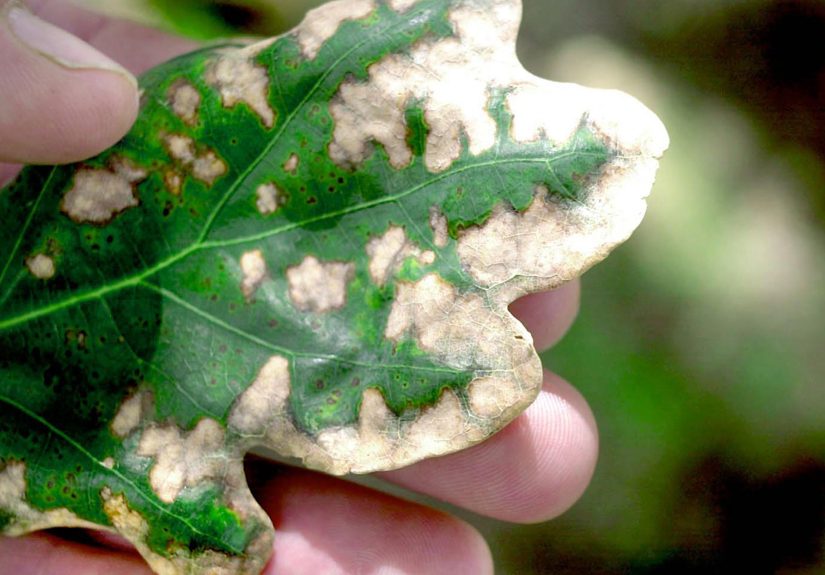
What leaf scorch looks like
- Tan to brown leaf edges and tips
- Sometimes a yellow band between healthy green tissue and the brown area
- Leaves may curl, feel crispy, or drop early
- Often worse on the hottest, sunniest, windiest side of the tree
Why scorch happens more in summer
Summer browning can be triggered by:
heat waves, dry winds, low humidity,
inconsistent watering, and roots that can’t keep up (due to damage, disease, or poor soil).
Newly planted trees are also more vulnerable because their root systems are still limited.
Water Problems: Too Little and Too Much Can Look the Same
Here’s the unfair part: drought stress and overwatering can both cause browning.
Both limit water delivery to leavesdrought because there isn’t enough water, and overwatering because roots can suffocate
and rot in soggy soil.
How to tell which one you’re dealing with
Do a simple soil check before changing your routine:
- Dig 4–6 inches down under the canopy (not right by the trunk).
- If the soil is dry and dusty, drought stress is likely.
- If it’s wet, sticky, or smells swampy, overwatering or poor drainage may be the real villain.
Common drought-stress triggers
- Shallow sprinkling that wets only the surface
- Watering the lawn but not the tree’s deeper root zone
- Heat waves that spike water demand overnight
- Competition from turfgrass (lawns are thirsty roommates)
Common overwatering triggers
- Automatic irrigation running too often
- Clay soil that holds water
- Mulch piled against the trunk (mulch “volcanoes” can trap moisture and stress bark)
- Planting too deeply, which reduces oxygen to roots
Hot Sites Make Leaves Brown Faster
Sometimes the tree isn’t “underwatered” so much as it’s “overcooked.”
Urban and suburban landscapes can create mini heat islands.
Site factors that amplify summer browning
- Reflected heat from pavement, stone, or light-colored walls
- Hot, drying winds (especially in open areas)
- Compacted soil (less oxygen and poorer water infiltration)
- Limited rooting space (trees in small cutouts near sidewalks)
If your tree is planted between a driveway and a south-facing wall, it may be living inside a solar oven.
In these spots, even “normal” watering can fall short because the leaves are losing water like a paper towel in a sauna.
Root Stress: The Hidden Cause People Miss
Leaves are the loud part of the problem. Roots are often the quiet part.
If roots are damaged, stressed, or restricted, the canopy can brown even when the soil looks fine.
Common root-related reasons leaves turn brown in summer
- Construction damage (trenching, grade changes, heavy equipment)
- Soil compaction from foot traffic or vehicles
- Girdling roots (roots circling the trunk and choking water flow)
- Poor drainage leading to root decline
- Root rot pathogens that thrive in wet soils
A classic clue is when only one section of the canopy browns repeatedly,
or browning worsens year after year in the same area. That often maps back to a root-zone issue.
Diseases That Can Cause Summer Browning
Not all browning is environmental. A few diseases peak in summer because heat and water stress
make symptoms show up more dramatically.
Bacterial leaf scorch
This chronic condition often shows up as premature browning in mid- to late summer,
typically starting at leaf margins. In many cases, a yellow band separates green tissue from the brown edge.
Symptoms often repeat and worsen over multiple years, gradually thinning the canopy.
Important: it can look like drought scorch, but watering won’t “fix” it.
Confirmation usually requires lab testing, and management focuses on overall tree health and long-term planning.
Anthracnose (leaf spot/leaf blight group)
Anthracnose diseases cause tan-to-brown irregular spots or blotches, often following veins.
Some trees may drop infected leaves and then push a second flush later.
The good news: on established shade trees, anthracnose is often more cosmetic than fatalthough it can look dramatic.
Oak wilt (a “don’t-ignore-this” disease for oaks)
Oak wilt can cause rapid leaf browning and dropespecially in red oakssometimes progressing quickly.
One distinguishing detail often mentioned by tree specialists: browning may involve larger portions of the leaf,
sometimes including veins, and defoliation can accelerate fast compared with typical scorch.
If you suspect oak wilt, avoid pruning during high-risk periods and contact a local extension office or certified arborist.
Timing and proper diagnosis matter.
Verticillium wilt
Verticillium is a soil-borne fungus that can block water movement. Symptoms can include
wilting and browning on one branch or one side of the tree, and in some cases
discolored streaking in sapwood under the bark. Maples are common hosts.
Chemical Injury: When Leaves Brown After Lawn Care
If browning shows up soon after spraying weedsor after a neighbor didchemical injury deserves a look.
Herbicide drift and misapplication can cause a wide range of symptoms, including:
- Cupped, curled, twisted leaves
- Oddly narrow or “strapped” new growth
- Scorched tips or brown margins
- Distorted stems and reduced vigor
The giveaway is often distortion on new growth, not just crisp edges on older leaves.
If you think chemicals are involved, document symptoms with dated photos and avoid additional stress (like heavy pruning).
Fertilizer, Salt, and Nutrient Issues
Sometimes leaves brown because of what’s in the soiltoo much, too little, or the wrong chemistry.
Fertilizer burn
Over-fertilizing can contribute to marginal leaf burn and stress. Trees already struggling in heat don’t need extra pressure.
If your tree is scorched and you recently fertilized heavily, pause future applications until conditions improve.
Salt stress
In some regions, salt can accumulate from de-icing products or salty irrigation water. Salt stress can show up as leaf scorch-like browning.
If this is common in your area, local extension guidance can help you manage soil salts and irrigation practices.
Nutrient deficiencies (often starting as yellowing)
Certain nutrient issues show up first as yellowing (sometimes with green veins) and may progress to browning if severe.
These problems are highly site-specificsoil pH, drainage, and tree species all matterso a soil test can be smarter than guessing.
What to Do Right Now (Without Making It Worse)
When a tree is stressed, well-meaning “fixes” can backfire. Here’s the calm, tree-friendly plan.
1) Check soil moisture before watering
- If soil is dry several inches down, give the tree a slow, deep soak.
- If soil is already wet, stop frequent irrigation and focus on drainage and root health.
2) Water deeply, not daily
Trees generally do better with occasional deep watering than frequent shallow sprinkling.
Aim to wet the root zone under the canopy, then let the upper soil begin to dry slightly before watering again.
(Newly planted trees may need more frequent attention than established trees.)
3) Mulch like a professional, not like a volcano artist
- Use 2–4 inches of organic mulch under the canopy (keep it off the trunk).
- Mulch helps conserve moisture and moderate soil temperaturetwo big wins in summer.
4) Pause aggressive pruning and heavy fertilizing
Stressed trees need energy. Removing lots of foliage or pushing growth with fertilizer during peak heat can compound stress.
Remove only dead, hazardous branches unless a professional recommends otherwise.
5) Look for “red flags” that need expert help
- Sudden, rapid leaf drop across large sections of the canopy
- One-sided canopy decline that worsens quickly
- Significant branch dieback
- Oaks showing fast browning/wilting in summer (especially if nearby oaks are affected)
- Mushrooms at the base, oozing, cracking bark, or obvious trunk damage
When you need a next step, a certified arborist (and your local cooperative extension office)
can help confirm whether you’re dealing with environmental scorch or something that requires targeted management.
How to Prevent Summer Browning Next Year
- Water proactively during heat waves, especially for young trees.
- Expand mulch rings to reduce lawn competition and conserve moisture.
- Avoid trunk injuries (string trimmers and mowers are tiny chainsaws with bad attitudes).
- Protect the root zone from heavy traffic and construction.
- Choose site-appropriate trees for your climate, soil, sun exposure, and available rooting space.
FAQ
Will the brown leaves turn green again?
Usually, no. Once leaf tissue is crispy-brown, it’s dead. The goal is preventing further damage and supporting healthy growth next season.
Should I remove all the brown leaves?
If leaves are still attached, let the tree decide. Premature stripping can stress the tree more.
Rake up fallen leaves if disease is suspected, since sanitation can reduce repeat issues.
Is my tree dying?
Not necessarily. Many trees bounce back from a bad summer. But repeated annual browning, increasing dieback,
or rapid canopy decline are signs to get a professional diagnosis.
Real-Life Summer Experiences (and What They Usually Mean)
If you’ve ever Googled “tree leaves turning brown in summer” at 11:47 p.m. while side-eyeing your sprinkler system,
you’re in excellent company. Here are some common summer scenarios homeowners run intoand the lessons they tend to learn.
Consider this the “been there, watered that” section.
The Vacation Surprise: “We were gone five days and now it’s crunchy.”
A classic. You leave during a hot spell, come back, and your tree looks like it spent the week blow-drying itself.
What often happened is a double-whammy: high temperatures increased water demand, and irrigation didn’t reach the deeper root zone.
Lawns can look fine because shallow grass roots get frequent light wateringbut trees need moisture deeper down.
The fix is usually a slow, deep soak that rehydrates the root zone, plus mulch to reduce evaporation.
The big takeaway: summer stress can show up fast when the weather is extreme.
The New Tree Panic: “I planted it this spring, and now the leaves are browning.”
Newly planted trees are basically toddlers on a hike: enthusiastic, not fully prepared, and easily dehydrated.
Their roots haven’t spread far, so they can’t “shop around” for moisture. But here’s the twist:
some people respond by watering every day, which can keep soil too wet and reduce oxygen to roots.
That’s how a tree can look thirsty while standing in a puddle. The best approach tends to be consistent moisture,
checked by feel (dig a little), not a rigid calendar. If the soil is damp several inches down, don’t drown it out of guilt.
The Driveway Edge Mystery: “Only the side near the pavement is brown.”
This one is a landscape classic. Pavement reflects heat and dries soil faster, and the tree may have fewer roots on that side
due to compaction or limited space. The result is leaf scorch that’s worse on the “hot side.”
Many homeowners fix this by widening the mulch ring, deep-watering that side more intentionally,
and reducing turf competition. The moral: sometimes the tree isn’t “sick”it’s just living next to a heat mirror.
The Post-Lawn-Care Plot Twist: “Now the new growth looks twisted and weird.”
When browning comes with leaf cupping, curling, twisting, or narrow strap-like leavesespecially on new growth
herbicide drift or misapplication jumps up the suspect list. It can happen from your own yard, a neighbor’s,
or even a windy day that carried a spray where it didn’t belong. In these cases, doubling down on fertilizer or pruning can backfire.
What usually helps most is reducing stress: water appropriately, avoid additional chemicals, and take photos to track progression.
If symptoms persist or worsen, a local expert can help confirm the cause.
The “It Happens Every Year” Tree: “Late summer always looks rough, but spring is fine.”
Some trees are prone to seasonal scorchespecially in climates with intense sun, dry air, or hot winds.
If the tree leafs out beautifully each spring and then browns late every summer without major dieback,
you may be dealing with recurring environmental stress rather than a fast-moving disease.
The long-term solution is usually boring (and effective): better soil moisture management, mulch, and protecting the root zone.
Sometimes, it’s also a sign the species is mismatched for the sitelike asking a cool-weather tree to thrive on a sunny sidewalk strip.
The consistent theme across these experiences is simple: summer browning is often about water movementnot just water presence.
A tree can have water nearby and still struggle if roots are stressed, soil is compacted, or heat and wind pull moisture out faster than it can be replaced.
Once you read the pattern and check the soil, you can make a smart move instead of a frantic one.
And yes, your tree will forgive you for that one time you panic-watered at midnight. Probably.
SEO Tags
Reporting note (for transparency): This article was informed by guidance from multiple U.S. university extension programs, state forestry/natural resource agencies, and public garden/plant pathology references.