Table of Contents >> Show >> Hide
- Why Henrietta Hotel London stands out in Covent Garden
- Dorothee Meilichzon design: playful, layered, and deeply site-specific
- The Covent Garden factor: why the neighborhood matters so much
- Rooms, atmosphere, and the boutique-hotel formula done right
- Food, cocktails, and the Experimental Group effect
- Who should book Henrietta Hotel London?
- Experience Henrietta: what a stay actually feels like
- Final thoughts
If London hotels were auditioning for a stylish lead role, Henrietta Hotel London would not be the one shouting from the back of the room. It would stroll in late, wearing velvet, carrying a very good cocktail, and somehow still steal the scene. Tucked into Covent Garden, this boutique stay has become a favorite for travelers who want more than a bed and a tiny kettle with emotional issues. They want character. They want design. They want location. And ideally, they want all three without feeling like they checked into a museum gift shop.
That is exactly where Dorothée Meilichzon’s design comes in. Her interiors at Henrietta do not simply decorate the hotel; they tell a story about the street, the neighborhood, and the kind of London visit that feels cinematic without becoming cheesy. This is a hotel that understands modern boutique hospitality: give guests a strong sense of place, add a little wit, keep the food and drinks serious, and make every room feel like it has a point of view.
For anyone searching for a new Covent Garden boutique hotel with style, substance, and a refreshingly un-corporate personality, Henrietta remains one of the most interesting answers. It is small enough to feel intimate, polished enough to feel special, and playful enough to avoid the usual luxury-hotel stiffness. Nobody here seems interested in whispering the word “bespoke” every five minutes, which is honestly a relief.
Why Henrietta Hotel London stands out in Covent Garden
Location is the obvious headline. Covent Garden is one of those London neighborhoods that can feel almost suspiciously convenient. The market, the Royal Opera House, theaters, restaurants, bars, and central landmarks are all close enough to make walking the default mode of transportation. That matters because a good boutique hotel does not just give you a room; it gives you an urban rhythm. Henrietta lets guests slip in and out of the neighborhood with almost annoying ease. You can see a show, browse the market, linger over dinner, and still be back in your room before your feet decide to file a formal complaint.
But the hotel’s appeal is not just about pinning the right spot on a map. Henrietta has always leaned into the idea that hospitality should feel personal. The original concept began with 18 rooms and a restaurant-bar setup that made food and drink part of the hotel’s identity rather than an afterthought. That formula helped it stand out from bigger London properties that may offer more facilities but less personality. Over time, the hotel expanded to 40 rooms, yet it kept the boutique feel that made the original version so memorable.
This balance is tricky. Many hotels talk a big game about intimacy and design, then end up feeling either too precious or too generic. Henrietta lands in the sweet spot. It feels designed, yes, but not over-designed. Stylish, but not smug. That distinction matters for travelers who like interiors but do not want to feel judged by a lampshade.
Dorothee Meilichzon design: playful, layered, and deeply site-specific
The reason people keep mentioning Dorothee Meilichzon design whenever Henrietta comes up is simple: the interiors are not random prettiness. They are rooted in the architecture and mood of Henrietta Street and the surrounding Covent Garden area. Meilichzon has said she often starts with the neighborhood, and that approach is visible everywhere here. The local buildings, with their ornamental details, arches, rooflines, and varied facades, become the raw material for the design language inside the hotel.
That translation from street to interior is what makes Henrietta smarter than your average “design hotel.” You can see it in the recurring arches, curved mirrors, glazed shapes, and custom details that echo exterior architectural motifs. Even the restaurant’s skylight concept was tied to the arched glass ceiling of Covent Garden Market. In other words, the design is not just pretty wallpaper and expensive chairs. It is contextual. It listens to the city before it starts talking.
A boutique hotel with a sense of humor
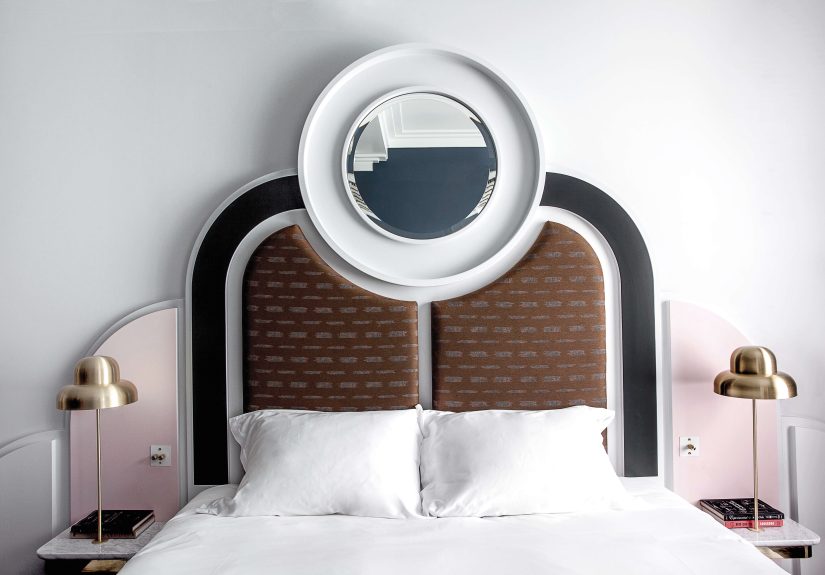
Meilichzon’s work also avoids the coldness that can make some boutique hotels feel like a beautifully lit dentist’s office. At Henrietta, there is warmth and a little theatricality. Oversized headboards, patterned carpets, brass bedside lights, velvet seating, marble details, and playful shapes create rooms that feel composed but alive. They have personality without becoming costume drama. The look nods to Art Deco, Italian influences, and the 1970s, but it blends those references rather than turning them into a design lecture.
That blend is one of the hotel’s biggest strengths. The interiors can be feminine without feeling fragile, retro without feeling gimmicky, and luxurious without drifting into full peacock mode. There are curves, color stories, and textural contrasts everywhere, but they work because the hotel never mistakes volume for charm. It knows when to wink and when to stop talking.
Color, materials, and the magic of details
Several design elements have become closely associated with Henrietta. The rooms use a palette that includes terracotta, green, blush, and other softened tones, often paired with botanical prints or graphic patterns. Carrara marble appears in bathrooms and trim, while brass lighting adds warmth and polish. Some rooms feature statement headboards inspired by Milanese door frames, and the furniture often carries rounded, sculptural forms that hint at 1970s design. These details create the hotel’s visual identity: elegant, a little mischievous, and very photogenic without screaming, “Take a selfie here immediately.”
The material mix matters too. Marble and brass could have made the hotel feel grand in a stiff way, but the softer fabrics, curved lines, and hand-painted or crafted details keep it relaxed. That tension between refinement and informality is where Henrietta gets its charm. It feels upscale, but it still feels human.
The Covent Garden factor: why the neighborhood matters so much
Henrietta would not be Henrietta anywhere else. Covent Garden boutique hotel is not just an SEO phrase here; it is the whole point. Covent Garden carries layers of history, from its centuries-long market life to its deep ties to theater and performance. That mix of commerce, culture, and spectacle gives the neighborhood an energy that is uniquely suited to a design-forward hotel. You are in a part of London that has always known how to put on a show.
That theatrical quality spills into the experience of staying here. The hotel is close to West End theaters, the Royal Opera House, galleries, shopping, and a wide range of restaurants and bars. For first-time visitors, it offers an efficient base. For repeat visitors, it offers a stylish one. Either way, it helps that Henrietta Street itself feels tucked in enough to provide relief from the tourist bustle without disconnecting you from the neighborhood’s pulse.
In practical terms, this means Henrietta works for people who want to do London properly: walk a lot, eat well, duck into museums, catch a show, have one more drink than planned, and still make it back to a comfortable room without needing a heroic transport strategy. That convenience is part of the luxury, even if it is less glamorous than a marble bathtub.
Rooms, atmosphere, and the boutique-hotel formula done right
The original Henrietta made an impression with just 18 rooms, and that smaller scale helped shape its identity. Even after expanding to 40 rooms across townhouses, it still feels intimate rather than sprawling. That is important because the modern boutique-hotel guest usually wants personality first, not endless corridors and a lobby the size of a regional airport.
The rooms are not trying to out-muscle London with sheer square footage. Instead, they make their case through layout, style, and atmosphere. High ceilings, large windows in some rooms, thoughtfully integrated furniture, and strong visual character help them feel more generous than a standard city-center setup. The design does the heavy lifting, but it does so with charm. Floating closets, statement headboards, clever door treatments, layered textures, and rich bathrooms all contribute to the feeling that somebody actually cared about how the room works, not just how it photographs.
That last point matters. Plenty of boutique hotels are all lipstick, no personality. Henrietta, by contrast, seems to understand that true comfort is not the enemy of style. The rooms are eye-catching, but they also seem designed for actual human behavior: sleeping, reading, showering, unpacking, getting ready for dinner, regretting that second cocktail, and then ordering a third anyway.
Food, cocktails, and the Experimental Group effect
You cannot talk about Henrietta without talking about the Experimental Group. The brand’s cocktail roots are essential to the hotel’s DNA, and that is a major reason the property feels livelier than many design-led stays. From the beginning, Henrietta positioned itself as more than a place to sleep. It was a social address, a restaurant-and-bar destination, and a stylish refuge for travelers who appreciate a hotel with some pulse.
That “bed and beverage” spirit shaped the original property and still defines the experience. The food-and-drink offering has evolved over time, but the larger point remains the same: Henrietta treats hospitality as a whole mood, not a checklist. The bar matters. The restaurant matters. The atmosphere downstairs matters just as much as the room upstairs. This is the sort of hotel where a good drink is not a side quest; it is part of the architecture of the stay.
That approach also helps explain why the hotel feels more Parisian in attitude than many London properties. There is a sociability to it, a looseness, a sense that style should be lived in rather than guarded. If some hotels feel like they were designed for people who fear red wine, Henrietta feels like it was designed for people who order another glass and then start talking about lamps.
Who should book Henrietta Hotel London?
Henrietta works especially well for design lovers, theatergoers, couples, stylish solo travelers, and anyone who values atmosphere over sprawling amenities. If your dream hotel includes a huge spa, five conference floors, and a breakfast buffet that resembles a small nation-state, this may not be your match. But if you want a London boutique hotel with personality, excellent location, layered interiors, and a strong food-and-drink identity, Henrietta deserves a serious look.
It also suits travelers who appreciate design that is rich but not intimidating. You do not need a degree in interiors to enjoy what Meilichzon has done here. The hotel is accessible in the best way: visually smart, emotionally warm, and easy to enjoy even if you cannot identify the chair references. Though if you can identify the chair references, you will probably be very happy here.
Experience Henrietta: what a stay actually feels like
Staying at Henrietta Hotel London feels a little like slipping behind the curtain of Covent Garden without losing access to the show. You step in from a neighborhood that is always moving, always humming, always selling tickets, cocktails, flowers, fashion, or some combination of the above, and suddenly the mood changes. The hotel does not mute London; it edits it. Outside is bustle. Inside is composition.
The first thing you notice is that the interiors are confident without being loud. There is color, yes, but it is not color for color’s sake. There are curves, textures, marble edges, brass details, and big headboards that know they are good-looking, but nothing feels like it is trying too hard. The effect is welcoming rather than theatrical, which is impressive given that the whole neighborhood is basically powered by performance. Henrietta manages to feel like a stylish friend’s townhouse if that friend had impeccable taste, a thing for vintage references, and much better lighting than the rest of us.
Mornings here have a particular charm. Covent Garden starts waking up outside, and the hotel feels like a calm pocket within it all. Light lands beautifully in the rooms, especially where the windows are generous, and the layered materials begin to make sense in a different way. At night, the hotel feels glamorous. In the morning, it feels thoughtful. The marble in the bathroom, the brass fixtures, the softness of the upholstery, the visual rhythm of the patterns, all of it reads less like decoration and more like atmosphere. Even the small design gestures start to feel memorable. A mirror shape. A curve in a chair. The way a doorway frames a room. Henrietta is very good at turning details into mood.
Then there is the simple pleasure of where you are. You can head out for coffee, circle the market, wander toward Soho, dip into a museum, or spend an afternoon doing the noble urban activity known as “walking around with no plan and calling it culture.” By evening, the neighborhood shifts again. Theater crowds appear. Bars fill up. The streets get brighter and livelier. Returning to Henrietta after that feels satisfying in a way big hotels rarely manage. You are not retreating into anonymity; you are returning to a place with its own style and pulse.
Perhaps the best way to describe the experience is this: Henrietta feels curated, but never controlled. It offers personality without chaos, elegance without stiffness, and luxury without the exhausting need to prove it. It is the kind of hotel that quietly improves a trip because it sharpens your sense of place. You remember the room, the neighborhood, the textures, the mood, the dinner, the late drink, the ease of getting everywhere, and the satisfying feeling that you chose somewhere with actual point of view. In a city full of grand hotels and polished addresses, Henrietta wins by being specific. And in travel, specific is often what becomes unforgettable.
Final thoughts
Henrietta Hotel London succeeds because it knows exactly what kind of hotel it wants to be. It is not trying to be the biggest, the flashiest, or the most stuffed with amenities. Instead, it offers a tightly edited version of luxury built around location, atmosphere, and Dorothee Meilichzon design. That combination makes it one of the most compelling boutique stays in Covent Garden.
For travelers who want a hotel with visual intelligence, neighborhood connection, and enough personality to stay in the memory long after check-out, Henrietta remains a standout. In a world full of hotels that look expensive but feel forgettable, that is no small accomplishment.