Table of Contents >> Show >> Hide
- What Is Cover Your Assets?
- What Comes in the Game?
- How to Set Up Cover Your Assets
- Key Terms You Need to Know
- How to Play Cover Your Assets
- How Drawing Cards Works
- How a Round Ends
- How Scoring Works in Cover Your Assets
- How to Win the Game
- Advanced Rules: More Mayhem, More Strategy
- Two-Player and Three-Player Rule Changes
- Best Strategy Tips to Win Big
- Common Rules Mistakes
- Game Night Experiences: What Playing Cover Your Assets Actually Feels Like
- Conclusion
- SEO Tags
If your ideal game night includes laughter, mock betrayal, and someone shouting, “You stole my house again?,” then Cover Your Assets is very much your kind of chaos. This fast-paced card game from Grandpa Beck’s Games looks simple at first glance: make matching sets, stack them up, and race to a million dollars. Easy, right? Well, not quite. The catch is that your top set is always in danger, and your friends and family will absolutely try to swipe it the second you look comfortable.
That mix of easy rules and sneaky tension is exactly why people keep coming back to it. The game is quick to learn, surprisingly interactive, and just mean enough to stay funny instead of requiring therapy afterward. In this guide, you’ll learn the Cover Your Assets rules, how to set up the game, how scoring works, what the advanced rules change, and the best ways to play a smarter, sharper, less-weepy game.
What Is Cover Your Assets?
Cover Your Assets is a set-collection card game for 2 to 6 players. In the current official version, the classic rules are best with 4 to 6 players, though there are official adjustments for 2 and 3 players. Your goal is simple: build stacks of matching asset cards, protect your exposed top set, and finish with the most money.
The theme is wonderfully ridiculous. You’re collecting things like piggy banks, baseball cards, bank accounts, speed boats, jewels, classic autos, and homes. It is, in other words, the rare game where stuffing cash under the mattress counts as responsible portfolio management.
What Comes in the Game?
The deck is built around 10 types of asset cards plus wild cards. In the current rule set, the classic game uses the standard asset cards and the Gold and Silver wilds. The advanced game adds extra cards like Swap, Move, and Penny Jar. For most first-time players, classic mode is the right place to start.
One reason the game works so well is that the card values are printed clearly, so scoring is painless. Well, mostly painless. It still stings if your cousin steals your speed boats five seconds before the round ends.
How to Set Up Cover Your Assets
Classic rules setup
- Choose a dealer.
- Remove the advanced-rule cards: Swap, Move, and Penny Jar.
- Shuffle the remaining deck.
- Deal 5 cards to each player.
- Place the rest in the center as the draw pile.
- Flip 1 card face up to begin the discard pile.
- The player to the dealer’s left goes first.
- Leave room in front of each player for a growing stack of sets.
That’s it. No board. No tiny wooden turnips. No 11-minute setup speech. Just shuffle, deal, and prepare to distrust everyone at the table.
Key Terms You Need to Know
Asset
An asset is any regular card you collect into matching sets.
Wild
Gold and Silver cards are wilds. They can match any asset when forming or defending a set. One important rule: when you build a set using a wild, the wild should be placed below the asset card.
Set
A set begins as either two identical asset cards or one asset card paired with one wild. Over time, that set can grow larger if players battle over it.
Stack
Your stack is the pile of multiple sets in front of you. Only the top exposed set is vulnerable in the classic game. Everything underneath is temporarily protected.
How to Play Cover Your Assets
On your turn, you must take one action in the classic game. You cannot pass. Your options are:
- Form a set
- Discard
- Challenge another player to steal a set
1) Form a set
You can form a set in three ways:
- Play two identical asset cards from your hand.
- Use one card from your hand plus the matching top card from the discard pile.
- Use one asset card plus one wild card.
There are three easy-to-miss limits here. First, you cannot form a set using two wild cards. Second, a new set must begin as exactly two cards. Third, even if you make another set of the same asset later, it does not merge with a previous set. It becomes a separate layer in your stack.
Every time you add a new set, stack it on top of the last one in an alternating horizontal-and-vertical pattern. That layout is not just for looks. It helps everyone see which set is exposed and therefore stealable.
2) Discard
If you cannot or do not want to form a set or challenge someone, discard one card face up onto the discard pile. This sounds boring, but smart discarding matters. A bad discard can hand the next player exactly what they need. In Cover Your Assets, even your garbage can become someone else’s investment strategy.
3) Challenge another player
This is the spicy part. To steal the top set from another player, play a matching asset card or a wild card in front of them. If their exposed set is Jewels, you can challenge it with Jewels, Gold, or Silver.
The defender can respond by playing a matching asset or wild from their hand. Then the challenger can respond again. This back-and-forth continues until one player can’t continue or decides not to. The last player to reveal a legal card wins the battle.
Whoever wins gets:
- The contested set
- All cards played during the challenge
That detail is huge. A two-card set can become a chunky, high-value prize after a long challenge. That’s why the game feels so swingy and dramatic. You are not just stealing money; you are inflating it while stealing it.
Two challenge rules people forget
- Your first bottom set is safe and cannot be stolen in the classic game.
- You must have formed at least one set of your own before you can challenge another player’s stack.
Also, you may not draw new cards during a challenge. You fight with what you already have in hand, which means timing matters more than bravado.
How Drawing Cards Works
After you take your action, draw back up to 5 cards. If another player used cards to defend during your turn, they also draw back up to 5 after the action resolves. Then play passes left.
This creates one of the game’s sneakiest rhythms: defending a set may cost you good cards now, but at least you refill afterward. That makes big battles painful, but not permanently devastating.
How a Round Ends
When the draw pile runs out, keep playing until every player has used the rest of the cards in hand. You still may not pass. If you choose not to form a set or challenge, you must discard.
This endgame is where things get deliciously tense. Since no fresh cards are coming, everyone starts calculating who can still defend, who is bluffing confidence, and who is one bad discard away from emotional collapse.
How Scoring Works in Cover Your Assets
Cover Your Assets scoring is straightforward: at the end of the round, add the value of every card in your stack. That means:
- Every card in every set counts
- Cards added during stolen-set battles also count
- Wild cards count at their printed values too
So if you win a long battle over a Classic Auto or Home set, that stack can become dramatically more valuable than it was when the fight started. That is one reason skilled players do not only chase big assets. They also watch for fightable assets: sets juicy enough to attack, but still realistic to defend once stolen.
How to Win the Game
The official rules give you several ways to finish a game:
- Classic game: Play rounds until a player passes $1,000,000 total. That player wins.
- Quick game: Highest score after one round wins.
- Best after 3 rounds: Track round totals and compare after three rounds.
- First to win 2 rounds: Only track round wins, not cumulative money.
If your group likes fast, loud, revenge-filled fun, the quick game is perfect. If your group enjoys grudges with better recordkeeping, the classic race to a million is the better choice.
Advanced Rules: More Mayhem, More Strategy
Once everyone understands the basics, the advanced rules add more depth. They also add more opportunities for you to mutter, “Well, that escalated quickly.”
What changes in advanced play?
- Players are dealt 6 cards instead of 5.
- You may take up to 2 actions on your turn.
- You can Improve a Set by adding one matching non-wild asset to your top set.
- You can play Action cards like Swap and Move.
- The second set from the top can also be challenged, but only with a stronger opening requirement.
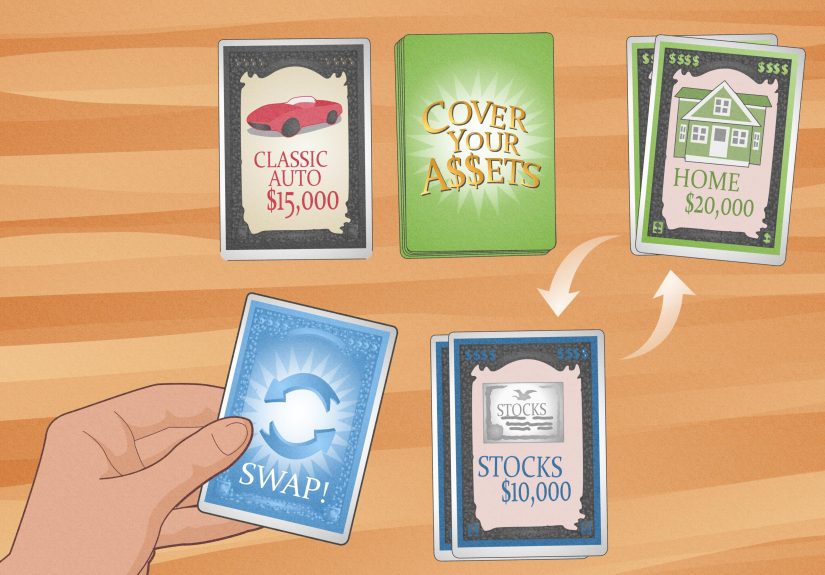
Swap
Swap lets you exchange the top set in your stack with the top set in another player’s stack. According to the official FAQ, a first set may be swapped even though it may not be stolen through a normal challenge. That makes Swap wonderfully rude.
Move
Move lets you shift the top set of any player’s stack to the bottom, or the bottom set to the top. In other words, it can expose a vulnerable prize or bury one for safety.
Penny Jar
The Penny Jar wild is a tiny troublemaker. It works like a special heavy wild in advanced play and can count as two wilds when used in a challenge or defense. It is worth very little in raw points, but strategically it hits like a folding chair in a wrestling match.
Two-Player and Three-Player Rule Changes
If you are playing with fewer people, the official rules adjust the setup so the game still feels lively.
Two players
In the two-player game, some cards are removed, each player gets 6 cards, and three draft piles of 10 cards are created. A new action called Draft a Set allows players to form sets using visible cards from those draft piles. Your opponent may still challenge the set, so it is not exactly a peaceful economic summit.
Three players
Three-player rules are similar to the two-player version, but with the full deck and 5-card hands. The draft-pile arrangement changes based on player positions.
If your group mainly plays as a trio, definitely use the official three-player variant. It keeps the pace up and gives players more shared opportunities instead of waiting around for lightning to strike from the draw pile.
Best Strategy Tips to Win Big
Cover valuable sets quickly
This is the most important rule of survival. If you leave a juicy set exposed, you are basically hanging a “Free Money” sign around its neck. The faster you place a new set on top, the safer the older one becomes.
Do not waste wilds too early
Wild cards are flexible, powerful, and excellent for both offense and defense. Burning one on a low-value set in the first few turns can feel smart until somebody later walks off with your high-value Home set because you no longer have backup.
Attack when the math favors you
Do not challenge just because you can. Challenge when:
- The exposed set is valuable
- The opponent looks card-poor or recently spent cards defending
- You have enough backup to survive a multi-card battle
A failed steal does not just miss; it can enrich your opponent.
Watch what people discard
The discard pile is public information. If someone tosses an asset they probably wanted earlier, that tells you something about their hand. If they stop discarding a suit entirely, they may be holding it for a challenge. Cover Your Assets is not poker, but a little table reading goes a long way.
Use “safe” first sets wisely
Your first set cannot be stolen in the classic game, so it is a great place to park solid value. If you open with a stronger set, you build a stable scoring base and reduce the pain of later thefts.
Know when to discard instead of forcing a play
Sometimes the smartest move is to dump a weak card instead of exposing a vulnerable mid-value set. A flashy move is not always a profitable move. Yes, this is a card game article, but that sentence also sounds like tax advice.
Common Rules Mistakes
- Thinking you can form a set with two wilds. You cannot.
- Thinking same-type sets combine automatically. They do not.
- Forgetting the first bottom set is safe in classic play.
- Using the discard pile to challenge. The official FAQ says no.
- Drawing during a challenge. Also no.
- Forgetting that all challenge cards go to the winner of the battle.
Game Night Experiences: What Playing Cover Your Assets Actually Feels Like
One reason Cover Your Assets has such staying power is that the game creates memorable stories almost by accident. You do not need a giant board, an app, or a cinematic campaign. You just need a handful of cards, a table full of suspiciously confident people, and enough emotional resilience to watch your top set get stolen right before your turn comes around again.
In real game-night settings, the first round usually starts politely. People make small pairs. Someone builds a piggy bank set. Someone else grabs coins from the discard pile and acts like they have discovered fire. Then, somewhere around the moment a speed boat or jewels set becomes exposed, the social contract quietly evaporates. The table changes. Smiles narrow. Voices get louder. Suddenly everyone understands the title of the game on a personal level.
What makes those experiences so fun is that the tension is shared. In many card games, you sit quietly waiting for your turn to matter. Here, you care during other players’ turns because they might attack you, defend against someone else, or expose a stack you can target next. Even when it is not your turn, your blood pressure is technically participating.
Families also tend to like the game because the rules are easy enough for younger players to grasp, while the timing decisions still give adults something to chew on. A child can understand, “I made a pair, now I put it on top,” in about 15 seconds. An experienced player, meanwhile, is thinking, “If I expose this bank account now, Aunt Lisa will absolutely come after it with a Gold card, and I am not emotionally prepared for that.” Both players are engaged, just at different levels.
Another common experience is the dramatic momentum swing. You can feel comfortably ahead, with a tall stack and a smug little grin, and then one battle turns everything upside down. Somebody challenges your top set, you defend, they defend again, you run out of gas, and the winner walks away with a much fatter set than either of you started with. That kind of reversal is exactly why the game stays lively. Nobody is fully safe, and nobody is completely out of it until scoring is done.
The game also produces a lot of table talk. Players bargain, tease, warn, bluff, and occasionally perform fake public service announcements like, “You know, if anyone should steal from anybody, it should obviously be Kevin.” That social energy matters. It turns the game from a mechanical exercise into a loud, funny group event, especially with four or more players.
Perhaps the best thing about the experience, though, is its rhythm. A round is short enough that a brutal loss does not ruin the night. You can get robbed, complain theatrically, shuffle up, and be back in business fast. That makes Cover Your Assets a great filler game, a family favorite, or a warm-up before heavier strategy games. It is not trying to be a three-hour masterpiece. It is trying to create laughter, tension, and at least one hilariously petty grudge per round. On that front, it delivers like a champion.
Conclusion
If you want a card game that is easy to learn, highly interactive, and just chaotic enough to keep everyone locked in, Cover Your Assets earns its popularity. The rules are simple: make sets, protect the top one, steal when you can, and count every dollar at the end. But beneath that simple structure is a sneaky little strategy game about timing, hand management, and knowing exactly when to go for the throat. Learn the core rules first, add the advanced options later, and remember the golden law of this game: if your best set is sitting on top uncovered, it is not your asset anymore. It is merely on loan to the table.