Table of Contents >> Show >> Hide
- The Story: When a “Simple Request” Turns Into a Deal-Breaker
- Why the Weigh-In Demand Was Such a Massive Red Flag
- Wedding Culture + Diet Culture: A Toxic Tag Team
- Body Autonomy Is Not Optional Even for Weddings
- The Internet’s Reaction: Team Bride, Almost Universally
- Where Do Boundaries Fit Into Wedding Planning?
- What Couples Can Learn from the Weigh-In Engagement Disaster
- of Lived Experience: When Wedding Weight Talk Goes Off the Rails
- Conclusion: Love Should Never Be Conditional on a Number on a Scale
Of all the ways an engagement can implode in-law drama, venue disasters, mysterious exes reappearing “I refused to strip for a weigh-in” is not the one most people have on their bingo card. Yet that’s exactly the scenario that blasted across the internet after one bride-to-be walked away from her fiancé when he demanded she lose weight and step on a scale in front of him to prove it.
The story, shared on Reddit and later covered by Bored Panda, hit a nerve because it blended three highly explosive ingredients: wedding stress, diet culture, and controlling behavior disguised as “concern.” The result? An engagement in ruins and a global debate about body autonomy, red flags, and what partners are and absolutely are not entitled to expect from each other.
The Story: When a “Simple Request” Turns Into a Deal-Breaker
Here’s the short version of what happened, based on the original Reddit post and Bored Panda’s coverage:
- The couple got engaged and started planning their wedding. At first, everything felt pretty normal and exciting.
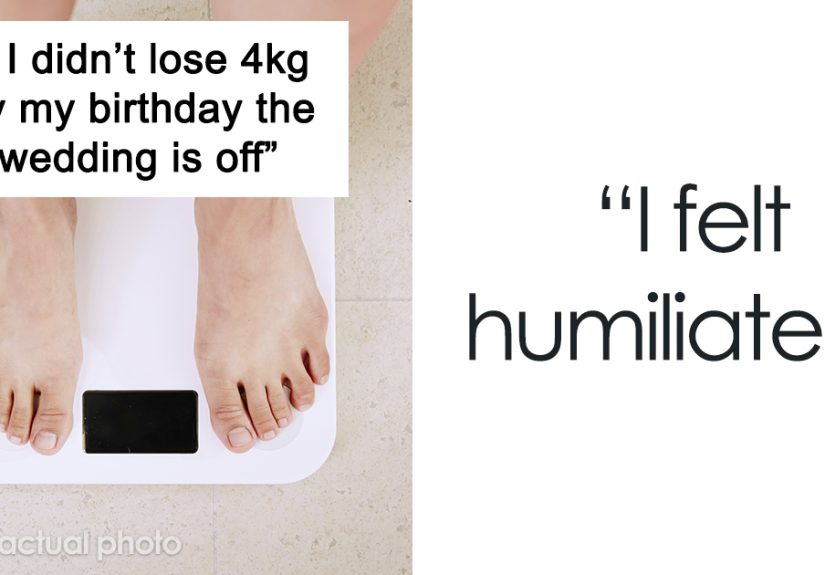
- At some point, the fiancé decided his bride “should” lose about 4 kilograms (roughly 9 pounds) before the big day so she’d “look her best” in photos.
- What began as a “suggestion” slowly escalated into a condition: she was told she needed to lose the weight and prove it or the wedding might not happen.
- He pushed for regular weigh-ins. Not private weigh-ins between her and her doctor, not a casual “how’s it going?”, but literal weigh-ins in front of him.
- Eventually, he wanted her to strip down and step on the scale to “verify” she was meeting his requirement.
- She refused. He got furious. She realized that if her future husband was willing to call off a wedding over a few pounds and her refusal to perform a humiliating weigh-in, this was not someone she wanted to marry.
So she ended the engagement. Cue thousands of comments online, nearly all of them sounding something like: “You didn’t dodge a bullet you dodged the entire firing range.”
Why the Weigh-In Demand Was Such a Massive Red Flag
Let’s be honest: everyone understands that attraction is part of romantic relationships. But there’s a giant canyon between being attracted to your partner and treating your partner like a project with a target weight and compliance checks.
Controlling Your Partner’s Body = Not Romantic, Actually
Experts who work with couples consistently point out that control is one of the biggest red flags in a relationship. Dr. Lauren Fogel Mersy, a psychologist and couples therapist interviewed in the Bored Panda piece, notes that “red flags” often show up around how a partner reacts to your autonomy, needs, and boundaries especially under stress.
Demanding weigh-ins, insisting on specific numbers, and tying the future of the relationship to a clothing size isn’t “motivation.” It’s control. It also sets up a creepy precedent: if a partner feels entitled to dictate your body before the wedding, what happens later when life inevitably brings weight changes, illness, pregnancy, aging, or disability?
Ultimatums Are a Terrible Relationship Tool
Healthy boundaries usually sound like, “I feel X when Y happens, and here’s what I need.” Unhealthy ultimatums sound like, “Do this thing or I’ll blow everything up.”
In this case, the groom-to-be hinted and then basically stated that if she didn’t hit his preferred number on the scale (in his preferred way), the marriage was off the table. That’s not problem-solving; that’s emotional blackmail with a side of body shaming.
Wedding Culture + Diet Culture: A Toxic Tag Team
Part of why this story resonated so widely is that it exposed something a lot of brides already feel but rarely say out loud: weddings are absolutely soaked in diet culture.
Research on brides and bridesmaids has found that over 50% of participants plan to lose weight before the wedding, and about two-thirds intend to exercise more as part of “beauty prep.” Articles in Psychology Today and similar outlets have pointed out that the “shred for the wed” mentality is now practically a wedding industry slogan, pushing people toward crash diets and extreme workouts in the name of a single day.
Organizations like the National Eating Disorders Association have warned that wedding-focused dieting can quickly spiral from “just tightening up a bit” into disordered eating and obsession with weight. And body image nonprofits note that brides, grooms, and wedding party members all report feeling intense pressure to look “perfect” in photos.
So this groom’s attitude didn’t appear out of thin air. It came from a culture that treats weddings like a high-stakes photoshoot instead of a meaningful commitment between two humans who will, shockingly, change over time.
Body Autonomy Is Not Optional Even for Weddings
There’s a key concept at the center of this story: body autonomy. Simply put, it means each person gets to make decisions about their own body without coercion or humiliation.
Body autonomy covers obvious things like consent, medical decisions, and reproductive health. But it also includes more everyday issues: whether you gain or lose weight, what you wear, what you eat, and whether you choose to share your weight with anyone at all.
When a partner demands to monitor your weight like a coach with a clipboard, they’re not just commenting on your appearance they’re trying to take authority over your body. That’s why so many readers found the bride’s refusal so powerful: she recognized that the “small” issue on the surface (a few kilos) was really a test of something much bigger.
The Internet’s Reaction: Team Bride, Almost Universally
On Reddit, in the Bored Panda comments, and across social media, the reaction was overwhelmingly in favor of the bride’s decision to walk away. Many commenters shared their own stories of partners or in-laws making “you should lose weight” remarks around wedding planning. Others pointed out that it’s far easier to cancel an engagement than it is to untangle a marriage from someone who’s controlling and cruel about your body.
People also highlighted an important nuance: plenty of couples get healthier together, work out together, or support each other’s fitness goals. The difference is that in those cases, the desire to change comes from the person themselves not from a fiancé issuing demands and threatening the relationship if they don’t comply.
And this story isn’t a one-off. In recent U.S. coverage of wedding drama, brides have described future mothers-in-law telling them to “lose a few pounds” after dress shopping, and those comments have been widely criticized for being undermining and harmful especially for people with a history of body image struggles. The pattern is familiar: someone claims to be “just being honest” or “helping,” but the person on the receiving end feels reduced to a body, not loved as a partner.
Where Do Boundaries Fit Into Wedding Planning?
If there’s a silver lining in this messy story, it’s that it’s sparked conversation about boundaries during engagement and wedding planning. Relationship experts and wedding planners alike note that setting boundaries early with partners, parents, and in-laws is one of the most important skills couples can practice.
Healthy boundaries might sound like:
- “Comments about my body are off limits, even if you think they’re harmless.”
- “We’re not dieting for the wedding. We’re focusing on feeling good and staying sane.”
- “You’re allowed to have preferences, but I make decisions about my body.”
- “If you pressure me about my weight, I’m going to end the conversation.”
The fact that this bride ultimately ended her engagement isn’t a failure of boundaries it’s boundaries doing exactly what they’re supposed to do. When someone keeps refusing to respect your limits, the consequence is distance, up to and including ending the relationship.
What Couples Can Learn from the Weigh-In Engagement Disaster
1. Talk About Values, Not Just Venues
Lots of couples spend hours discussing colors and catering but never directly talk about values: body image, money, parenting, aging, illness, mental health, expectations for intimacy, and more. Experts emphasize that discussing past experiences, family dynamics, and emotional needs is crucial before making a long-term commitment.
If a partner’s views on bodies sound like “you must maintain this exact weight to be lovable,” that’s not a mismatch that’s a flashing hazard sign.
2. Watch How They Handle Change
Wedding planning is like an emotional stress test. It reveals how people handle pressure, unexpected expenses, family opinions, and yes, changes in appearance. A mature partner understands that bodies change with age, hormones, stress, and life in general. Someone who can’t handle a minor weight fluctuation is unlikely to gracefully handle pregnancy, injury, or middle age.
3. Don’t Ignore Humiliation “Just This Once”
If a partner asks you to do something that makes you feel deeply ashamed strip for a weigh-in, send progress photos, report what you ate and you feel “small” afterward, that’s information. You don’t owe anyone access to your weight, your naked body, or your medical details to prove you’re worthy of love.
4. It’s Okay to Walk Away Late in the Game
Breaking off an engagement is painful, embarrassing, expensive pick any adjective, it probably applies. But as many wedding therapists and etiquette experts note, a cancelled wedding is still far less complicated than a divorce, especially if there are kids, joint finances, or property in the picture later on.
This bride’s story reinforces a blunt but freeing truth: you are allowed to call it off if you realize your partner is not who you thought they were, even if the dress is bought and the deposits are paid.
of Lived Experience: When Wedding Weight Talk Goes Off the Rails
Ask around and you’ll find that a shocking number of people have a “wedding weight” story. It might not be as extreme as a forced weigh-in, but the themes are eerily similar: comments about fitting into a dress, “jokes” about losing 10 pounds for photos, relatives comparing sizes in the dressing room, or friends casually announcing they’re skipping meals to look “good” on the big day.
One common thread in these experiences is how early the pressure starts. The minute someone gets engaged, people begin saying things like, “So when are you starting your wedding diet?” or “Wait until you see your dress; it’ll motivate you to lose a little.” For someone who already struggles with body image, that can feel like a trap suddenly the engagement ring doubles as a countdown timer for shrinking yourself.
In real-world scenarios, the person making the comment often doesn’t see themselves as the villain. They might be a mom who grew up steeped in “thin is best” culture, a friend who thinks pushing the gym is being supportive, or a partner who genuinely believes that “honesty” about weight is part of caring. But intention doesn’t erase impact. The bride who walks out of a dress fitting feeling like a disappointment is still carrying those words home, even if the person who said them goes back to scrolling on their phone five minutes later.
There are also stories from the other side partners who chose a different path. One bride remembers telling her fiancé she was thinking of crash dieting before their wedding. Instead of agreeing, he said, “I want to marry the person I’m with now, not some edited version. Let’s just try to sleep, hydrate, and not scream at our vendors.” She laughs about it now, but at the time, that simple sentence completely reframed the goal: not to be smaller, but to be present. That couple still likes their wedding photos years later not because they look flawless, but because they look like themselves.
Then there are couples who consciously decide to opt out of the whole “wedding body” narrative. They tell vendors that diet talk is off limits. They avoid “shedding” programs marketed to brides. They pick outfits that fit their current bodies instead of chasing a fantasy size. Some even add a note to their wedding website asking guests not to comment on anyone’s appearance or weight, focusing compliments on joy, style, or the celebration itself.
These experiences highlight the main lesson hiding in that now-famous weigh-in story: the wedding is not an audition for being worthy of love. The engagement isn’t a training camp where you must prove discipline, compliance, or a specific BMI. It’s supposed to be a runway into a life where you’re respected and valued as a whole person, flesh and feelings included.
So when a bride refuses to strip for a weigh-in and then refuses to proceed with a wedding built on humiliation she isn’t overreacting. She’s making a deeply rational choice. And for everyone watching from the sidelines, it’s a reminder to ask a hard but crucial question: if someone demanded this of me, would I still want to say “I do”?
Conclusion: Love Should Never Be Conditional on a Number on a Scale
The story of the bride who ended her engagement rather than comply with a degrading weigh-in is more than internet drama. It’s a case study in how diet culture, entitlement, and lack of empathy can corrode a relationship from the inside.
At its core, this saga isn’t about a few kilos. It’s about respect, autonomy, and the kind of partner you’re choosing for the long haul. Bodies will change guaranteed. What matters is whether your relationship can hold steady through those changes without resorting to threats, humiliation, or body shaming.
If you’re planning a wedding, this is your permission slip to step off the “wedding diet” hamster wheel, set firm boundaries around body talk, and choose partners and relatives who care more about how you treat each other than how you’ll look in a single set of photos. And if someone insists that your worth is measured in pounds and inches?
Well. There’s an ex-fiancé out there whose story proves you’re allowed to say “no,” put the ring down, and walk straight into a life where your body is not a negotiating tool.