Table of Contents >> Show >> Hide
- Who Is Div.A Arkitekter?
- The Div.A Design Language: Quiet, Strong, and Site-Specific
- Mountain Lodge Skarsnuten: A Cabin That Knows Where It Is
- Norwegian Cabin Architecture: More Than Pretty Snow Photos
- The Scandinavian Secret: Warm Minimalism
- Div.A Beyond Cabins: Schools, Museums, and Civic Architecture
- What Designers Can Learn from Div.A Arkitekter
- Why This Style Still Feels Fresh
- Experience Notes: Visiting, Studying, and Feeling Div.A’s Architecture
- Conclusion
Editorial note: This article is an original, web-ready synthesis based on real information about Div.A Arkitekter, Norwegian mountain cabins, Scandinavian design principles, and contemporary architecture in Norway. It contains no source links or citation placeholders inside the publishable article body.
Some architecture shouts for attention. It arrives wearing a shiny jacket, waving a flag, and asking whether anyone noticed the dramatic roofline. Then there is the work of Div.A Arkitekter in Norway: calm, precise, grounded, and perfectly content to let the mountain, snow, timber, stone, and light take the first bow.
Based in Oslo, Div.A Arkitekter has built a reputation for architecture that feels deeply Scandinavian without turning into a design cliché. Their work includes mountain cabins, schools, cultural buildings, homes, urban planning projects, and public facilities. What connects these different building types is not a decorative signature, but a way of thinking: function first, context always, natural materials whenever possible, and a strong human dimension.
The title “Architect Visit: Div.A Arkitekter in Norway” naturally brings to mind the firm’s celebrated mountain cabin work, especially the Skarsnuten cabin in Hemsedal. It is the kind of project that makes design lovers lean closer to the screen and whisper, “I could live there,” even if they have never successfully kept a houseplant alive through winter.
Who Is Div.A Arkitekter?
Div.A Arkitekter is a Norwegian architecture practice established in 1987 by Henriette Salvesen and Christopher Adams. The studio is based in Oslo and has worked across a wide range of project types, from private cabins and single-family homes to schools, museums, housing developments, and urban plans.
That variety matters. Some studios become known for one building type and keep refining the same idea. Div.A’s portfolio shows a broader architectural curiosity. A school, for example, must organize movement, noise, daylight, learning styles, social space, and durability. A mountain cabin must deal with slope, weather, storage, views, privacy, and the eternal mystery of where to put wet ski boots. A museum must hold memory, people, objects, and civic meaning. Div.A’s work suggests that architecture is not just about making beautiful objects. It is about solving real-life problems gracefully.
The Div.A Design Language: Quiet, Strong, and Site-Specific
Div.A Arkitekter’s design approach fits comfortably within the Scandinavian architectural tradition, but it is not bland minimalism. The firm’s best work feels quiet because the decisions are disciplined, not because the architecture lacks personality.
Many of the firm’s projects use clean geometric forms, clear materials, and direct relationships between structure and landscape. Timber, stone, concrete, glass, and carefully planned built-in elements often do the heavy lifting. The result is architecture that feels modern, but not disposable; warm, but not overly decorated; simple, but definitely not simplistic.
Function Without Fuss
In Div.A’s work, function is not treated like the boring part that happens after the pretty renderings. It is the foundation of the design. Circulation, storage, thresholds, seating, and light are considered as carefully as façades. This is especially visible in the mountain cabin projects, where everyday rituals become part of the architecture: entering with outdoor gear, moving between levels, gathering around a view, finding a warm place to sit, and transitioning from snow-bright exterior to wood-lined interior.
Materials That Tell the Truth
Norwegian architecture often benefits from a refreshing honesty about materials. Wood looks like wood. Concrete looks like concrete. Stone is not asked to pretend it is wallpaper. Div.A’s work follows this logic. The materials are chosen not just for appearance, but for their connection to climate, tradition, durability, and atmosphere.
In mountain settings, timber brings warmth and tactility. Concrete can anchor a building into difficult terrain. Stone connects a structure to local building traditions. Glass opens controlled views toward landscape without turning the house into an aquarium. Together, these materials create buildings that feel robust enough for winter and calm enough for long evenings indoors.
Mountain Lodge Skarsnuten: A Cabin That Knows Where It Is
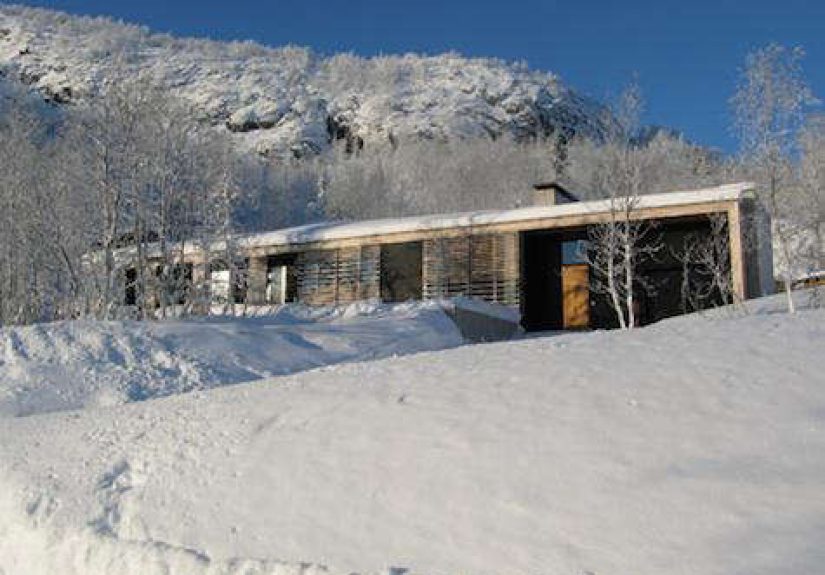
One of Div.A Arkitekter’s most admired residential projects is the Mountain Lodge Skarsnuten in Hemsedal, Norway. Hemsedal is known for alpine terrain, ski culture, dramatic views, and weather that does not care about your outfit. In that context, a cabin must be more than photogenic. It has to work.
The Skarsnuten cabin is often described as modest, even though its design intelligence is anything but small. Constructed primarily with timber and concrete, it follows the contours of the hillside rather than fighting the site. Instead of sitting on the landscape like an imported object, it settles into the slope with unusual restraint. The building understands a key rule of mountain architecture: the mountain was there first.
The cabin’s relationship with the hillside gives it a natural sense of belonging. It does not need a dramatic gesture to be memorable. Its drama comes from proportion, placement, material contrast, and the way interior life is organized around terrain and view.
Why the Skarsnuten Cabin Works
The success of the Skarsnuten cabin lies in several smart design moves. First, the building is responsive to topography. Rather than flattening the site into submission, the architecture uses level changes to create spatial interest. Second, the materials match the setting. Timber provides warmth and rhythm; concrete provides mass and stability. Third, the plan supports the way people actually live in a mountain retreat.
Storage and entry areas matter in a ski environment. So do places to sit, pause, remove layers, and transition from outdoor intensity to indoor comfort. In strong cabin design, the entry is not an afterthought. It is a small piece of theater: boots off, shoulders relaxed, cold air left behind, hot drink incoming.
The interior also demonstrates a clever use of built-in features. A wide stair can do more than connect levels; it can become informal seating. A kitchen can shift into storage and shelving. Wood slats can buffer indoor and outdoor zones. These moves make the cabin feel efficient without becoming cramped.
Norwegian Cabin Architecture: More Than Pretty Snow Photos
It is easy to romanticize Norwegian cabins. Add snow, warm lighting, wool blankets, and one ceramic mug, and suddenly every design blog reader is mentally moving to the mountains. But the best Norwegian cabins are not just lifestyle fantasies. They are lessons in restraint, climate response, and site-specific construction.
Norway’s landscape is not gentle everywhere. There are steep slopes, rocky sites, heavy snow loads, strong winds, long winters, and low winter light. Buildings must account for these realities. That is why many successful Norwegian cabins use compact forms, durable cladding, protected outdoor spaces, thick walls, practical entries, and carefully framed windows.
Div.A’s mountain projects fit into this larger tradition while still feeling modern. They do not copy old vernacular buildings directly. Instead, they translate familiar ideasshelter, hearth, timber, stone, dark exterior tones, thick walls, built-in storageinto contemporary architecture.
The Scandinavian Secret: Warm Minimalism
Scandinavian design is often mislabeled as “minimal,” which sometimes makes people imagine empty rooms where one chair is expected to do emotional labor for the entire house. But the best Scandinavian interiors are not cold or empty. They are edited. There is a difference.
Warm minimalism is about removing clutter while keeping comfort. Div.A’s work shows how that balance can happen. Wood surfaces soften clean geometry. Built-ins reduce visual noise. Natural materials create texture without decorative overload. Views become part of the interior experience. The result is a space that feels calm, not sterile.
In a mountain cabin, this matters enormously. The surrounding landscape already provides visual drama. Inside, the architecture can afford to be quieter. A restrained interior lets snowfields, trees, slopes, clouds, and changing daylight do what expensive wallpaper never could.
Div.A Beyond Cabins: Schools, Museums, and Civic Architecture
Although the Skarsnuten cabin is a natural star for design enthusiasts, Div.A Arkitekter’s work extends well beyond private retreats. The firm has designed and contributed to educational and cultural buildings, including schools and museum projects. These projects reveal another side of the practice: architecture as social infrastructure.
Div.A has been associated with several school projects in Norway, including Kastellet School, Ringstabekk School, Marienlyst School, and others. School architecture is a demanding test of design quality. Buildings must be durable, flexible, safe, welcoming, and adaptable to different learning methods. When done well, a school is not just a container for classrooms. It becomes a small city for young people, full of routes, gathering places, quiet corners, and shared identity.
The firm was also involved in the Aust-Agder museum and archive project in Arendal, known as KUBEN, in collaboration with David Chipperfield Architects. The building is associated with oak, glass, concrete, and a strong civic presence. It demonstrates how Div.A’s material clarity can scale up from intimate cabins to public cultural architecture.
What Designers Can Learn from Div.A Arkitekter
Div.A Arkitekter’s work offers practical lessons for architects, interior designers, homeowners, and anyone trying to create a space that feels both modern and grounded.
1. Start With the Site
The strongest buildings do not treat the site as a blank background. They respond to slope, sun, wind, approach, views, and neighboring structures. Skarsnuten is compelling because it appears to grow from its hillside rather than ignore it.
2. Use Fewer Materials, But Use Them Better
A limited material palette can make a building feel more coherent. Timber, concrete, stone, and glass are not exotic, but in the right hands they create depth, contrast, and atmosphere. The trick is not to use many materials. The trick is to make each material earn its place.
3. Make Transitions Beautiful
Great architecture pays attention to thresholds: outside to inside, public to private, active to quiet, bright to dim, cold to warm. Div.A’s cabin work shows how entries, terraces, stairs, and built-in seating can turn ordinary movement into memorable experience.
4. Let Function Create Form
When storage, seating, structure, and circulation are thoughtfully integrated, the building becomes calmer. There is less need for decoration because the architecture itself is doing useful, visible work.
Why This Style Still Feels Fresh
The reason Div.A Arkitekter’s mountain work continues to attract attention is simple: it has aged well. Trend-heavy design often looks tired quickly. Site-sensitive architecture, honest materials, and functional planning tend to last longer because they are rooted in real conditions rather than visual fashion.
A cabin like Skarsnuten does not rely on novelty. It relies on proportion, restraint, atmosphere, and a deep understanding of place. That makes it relevant not only to architecture fans, but also to anyone thinking about sustainable design, compact living, mountain homes, or Scandinavian interiors.
Experience Notes: Visiting, Studying, and Feeling Div.A’s Architecture
Experiencing architecture like Div.A Arkitekter’s work is different from simply looking at pictures. Photos can show the clean lines, the timber surfaces, the snowy roof edges, and the beautiful discipline of the design. But architecture becomes fully alive when you imagine moving through it. That is where the real lesson begins.
Picture arriving at a mountain cabin after a long drive through winter roads. The air is sharp, the landscape is quiet, and the snow makes every sound feel slightly padded. A good building does not interrupt that mood. It receives it. The entry should feel protected, practical, and calm. There should be a place to sit, a place to put gear, a place where the mess of outdoor life can be handled without turning the living room into a small sporting goods store.
Inside, the experience changes again. The best Scandinavian mountain interiors do not overwhelm you with decoration. They let your attention settle. Timber surfaces warm the light. A concrete floor or wall gives the room weight. Windows frame the outside world in deliberate pieces, like landscape paintings that happen to change every minute. The view is not just “nice.” It becomes part of the daily rhythm.
One of the most valuable experiences related to Div.A’s architecture is the sense of spatial efficiency. In a well-designed cabin, every element can have more than one job. A stair is circulation, seating, and social space. A thick wall can hold storage, a fireplace, or a built-in bench. A terrace can become a weather buffer, an outdoor room, and a visual bridge to the landscape. This is where architecture becomes quietly brilliant. Nothing screams, yet everything works.
For homeowners, the lesson is surprisingly practical. You do not need a Norwegian mountain plot to borrow the thinking. Start by asking what your home needs to handle every day. Where do shoes pile up? Where does morning light enter? Which view deserves attention? Which materials will age gracefully? Which built-ins could reduce clutter? Div.A’s work reminds us that good design is not about copying a look. It is about making decisions that fit a place and a way of living.
For travelers and design lovers, visiting Norwegian architecture can sharpen the eye. You begin to notice how buildings sit on land, how roofs respond to snow, how dark exterior cladding can make a structure recede into trees, and how warm interiors balance harsh weather. You also notice that “simple” architecture is rarely simple to design. It requires discipline, editing, and confidence. It takes courage to stop before adding one more dramatic feature.
That may be the most memorable experience connected to Div.A Arkitekter: the pleasure of restraint. Their architecture does not beg for applause. It stands calmly in the landscape, uses materials with intelligence, and makes ordinary human activities feel considered. In a noisy design world, that kind of quiet confidence is not just refreshing. It is almost radical.
Conclusion
Div.A Arkitekter’s work in Norway shows how architecture can be modern without being flashy, minimal without being cold, and practical without being dull. From the much-admired Skarsnuten cabin in Hemsedal to schools, cultural buildings, and civic projects, the Oslo-based practice has developed a language rooted in function, context, natural materials, and human experience.
For anyone interested in Scandinavian architecture, Norwegian mountain cabins, or thoughtful residential design, Div.A offers a valuable case study. Their work proves that the most memorable buildings are not always the loudest. Sometimes they are the ones that know when to step back, let the landscape speak, and quietly make life better.