Table of Contents >> Show >> Hide
- Quick Setup: 3 Rules That Prevent 90% of Area Mistakes
- 1) Count Unit Squares (The Grid Method)
- 2) Use Length × Width for Rectangles and Squares
- 3) Use Base × Height for Parallelograms and Trapezoids
- 4) Use Triangle Area (Even When the Height Is Missing)
- 5) Use Circle (and “Pizza Slice”) Formulas
- 6) Decompose Composite Shapes (Add and Subtract Like a Pro)
- 7) Use Coordinates (Shoelace Formula) or Approximate Irregular Shapes
- Fast Troubleshooting Checklist
- Area Experiences: What People Learn the Hard Way (and Then Laugh About)
- 1) The paint job that teaches unit discipline
- 2) Flooring and tile: the moment composite shapes become real
- 3) Gardening and landscaping: nature does not respect right angles
- 4) Sewing and crafting: margins matter
- 5) Sports fields, posters, and “how big is big?”
- 6) The confidence move: checking with a second method
- Conclusion
Area sounds like a school-only concept until you try to buy paint, tile a floor, or spread mulch in a garden bed shaped like a kidney bean. In math terms, area is the amount of flat space inside a 2D boundary, measured in square units (ft², in², m², etc.).
Some shapes play nice and come with a simple formula. Others are composites, curvy, or downright weird. That’s why it helps to know more than one approach. Here are seven reliable ways to find the area of a shape, with examples and a few “please don’t do this” warnings.
Quick Setup: 3 Rules That Prevent 90% of Area Mistakes
- Square units only. If lengths are in inches, the area is in square inches (in²).
- Convert before you calculate. Don’t mix feet and inches in the same equation.
- Height means perpendicular. A slanted side is not a height (no matter how confident it looks).
1) Count Unit Squares (The Grid Method)
If a shape is on graph paper, area can be as literal as counting how many 1-by-1 squares it covers. This method is the foundation for why area formulas work: rectangles are just a bunch of unit squares lined up neatly, like math’s most organized parking lot.
How to do it
- Count full squares as 1.
- Combine partials (two halves make a whole).
- If the border is curvy, estimate partial squares (quarter-ish, three-quarters-ish, etc.).
Example
A shape covers 18 full squares plus 6 half-squares. Area = 18 + (6 ÷ 2) = 21 square units.
Best for: quick estimates, checking your work, and building intuition for “what area even means.”
2) Use Length × Width for Rectangles and Squares
Rectangles are the friendly golden retrievers of geometry: predictable and helpful. If a rectangle is l units long and w units wide, you can imagine it as l rows of w unit squares (or vice versa). Multiply to count them fast.
- Rectangle: A = length × width
- Square: A = side²
Example
A rectangle is 8 ft by 5 ft. Area = 8 × 5 = 40 ft². A square with side 9 in has area 9² = 81 in².
Reality check: If you double both side lengths, the area becomes four times bigger. Area grows fast, which is why “just a little larger” rugs are never “just a little” more expensive.
3) Use Base × Height for Parallelograms and Trapezoids
Some “rectangle-ish” shapes still use height (perpendicular distance), even if their sides slant. A good mental model: if you cut a right triangle off one side of a parallelogram and slide it to the other side, you’ve turned it into a rectangle with the same base and heightso the area stays the same.
Parallelogram
- Parallelogram: A = base × height
Example: base 10 cm, height 6 cm → area = 10 × 6 = 60 cm².
Trapezoid
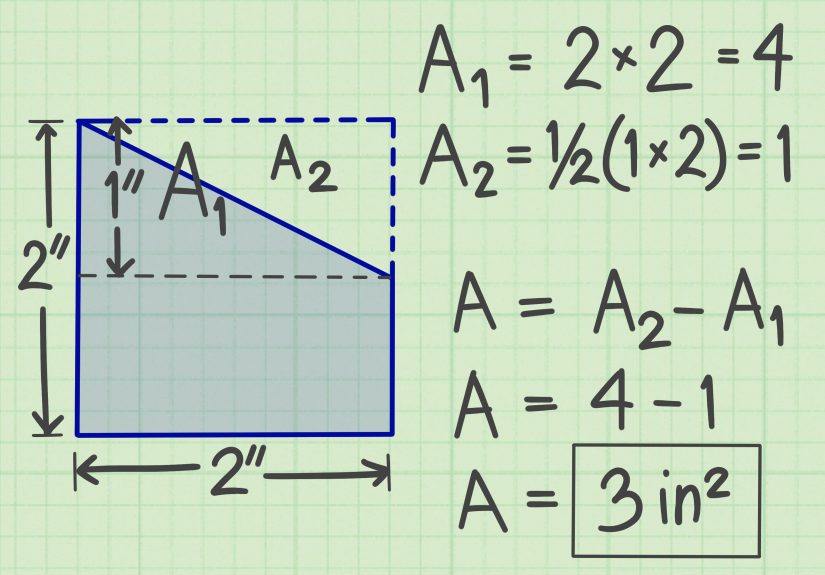
- Trapezoid: A = ½( b1 + b2 )h
Example: bases 12 m and 8 m, height 5 m → area = ½(20)×5 = 50 m².
Common mistake: plugging in a slanted side for h. The height must meet the bases at a right angle.
4) Use Triangle Area (Even When the Height Is Missing)
Triangles show up everywherefrom rooflines to rampsso it pays to be fluent. The core triangle formula is:
- Triangle (base-height): A = ½ × base × height
Example (base and height)
base 12 in, height 7 in → area = ½×12×7 = 42 in².
If you don’t know the height
When a triangle refuses to give you a height, you still have options:
- Heron’s formula (know all three sides): s = (a+b+c)/2, then A = √(s(s−a)(s−b)(s−c)).
- Trig formula (know two sides and the included angle): A = ½ab sin(C).
Mini example (Heron): sides 5, 6, 7 → s = 9 → area = √(9×4×3×2) = √216 ≈ 14.7 square units.
Why the ½? Two identical triangles fit perfectly into a parallelogram (or rectangle) with the same base and height. One triangle is half the area of that shapehence the one-half.
5) Use Circle (and “Pizza Slice”) Formulas
Circles are simple: they just refuse to stop at the decimal point. If you know the radius, area is:
- Circle: A = πr²
Example
Radius 4 m → area = 16π ≈ 50.27 m² (using π ≈ 3.1416).
Sectors, semicircles, and other circle “fractions”
If you have a slice of a circle, treat it like a fraction of the full area.
- Sector: A = (θ/360) × πr²
- Semicircle: A = ½ × πr²
- Quarter circle: A = ¼ × πr²
Example (sector): a 90° sector with radius 10 cm → area = (90/360)×100π = 25π ≈ 78.54 cm².
Watch out: if you’re given diameter d, then r = d/2. Many circle mistakes are just “forgot to halve the diameter” in disguise.
6) Decompose Composite Shapes (Add and Subtract Like a Pro)
Real-life shapes are often made from simpler ones: a rectangle with a semicircle attached, a courtyard with a cutout, a “house” silhouette, and so on. The strategy is simple and powerful:
- Split the figure into familiar shapes.
- Find each area.
- Add areas together (subtract holes/cutouts).
Example (add pieces)
A “house” shape: rectangle 10 ft by 6 ft (60 ft²) plus a triangle on top with base 10 ft and height 4 ft (½×10×4 = 20 ft²). Total area = 80 ft².
Example (subtract a cutout)
A 12 in by 12 in square has a circular hole of radius 3 in. Square area = 144 in². Hole area = 9π ≈ 28.27 in². Remaining area ≈ 115.73 in².
Tip: Label every length you know, circle every formula you’ll use, and treat the shape like a puzzle. Composite area is less “advanced geometry” and more “smart bookkeeping.”
7) Use Coordinates (Shoelace Formula) or Approximate Irregular Shapes
Sometimes you don’t have clean measurements, but you do have points (coordinates) or a messy boundary. In those cases, use coordinate formulas or approximation techniques.
Option A: Shoelace formula (polygons on a coordinate plane)
For a polygon with vertices (x1,y1), (x2,y2), …, (xn,yn), the shoelace method computes area from the coordinate list. You multiply “down the laces,” multiply “up the laces,” subtract, take the absolute value, then divide by 2.
Example: triangle with points (1,1), (5,1), (3,4).
- Down: 1×1 + 5×4 + 3×1 = 24
- Up: 1×5 + 1×3 + 4×1 = 12
- Area = |24 − 12| ÷ 2 = 6 square units
Why it’s useful: It avoids drawing heights, splitting into triangles manually, and other time-consuming stepsespecially for polygons with many vertices.
Option B: Approximate for irregular or curvy regions
Overlay a grid and count squares (estimating partials), or use thin rectangles/strips to approximate the region. The smaller the pieces, the closer the estimate. In more advanced settings, calculus formalizes this idea using integrals to find area under curves or between curves.
Practical takeaway: If the boundary is messy, “accurate enough for planning” is often the goal. A careful estimate can be better than a perfect formula applied to the wrong shape.
Fast Troubleshooting Checklist
- Units mismatch? Convert before calculating.
- Wrong height? Height must be perpendicular.
- Forgot the ½? Triangles, trapezoids, and circle fractions depend on it.
- Added instead of subtracted? Holes and cutouts get subtracted.
- Rounded too early? Keep π and square roots until the end when you can.
Area Experiences: What People Learn the Hard Way (and Then Laugh About)
Area shows up in real life right when you think you’re “not a math person.” The first time you order supplies for a project, area becomes your new best friendor your newest villain. Here are some very common “area experiences” that teach the concept fast.
1) The paint job that teaches unit discipline
A classic scenario: someone measures a wall in feet, then subtracts a door measured in inches, then wonders why the final area looks like a lottery number. After one trip back to the store, the lesson is permanent: choose one unit system, convert everything, then compute. It’s not glamorous, but it prevents the “one lonely gallon” problem.
2) Flooring and tile: the moment composite shapes become real
Rooms rarely behave. There’s an alcove, a closet bump-out, a fireplace hearth, or that one corner that’s somehow not square despite your best hopes. People learn to break the floor plan into rectangles, triangles, and trapezoids, then add the areas. They also learn the practical bonus rule: buy extra. Even perfect area math can’t stop tiles from cracking or cuts from going sideways.
3) Gardening and landscaping: nature does not respect right angles
Garden beds are the original “irregular shapes.” Curves happen, borders drift, and the bed widens near the hose spigot because that’s where plants thrive. Many gardeners start by estimating with a grid: stake a rough rectangle, then count/estimate the curvy parts. The goal isn’t a flawless answerit’s an order of mulch or soil that’s close enough that you’re not hauling bags twice.
4) Sewing and crafting: margins matter
In fabric projects, area is basically money. You calculate the main panel as a rectangle, then add area for hems, seam allowances, and pattern matching. Crafters learn that formulas describe ideal shapes, while real projects include overlap, folding, and “oops.” That experience turns area from a worksheet skill into a planning skill.
5) Sports fields, posters, and “how big is big?”
Area also sneaks into everyday decisions. Coaches estimate the playable area for drills. Students making a poster learn that doubling the length and width makes the poster four times the area (and suddenly it doesn’t fit on the desk). Even choosing a rug teaches the same lesson: a small change in side length can be a huge change in coverage. These moments make area feel less like a formula and more like a way to predict what will actually fit.
6) The confidence move: checking with a second method
Students and DIYers build confidence when they verify area two ways. A composite figure can be checked by grid estimation. A coordinate polygon can be checked by splitting into triangles. That habit turns “I hope this is right” into “I can justify this,” which is a great feelingespecially when the stakes are a grade, a budget, or a weekend you’d rather not spend returning supplies.
Most “area stories” end the same way: draw it, label it, break it into smaller pieces, and keep your units consistent. That’s not just math adviceit’s life advice with a ruler.
Conclusion
To find the area of a shape, you don’t need a single perfect formulayou need the right strategy for the situation. Count unit squares for a visual answer, use standard formulas for rectangles, triangles, trapezoids, and circles, decompose composite figures for real-world layouts, use coordinates when vertices are given, and estimate when shapes get irregular. With these seven methods in your toolbox, you can match the method to the shape and get an answer you trustwhether you’re solving a worksheet or planning a project. Draw it, label it, pick the simplest method that fits, and keep your units consistent.