Table of Contents >> Show >> Hide
- Before You Start: Quick Setup for Safer, Faster Onion Prep
- At-a-Glance: Which Onion Cut Should You Use?
- Way #1: How to Dice an Onion (Small, Medium, or Large)
- Way #2: How to Slice an Onion (Half-Moons or Rings)
- Way #3: How to Mince an Onion (Finely Chopped Without the Chaos)
- Common Onion-Chopping Mistakes (and How to Fix Them)
- Storage and Make-Ahead Tips
- Extra: of Real-Life Onion-Chopping Experiences (The Good, The Bad, The Teary)
- Conclusion
Onions are the opening act for an unbelievable number of great mealsand also the only produce item that can make fully grown adults cry while insisting, “I’m fine.” Whether you’re building flavor for soups, tacos, stir-fries, or that “quick” weeknight pasta that somehow uses every pan you own, knowing how to chop an onion the right way saves time, improves texture, and makes everything cook more evenly.
This guide breaks down three practical onion cutting techniques you’ll use constantly: dicing, slicing, and mincing. You’ll get step-by-step instructions, the best uses for each cut, and a few tear-reducing tricksbecause your dinner shouldn’t feel like a romantic drama.
Before You Start: Quick Setup for Safer, Faster Onion Prep
Tools that actually matter
- Sharp chef’s knife (a dull one crushes onion cells and makes more irritating fumesplus it’s less safe)
- Stable cutting board (use a damp paper towel underneath to stop sliding)
- Optional: bench scraper (for scooping), kitchen towel (for grip), and a bowl for scraps
Onion anatomy in 10 seconds
An onion has two key ends: the stem/top (often pointy or dried) and the root end (hairy roots). For most cuts, you’ll trim the top and keep the root end more intact for stabilitylike a built-in “handle” that holds layers together while you cut.
How to reduce tears (without wearing swim goggles… unless you want to)
- Use a sharp knife to slice cleanly instead of smashing cells.
- Chill the onion for 20–30 minutes if you’re extra sensitive.
- Ventilation helps: cut near an open window, under a hood, or with a small fan pulling air away from your face.
- Don’t linger: slow, careful cuts are good, but pausing mid-chop to stare into the onion’s soul is not.
At-a-Glance: Which Onion Cut Should You Use?
| Cut | What it looks like | Best for | Why it works |
|---|---|---|---|
| Dice | Even little cubes | Salsas, soups, sauces, chili, mirepoix | Cooks evenly; disappears into flavor |
| Slice | Half-moons or rings | Caramelized onions, fajitas, burgers, salads | Great bite/texture; browns beautifully |
| Mince | Tiny pieces (almost paste-y) | Meatballs, marinades, dips, quick sauces | Melts into the dish; spreads flavor fast |
Way #1: How to Dice an Onion (Small, Medium, or Large)
Dicing an onion gives you neat, even cubes that cook uniformly. This is the cut you want when onions are meant to “be everywhere” in a dishsupporting the flavor without stealing the spotlight.
Choose your dice size
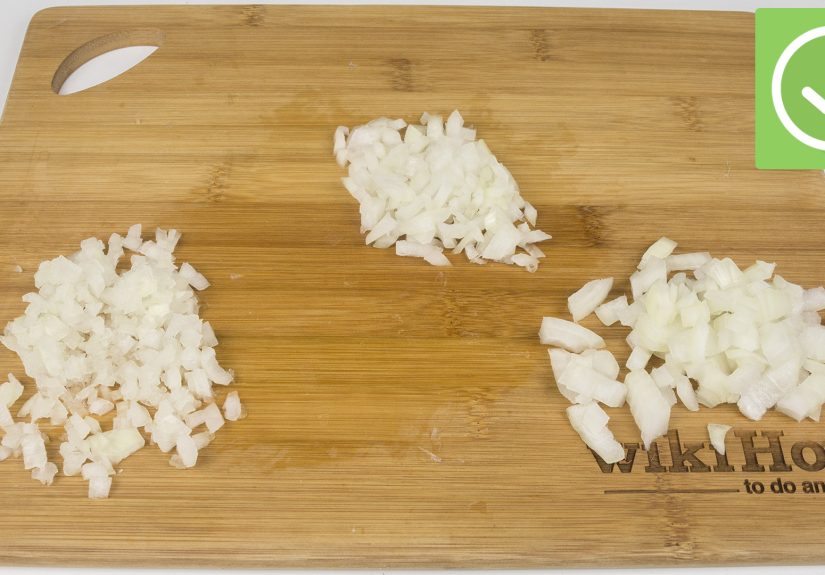
- Small dice (about 1/4 inch): salsas, sauces, quick sautés
- Medium dice (about 1/2 inch): soups, stews, sheet-pan dinners
- Large dice (about 3/4 inch): chunky roasts, skewers, rustic dishes
Step-by-step: classic dice
- Trim the top. Slice off about 1/2 inch from the stem end. Leave the root end mostly intact (trim only the straggly hairs if needed).
- Cut in half through the root. Place the onion on its side and slice from top to root, creating two halves.
- Peel. Remove papery skin and any tough outer layer. Keep the root end attachedit’s your onion’s seatbelt.
- Place flat-side down. This is your stability move. Wobbly onions lead to wobbly confidence.
- Make vertical cuts (toward the root). Slice lengthwise lines from the top toward the root, spacing them based on your desired dice size. Stop short of cutting through the root so the onion stays together.
- Make crosswise cuts. Now slice across the onion to create cubes. Let your knuckles guide the blade (the “claw grip”) and keep fingertips tucked.
Pro tips for better diced onions
- Even spacing = even cooking. If half your dice are tiny and half are big, the tiny ones burn while the big ones stay crunchy. Not ideal.
- Skip the “smash cut.” Pressing hard releases more juices and can make the board slippery.
- Use a bench scraper. Scooping with the knife edge can dull it faster (and it’s rough on your cutting board).
Example: when diced onions are the right call
Making chili? Diced onions melt into the base and distribute sweet-savory flavor in every spoonful. Same for pasta sauce, taco meat, and soups where you want a consistent bite.
Way #2: How to Slice an Onion (Half-Moons or Rings)
Slicing an onion is all about texture. Slices hold their shape, soften slowly, and brown beautifullyperfect for caramelizing, topping burgers, or piling into fajitas like you’re running a sizzling plate delivery service.
Pick your slice style
- Half-moons: slice a halved onion crosswise for curved strips
- Rings: slice a whole onion crosswise for circles (great for onion rings or salads)
Step-by-step: half-moon slices (the everyday favorite)
- Trim the top. Cut off the stem end. Keep the root end mostly intact.
- Halve through the root. Slice from top to root.
- Peel and place flat-side down. Flat side down = safe side down.
- Slice crosswise. Cut perpendicular to the root-to-top line to create half-moons. For “thinly sliced,” aim for 1/8 inch; for “thick,” aim for 1/4 inch.
- Stop before the root gets annoying. When you reach the root nub, save it for stock or discard.
Step-by-step: onion rings
- Trim both ends. Remove the top and a thin slice of the root end for stability.
- Peel. Remove skin and any tough outer layer.
- Slice crosswise into rounds. Separate into rings with your fingers.
Pro tips for clean, uniform slices
- Go slow and steady. Speed comes after consistencylike parallel parking, but with fewer horns honking.
- For caramelized onions, slice evenly. Uneven slices cook at different speeds, and caramelizing is already a patience game.
- Use thicker slices for grilling. Thin slices can collapse or burn quickly over high heat.
Example: when sliced onions shine
For fajitas, slices soften while keeping a satisfying bite. For burgers, thicker slices can be grilled or sautéed without vanishing into onion vapor. For salads, thin slices give you flavor without feeling like you’re chewing a crunchy bracelet.
Way #3: How to Mince an Onion (Finely Chopped Without the Chaos)
Mincing an onion means tiny, fine piecessmaller than a standard diceso onion flavor spreads quickly and the texture nearly disappears. This is the move for dips, meatballs, marinades, and sauces where you want onion presence, not onion chunks.
Two easy ways to mince
Method A: Fine dice, then chop again
- Start with a small dice. Follow the dicing method above, aiming for a 1/4-inch dice.
- Gather into a pile. Use a bench scraper to corral the pieces.
- Rock-chop. Hold the knife tip on the board and rock the blade through the pile, turning it occasionally, until pieces are very small and even.
Method B: “French-style” fine chop (controlled and neat)
- Halve and peel the onion. Root end intact.
- Make multiple lengthwise cuts. Cut toward the root with very tight spacing.
- Make shallow cross-cuts (optional). If you’re comfortable, you can add one or two very shallow horizontal cuts parallel to the boardcarefully, and only if the onion is stable.
- Finish with crosswise cuts. Slice across to create a very fine chop.
Pro tips for minced onions that don’t turn into onion mush
- Don’t over-chop. If it turns watery, it won’t sauté well and can make dips runny.
- For raw dishes, rinse if needed. If the onion is too sharp for a salsa or salad dressing, a quick rinse and drain can mellow it.
- For meatballs or burgers, mince = better binding. Big onion chunks can create weak spots that break apart when cooking.
Example: when mincing is the best choice
In a yogurt dip, minced onion spreads flavor evenly without crunchy interruptions. In meatloaf, it blends in so each slice holds together and tastes seasoned throughout.
Common Onion-Chopping Mistakes (and How to Fix Them)
Mistake: Cutting with the onion rolling around
Fix: Always create a flat base. Halving the onion and placing it cut-side down is the simplest safety upgrade you can make.
Mistake: Using a dull knife
Fix: Sharpen your knife or use a honing rod regularly. A sharper blade cuts cleaner, is more predictable, and usually leads to fewer tears.
Mistake: Inconsistent sizes
Fix: Let the recipe decide. If the onion is meant to disappear (sauce), go smaller. If it’s meant to be felt (fajitas), slice. Keep spacing consistent so it cooks evenly.
Mistake: Turning your cutting board into a slip ‘n slide
Fix: Put a damp towel or paper towel under the board. Also wipe onion juices occasionally, especially if you’re chopping multiple onions.
Storage and Make-Ahead Tips
- Chopped onion keeps in an airtight container in the fridge for 2–3 days (it gets stronger over time).
- Sliced onions hold shape best when stored flat and used within 1–2 days.
- Freeze diced onions for cooking (soups, sautés). Texture changes after freezing, so they’re not ideal for raw use.
Extra: of Real-Life Onion-Chopping Experiences (The Good, The Bad, The Teary)
If you’ve ever started cooking feeling confidentonly to be humbled by an onionwelcome to the club. Onion prep is one of those “basic” kitchen tasks that everyone assumes they already knows… until the moment the onion slides, the pieces go rogue, and your eyes turn into two leaky faucets. The funny part? Most onion disasters happen for the same reason: we rush the boring parts.
One common experience: you cut the onion, it wobbles, and suddenly you’re white-knuckling the knife like it’s a video game controller. That’s usually a stability problem, not a talent problem. The first time many home cooks switch to “flat side down” (after halving through the root), it feels almost suspiciously easylike you found a cheat code. The onion stops rolling, the knife path feels cleaner, and you’re no longer negotiating with a vegetable.
Then there’s the “Why am I crying this much?” phase. People try all kinds of creative solutionsholding their breath, chewing gum, lighting a candle, staring angrily at the onion as if intimidation will help. But the most consistent experience across kitchens is this: a sharper knife changes everything. A dull blade crushes and bruises onion layers, which tends to release more irritating compounds and more juice, making the board slippery and the air spicy. A sharp knife, on the other hand, glides. You cut faster, cleaner, and with less drama. It’s not just a pro-chef flexit’s a quality-of-life upgrade.
Another very real moment: learning that the “right” cut depends on the dish. The first time you caramelize onions with thick, uneven slices, you get a pan where half the onions are browned and jammy while the rest are still firm and pale. The next time you slice evenlythin half-moons, same thickness end to endthe onions soften at the same pace and brown more consistently. It feels like magic, but it’s really just geometry and patience working together.
And let’s talk about mincing. Many people start mincing onions by hacking at them like they owe rent money. The result? Onion confetti plus a puddle of onion juice. A calmer approachsmall dice first, then a controlled rock-chopcreates finer pieces without turning the onion into watery paste. That’s especially noticeable in dips or meatballs: minced onions distribute flavor without leaving crunchy surprises.
Finally, there’s the oddly satisfying experience of mastery. You don’t need fancy knife tricks; you just need a repeatable system. After a few weeks of consistently dicing, slicing, and mincing with intention, you’ll notice a shift: you stop “fighting” the onion. Your cuts get more even, your cooking gets more consistent, and you spend less time blinking through tears like you just watched the final scene of a sad movie. Turns out the real secret to chopping onions isn’t braveryit’s technique.
Conclusion
When you know three reliable ways to chop an oniondice for even cooking, slice for texture and browning, and mince for fast flavoryou’ll cook faster, waste less, and get better results in almost any recipe. Keep the onion stable, use a sharp knife, match the cut to the dish, and your onions will finally start working with you instead of emotionally manipulating you.