Table of Contents >> Show >> Hide
- How to Plan a Sunset Hike (Without Becoming a Cautionary Tale)
- 1) Sentinel Dome (Yosemite National Park, California)
- 2) Canyon Overlook Trail (Zion National Park, Utah)
- 3) Delicate Arch (Arches National Park, Utah)
- 4) Ooh Aah Point via South Kaibab Trail (Grand Canyon National Park, Arizona)
- 5) Queen’s Garden / Navajo Loop Combination (Bryce Canyon National Park, Utah)
- 6) Hawk Hill (Marin Headlands, California)
- 7) Mount Hollywood (Griffith Park, Los Angeles, California)
- 8) Rattlesnake Ledge (Near North Bend, Washington)
- 9) Black Balsam Knob (Pisgah National Forest, North Carolina)
- 10) Cadillac Mountain via North Ridge Trail (Acadia National Park, Maine)
- How to Choose the Right Sunset Hike for You
- Conclusion: Go Chase the Light (Responsibly)
- Bonus: of Sunset-Hike Experience (a.k.a. Things You’ll Learn the Funny Way)
Sunsets are the original daily limited-edition drop: everyone wants one, nobody can buy one, and the best ones
vanish before you finish saying “Waitlook at THAT cloud.”
The trick is getting yourself to a view worth the effort… and then getting back down without starring in a
headlamp commercial.
This guide rounds up ten of the most beautiful sunset hikes in the United Statescoastlines, desert arches,
canyon rims, alpine domes, and a couple of “how is this in a city?” surprises. Each pick includes practical
trail stats, what makes the sunset special, and small, sanity-saving tips that separate the golden-hour heroes
from the people eating trail mix in the dark while whispering, “I swear the parking lot was right here.”
How to Plan a Sunset Hike (Without Becoming a Cautionary Tale)
Time it like you’re catching a flight (because you kind of are)
Start earlier than your optimism suggests. Golden hour begins before the sun actually touches the horizon.
A good rule: aim to reach your viewpoint 30–45 minutes before sunset, then budget your descent for afterglow.
The sky often gets better 10–20 minutes after the sun dipsdon’t leave during the best part like it’s a movie
and you’re trying to beat traffic.
Bring light (yes, even if your phone is “fully charged”)
A real headlamp beats the “flashlight app” every time. Darkness comes faster than you think, especially in canyons
and forests. Pack spare batteries or a backup light. Also: phone batteries drop like a rock when it’s cold or when
you’ve taken 317 photos of the same orange gradient “just in case.”
Dress for two hikes
The hike up is warm. The viewpoint is windy. The hike down is chilly, slow, and full of people moving at different
speeds like a polite, outdoor-themed traffic jam. Layers win. So does a beanie that makes you look like a tiny
national park ranger.
Leave No Trace (because sunsets don’t need wrappers)
Pack out everything. Stay on trail, especially in fragile desert and alpine environments. Your future selfand every
person who hikes there after youwill thank you.
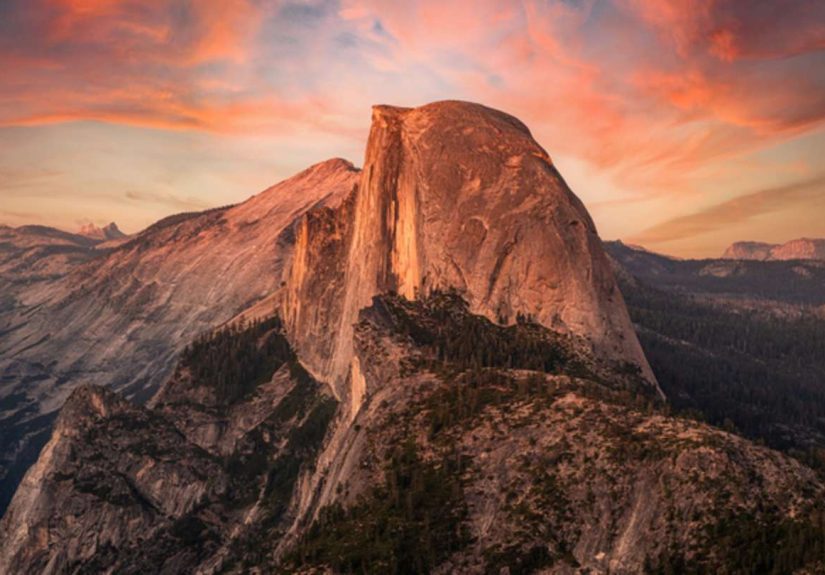
1) Sentinel Dome (Yosemite National Park, California)
If you want a sunset that feels like Yosemite is showing off, Sentinel Dome is the move. It’s a short hike with a
big payoff: wide-open granite, minimal tree cover, and a 360-degree panorama that makes you look around like you’re
checking for hidden cameras.
Why sunset here hits different
The dome’s open summit lets you watch the light slide across Yosemite’s high country and into the valley. As the sun
drops, the granite shifts from bright silver to warm goldlike the park just switched filters in real time.
Quick trail notes
- Distance: ~2 miles round trip
- Elevation gain: ~400 feet
- Difficulty: Moderate, with a final granite scramble
- Pro tip: Sunset hike = headlamp hike. Bring one and use it.
2) Canyon Overlook Trail (Zion National Park, Utah)
Short, iconic, and ridiculously scenic, Canyon Overlook is the kind of trail that makes you suspicious it’s too good
to be true. Spoiler: it’s real. And at sunset, Zion Canyon’s cliffs glow like they’ve been lit from inside.
Why sunset here hits different
Zion’s layered sandstone catches evening light with dramatic contrastdeep shadows in the canyon, bright fire on the
walls, and a slow fade into pastel skies. It’s a lot of drama for a half-mile hike (one way), and we mean that as a compliment.
Quick trail notes
- Distance: ~0.5 mile one way (about 1 mile round trip)
- Elevation gain: ~150 feet
- Difficulty: Easy-to-moderate; narrow sections, big views
- Pro tip: Arrive earlythis one is popular for a reason.
3) Delicate Arch (Arches National Park, Utah)
Delicate Arch at sunset is basically Utah’s grand finale. The arch frames the sky while the surrounding slickrock
blushes red-orange, and the whole scene feels like a postcard that got tired of being two-dimensional.
Why sunset here hits different
The low-angle light makes the arch glow and sharpens the texture of the sandstone. You’ll also catch long shadows
stretching across the bowl behind itgreat for photos, better for just standing there quietly and pretending you’re
in a nature documentary.
Quick trail notes
- Distance: ~3 miles round trip
- Elevation gain: ~480 feet
- Difficulty: Moderate; exposed sections, sun and heat are real
- Pro tip: Water, sun protection, and patience. Sunset crowds are a thing.
4) Ooh Aah Point via South Kaibab Trail (Grand Canyon National Park, Arizona)
The Grand Canyon at sunset is not subtle. The color changes come in wavesgold, pink, purple, and then the canyon
seems to deepen into something almost unreal. Ooh Aah Point is a classic for a reason: you get big canyon drama
without committing to an all-day descent.
Why sunset here hits different
The South Kaibab follows a ridgeline, so you get open views early. At sunset, the shadows pour into side canyons and
the rim lights up. It’s the kind of moment that makes people talk in hushed voices, like the canyon can hear them.
Quick trail notes
- Distance: ~1.8 miles round trip
- Elevation change: ~790 feet (down then back upyour legs will notice)
- Difficulty: Moderate-to-hard because the return is uphill
- Pro tip: There’s little shade and no water on the trailbring what you need.
5) Queen’s Garden / Navajo Loop Combination (Bryce Canyon National Park, Utah)
Bryce is basically an amphitheater built for sunset. Hoodoosthose tall, weird, wonderful rock spirescatch the last
light and glow like they’re made of embers. The Queen’s Garden/Navajo loop drops you into the formations and brings
you back up at Sunset Point, which feels like a well-written plot.
Why sunset here hits different
The hoodoos shift through warm oranges into muted reds as shadows stretch across the amphitheater. The higher altitude
air often makes the colors look extra crisp, like Bryce decided to crank up the contrast for your benefit.
Quick trail notes
- Distance: ~2.9 miles
- Elevation gain: ~625 feet
- Difficulty: Moderate; steady climb out at the end
- Pro tip: Start with Queen’s Garden and finish up Navajo toward Sunset Point for the grand finale.
6) Hawk Hill (Marin Headlands, California)
Hawk Hill is where you go when you want ocean air, a Golden Gate Bridge cameo, and a sunset that can include fog
rolling in like a special effect. It’s one of the most famous viewpoints above San Francisco for good reason:
it’s a jaw-dropping front-row seat to the Pacific and the skyline.
Why sunset here hits different
The sun drops toward the ocean, lighting up the water and (on clear days) turning the city into a silhouette.
On foggy nights, you might watch the sky go molten above a soft white blanket. Either way: cinematic.
Quick trail notes
- Distance: Varies by route; short options exist near the top plus longer coastal combos
- Difficulty: Easy-to-moderate depending on how much you add
- Pro tip: Wind is basically a permanent residentbring a layer even in summer.
7) Mount Hollywood (Griffith Park, Los Angeles, California)
A sunset hike inside a major city shouldn’t feel this good, but Mount Hollywood is proof that Los Angeles can do
“nature moment” with the best of them. You’ll get sweeping views over the LA Basin, the Griffith Observatory, and
yesthe Hollywood Sign, because LA loves a cameo.
Why sunset here hits different
The city lights start flickering on as the sky fades, creating that classic “golden hour to glitter hour” transition.
The haze (which LA has in… generous supply) can actually make the sky look softer and more pastel.
Quick trail notes
- Distance: Multiple routes; common loops land around 3–4 miles
- Elevation gain: Route-dependent; expect a steady climb
- Difficulty: Moderate, mostly because you’ll stop every 90 seconds for photos
- Pro tip: Weekdays feel calmer. Weekends feel like a friendly fitness festival.
8) Rattlesnake Ledge (Near North Bend, Washington)
If you’ve ever wanted to watch a sunset reflected on a lake while surrounded by evergreen forest and mountain ridges,
Rattlesnake Ledge is your answer. It’s famously popularbecause it’s famously beautifuland the viewpoint above
Rattlesnake Lake delivers a classic Pacific Northwest glow.
Why sunset here hits different
The ledge faces out over the Cedar River watershed with layered ridgelines that catch the last light. On clear evenings,
the sky’s colors mirror on the lake, and the forest silhouettes look like a perfectly cut paper collage.
Quick trail notes
- Distance: About 4 miles round trip (roughly 2 miles to the ledge)
- Elevation gain: ~1,100+ feet (short and steepefficient suffering)
- Difficulty: Moderate
- Pro tip: Go early for parking. Also: keep extra space at the ledgecliffs don’t negotiate.
9) Black Balsam Knob (Pisgah National Forest, North Carolina)
Black Balsam Knob is what happens when the Blue Ridge Parkway decides to be generous. You get big open-sky views,
high-elevation breezes, and a short hike that feels like it should require a much longer approach. The bald summit
(meaning: treeless) makes sunsets feel huge and unblockedjust you, the horizon, and the kind of sky that makes
you text friends “no filter” like it’s a personality trait.
Why sunset here hits different
The rolling ridgelines of the Appalachians stack into the distance, and the sun paints them in layerswarm foreground,
cool blue background. It’s the “smoky mountains” effect in real time, especially when humidity and haze soften the far peaks.
Quick trail notes
- Distance: Short routes to the knob are common; longer ridge hikes are easy to add
- Difficulty: Easy-to-moderate (wind can make it feel spicier)
- Pro tip: Weather changes fast up high. Bring a layer and don’t trust that sunny trailhead.
10) Cadillac Mountain via North Ridge Trail (Acadia National Park, Maine)
Cadillac Mountain is famous for sunrise, but sunset from the summit is its underrated second act. You’re looking out
over Mount Desert Island and the Atlantic, and the light can turn the granite and water into a soft, glowing gradient
that feels quietly epic.
Why sunset here hits different
Coastal sunsets bring their own mood: pastel skies, sea air, and sometimes clouds that cooperate like professional
stagehands. In fall, the lower forests can add extra color before the sun even gets involved.
Quick trail notes
- Distance: ~4.4 miles round trip (North Ridge)
- Difficulty: Moderate; steady hiking with classic Acadia rock underfoot
- Pro tip: Start early enough to enjoy the summit before the “everyone arrived” moment.
How to Choose the Right Sunset Hike for You
If you want “short hike, big payoff”
Try Canyon Overlook (Zion), Sentinel Dome (Yosemite), or Black Balsam Knob (Pisgah). These are the “I want a sunset,
not a saga” options.
If you want iconic national park scenery
Delicate Arch, Bryce’s hoodoos, and the Grand Canyon deliver the kind of landscapes that make your camera roll look
like it got sponsored.
If you want city-meets-sunset energy
Mount Hollywood gives you that rare combo: real trail vibes plus a skyline that literally turns on its lights when the
sky dims. Hawk Hill adds ocean drama and a bridge cameo.
Conclusion: Go Chase the Light (Responsibly)
The best sunset hikes in America aren’t just about pretty skiesthey’re about being in the right place at the right
time, watching a landscape change in minutes. Whether you’re standing on a granite dome in Yosemite, sitting quietly
beneath a desert arch in Utah, or looking over a lake in Washington as the day fades, the magic is the same:
you showed up, you slowed down, and you let the view do its thing.
Pack a headlamp, bring a layer, start earlier than you think you need to, and give yourself permission to linger for
the afterglow. Sunsets are free, but they do charge an entry fee in patienceand sometimes in calf muscles.
Bonus: of Sunset-Hike Experience (a.k.a. Things You’ll Learn the Funny Way)
Sunset hiking has a predictable storyline, and once you’ve done a few, you start noticing the “characters.” There’s
the Optimist, who says, “We’ve got plenty of time,” while walking uphill at a pace best described as “casual museum
stroll.” There’s the Photographer, who carries a tripod like a sacred relic and speaks in shutter speeds. There’s the
Snack Philosopher, who somehow packed three kinds of cheese and zero water. And then there’s youtrying to be all of
them at once, because sunsets turn everyone into a little bit of a romantic and a little bit of a planner.
The first big lesson: the hike down is part of the hike. It sounds obvious until you’re standing at a viewpoint with
that “Wow” feeling and you realize the trail home has turned into a shadowy puzzle. The fix is simple and slightly
unsexy: bring a headlamp and actually know where it is in your bag. Bonus points if you test it before you leave the
carnothing builds character like discovering dead batteries while the sky is doing its last purple flourish.
The second lesson: temperature is a prankster. The climb warms you up, the wind at the top chills you, and the moment
the sun disappears it’s like someone turned the thermostat down for dramatic effect. A light jacket or fleece feels
unnecessary at 4:30 p.m. and absolutely essential at 6:12 p.m. Add in coastal fog or high-elevation exposure and you’ll
be grateful you brought an extra layer instead of relying on “positive vibes” for warmth.
Third: sunsets attract crowds, and crowds change the vibe. Sometimes it’s funeveryone cheering when the sky explodes
into pink and orange like a stadium wave. Sometimes you want quieter. If solitude matters, choose longer trails, go on
a weekday, or pick shoulder seasons when fewer people are chasing the same golden hour. And if you do end up sharing a
viewpoint with a bunch of strangers, lean into the wholesome chaos: offer to take someone’s photo, accept that you’ll
hear at least one person say “This doesn’t look as good on my phone,” and remember that the best camera is the one that
doesn’t make you miss the moment.
Finally: the afterglow is the secret sauce. A lot of hikers leave the instant the sun dips, as if the sky just clocked
out. But that’s often when the best color shows upsoft purples, peach tones, and a calm that feels like the landscape
exhaled. If you planned your timing well, you can stay for that last bit of magic and still walk back safely. That’s the
real sunset-hike flex: not just catching the light, but enjoying it without rushing, panicking, or jogging downhill
like you’re late to your own life.