Table of Contents >> Show >> Hide
- 1. The Record-Breaking Red Jade Imperial Seal
- 2. Scottish Jade Axes from the Italian Alps
- 3. Jade Burial Suits: Armor for Immortality
- 4. The Mayan Shark-Toothed Sun God Mask
- 5. Enigmatic Jade Tool from Emirau Island
- 6. Jade Funeral Discs with an Unknown Purpose
- 7. The Underwater Corncob Offering of Arroyo Pesquero
- 8. The Vanished Heirloom Seal of the Realm
- 9. Lord Pakal’s Jade Death Mask
- 10. Liangzhu’s Enigmatic Jade Cong
- Living with Mystery: Why Jade Still Captivates Us
- Experiences Around “10 Mysterious Jade Relics”
- Conclusion: The Stone That Refuses to Explain Itself
For more than 100,000 years, humans have been obsessed with jade. This tough,
shimmering stone has been turned into axe heads, imperial stamps, burial armor,
and masks meant to impress the gods. In many cultures, jade wasn’t just pretty
rock it was a shortcut to power, protection, and maybe even immortality.
Modern science has made jade a little less mysterious. We now know that “jade”
is actually two different minerals nephrite and jadeite both metamorphic
silicate rocks tough enough to blunt steel tools. Yet some jade artifacts are
still baffling. They appear far from any known jade source, show bewildering
levels of craftsmanship for their age, or are wrapped in legends of vanished
empires and lost royal regalia.
This Listverse-style tour looks at 10 of the most mysterious jade relics ever
discovered. From Neolithic ritual tubes to underwater offerings and missing
imperial seals, these objects raise as many questions as they answer and
keep archaeologists happily confused.
1. The Record-Breaking Red Jade Imperial Seal
In 2016, a small block of reddish jade turned an auction room into a frenzy.
The piece was an 18th-century Chinese imperial seal from the reign of the
Qianlong emperor, carved from rare red and beige nephrite. It sold for about
21 million euros roughly 20 times its pre-sale estimate instantly shattering
the previous record for a jade seal.
The seal is more than an expensive stamp. It’s a physical symbol of imperial
authority. During his long rule in the Qing dynasty, Qianlong doubled the size
of the empire and presided over an explosion of art, poetry, and calligraphy.
The seal’s inscription, often translated as “Treasure of the imperial brush of
Qianlong,” suggests he used it to mark his own writings. Nine writhing dragons
on top embody masculine power and the cosmic mandate to rule.
The mystery lies in the piece of jade itself. Red jade of this intensity is
extremely rare. Art historians still debate exactly where the stone was quarried
and how such a flawless piece ended up reserved for one imperial masterpiece.
Was it set aside generations earlier, waiting for the “right” emperor, or
discovered and carved specifically for Qianlong? The stone isn’t talking.
2. Scottish Jade Axes from the Italian Alps
In the National Museum of Scotland, a group of polished jade axe heads looks
like something a stylish Neolithic lumberjack might have used if they hadn’t
been far too precious for actual chopping. These ceremonial axes, dating to
around 4000 BCE, are made of Alpine jade quarried high in the Italian mountains
at elevations over 6,500 feet.
Archaeologists have now cataloged more than 1,600 jade axeheads scattered
across Europe. Chemical analysis shows that many of them came from quarries
near Monte Viso and Mont Beigua in Italy. The mind-bending part? These stones
were shaped and polished with nothing but stone tools and abrasive sand, then
carried hundreds or even thousands of miles across the continent.
The axes found in Scotland were already centuries old when they arrived. They
show almost no wear, suggesting they weren’t used as tools but as prestige
objects or sacred offerings. Neolithic people likely viewed the high mountains
as the realm of the gods, and jade brought down from those peaks may have been
considered charged with spiritual power. Why some communities received these
exclusive imports while others didn’t remains a mystery in Stone Age logistics
and social networking.
3. Jade Burial Suits: Armor for Immortality
In 1968, archaeologists tunneling into a Western Han dynasty tomb in Mancheng,
northern China, made a discovery so wild that scholars had previously assumed
it was exaggerated legend. Inside the tombs of Prince Liu Sheng and his wife,
Princess Dou Wan, they found full-body suits made entirely of tiny jade plates,
stitched together with precious metal wire.
The prince’s suit is made of nearly 2,500 jade plaques connected with gold
thread; the princess’s suit uses silver. Each piece was individually shaped and
drilled, then sewn into a complete “armor” that covers the body from head to
toe. Later finds show that aristocrats of different ranks had suits stitched
with gold, silver, copper, or silk, creating a social hierarchy even in death.
Han texts suggest people believed jade could prevent decay and protect the soul.
Modern analyses by museums and UNESCO describe the suits as a kind of immortal
armor, meant to shield the body and spirit on their journey into the afterlife.
Yet only about 15 largely intact suits have been found, and Emperor Wen
reportedly banned their production in the third century CE because they
encouraged tomb robbery.
The biggest questions remain practical. A single suit may have taken years of
labor from specialized artisans. Who coordinated that work? How were the suits
fitted to the body? And did Han elites genuinely expect jade to halt decay, or
was that belief more symbolic than literal? The serene, lifeless figures in
display cases look peaceful but their silence is deafening.
4. The Mayan Shark-Toothed Sun God Mask
Deep in the jungles of northern Guatemala, at the Maya site of Río Azul,
archaeologists uncovered a striking jade mask representing Kinich Ahau, the Sun
god. The face is elaborately carved, but one feature grabs all the attention:
a single, oversized shark tooth in the deity’s mouth.
Shark teeth are surprisingly common at Maya sites, even ones far from the
coast. They were used in jewelry, tools, and ritual bloodletting. Coastal Maya
likely hunted sharks and traded the teeth inland, mixing practical knowledge
with wild stories of sea monsters during their journeys. Over time, those tales
grew into mythology, with sharks taking on an almost supernatural role.
The jade mask raises a fascinating puzzle: Why connect the Sun god with a shark?
Some researchers suggest it symbolizes power over both sky and sea, or the
terrifying inevitability of time like a cosmic predator that never stops
moving. Others think the shark tooth reflects a specific myth or legendary
shark that has been lost to history. Whatever the answer, the mask shows that
for the Maya, jade was not just a luxury material but also a canvas for their
most unsettling ideas about gods and danger.
5. Enigmatic Jade Tool from Emirau Island
On tiny Emirau Island in the Bismarck Archipelago, north of Papua New Guinea,
archaeologists found something that shouldn’t really be there: a polished jade
tool made of jadeite, the hardest form of jade. The artifact dates to around
3,300 years ago and is linked to the Lapita people, ancestors of today’s
Polynesians.
Here’s the problem: there are no known jadeite sources anywhere near Emirau.
Chemical analysis shows that the stone does not match jade from Japan or Korea,
the closest previously known sources for similar material. Instead, it has a
closer match to jade from Baja California in North America, which would imply a
staggering journey across the Pacific something archaeologists consider
extremely unlikely for that period.
An obscure early 20th-century German report hints at jade deposits in parts of
Indonesia, which could offer a more reasonable explanation, but no modern
survey has fully confirmed this. Until geologists find a matching quarry, the
Emirau tool remains a geological orphan and a quiet reminder that prehistoric
trade networks may have been far more complex than we imagine.
6. Jade Funeral Discs with an Unknown Purpose
If you’ve ever seen a flat jade disc with a hole in the center in a museum and
thought, “Nice coaster,” congratulations you’ve just insulted one of the most
mysterious ritual objects in ancient China. These discs, called bi,
appear in elite tombs dating back to at least 5000 BCE and are especially
associated with the Hongshan and Liangzhu cultures.
Bi discs were usually laid on the chest, stomach, or near the body of high-status
individuals. Many show motifs related to the sky or heavenly realms. The discs
were produced long before metal tools were widely available, so craftspeople
had to patiently grind and polish the jade with abrasives a process that
could take months or years.
Scholars have speculated that the discs symbolize the sun, the heavens, or a
portal between worlds. Some believe they were used in ancestor worship
ceremonies; others think they worked as status symbols that followed the elite
into the afterlife. Despite decades of research, there is still no consensus.
The discs are beautiful, heavy, and eerily mute about their true purpose.
7. The Underwater Corncob Offering of Arroyo Pesquero
In the Mexican state of Veracruz, at a site called Arroyo Pesquero, divers
exploring a murky stream pulled up one of the strangest jade objects ever
recorded. The artifact, carved from mottled brown and white jadeite, dates
between 900 and 400 BCE. It has abstract incisions and a tapered top, and most
researchers interpret it as a stylized corncob.
The object was found about 10 feet underwater in a spot where freshwater and
saltwater meet a liminal location that would have had powerful symbolic
meaning for the Olmec people who lived nearby. Over the last half-century,
thousands of artifacts have been recovered from this same stream, suggesting it
served as a ritual dumping ground for offerings rather than a casual trash
pit.
The corncob-shaped jade is especially puzzling. Corn was the staple crop and
spiritual heart of many Mesoamerican cultures, but an object this elaborate,
carved from jadeite harder than steel, must have represented an enormous
investment of time and skill. Was it dedicated to a maize deity? Was it linked
to fertility, rainfall, or political power? With no written records from the
Olmec themselves, archaeologists are left to interpret a single carved “ear of
corn” lying quietly at the bottom of a sacred stream.
8. The Vanished Heirloom Seal of the Realm
Some jade relics are mysterious not because we’ve just discovered them, but
because they vanished centuries ago. The Heirloom Seal of the Realm, one of
China’s most famous lost objects, falls squarely into that category. According
to traditional histories, it was carved in 221 BCE from an extraordinary piece
of jade called the He Shi Bi, originally owned by a man who suffered mutilation
while trying to present it to a suspicious ruler.
When Qin Shi Huang unified the Warring States to create the first Chinese
empire, he allegedly ordered this legendary stone cut into an imperial seal.
The inscription roughly meant, “Having received the Mandate of Heaven, may the
emperor live long.” Possession of the seal became a potent symbol of legitimate
rule, passed from dynasty to dynasty like a divine receipt.
Then, sometime around the 10th century CE, the trail goes cold. Some stories
claim the seal was lost in a rebellion or melted down during wartime chaos;
others suggest later emperors hoarded so many seals that the original lost its
status and quietly disappeared. No verified fragment has ever surfaced. If the
Heirloom Seal still exists, it might be sitting in a private collection,
mislabeled in a storeroom or broken and buried in an unmarked grave,
forever beyond identification.
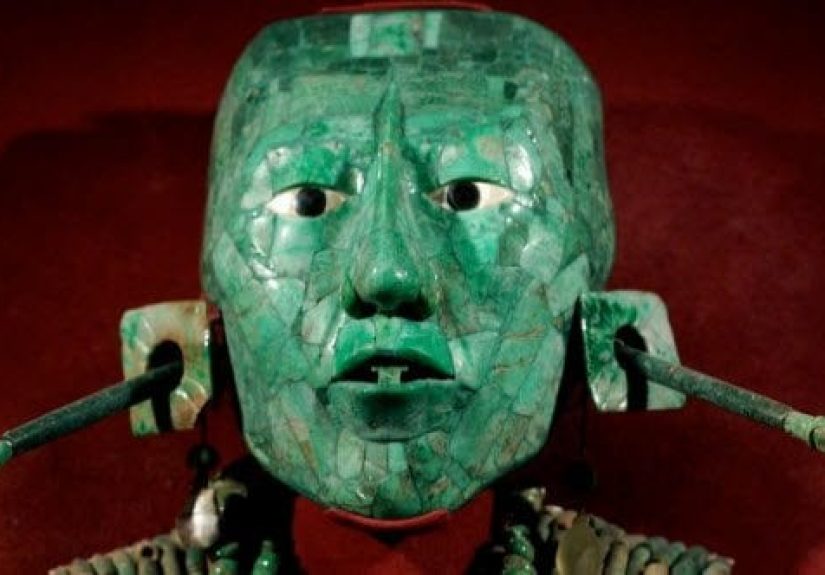
9. Lord Pakal’s Jade Death Mask
In 1952, the Mexican archaeologist Alberto Ruz Lhuillier tunneled beneath the
Temple of the Inscriptions at Palenque and found a hidden crypt. Inside lay
the sarcophagus of K’inich Janaab’ Pakal, usually known as Lord Pakal the Great,
one of the most important rulers of the Classic Maya. Covering his face was an
exquisite mosaic mask made of roughly 300 pieces of jadeite, along with tiles
of albite, quartz, and other stones.
The mask’s eyes are made from shell and obsidian, giving Pakal an almost
lifelike gaze. Archaeologists believe the mask symbolized the king’s
transformation into a divine, maize-linked ancestor and was meant to help him
be reborn in the afterlife. The choice of jade, associated with breath, life,
and vegetation, reinforces this theme.
The mask’s modern history is almost as dramatic as its ancient one. In 1984,
thieves broke into Mexico City’s National Museum of Anthropology through the
air ducts, stealing Pakal’s mask and other treasures. The loot eventually passed
through the hands of drug traffickers before a police informant helped recover
it in 1989. Today, Pakal’s jade face once again stares out from a display case,
but questions remain: How exactly did the Maya quarry and transport enough
high-quality jade, and what specific rituals surrounded the placing of the mask
on the king’s face? The glyphs tell part of the story, but not all.
10. Liangzhu’s Enigmatic Jade Cong
If there’s a single jade object that makes archaeologists shrug and say “we
honestly don’t know,” it’s the cong. These Neolithic ritual tubes, most
famously produced by the Liangzhu culture in China’s Yangtze River Delta
around 3300–2200 BCE, are square on the outside, round on the inside, and
exquisitely carved.
Cong range from small hand-sized pieces to massive blocks weighing several
kilograms. Many are decorated with stylized faces that combine human and animal
features, possibly representing protective spirits or deities. Elite Liangzhu
tombs often contain multiple cong along with bi discs, suggesting a strongly
developed ritual system centered on jade.
Despite decades of scholarship, their exact function is still unknown. Some
specialists think the square exterior represents the earth and the circular
interior the heavens, with the cong acting as a kind of spiritual conduit.
Others argue they were purely status symbols, meant to display the wealth and
authority of the buried elite. What’s clear is that producing a cong required
tremendous skill, as jade is notoriously difficult to carve. Every time a new
example is excavated, it adds more detail but doesn’t quite solve the puzzle.
Living with Mystery: Why Jade Still Captivates Us
One reason these jade relics remain fascinating is that they sit right on the
edge between what we know and what we can only guess. Modern lab techniques can
identify quarries, trace trade routes, and even study microscopic wear on jade
surfaces. But no amount of spectroscopy can tell us exactly what it felt like
to commission a burial suit or dedicate a jade corncob to a river, hoping a god
was listening.
Jade’s toughness adds to the drama. Many of these objects have outlasted the
cities, languages, and belief systems that produced them. A Scottish farmer’s
field may hold a polished Alpine axe that was already an antique when the
Pyramids were young. A jade cong might spend thousands of years in a tomb,
survive looters, wars, and damp soil, and still emerge sharp-edged and cool to
the touch.
Experiences Around “10 Mysterious Jade Relics”
Reading about mysterious jade relics is one thing; encountering them in person
is something else entirely. People who have seen these artifacts up close often
report a surprisingly emotional reaction. Part of that comes from the sheer
craftsmanship: when you stare at a jade burial suit or a finely carved cong,
you’re looking at thousands of hours of human effort condensed into a single
object.
Standing in Front of a Jade Burial Suit
Imagine walking into a museum gallery and suddenly realizing there’s a human-shaped
figure lying in a glass case, made entirely of small jade tiles. Up close, you
can see the tiny drill holes and threads that once stitched the plates
together. The surface catches the light in a way that feels almost organic,
like skin made of stone.
Visitors often describe an odd mix of awe and discomfort. On one hand, the suit
is astonishingly beautiful, and the idea of trying to “armor” yourself against
decay is both poetic and understandable. On the other, it’s impossible to forget
that this was designed for a real person’s body someone who expected that jade
might carry them safely into eternity. That mix of intimacy and distance is
part of what makes the experience stick with you long after you leave the
gallery.
The Quiet Power of Jade Masks and Discs
Jade masks like Lord Pakal’s have a different energy. They’re often displayed
at eye level, so you find yourself accidentally making “eye contact” with a
king who died over a thousand years ago. The slight asymmetries in the mosaic
pieces remind you that this was hand-cut and hand-assembled by artisans who
probably never imagined their work would end up in a climate-controlled case
instead of a sealed crypt.
Bi discs and cong feel more abstract but no less powerful. Their weight and
smoothness encourage mental questions: How did someone plan this design with no
written blueprint? Did they think of the stone as alive? Would they be pleased
or horrified to see their sacred object sitting between a gift shop and a café?
Tips for Exploring Jade Relics Yourself
If this list has you itching to see jade relics in person, you’re in luck.
Major museums in the United States including institutions in New York,
Washington, D.C., Chicago, and San Francisco have significant collections of
Chinese and Mesoamerican jade artifacts. Many display at least one jade burial
suit or mask, along with cong and bi discs.
When you visit, try a slower approach than the usual “scan and move on” museum
walk:
-
Spend a full minute just looking at one object. Notice tool marks, repaired
cracks, and variations in color. -
Read the labels carefully, but then step back and imagine how the artifact
was used based on what you know of the culture. -
Compare different pieces of jade. Some are translucent apple green, others
are milky white, dark gray, or even mottled brown each color had its own
symbolic associations. -
Think about logistics. How far did this stone travel? How many people had to
cooperate to create it? Who was allowed to touch it?
At home, documentaries and virtual museum tours can give you close-up views of
jade relics you might never see in person, such as artifacts from newly
excavated Chinese tombs or underwater finds in Mexico. Even on a screen, the
cool gleam of jade has a way of cutting through the centuries.
Conclusion: The Stone That Refuses to Explain Itself
From record-breaking imperial seals to underwater corncobs and vanished royal
regalia, jade relics are a reminder that human beings have always been willing
to pour immense effort into objects that sit somewhere between art, technology,
and faith. Modern science can tell us what these artifacts are made of and
where they came from, but not always why they were created or how people felt
about them.
That lingering mystery is part of the appeal. Jade doesn’t rust or rot; it
simply waits. Thousands of years later, it still gleams under museum lights,
challenging us to imagine the worlds that produced it and hinting that some
secrets, especially the most interesting ones, were never meant to be fully
solved.