Table of Contents >> Show >> Hide
- What Is a Gibbous Moon, Exactly?
- What Does the Waxing Gibbous Moon Mean?
- What Does the Waning Gibbous Moon Mean?
- How to Tell the Difference Between Waxing and Waning Gibbous
- Why the Gibbous Moon Happens
- What the Gibbous Moon Looks Like in Real Life
- Common Myths and Misunderstandings
- What the Waxing and Waning Gibbous Moon Mean in Culture and Everyday Life
- Best Ways to Enjoy a Gibbous Moon
- Final Thoughts: So, What Does the Waxing and Waning Gibbous Moon Mean?
- Experiences Related to the Waxing and Waning Gibbous Moon
If you have ever looked up and thought, “That Moon is almost full, but not quite,” congratulations: you have met the gibbous Moon. It is the lunar phase that looks like the Moon put on its fancy round outfit but stopped just short of buttoning the top button. More than half of the Moon is illuminated, yet it is not fully lit. That in-between look is what makes both the waxing gibbous Moon and the waning gibbous Moon so easy to notice and so oddly easy to misunderstand.
So, what does the waxing and waning gibbous Moon mean? In astronomy, the meaning is wonderfully straightforward. Waxing gibbous means the visible illuminated portion of the Moon is increasing on its way toward a full moon. Waning gibbous means the illuminated portion is decreasing after the full moon. In other words, one is the Moon building up; the other is the Moon easing back down. No drama, no cosmic passive-aggressive text message from the universe, just orbital geometry doing its thing.
Still, people have long attached symbolic meaning to these phases. The waxing gibbous Moon is often associated with momentum, refinement, preparation, and anticipation. The waning gibbous Moon is commonly linked with reflection, gratitude, release, and sharing wisdom. Those symbolic meanings belong to folklore, spiritual practice, and astrology rather than science, but they remain part of how many people talk about the Moon today.
What Is a Gibbous Moon, Exactly?
The word gibbous refers to a shape that is rounded and bulging. In moon-phase language, it describes any phase in which more than half of the Moon’s visible face is lit, but the Moon is not yet fully illuminated or is no longer fully illuminated. That means the gibbous phases sit on either side of the full moon in the lunar cycle.
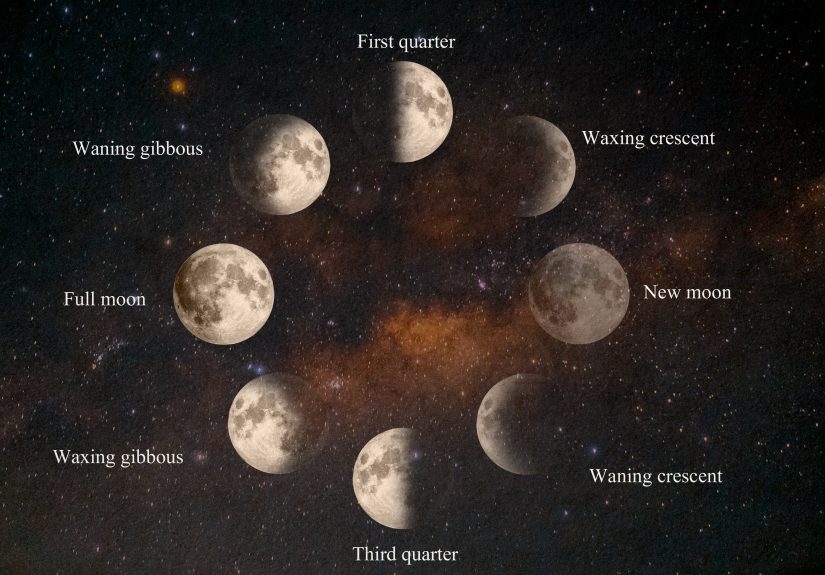
The full cycle of lunar phases takes about a month, and the Moon moves through eight commonly named phases: new moon, waxing crescent, first quarter, waxing gibbous, full moon, waning gibbous, third quarter, and waning crescent. The gibbous stages are therefore the “almost full” chapters of the lunar month, and they last for several days rather than a single brief moment.
This matters because many people casually call the Moon “full” for a night or two on either side of the actual full moon. Astronomically, though, the full moon is exact only at a specific moment. Before that moment, the Moon is waxing gibbous. After it, the Moon is waning gibbous. So if you point at a nearly perfect Moon and say, “Look at the full moon,” you may be emotionally correct and technically a little spicy.
What Does the Waxing Gibbous Moon Mean?
Astronomical meaning
The waxing gibbous Moon appears after the first quarter and before the full moon. “Waxing” means the illuminated portion we see from Earth is growing. During this phase, the Moon is more than half lit, and each night it appears brighter and rounder as it approaches full illumination.
In practical skywatching terms, a waxing gibbous Moon is usually visible in the afternoon and evening. It rises before the full moon does, often in the afternoon, shines prominently during the early evening, and sets after midnight. That is one reason it feels familiar even to people who are not actively moon watching: it tends to show up when people are outside walking the dog, driving home, or pretending to enjoy a jog.
Symbolic meaning
Outside astronomy, the waxing gibbous Moon is often interpreted as a phase of adjustment, growth, and fine-tuning. If the new moon is about beginnings and the first quarter is about action, waxing gibbous is the stretch where you review, improve, and keep going. It is the cosmic equivalent of proofreading the essay, tightening the bolts, and adding the parsley before dinner guests arrive.
Many people use this phase as a symbolic checkpoint. It suggests that something is in progress and gaining form, but still needs polish. In journals, meditation practices, and moon-themed rituals, the waxing gibbous is often linked to focus, patience, and readiness for completion.
What Does the Waning Gibbous Moon Mean?
Astronomical meaning
The waning gibbous Moon appears after the full moon and before the third quarter. “Waning” means the illuminated portion visible from Earth is shrinking. It still looks more than half lit, but each night a little less of the bright face is visible.
This phase is especially associated with late-night and early-morning viewing. A waning gibbous Moon rises later than a full moon, often after sunset, climbs high after midnight, and remains visible into the morning sky. If you have ever stepped outside before sunrise and spotted a bright Moon hanging in the west, there is a good chance you were looking at a waning gibbous.
Symbolic meaning
In symbolic traditions, the waning gibbous Moon is often connected with reflection, gratitude, teaching, and release. The idea is simple: the Moon has already reached fullness, so this phase represents what happens after the peak. You review what worked, share what you learned, and let go of what is no longer needed.
That makes the waning gibbous feel different from the waxing gibbous, even though the Moon may look similarly round. One phase points toward completion; the other points away from it. One says, “Keep building.” The other says, “Now make meaning out of what happened.”
How to Tell the Difference Between Waxing and Waning Gibbous
At first glance, the two phases can look almost identical. Both are bright. Both are more than half illuminated. Both can make you wonder whether the Moon is full or just showing off. Fortunately, there are a few reliable ways to tell them apart.
1. Check whether the light is increasing or decreasing
If the Moon is moving toward full, it is waxing gibbous. If it is moving away from full, it is waning gibbous. A moon-phase calendar makes this easy, but even casual observation over a couple of nights can show the difference.
2. Notice when you see it
A waxing gibbous Moon is usually an evening Moon. A waning gibbous Moon is usually a late-night or morning Moon. If it is bright before bedtime, waxing is likely. If it is hanging around while you are making coffee and rethinking your life choices, waning is likely.
3. Look at which side is lit
In the Northern Hemisphere, waxing phases generally appear lit on the right side, while waning phases appear lit on the left. In the Southern Hemisphere, the orientation is reversed. Near the equator, the Moon’s orientation can look different again depending on its position in the sky, which is a good reminder that the Moon enjoys keeping humans humble.
Why the Gibbous Moon Happens
The Moon does not change shape. It is always half illuminated by the Sun. What changes is how much of that sunlit half we can see from Earth as the Moon orbits our planet. The phases are caused by the changing angle between the Sun, Earth, and Moon.
When the Moon is between Earth and the Sun, the side facing us is mostly dark: new moon. As the Moon moves along its orbit, we see more of the lit half: waxing crescent, first quarter, then waxing gibbous. When Earth is roughly between the Sun and Moon, we see the fully illuminated face: full moon. After that, the visible lit portion begins to decrease: waning gibbous, third quarter, and waning crescent.
That is why the waxing and waning gibbous Moon mean something precise in science. They are not vague moods. They are clear descriptions of illumination and orbital position.
What the Gibbous Moon Looks Like in Real Life
The gibbous Moon is one of the most satisfying lunar phases to observe because it is bright, easy to find, and detailed enough to reward a closer look. With the naked eye, it appears plump and brilliant. With binoculars or a small telescope, it becomes even more interesting.
During the waxing gibbous phase, the line between lunar day and lunar night, called the terminator, cuts across the Moon in a way that makes craters, ridges, and valleys stand out with dramatic shadows. Many skywatchers love this phase because the full moon can be so bright that surface features look washed out, while a gibbous Moon often gives better contrast.
The waning gibbous phase offers the same kind of pleasure from the opposite side. Features along the terminator become visible in a different light angle, which changes the look of familiar craters and maria. So if you enjoy lunar photography or telescope viewing, both waxing and waning gibbous phases are prime time. The Moon is basically serving high-definition geology with theatrical lighting.
Common Myths and Misunderstandings
“A gibbous Moon is basically a full moon.”
Close, but not quite. A gibbous Moon is not fully illuminated, even if it looks very close. The full moon is an exact phase moment, while the gibbous phases span days on either side.
“The Moon is bigger during the gibbous phase.”
Nope. The Moon’s apparent size can vary a little because its orbit is not a perfect circle, but the gibbous shape itself is about illumination, not the Moon swelling like a bread loaf in the oven.
“Gibbous moons cause the strongest tides.”
The Moon absolutely affects Earth’s tides, but the strongest average tidal ranges happen around the new moon and full moon, when the Sun, Moon, and Earth are more closely aligned. Gibbous phases can still coincide with noticeable tides, but they are not the main stars of the spring-tide show.
“Waxing and waning mean the Moon is growing and shrinking physically.”
They do not. Those words describe the changing amount of the illuminated Moon we can see from Earth, not the Moon itself changing size.
What the Waxing and Waning Gibbous Moon Mean in Culture and Everyday Life
Even though the scientific explanation is clear, the Moon has never been just a science object in human culture. Moon phases have shaped calendars, folklore, religious observances, farming traditions, art, poetry, and plain old backyard wonder. That is part of why people keep asking what the waxing and waning gibbous Moon mean. They are asking for the science, yes, but also for the feeling.
The waxing gibbous Moon often feels energetic because it appears before the full moon, at a time when brightness is building. It can symbolize expectancy, anticipation, and the sense that something important is getting closer. The waning gibbous Moon, by contrast, often feels thoughtful and calm because it arrives after peak brightness. It can symbolize processing, wisdom, and a graceful easing downward rather than a dramatic ending.
Neither symbolic interpretation is scientific fact, but both reflect a very human habit: we turn recurring natural patterns into stories that help us mark time. And honestly, that is one of our better habits.
Best Ways to Enjoy a Gibbous Moon
- Go outside in the early evening for a waxing gibbous Moon and in the late evening or morning for a waning gibbous Moon.
- Use binoculars to explore the lunar surface without needing fancy equipment.
- Watch the Moon for several nights in a row to see the difference between waxing and waning more clearly.
- Take photos on both sides of the full moon and compare the shadows and features.
- Keep a moon journal if you enjoy blending observation with reflection.
Final Thoughts: So, What Does the Waxing and Waning Gibbous Moon Mean?
The simplest answer is this: a waxing gibbous Moon means the Moon is more than half illuminated and growing toward full, while a waning gibbous Moon means it is more than half illuminated and shrinking away from full. That is the scientific meaning, and it is rooted in the Moon’s monthly orbit around Earth.
But the deeper reason people keep asking the question is that the gibbous Moon does not just explain itself with geometry. It also feels meaningful. The waxing gibbous suggests building, refining, and nearing completion. The waning gibbous suggests reflecting, sharing, and letting go. Science tells us what these phases are. Human imagination tells us what they feel like.
Put those together, and the gibbous Moon becomes more than an “almost full” moon. It becomes a visible reminder that not every important stage is a beginning or an ending. Sometimes the most interesting part is the nearly-there part, or the just-past-it part. And the Moon, as usual, manages to make that look spectacular.
Experiences Related to the Waxing and Waning Gibbous Moon
One of the most memorable things about the waxing gibbous Moon is how social it feels. Unlike the shy crescent that hugs the horizon or the full moon that steals the whole scene, the waxing gibbous often appears when life is still happening. You notice it on your commute home, during an evening walk, while taking out the trash, or while standing in a parking lot wondering why you came there in the first place. It has this quiet confidence. It is bright enough to stop you in your tracks, but not so dramatic that it feels like a performance. Many people describe it as the Moon phase that makes them look up unexpectedly and stay there a little longer than planned.
The waning gibbous Moon creates a different kind of experience. It belongs to quieter hours. You see it after a late shift, during an early airport drive, or out a kitchen window before sunrise. Because it often hangs in the morning sky, it can feel strangely intimate, like you found a beautiful detail that daytime almost forgot to erase. There is something especially moving about seeing a bright Moon while the world is already shifting toward breakfast and emails. It feels like two clocks are running at once: the human one and the celestial one.
For amateur skywatchers, the gibbous phases are often when the Moon becomes genuinely addictive. A person might begin by casually admiring it, then grab binoculars “just for a second,” and twenty minutes later be identifying craters and tracing the terminator like a lunar detective. Waxing gibbous nights are famous for this because shadows along the Moon’s surface make ridges and crater walls pop. Waning gibbous mornings can be just as rewarding, especially for people who enjoy comparing how the same features look under different lighting angles.
Photographers also love these phases for practical reasons. The Moon is bright, easy to locate, and visually rich, but not as flat-looking as the full moon can sometimes be. A waxing gibbous over a city skyline can feel energetic and cinematic. A waning gibbous above a quiet neighborhood at dawn can feel reflective and almost dreamlike. The phase changes the mood of the picture, even when the subject is the same familiar Moon.
Then there is the emotional experience, which is harder to measure and easier to recognize. People often attach the waxing gibbous to effort, progress, and that satisfying feeling of being close to something important. The waning gibbous, by contrast, often feels like the exhale after the event, the grade after the test, the conversation after the celebration. Whether you approach the Moon scientifically, spiritually, artistically, or just as someone who likes pretty skies, the gibbous phases have a way of meeting you where you are. They do not demand a grand belief system. They simply offer a repeated experience of change that is visible, reliable, and strangely comforting.