Table of Contents >> Show >> Hide
- What “Small Domestic Folks” Really Means (And Why Humans Keep Inventing Them)
- The Classic Job Description: Help at Night, Mischief by Morning
- Brownies: The Night-Shift Housekeepers of British Folklore
- Kobolds: Helpful… Until They’re Not
- Domovoi: The House Spirit with Deep Roots
- Tomte/Nisse: The Farmstead Guardian with Strong Opinions
- Zashiki-warashi: A “Tatami-Mat Child” That Brings Luck
- Menehune: Hawai‘i’s Legendary “Little People” Builders
- Why This Motif Shows Up Everywhere
- A Modern Twist: Turning Kitchen Chaos into Creatures
- So… Did We Invent Them, or Did They Invent Us?
- How to “Create” Your Own Small Domestic Folks (As a Healthy, Harmless Practice)
- Extra of Experiences Related to “We Created Small Domestic Folks”
- Conclusion: The Small Domestic Folks Are Us, With Better PR
You know that moment when you walk into the kitchen and instantly realize something happenedyet you were not
invited to the meeting? Flour dust on the counter like fresh snow. A spoon in the sink that looks like it fought a
small war. A trail of crumbs that suggests a midnight parade. The rational explanation is simple: humans are messy,
gravity is undefeated, and dishwashers do not load themselves.
And then there’s the other explanationthe one your brain offers when it’s tired, amused, or trying to keep the peace:
small domestic folks did it.
“Small domestic folks” isn’t a scientific category. It’s a playful, modern way to talk about an old idea:
tiny, usually invisible beings who live near us, help us, prank us, and occasionally redecorate our homes with chaos.
Across cultures, these characters show up as household spirits, “little people,” barn helpers, kitchen gremlins, and
luck-bringersmini neighbors with big opinions about how you run your home.[1]
What “Small Domestic Folks” Really Means (And Why Humans Keep Inventing Them)
Folklore scholars describe folklore as living tradition: shared stories, beliefs, and practices that communities keep
remixing over time. It’s not just dusty legendsit’s culture that adapts. That’s why the “small domestic folks” concept
feels instantly familiar even if you’ve never used the phrase before.[1]
The idea solves several human problems at once:
- It explains the unexplainable. Where did the missing sock go? Who knocked over the measuring cup?
- It adds meaning to ordinary life. A home becomes a stage where effort, luck, and mischief play out.
- It keeps the peace. It’s easier to laugh at “tiny house spirits” than start a roommate summit.
- It teaches social rules. Many of these tales reward respect, cleanliness, and generosityand punish arrogance.
In other words, we didn’t just “create” small domestic folks for entertainment. We created them because they’re
emotionally useful. They let us turn everyday disorder into storysomething we can understand, repeat, and share.
The Classic Job Description: Help at Night, Mischief by Morning
If you collect household-spirit stories from around the world, you’ll notice a pattern: these beings often do chores
when humans aren’t looking… but they also have a temper. The arrangement is basically an ancient service contract:
“Treat us with respect, and we’ll help. Disrespect us, and your life becomes a low-budget prank show.”
Brownies: The Night-Shift Housekeepers of British Folklore
In English and Scottish folklore, a brownie is often described as a small, industrious household spirit
associated with homes and barnsrarely seen, more often heard at night while cleaning or doing housework. Some stories
also paint brownies as mischievous, especially if they feel insulted or taken for granted.[2]
The “moral” is clear: appreciate help, don’t be greedy, and don’t assume you can control everything that happens in a
home. Also: if you wake up to a mysteriously tidier kitchen, maybe say thank you out loud. Worst case, you sound
eccentric. Best case, you sound eccentric and polite.
Kobolds: Helpful… Until They’re Not
In German folklore, kobolds are often described as household spirits who can help with chores and
servicesbut they’re temperamental. Stories frequently mention them hiding tools or causing trouble if they aren’t
treated properly (including being fed). Think of them as a tiny roommate who strongly believes in snacks and respect.[3]
Domovoi: The House Spirit with Deep Roots
Slavic traditions include the domovoi (also spelled domovoy/domovoi), often described as a household
spirit connected to family and home. Some sources tie the figure to older forms of ancestor-related beliefanother sign
that “house spirits” aren’t just cute inventions; they’re ways societies talk about continuity, protection, and the
sacredness of domestic space.[4]
Tomte/Nisse: The Farmstead Guardian with Strong Opinions
Scandinavian traditions include the tomte (and related nisse figures), typically described as a
household/farm spirit associated with protecting a homestead and helping with choresespecially when treated well.
Across many tellings, the vibe is consistent: reward good stewardship, punish disrespect.[5]
Zashiki-warashi: A “Tatami-Mat Child” That Brings Luck
Japan has traditions surrounding zashiki-warashi, sometimes described as a child spirit associated with
a homeoften seen by childrenand commonly linked to good fortune for households it visits (and misfortune when it
leaves). Even the name is explained as meaning something like “tatami-mat child,” tying the being directly to the
domestic interior.[6]
Menehune: Hawai‘i’s Legendary “Little People” Builders
In Hawaiian tradition, menehune are often described as “little people” known in legend for impressive
building featssometimes said to work at night. Their stories show how “small folks” can represent community memory,
craftsmanship, and wonder attached to real places and structures.[7]
Different names, different costumes, different regionssame basic human impulse: to imagine a hidden workforce and a
hidden meaning inside everyday life.
Why This Motif Shows Up Everywhere
One reason “small domestic folks” persist is that folklore is incredibly good at traveling through time. Storytellers
adapt plots and characters to match what audiences need: belonging, awe, humor, comfort, cautionary lessons, and a way to
talk about things that feel bigger than logic. In many communities, the “wee folk” can be spoken of as both fictional and
socially realreal enough to shape behavior, taboos, and respect for certain places.[8]
Another reason is psychological: stories give us a handle on uncertainty. When you can’t prove why the pantry is chaotic,
a tale steps in and says, “Here’s a character who would do that.” It’s not a scientific claim; it’s a narrative tool.
And narrative tools are how humans carry values across generations.
Even modern pop culture keeps recycling the same old ingredientsotherworldly beings close to home, bargains, warnings,
and consequencesbecause those ingredients still taste right. The costumes change. The craving doesn’t.[9]
A Modern Twist: Turning Kitchen Chaos into Creatures
Here’s where the title “We Created Small Domestic Folks” becomes literalnot as a claim that someone engineered a
species, but as a creative act. A modern art-and-photography project took household messes and gave them residents.
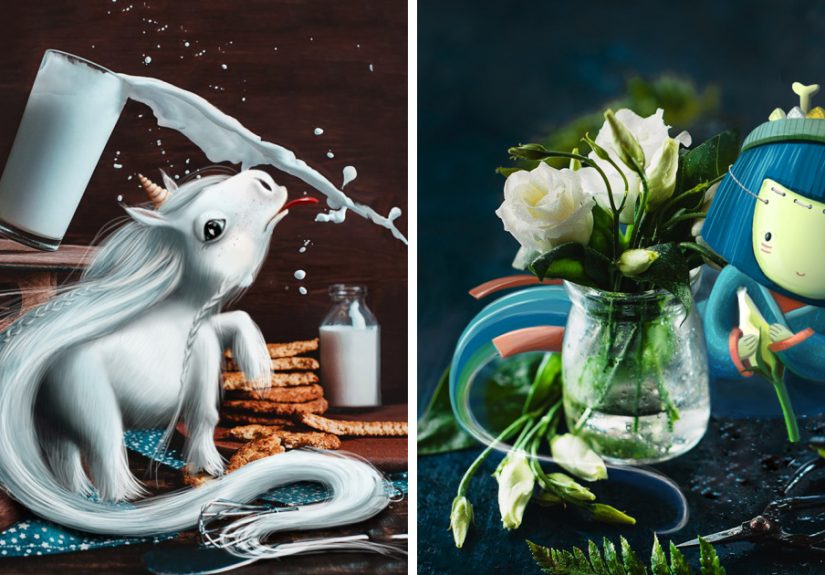
In a well-known illustrated photo series created by illustrator Marina Fandeeva and photographer
Dina Belenko (based in Los Angeles), “small domestic folks” are framed as house spirits and tiny
creatures who “help” around the home… by creating the exact kind of disorder that makes you question reality. The creators
pair staged kitchen scenes (spilled flour, scattered ingredients, toppled utensils) with detailed character illustrations
and short lore-style descriptions.[10]
What makes the concept stick is the strategy:
- Start with a real domestic moment (the kind you’ve personally witnessed at 11:57 p.m.).
- Assign it a creature with a personality that “fits” the mess.
- Borrow from global folklore motifshouse spirits, little helpers, pranksters, luck-bringers.
- Let the image do half the storytelling, so the viewer fills in the rest.
The project’s cast draws inspiration from multiple traditionsnaming figures like zashiki-warashi and also inventing or
remixing lesser-known “domestic folk” characters to match specific scenes. In other words: it treats folklore the way
folklore actually worksby adapting and recombining familiar ideas into new forms that feel instantly believable.[10]
The series gained broad internet attention because it validates something everyone recognizes: kitchens do not become
chaotic in a neat, rational way. They become chaotic in a theatrical way. The photos and illustrations simply give the
theater a cast list.[11]
So… Did We Invent Them, or Did They Invent Us?
When people say “We created small domestic folks,” they’re also admitting something about humanity: we can’t stand a
boring explanation if a better story is available.
Notice how many household-spirit tales mirror real domestic tensions:
- Invisible labor: cleaning, repairing, maintainingwork that’s essential but easy to overlook.
- Fairness: who does what, who appreciates it, and who “forgets” until everything collapses.
- Boundaries: respect the home; don’t spy, don’t mock, don’t act entitled.
- Shared responsibility: your home thrives when everyone contributes (including your imaginary residents).
In that sense, small domestic folks are like a cultural pressure gauge. They’re the story-form our ancestors (and our
meme-loving friends) used to talk about domestic life without turning it into a lecture.
How to “Create” Your Own Small Domestic Folks (As a Healthy, Harmless Practice)
No, you don’t need a crystal, a ritual, or a legal agreement with your pantry. You just need observation and imagination.
Here are some ways people use the idea responsiblyas humor, creativity, and a nudge toward better habits:
1) Name the Mess (So It Stops Feeling Like a Personal Attack)
Instead of “I’m a disaster,” try: “Ah. The Crumb Courier has been active.” This tiny shift can reduce shame and turn
cleanup into a manageable task rather than a character judgment.
2) Assign Personalities That Teach Something Useful
The “Flour Sprite” only appears when you bake without preparing your workspace. The “Sock Borrower” thrives when laundry
lives in a chair-based ecosystem. These personalities are basically comedic reminders.
3) Use the Story to Build Family or Roommate Culture
For kids, these stories can turn chores into a game (“Let’s outsmart the Night Sweeper by putting things away before bed”).
For adults, it can become gentle shorthand that avoids blame (“Looks like the Pantry Gremlin struckwant to reset together?”).
4) Make Art From It
Sketch them. Write a two-paragraph “field note.” Take a photo of a harmless domestic moment and add a doodle overlay later.
The point isn’t to convince anyone they’re real; it’s to give form to a feeling and laugh while you do it.
5) Keep It Grounded
The healthiest version of “small domestic folks” is a metaphor you controlnot a fear you obey. If the idea ever makes
you anxious, pull it back to what it is: folklore-flavored creativity.
Extra of Experiences Related to “We Created Small Domestic Folks”
What does it feel like to live with the “small domestic folks” idea in real lifenot as a belief system, but as a lens?
People describe a surprisingly consistent set of experiences, and they’re less about the supernatural and more about
attention, humor, and pattern-recognition.
Experience #1: You start noticing micro-mysteries. The classic trigger is something tiny: a cabinet left
open, a teaspoon that migrates to a strange location, a smear of peanut butter that appears on the fridge handle like a
signature. You probably already know the real cause (a rushed morning, a distracted snack, a tired brain), but the “small
domestic folks” framing makes you pause and look. Instead of blowing past the mess, you see it as a clueand you become
just a little more intentional.
Experience #2: Cleanup becomes less emotionally loaded. A lot of household stress is not about the mess
itself. It’s about the story we attach to the mess: “No one respects my time,” “I’m failing at adulthood,” “Why am I the
only one who notices?” Humor doesn’t fix the underlying issue, but it can lower the temperature. When you joke that the
“Crumb Parliament” held an emergency session on your cutting board, you’re not denying realityyou’re making it easier to
re-enter reality without resentment.
Experience #3: You create gentler routines. Many people who adopt playful household narratives end up
building small rituals that are actually practical. A two-minute “closing shift” before bed. A reset of the counter after
cooking. A “future me” station where keys, chargers, and tomorrow’s essentials live. The folklore is the wrapping; the
habit is the gift. It’s the same logic behind older household-spirit tales: respect the home, and life runs smoother.
Experience #4: Your home feels more alive. This is the sneaky benefit. When a home is only a set of tasks,
it can feel like a spreadsheet you live inside. When it has stories, it feels like a place. That’s why folklore is so
durable: it turns space into meaning. The “small domestic folks” idea can make a kitchen feel less like a battleground
and more like a creative studiostill messy sometimes, still human, but warmer.
Experience #5: You become a storyteller without trying. Someone visits, sees the flour explosion, and you
don’t just apologizeyou narrate. “Oh, the Biscuit Goblins were clearly unsupervised.” People laugh. They share their own
version. Suddenly you’re swapping micro-folklore, building community in the smallest possible way. That’s folklore doing
what it does best: giving ordinary life a shared language and a little wonder.
Conclusion: The Small Domestic Folks Are Us, With Better PR
“We Created Small Domestic Folks” works as a title because it’s true on two levels. On the surface, it points to the
modern creative actartists and storytellers giving domestic chaos a cast of characters. Underneath, it points to a much
older human habit: using folklore to explain, soften, and share the strange little dramas of home life.
Whether you meet brownies in a folktale, hear about tomte traditions, read about zashiki-warashi bringing luck to a home,
or scroll past a photo series where tiny residents “cause” your kitchen mess, the message stays the same: a home is never
just a building. It’s a relationship. And relationships run better when you bring respect, humor, and a willingness to
clean up after the invisible party you swear you didn’t host.