Table of Contents >> Show >> Hide
- First: What “Startup Valuation” Really Means (And Why It Feels Like Wizardry)
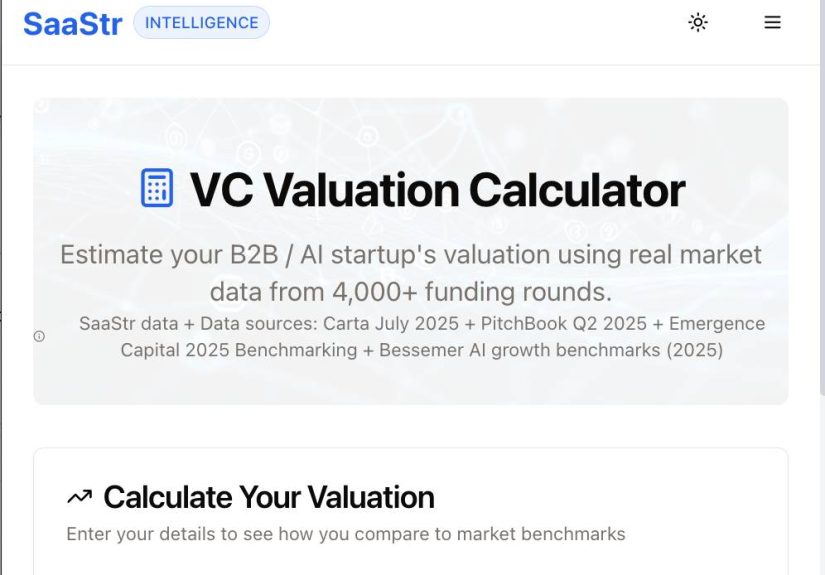
- What the FREE SaaStr VC Valuation Calculator Is Trying to Do
- The Inputs That Usually Move Valuation (A Lot)
- Pre-Money vs. Post-Money: The Two Words That Accidentally Start Founder Wars
- Term Sheet Reality: Your Valuation Isn’t Always Your Payday
- 409A Valuation vs. VC Valuation: Please Don’t Mix These Up
- How to Use a Valuation Calculator Like a Pro (Not Like a Meme)
- A Worked Example (Hypothetical, But Painfully Familiar)
- Common Founder Mistakes After Seeing a Calculator Result
- Bottom Line: Use the Free Tool, Then Do the Grown-Up Part
- +: Founder Field Notes “Experiences” Using a VC Valuation Calculator
Every founder has had the same late-night thought: “So… what are we worth?” Usually followed by:
“And please don’t say ‘it depends’ because I already know it depends.” Welcome to startup valuationthe only
topic where two smart adults can look at the same numbers and arrive at results that differ by, oh, a casual
$40 million.
The good news: you don’t have to walk into investor conversations completely blind. Tools like the
FREE SaaStr VC Valuation Calculator are built to help founders quickly estimate a realistic valuation
range, using market data and patterns that look a lot like how VCs do their first-pass math. It won’t replace a
term sheet, but it can absolutely replace that “I saw a tweet once” approach to pricing your company.
In this guide, we’ll break down how valuation calculators work, what inputs actually matter, where founders
get tripped up (often by one innocent-looking hyphen in “pre-money”), and how to use a calculator result as a
strategy tool, not a magic spell.
First: What “Startup Valuation” Really Means (And Why It Feels Like Wizardry)
Let’s demystify one thing right away: when founders say “valuation,” they usually mean one of these:
- Headline valuation: the number people brag about at dinner.
- Pre-money valuation: the value of the company before new investment money hits the bank.
- Post-money valuation: pre-money plus the new capital raised.
- Enterprise value vs. equity value: the deeper finance-y distinction most startups don’t need dailybut bankers do.
- What founders actually care about: “How much dilution am I taking, and will my team still like me after this?”
In early stages, valuation is rarely a precise measurement. It’s a negotiated outcome shaped by traction,
market conditions, investor appetite, deal structure, and sometimes the cosmic alignment of “AI” buzzwords.
That’s why calculators are best used as calibration: they help you sanity-check your expectations and
pressure-test your fundraising story.
What the FREE SaaStr VC Valuation Calculator Is Trying to Do
SaaStr’s pitch is simple: know your number before you pitch. The calculator is positioned as “VC-style” and
built around market benchmarks and comparable patterns, so founders can estimate valuation quicklywithout
having to become a part-time valuation analyst (or a full-time doom-scroller of funding announcements).
According to SaaStr’s own write-up, the calculator is built using a large set of funding-round and benchmark
data and is designed to break down valuations by factors like funding stage, company type (for example,
traditional SaaS vs. AI variants), and growth and positioning. The core idea is to translate operating metrics
into a valuation range that resembles how investors bucket companies. In other words: “You’re not a number
but you’re also… kind of a number.”
Think of it like a mirror that’s a little brutally honest. Not because the tool is meanbut because the market
is mean, and the market doesn’t even feel bad about it.
The Inputs That Usually Move Valuation (A Lot)
You can’t calculator your way out of fundamentals. If you want a stronger valuation, you generally need
stronger fundamentalsor at least a stronger argument that your fundamentals are about to become stronger.
Here are the big levers most VC-style models respond to.
1) Revenue and Revenue Quality (ARR, MRR, and “Is It Real?”)
For B2B SaaS, recurring revenue is the language of valuation. Investors care about:
ARR/MRR, contract length, revenue predictability, and whether your revenue is “repeatable” (meaning it’s
not held together by one heroic salesperson and a pile of “one-time exceptions”).
If you’re pre-revenue, valuation tends to rely more on market size, founder-market fit, velocity of product
progress, early demand signals, and comparable seed pricing. Yes, it’s fuzzier. No, that doesn’t mean you can
just pick a fun number like $88 million because it “feels lucky.”
2) Growth Rate (Because Speed Still Wins)
Growth is the loudest instrument in the valuation orchestra. If your revenue is accelerating, your multiple is
more likely to expand. If growth is slowing, the multiple often compresses, and investors start asking questions
like “Is this a niche?” and “Is churn… a personality trait of your customers?”
3) Efficiency and the Rule of 40 (Yes, People Still Talk About It)
Growth alone isn’t always enough. Many investors also want evidence you can scale efficiently. That’s where
SaaS benchmarks like the Rule of 40 show up in conversations. One common framing is:
Rule of 40 = Growth Rate (%) + Profitability Metric (%)
(often using free cash flow margin or a similar profitability proxy).
It’s not a universal law, but it’s a popular shorthand for balancing growth and profitability. If you’re growing
55% and running at -30% free cash flow margin, your Rule of 40 is 25. If you’re growing 45% and you’re at
+5% free cash flow margin, your Rule of 40 is 50. Same planet, different investor reactions.
4) Retention (Churn Is the Silent Valuation Killer)
Two companies with the same ARR can have wildly different valuations depending on retention.
Investors look at gross retention, net revenue retention (NRR), expansion revenue, customer concentration,
and churn drivers. If customers expand quickly and stick around, your revenue becomes “higher quality,” which
typically supports higher multiples.
5) Market and Category Narrative (AKA “What Are You, Exactly?”)
The market you’re in changes the math. A crowded category with low differentiation often gets lower
valuations than a category with strong tailwinds, clear differentiation, and high willingness-to-pay.
And yes: AI has changed category narratives. But it hasn’t eliminated the need for distribution, retention,
margins, and a product customers actually keep using after the demo.
Pre-Money vs. Post-Money: The Two Words That Accidentally Start Founder Wars
A valuation calculator result is only useful if you understand what it implies for ownership.
Here’s the simplest version:
- Pre-money valuation = value before the investment.
- Post-money valuation = value after the investment = pre-money + new money.
Example: If you raise $1M at a $4M pre-money valuation, your post-money is $5M. The new investor owns
$1M / $5M = 20% (before any option pool changes, which is where the plot twist usually happens).
And then there’s the SAFE universe. SAFEs can be described as “simple,” which is adorable, because the moment
you stack multiple SAFEs, they become simple in the way a blender is simple: it has one button, and it can
still destroy your smoothie and your sense of control.
A quick SAFE sanity check
If you have SAFEs outstanding, the calculator’s valuation number should be paired with a dilution model:
how much ownership do those SAFEs convert into at a priced round? Are they post-money SAFEs? Are there
multiple caps? Do you have an option pool increase request baked into the term sheet?
A founder who understands this shows up calmer in negotiationsand “calm founder energy” is underrated
leverage.
Term Sheet Reality: Your Valuation Isn’t Always Your Payday
Even if you nail a strong headline valuation, deal terms can change what that valuation means for outcomes.
One of the most important: liquidation preference.
Liquidation preference generally gives preferred shareholders (investors) the right to receive proceeds before
common shareholders (founders and employees) in an exit. In plain English: it’s the “investors get paid first”
line item. Sometimes that’s fair. Sometimes it’s fine. Sometimes it turns your exciting $50M acquisition into a
“congrats on your new laptop” moment.
The punchline here isn’t “avoid liquidation preference.” It’s “don’t confuse valuation with proceeds.” A
calculator can estimate what the company might be worth on paperbut the term sheet decides how the pie is
sliced.
409A Valuation vs. VC Valuation: Please Don’t Mix These Up
If you’re issuing stock options, you’ve probably heard the phrase 409A valuation. That’s a different beast.
A 409A valuation is typically used to determine the fair market value of common stock for option strike prices
and compliance purposes. VC rounds price preferred stock, which has different rights and protections.
Translation: your 409A is not your fundraising valuation, and your fundraising valuation is not your 409A.
If they’re different, that doesn’t automatically mean something is wrong. It means they’re answering different
questions for different contexts.
How to Use a Valuation Calculator Like a Pro (Not Like a Meme)
1) Treat the result as a range, not a prophecy
The best founders use calculators to find a reasonable zone. Then they ask: “What would it take to credibly
move from the low end to the high end?” That becomes a roadmap: growth targets, churn fixes, pipeline
improvements, or margin upgrades.
2) Pair it with your fundraising “why now” story
Investors don’t just fund what you are; they fund what you’re becoming. If the calculator range feels lower
than you expected, your story needs to explain why the next 6–12 months changes the profile of the company.
The story should connect metrics to momentum: distribution unlocks, new channel economics, expansion
revenue, enterprise readiness, or a repeatable go-to-market engine.
3) Ground-check with market multiples (and today’s mood)
Multiples move with the market. A great company in a weak market can still face compressed multiples. And a
decent company in a frothy market can occasionally float upward like a balloon holding a “GenAI” sign.
Use external benchmarks as context so your expectations aren’t stuck in 2021.
4) Run “deal math” before you ever quote a valuation
A valuation is only helpful if it supports your plan. Before you anchor on a number, model:
- How much you need to raise
- How long it gives you (runway)
- What milestones you can hit with that runway
- What dilution you can tolerate (founders + future hiring)
- What option pool adjustments might be requested
The “best” valuation is the one that gives you enough fuel to hit the next inflection point without making the
next round impossible.
A Worked Example (Hypothetical, But Painfully Familiar)
Let’s say you’re running a B2B SaaS company:
- ARR: $2.0M
- YoY growth: 90%
- Gross margin: 82%
- NRR: 120%
- Free cash flow margin: -25% (you’re investing in growth)
Your Rule of 40-style score (growth + free cash flow margin) is roughly 65 (90 + -25). That’s the kind of
“fast and improving” profile that tends to get investors leaning inassuming churn isn’t hiding in the closet.
Now imagine you plug comparable inputs into a VC-style calculator. You might see a valuation range that
reflects:
- Higher multiples when growth and retention are strong
- Stage sensitivity (Seed vs. A vs. B changes expectations)
- Category premiums or discounts depending on market narrative
The useful part isn’t obsessing over the exact number. It’s noticing which metric adjustments move the
outcome. For example:
- If growth drops from 90% to 50%, the model may compress the multiple noticeably.
- If NRR improves from 120% to 130%, the “quality” of revenue improves and may support a stronger range.
- If burn improves while growth stays high, your efficiency narrative gets much sharper.
That’s how calculators become strategy tools: they show you where leverage lives.
Common Founder Mistakes After Seeing a Calculator Result
Mistake #1: Quoting the number like it’s a legal document
“The calculator says we’re worth $X” is not a fundraising strategy. “Based on our traction and comps, we
believe $X–$Y pre-money is a fair range” is better.
Mistake #2: Forgetting the structure
A great valuation with aggressive preferences or heavy dilution can be worse than a slightly lower valuation
with founder-friendly terms. Structure matters.
Mistake #3: Ignoring timing
If you’re six weeks away from a meaningful milestone (big launch, key enterprise deal, churn fix, pricing
shift), the smartest “valuation move” might be to waitif you have runway. If you don’t have runway, the
smartest move might be to raise now and live to fight another day.
Mistake #4: Assuming “AI” automatically means premium pricing
AI can support stronger multiples when it drives real product differentiation, retention, and expansion.
But “we added a chatbot” is not automatically “we deserve a category premium.” Investors have seen… a lot.
Bottom Line: Use the Free Tool, Then Do the Grown-Up Part
The FREE SaaStr VC Valuation Calculator can be a fast way to get oriented: a reality check, a confidence boost,
or a wake-up call (which, honestly, can also be a confidence boost if you act on it).
The smartest way to use it is to:
- Get a valuation range, not a single sacred number
- Understand what inputs drive that range
- Pair the result with a dilution model (especially if you have SAFEs)
- Remember that term sheetsnot calculatorsdecide economic outcomes
And once you know your number? You pitch with more clarity, negotiate with more confidence, and avoid the
two classic founder outcomes: getting lowballed because you didn’t do the math, or pricing yourself out of a
round because your number was powered entirely by vibes.
Disclaimer: This article is for informational purposes only and does not constitute legal, tax, or financial advice.
+: Founder Field Notes “Experiences” Using a VC Valuation Calculator
Below are common founder experiences and patterns (shared and repeated across many fundraising journeys),
written as short, story-style snapshots. They’re not meant as literal case studies of any one companythink
of them as “composite scenes” from the startup wilderness.
1) The “Oh, We’re Not Crazy” Moment
A founder runs the calculator before a big investor meeting, expecting it to spit out something painfully low.
Instead, it lands in the same range they were quietly hoping for. Suddenly, the pitch deck stops feeling like a
school presentation and starts feeling like a negotiation. The founder doesn’t become arrogantthey become
calm. And calm founders do better. They answer valuation questions without spiraling, they anchor with a range,
and they don’t accidentally negotiate against themselves with nervous over-explaining.
2) The “Wait, Pre-Money Means What?” Plot Twist
Another founder proudly tells their cofounder: “Great newswe’re raising at $12M!” The cofounder asks one
annoying question: “Pre or post?” That’s when the spreadsheet comes out. They realize the $12M number was
post-money, and once you back out the new capital (plus an option pool increase), the effective pre-money is
lower than expected. Nobody did anything “wrong,” but the founder learns a core fundraising truth:
valuation words are precise, even when people say them casually.
3) The “We Should Raise Less” Realization
A team wants to raise a big round “for safety.” The calculator result suggests their current metrics support a
smaller valuation than they’d hoped. Instead of forcing a mismatch, they reframe: raise a smaller amount now,
hit clear milestones, then raise again at a stronger position. It’s not always possible (runway is a tyrant), but
when it is, it can reduce dilution and improve optionality. The founder walks away with a mindset shift:
fundraising is not one decision; it’s a sequence of decisions.
4) The “Terms Matter More Than Twitter” Lesson
One founder gets excited by a high valuation range and starts envisioning celebratory burritos for the whole
office. Then a term sheet arrives with preferences that make the headline number feel… less celebratory.
They learn to ask better questions: What’s the liquidation preference? Is it participating? Is there a multiple?
What’s the option pool expectation? What’s the board composition? After that, their relationship with
“valuation” becomes healthier. They stop chasing the highest number and start chasing the best deal for the
company’s long-term success.
5) The “The Calculator Didn’t Like Me” Wake-Up (That Becomes a Win)
A founder enters inputs and gets a range that feels insultingly low. After a short, dramatic moment of “this
tool is broken,” they look closer. The range is being dragged down by slow growth and weak retention.
That’s not the calculator being rudethat’s the business sending a signal. They pick one lever and go to war
on it: churn. They tighten onboarding, fix product gaps, improve activation, and change pricing packaging.
Ninety days later, metrics improve. They rerun the calculator. The range jumps. The founder doesn’t just get a
better numberthey get a better company. And that’s the actual prize.
If there’s one repeating theme in these experiences, it’s this: valuation calculators don’t “decide your worth.”
They help you see what the market is likely to reward, what it’s likely to punish, and what to improve if you
want the next conversation to go your way.