Table of Contents >> Show >> Hide
- Why a Paper Towel Holder Becomes a Design Statement (Whether You Like It or Not)
- What “Vintage” Means for Kitchen Accessories (So You Don’t Get Bamboozled)
- The Anatomy of a Great Vintage Wooden Paper Towel Holder
- Popular Vintage Styles (and the Kitchens They Love)
- Wood Species, Finish, and Patina: The “Please Don’t Sand That” Section
- How to Shop Smart: A No-Regrets Checklist
- Cleaning and Restoring Without Ruining the Finish
- Daily-Life Tips: Make It Work Like a Modern Tool
- Styling Ideas That Don’t Feel Like “Set Dressing”
- Sustainability Bonus: The Most Practical Kind of “Vintage”
- Real-Life Experiences With a Vintage Wooden Paper Towel Holder (Extra Stories & Practical Lessons)
- Wrapping It Up
Every kitchen has a few unsung heroes: the spatula that flips like a gymnast, the mug that “accidentally” became your personality,
and the paper towel rollforever trying to escape its holder like it’s auditioning for an action movie. Enter the
vintage wooden paper towel holder: a small, sturdy, warm-toned upgrade that makes your countertop feel a little more collected,
a little less “I bought this in a panic on aisle nine.”
But “vintage” can mean everything from a genuinely old-school piece with real patina to a brand-new item that’s simply styled to look retro.
This guide breaks down what to look for, how to pick the right style, how to clean it without ruining the finish,
and how to make it look intentionallike it belongs in your kitchen instead of merely occupying it.
Why a Paper Towel Holder Becomes a Design Statement (Whether You Like It or Not)
A paper towel holder lives in prime real estate: near the sink, the stove, the islandwhere life actually happens.
Because it’s always out, it quietly becomes part of the room’s “visual vocabulary.” Wood brings warmth and texture in a way metal and plastic
can’t quite fake. A vintage wooden piece, especially, adds that “found object” vibelike your kitchen has a backstory.
The other reason this humble item earns its spotlight: function. Reviews and product testing across kitchen publications
consistently point to the same truth: heavier, steadier holders make it easier to tear a sheet one-handed without dragging the whole roll
across the counter. In plain English: less chasing, more cleaning.
What “Vintage” Means for Kitchen Accessories (So You Don’t Get Bamboozled)
In home and collectibles circles, “vintage” is commonly used for items that are at least a couple decades old but not quite antique.
Think: a piece that’s old enough to have character, young enough to still work in a modern kitchen.
That matters because true vintage often shows authentic wear (the good kind), uses older construction details,
and may have finishes that require gentler cleaning than today’s factory-sealed products.
Quick vocabulary check
- Vintage: older than “new,” often tied to a specific era and style.
- Antique: generally older, often treated as more historically significant (and sometimes more fragile).
- Retro: made recently but styled to look like something from the past.
The Anatomy of a Great Vintage Wooden Paper Towel Holder
A good holder is basically a tiny piece of furniture. When you’re shoppingonline, at an antique mall, or at a thrift storescan for these
practical details first, then fall in love with the looks.
1) The base: weight, footprint, and grip
The base is the difference between “effortless one-handed tear” and “countertop rodeo.” A wider footprint helps, but mass matters too.
Many high-performing designs rely on a heavy base and some kind of non-slip bottom so the holder doesn’t skid when you tug.
Vintage wooden holders sometimes hide weight inside the base (or rely on thick hardwood and a broad stance).
2) The spindle: height and roll fit
Most household paper towel sheets are around 11 inches wide, so you want a spindle that comfortably fits a standard roll and can accommodate
thicker “mega” rolls without feeling cramped. A little extra height prevents the roll from rubbing the top knob or finial.
3) The topper: knob, finial, or cap (a.k.a. the “grab handle”)
Vintage pieces often have turned-wood knobsclassic, tactile, and charming. Practically, the topper gives you a place to stabilize the roll
while you tear. If it’s loose or wobbly, you’ll feel it every day (and not in a fun, whimsical way).
4) The “control system”: friction, tension, or a stop bar
Modern holders sometimes use a tension arm to prevent unraveling. Vintage wooden holders do it more simply:
a snug spindle, a slightly grippy finish, or a bar-style wall mount that holds the roll in place.
Simpler can be greatfewer parts, fewer surprises.
Popular Vintage Styles (and the Kitchens They Love)
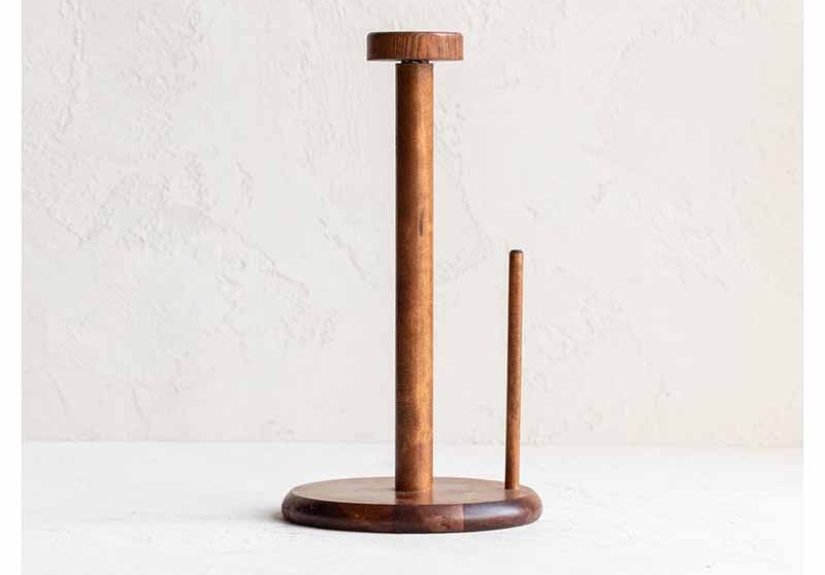
Countertop pedestal (classic turned wood)
This is the iconic look: a solid base with a vertical post. It works in almost any kitchen style, especially farmhouse, cottage, traditional,
and “I own at least one gingham napkin” aesthetics. Bonus: it’s portableeasy to move near the stove when you’re cooking, then back to the sink.
Wall-mounted rack (space-saver with serious charm)
If your counter space is limited, a wall-mounted wooden paper towel rack can feel like you just unlocked a secret room in your kitchen.
These are common in country kitchens and older homes. Look for sturdy mounting points and enough clearance to swap rolls easily.
Under-cabinet mount (the “I want my counter back” option)
Under-cabinet holders keep towels near your prep space without sitting out. Vintage versions may include a small shelf, spice cubby, or wrap
dispenser features. Great for tiny kitchens and anyone who hates visual clutter (but still spills things dailyso, everyone).
Novelty and folk-art (the conversation piece)
Painted wood, hand-carved motifs, and kitschy shapesthink apples, geese, bears, roostersshow up often in late-20th-century “country kitchen”
décor. These pieces can be delightfully specific. If your kitchen is neutral, a novelty holder can be the one charming weirdo in the corner.
Wood Species, Finish, and Patina: The “Please Don’t Sand That” Section
A vintage wooden paper towel holder’s magic often lives in its surface: softened edges, small nicks, a mellow sheen from years of use.
That’s patinaearned character, not damage. The goal is to clean and protect it, not erase its life story.
Common finishes you may encounter
- Oil finish: often looks matte to satin; may feel “dry” over time and benefits from periodic conditioning.
- Varnish/lacquer: typically more glossy and sealed; easier to wipe clean but can scratch or chip.
- Paint: can be charming (and very era-specific). Watch for chipsespecially near hands and the roll edge.
- Shellac: a traditional finish that can look warm and beautiful, but it doesn’t love harsh cleaners.
If you’re unsure what finish you have, treat it like a delicate heirloom until proven otherwise:
clean gently, keep water exposure minimal, and avoid strong chemicals.
How to Shop Smart: A No-Regrets Checklist
Whether you’re hunting in person or scrolling listings, use this checklist to avoid buying a “vintage-looking regret.”
Condition and stability
- Do the wiggle test: the post shouldn’t wobble, and the base shouldn’t rock.
- Check the bottom: non-slip pads are a plus; bare wood can slide (and scratch surfaces).
- Inspect cracks: hairline cracks in the base can worsen under daily pulling.
Practical fit
- Roll clearance: make sure the roll won’t rub against the finial/topper.
- Base size: small base = more tipping. If you’re a “rip paper towels with confidence” person, choose wider.
- Placement: consider where it will livenear sink splashes, next to the stove, or tucked in a corner.
Authenticity (without becoming a detective)
You don’t need to date it to a specific year to buy well. Instead, look for believable wear, solid joinery,
and materials that feel like the real thing (heavy wood, not feather-light composites).
If a listing says “vintage” but the piece looks factory-perfect and freshly stained, it may be retro.
Retro can still be greatjust pay a retro price.
Cleaning and Restoring Without Ruining the Finish
Kitchen items collect a special kind of grime: part dust, part cooking residue, part “how did this get sticky?” The safest approach is gentle,
low-moisture cleaningespecially for older wood finishes.
Step 1: Dry dust first
Use a dry microfiber cloth to remove loose dust. This keeps you from turning dust into mud when you start wiping.
Step 2: Wipe with mild soap and barely-damp water
Mix warm water with a few drops of dish soap. Dampen (don’t soak) a cloth, wipe gently, then dry immediately with a clean towel.
Avoid letting water linger on seams or around the base.
Step 3: Skip harsh cleaners and “miracle sprays”
Strong chemicals can strip finishes, cause discoloration, or leave residues that attract more dirt. For vintage wood, that’s a fast track to
“why does it look worse now?” Also, many preservation and conservation guides warn against silicone-based spray polishes because they can build up
and complicate future restoration.
Step 4: Condition dry wood (only if appropriate)
If the piece seems dry or chalky and appears to have an oil-style finish (not a thick glossy seal), a food-safe mineral oil can help refresh it.
Apply a thin coat, let it absorb, and wipe away excess. If you’re unsure, test on the underside first.
The goal is “soft glow,” not “greased bowling lane.”
Step 5: Handle odor and old kitchen funk gently
If you picked up a piece from a dusty shop and it smells like the 1970s in a way that’s not charming, let it air out in a dry place.
Avoid soaking it or blasting it with strong deodorizers. Time and airflow usually do more than aggressive cleaning.
Daily-Life Tips: Make It Work Like a Modern Tool
Get one-handed tearing without the drama
- Place it on a stable surface and keep the base clean (crumbs can create slip).
- Add discreet non-slip pads if the bottom slides.
- Use confident motion: a quick, firm pull works better than a slow tug that unspools the roll.
Keep it away from the mess-makers
Ironically, the paper towel holder should not live where it’s constantly splashed or steamed. Try to keep it a little away from the sink edge
and not directly beside the cooktop. Wood loves being usefuljust not waterlogged.
Styling Ideas That Don’t Feel Like “Set Dressing”
A vintage wooden paper towel holder can blend in or stand outboth are valid. The trick is pairing it with one or two supporting elements so it
looks like part of a story.
Easy pairings
- Wood-on-wood: a cutting board, a utensil crock, or a small tray echoes the material and feels cohesive.
- Warm neutrals: linen towels, woven baskets, and creamy whites make wood look richer.
- Modern contrast: black hardware or a sleek faucet keeps “vintage” from turning into “grandma museum.”
If your kitchen leans farmhouse or cottage
Lean into texture: wood + stoneware + simple ceramics. In these styles, a vintage piece feels right at home.
You don’t need a full makeoverone authentic wooden accent can do a lot of heavy lifting.
If your kitchen is modern
Treat the holder like a deliberate organic accent. Keep surrounding items minimal so it reads as a warm focal point rather than visual clutter.
One vintage item on a clean counter can look curated, not crowded.
Sustainability Bonus: The Most Practical Kind of “Vintage”
Buying vintage is one of the simplest forms of reuse: you’re extending the life of an existing object instead of demanding new resources.
A wooden holder can last for decades, and even small repairslike tightening a screw or replacing padscan keep it going.
It’s a tiny decision with a bigger mindset behind it: buy fewer things that last longer.
Real-Life Experiences With a Vintage Wooden Paper Towel Holder (Extra Stories & Practical Lessons)
Here’s the funny part about a paper towel holder: it’s not glamorous, but it’s involved in everything.
If you live with a vintage wooden paper towel holder for a while, you start noticing how it shapes your daily rhythmlike a small stage manager
quietly running the show. People don’t talk about this because it sounds ridiculous (“Let me tell you about my towel infrastructure”),
but it’s real.
Experience #1: The one-handed victory. You’re cooking, your hands are messy, and you need exactly one sheetright now.
With a stable wooden holder, you can pin the roll lightly at the top knob and tear cleanly. It’s a tiny win, but it happens multiple times a day.
Over time, those wins add up. You stop doing that awkward two-hand tug where the roll skitters away and you end up unraveling half the planet’s
paper supply. If your holder has a wide, hefty base, you’ll feel this improvement instantly. If it’s lighter, you may end up “chasing the roll”
like it owes you money.
Experience #2: The countertop mood shift. Wood changes how your kitchen feels, even if everything else stays the same.
A vintage wooden holder next to a modern faucet can soften the sharpness of metal and stone. It adds warmthlike putting on a sweater for your
counter. And unlike trendy décor that demands attention, a good wooden holder blends in while still looking special. Guests might not point at it,
but they’ll pick up the “this kitchen feels homey” vibe. (And you’ll pretend that was the plan all along.)
Experience #3: The “patina is proof you cook” mindset. Vintage wood encourages a healthier relationship with wear and tear.
A new glossy holder can make you feel like you’re babysitting it. A vintage one is already seasoned. A small scratch from a pot handle?
Not a crisis, just another chapter. The piece becomes less of a fragile decoration and more of a tool with history.
That’s especially freeing in busy kitchens where perfection lasts about six minutesright until someone opens a jar of tomato sauce with
the enthusiasm of a cartoon character.
Experience #4: The cleaning reality check. You learn quickly that wood and soaking don’t mix.
A vintage holder near the sink will eventually get splashed. The first time you notice a sticky film from cooking residue,
you’ll appreciate how easy it is to wipe with a lightly damp cloth and dry right away. You’ll also learn which “miracle cleaners” to avoid
because they leave a residue or dull the finish. In a weird way, the holder teaches you better cleaning habits: gentle, consistent, and
low-drama. It’s not a bad lesson for life, honestly.
Experience #5: The styling game becomes effortless. Once the wooden holder is in place, you’ll start casually matching it:
a wooden spoon in a crock, a cutting board leaned against the backsplash, a simple tray under soap and sponge.
Suddenly your countertop looks “styled,” but you didn’t set out to style ityou just made a few practical choices that happen to look good.
The holder becomes an anchor piece, like the bass line in a song: not always noticed, but everything sounds better when it’s there.
The bottom line: a vintage wooden paper towel holder improves your kitchen in small, repeatable ways. It’s sturdier than it looks, warmer than
plastic, and surprisingly satisfying to use. And if it has a little chipped paint or a softened edge from decades of hands, that’s not a flaw.
That’s evidence it’s been usefulexactly what you want in the middle of a real, lived-in kitchen.
Wrapping It Up
A vintage wooden paper towel holder is one of those rare kitchen upgrades that’s both practical and charming:
it steadies your daily mess-management routine while adding warmth and personality to your space.
Choose one with a stable base, a comfortable height for your favorite rolls, and a finish you can care for gently.
Then let it do what vintage does bestshow up every day, quietly proving that good design can also be useful.