Table of Contents >> Show >> Hide
- What Exactly Is a Zuni Rocket (and Why Is It Still Around)?
- How Did Zunis Get to Ukraine?
- The Real Trick: Mounting U.S. Rocket Pods on Soviet Aircraft
- Why Ukraine Would Use Unguided Rockets in a High-Threat Air Defense Environment
- What Zunis Can Do on the Battlefield
- Zuni vs. Soviet-Era Rockets: Why This Swap Makes Sense
- But Are They Accurate Enough? The Honest Answer
- Why Old Rockets Can Be Surprisingly Modern
- A Quick, Darkly Funny Sidebar: Zuni’s Famous Safety Lessons
- What Zuni Use Says About the Wider Air War in Ukraine
- Conclusion: A Vintage Rocket With a Very Current Job
- Field Notes: of Real-World Lessons (Without the Hollywood Filter)
In a war where drones livestream strikes, artillery gets “smart” fuzes, and air defenses can swat aircraft out of the sky like angry gods,
it’s almost rude that a rocket designed in the 1950s is still getting invited to the fight. Yet here we are: Ukraine has been firing U.S.-made
5-inch (127mm) Zuni rocketsa weapon old enough to have opinions about rock ’n’ rollagainst modern Russian positions.
This isn’t nostalgia. It’s math. When you’re short on compatible munitions, you don’t ask a rocket for its birth certificateyou ask whether it can
be mounted, launched, and deliver enough explosive persuasion to matter. Ukraine’s answer, after some ingenious “Franken-rigging,” has been: yes.
What Exactly Is a Zuni Rocket (and Why Is It Still Around)?
The Zuni is a U.S. Navy-developed folding-fin aircraft rocket that entered service in the late 1950s. Think of it as the bigger,
heavier cousin of the ubiquitous 2.75-inch Hydra rocketsless “pepper shaker,” more “kitchen mortar.” It was designed as a modular system, meaning
different warheads and fuzes could be paired with the same basic rocket motor. Over the decades, Zuni rockets were used by U.S. aircraft in multiple
conflicts, famously including the Vietnam era.
Why “66-Year-Old” Mattersbut Not the Way You Think
When headlines call them “66-year-old rockets,” they’re usually referencing how long the U.S. has been procuring and storing the Zuni family.
Many of the rockets supplied to Ukraine came from U.S. stockpilesold, yes, but still functional within storage and inspection regimes.
In other words: the design is vintage; the battlefield usefulness is very current.
How Did Zunis Get to Ukraine?
The United States publicly listed Zuni rockets in security assistance packages for Ukraine starting in early 2023, and later U.S. government tallies
showed a larger cumulative number of Zuni aircraft rockets provided over time. In practical terms, this meant Ukraine received a meaningful boost of
Western-standard air-launched rockets at a moment when compatible Soviet-era rocket stocks were increasingly difficult to replenish
at scale.
And because war is the world’s least fun supply-chain seminar, the “best” rocket is often the one you can actually get, move, and fire today.
The Real Trick: Mounting U.S. Rocket Pods on Soviet Aircraft
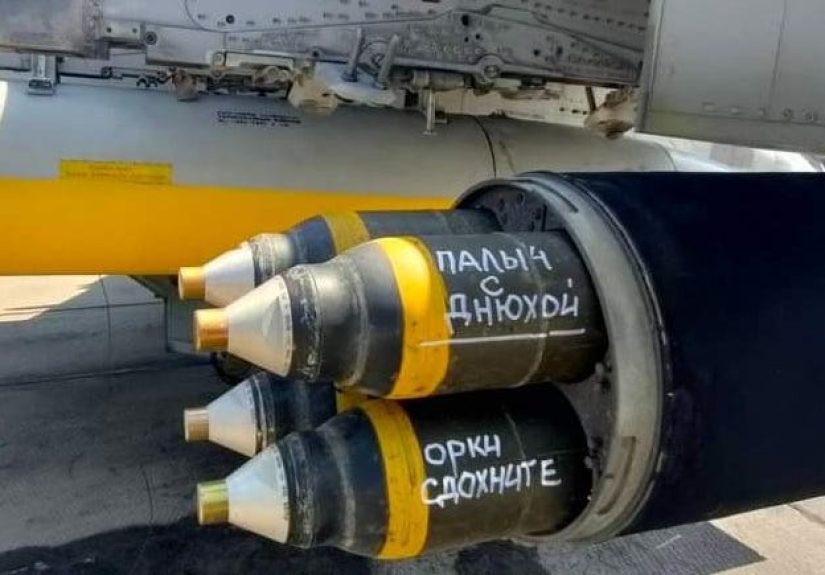
Getting rockets is one thing. Getting them into the air on Ukrainian platforms is another. Zunis are commonly fired from the LAU-10 rocket pod,
a four-tube launcher built around U.S. aircraft wiring standards and mounting interfaces. Ukraine’s front-line aviation fleet, meanwhile, includes
Soviet-designed aircraft with Soviet pylons, Soviet connectors, and a Soviet relationship with “standardization.”
“Frankenweapons” Done Right
Ukraine’s engineers and maintainers have repeatedly shown an ability to integrate Western munitions onto Eastern platforms. With Zunis, evidence emerged
of Ukrainian Su-25 Frogfoot attack jets carrying LAU-10 pods. Later reporting and imagery indicated integration on rotary-wing platforms,
including Mi-24 Hind helicopters. The result is a practical hybrid: Western rockets, Western pods, Soviet airframesone mission brief
away from becoming a meme.
The point isn’t elegance. It’s output. If the rocket leaves the tube, flies roughly where you intended, and explodes with enthusiasm near the enemy,
the integration earns its keep.
Why Ukraine Would Use Unguided Rockets in a High-Threat Air Defense Environment
On paper, unguided rockets look like a step backward. In practice, they fit a niche Ukraine desperately needs: relatively low-cost, aircraft-delivered
firepower that can be used quickly, in volume, and often from profiles that reduce exposure to enemy air defenses.
Lofting, Standoff, and the “Don’t Get Shot” Flight Profile
Ukraine’s aircraft frequently operate under the shadow of layered Russian air defenses. That reality pushes pilots toward tactics that trade precision
for survivabilitylike launching rockets in a lofted, ballistic arc. Instead of a direct dive-in (and a direct invitation to get tracked), an aircraft
can “pop up,” release rockets at an elevated angle, and turn away fast. The rockets fly farther than a flat shot, while the aircraft spends less time
in the worst part of the threat envelope.
Is this pinpoint accuracy? No. Is it a workable compromise when the alternative is “become a radar statistic”? Absolutely.
What Zunis Can Do on the Battlefield
The Zuni’s appeal is blunt: it carries more mass and warhead potential than smaller rocket families. That makes it useful for:
- Trench and treeline suppression when enemy infantry is dug in.
- Strikes on buildings and field fortifications used as command posts or firing positions.
- Attacks on light vehicles and logistics nodes when targets are clustered.
- “Area effects” fires that support ground troops, especially during assaults or withdrawals.
Specific Examples Without Over-Claiming
Publicly released Ukrainian footage has shown Su-25s employing Zuni rockets against Russian positions. These kinds of strikes are typically presented as
battlefield interdiction or close air support-style missions, often against structures, treelines, and dug-in areas. Because most operational details
are understandably not broadcast in real time, the best-supported takeaway is tactical: Zunis have been used as a repeatable, compatible strike option
when other air-launched munitions are scarce or risky to employ.
Zuni vs. Soviet-Era Rockets: Why This Swap Makes Sense
Ukraine has long used Soviet rocket families like the S-8 (80mm) and S-13 (122mm). Those rockets are effective, but wartime supply is complicated.
Zuni rockets offer a Western supply line and a standardized pod system, and they sit in a similar “heavy unguided rocket” category as larger Soviet options.
The Practical Advantages
- Supply diversification: Zunis reduce reliance on hard-to-source Soviet stocks.
- Compatibility across platforms: Once an interface solution exists, pods can potentially be shifted across aircraft types.
- High explosive effect: A heavier rocket can do meaningful damage even without guidance.
- Fast employment: Rockets can be launched in salvos for quick “on-call” effects.
But Are They Accurate Enough? The Honest Answer
Unguided rockets are not precision weapons. Their accuracy depends on pilot skill, release parameters, aircraft stability, range, wind, and whether
the enemy is kind enough to remain in the same place while you do trigonometry at 500 km/h.
Ukraine’s adaptations and tactics suggest Zunis are often used where suppression and area coverage matter more than
single-window precision. In modern combat, that can still be decisiveespecially if rockets are used to disrupt defenses, force troops into cover, or
complicate a counterattack at exactly the wrong moment for the opponent.
Could Ukraine Be Using Guided Zunis?
There have been U.S. efforts and demonstrations involving laser-guided Zuni concepts (a guidance section added to an otherwise unguided rocket).
However, public U.S. announcements about aid packages did not clearly specify whether Ukraine received unguided Zunis, a guided variant, or a mix.
Most evidence from operational footage and reporting points to unguided employmentwhich aligns with the lofted, standoff tactics
commonly observed.
Why Old Rockets Can Be Surprisingly Modern
Modern warfare isn’t only about “new.” It’s about systems, constraints, and time. Zunis check several boxes Ukraine cares about:
- Speed to the front: Stockpiled munitions can be transferred faster than newly manufactured ones.
- Simple logistics: Rockets and pods are relatively straightforward compared to complex guided weapons.
- Mission flexibility: Rockets can support multiple target types without needing bespoke programming.
- Volume matters: A salvo of rockets can shape a fight, even if each rocket isn’t “smart.”
A Quick, Darkly Funny Sidebar: Zuni’s Famous Safety Lessons
The Zuni’s history includes infamous U.S. Navy carrier deck disasters in the 1960s, where accidental rocket firing contributed to catastrophic fires.
That legacy is not a punchlineit’s a reminder that rockets are always serious business. In a modern Ukrainian context, it underscores the importance of
safe handling, robust mounting, reliable wiring, and disciplined proceduresespecially when you’re mixing hardware built for different nations, eras,
and engineering philosophies.
What Zuni Use Says About the Wider Air War in Ukraine
Ukraine’s Zuni story is less about a single rocket and more about a pattern:
adaptation beats perfection. The conflict has repeatedly rewarded forces that can:
- Integrate whatever arrives (even if it arrives in a different language and measurement system).
- Develop tactics that prioritize survivability in dense air defense environments.
- Create layered strike optionsdrones, artillery, missiles, and aircraft rocketsso no single shortage becomes fatal.
In that sense, Zunis aren’t “old.” They’re “available,” which in wartime is a superpower.
Conclusion: A Vintage Rocket With a Very Current Job
Ukraine’s use of 66-year-old Zuni rockets is a masterclass in pragmatic warfare. The rockets don’t pretend to be precision-guided marvels. They show up,
launch in salvos, and do the blunt work of suppressing, disrupting, and destroying targets that matter in ground combat. Mounted on Su-25s and Mi-24s,
fired with tactics designed to reduce exposure to air defenses, Zunis have become one more tool in Ukraine’s constantly evolving kit.
The biggest lesson is not “old weapons still work.” It’s “systems still work.” When engineers can integrate pods, pilots can adapt profiles, and logisticians
can keep a supply line moving, even a rocket from the Eisenhower era can help shape a fight in the 2020s.
Field Notes: of Real-World Lessons (Without the Hollywood Filter)
If you want to understand why Ukraine can make something like a Zuni work, picture the day-to-day reality behind the footage. It’s not just “bolt on pod,
press button, victory.” It’s a long chain of small wins, small mistakes avoided, and a lot of people doing unglamorous work while aircraft engines scream
in the background like they’re trying to win an argument.
One recurring “experience” theme you hear in modern Ukrainian aviation is the art of mixing ecosystems. Western pods speak one electrical dialect; Soviet
aircraft speak another. That means adapters, rewiring, testing, and retesting. A maintainer’s joke might be: “It’s like teaching two grandparents to text
each otherpossible, but you’ll be the tech support forever.” The humor is a coping mechanism, but the engineering is deadly serious. When a pylon interface
is slightly off, you don’t get a harmless error messageyou get a weapon that fails to fire, fires unpredictably, or stresses the airframe.
Then there’s pilot training. Firing unguided rockets in a heavy-threat environment is less about bravery and more about discipline. The “pop-up, loft, turn”
sequence has to be practiced until it’s muscle memory, because the window between “launch” and “someone is trying to kill you” can be uncomfortably small.
Pilots learn to respect the trade: better standoff and survivability usually means less accuracy. So you plan missions accordingly. If the target is a wide
trench line, a treeline, a building complex, or a suspected troop concentration, rockets make sense. If the target is a single vehicle parked beside a
barnmaybe you choose another tool, or you accept that you’re doing “area management,” not precision carpentry.
Logistics teams also develop a peculiar relationship with numbering systems. Western documentation might describe a LAU-10 with inch-based mounting and
specific electrical requirements; Soviet-era pylons and procedures may frame things differently. Someone, somewhere, becomes the human translation layer
between entire engineering cultures. That person deserves a medal and a vacation, preferably somewhere without spreadsheets.
Finally, there’s the battlefield feedback loop. Ground troops report what worked and what didn’t. If a lofted salvo lands consistently short, pilots adjust
release parameters; if the enemy shifts tacticsmore decoys, better camouflage, faster dispersalaircraft rockets become less about “destroy” and more about
“deny” and “disrupt.” That’s the quiet truth of Zuni use in Ukraine: it’s not a miracle weapon. It’s a reliable, adaptable option in a war where reliability
is rare, and adaptability is survival.