Table of Contents >> Show >> Hide
Some tattoo artists make clean lines. Some make bold color. And then there’s Pitta KKM, who seems to look at skin and think, “What if this became a moving piece of Korean visual poetry?” The result is the kind of work that makes people stop scrolling, squint at the details, and immediately begin doing dangerous things like checking flight prices to Seoul.
Pitta KKM has built an international reputation by fusing traditional Korean aesthetics with contemporary tattoo design. His pieces often echo Buddhist art, temple ornament, folk motifs, celestial symbolism, and the unmistakable drama of Korea’s historic color language. But what makes his tattoos feel so fresh is that they are not museum copies awkwardly dropped onto someone’s forearm. They are living reinterpretations: playful, precise, modern, and full of motion.
That balance is the real magic. His tattoos can feel ceremonial without being stiff, ornate without becoming cluttered, and deeply cultural without losing the fun that makes body art worth wearing in the first place. He can make a dragon look mythic, a crane look aristocratic, a koi look hypnotic, and a geometric color panel look like it escaped from a temple ceiling and decided to live its best life on someone’s arm.
Why Pitta KKM’s Tattoos Feel So Different
Pitta’s work stands out because he doesn’t treat tradition like a glass case. He treats it like a conversation. You can see traces of Korean architectural color systems, decorative patterning, Buddhist symbolism, folk visual language, and even references to Western fine art in the way he composes a piece. His tattoos are often rich in reds, blues, yellows, black, and white, and they carry the kind of rhythmic patterning that makes the eye keep moving.
There is also a strong storytelling instinct in his designs. Even when a tattoo is compact, it feels complete. A rabbit becomes cosmic. A crane becomes ceremonial. A dragon becomes less “generic fantasy creature from the internet” and more “guardian spirit with excellent posture and a serious personal brand.” That sense of narrative depth helps explain why so many of his works feel memorable at a glance and even better on a second look.
The Korean Visual Language Behind the Ink
Part of Pitta’s appeal comes from how naturally he channels Korean visual traditions into tattoo form. Temple painting and decorative architecture in Korea have long used strong, symbolic colors and repeating patterns that are both ornamental and meaningful. Motifs such as cranes, clouds, lotus forms, waves, the sun, and mythical creatures all carry long associations with purity, longevity, protection, harmony, or spiritual aspiration. In Pitta’s hands, those motifs stop behaving like historical footnotes and start acting like design superstars.
And that matters for SEO, yes, but more importantly for the human eyeball. These are not tattoos you “kind of” remember. These are tattoos that show up, take over the visual room, and politely refuse to leave.
30 Of Pitta KKM’s Best Works, Described
The following roundup uses descriptive labels for 30 published standout works associated with this viral collection. Think of it as a critic’s tour through the gallery rather than an official catalog.
- Celestial Rabbit Forearm A colorful rabbit layered with cosmic energy and celestial accents, this piece is whimsical, symbolic, and just odd enough to be unforgettable.
- Floral Ornament Forearm Intricate floral patterning turns a simple botanical concept into something closer to wearable architecture.
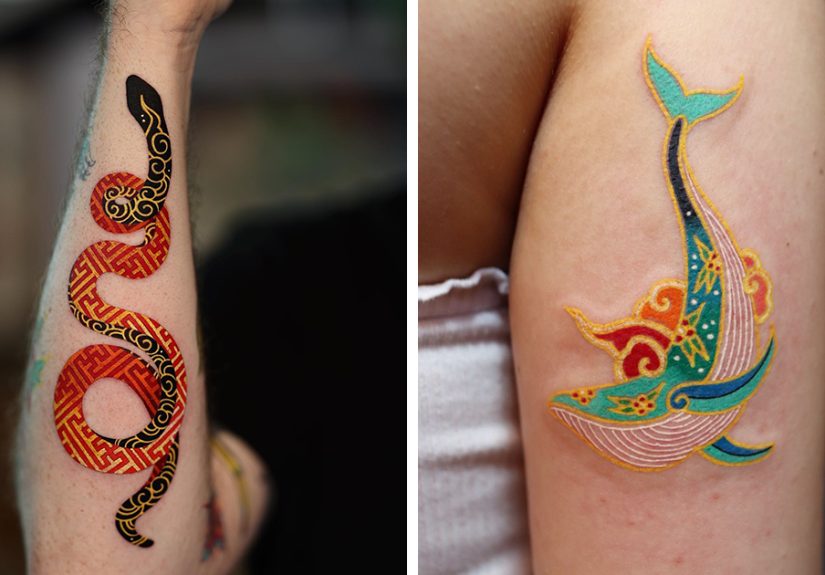
- Smiling Whale Piece A whale rendered with bright pattern work proves Pitta can make even a massive sea creature feel graceful, joyful, and strangely adorable.
- Patterned Snake Forearm This snake design coils with confidence, using color and ornament to turn menace into elegance.
- Dragon Arm Scroll One of those pieces that reminds you dragons are not just fantasy icons; in the right hands, they become design poetry.
- Gold-Feather Crane Arm Tattoo Delicate feather treatment and refined composition make this crane look noble rather than merely pretty.
- Color Crane on the Leg The leg placement gives the bird extra movement, and the color work makes it feel ceremonial without becoming heavy.
- Koi Fish Forearm A classic motif reborn with Korean-inflected ornament and color control. Familiar subject, very unfamiliar finish.
- Abstract Upper-Arm Talisman An abstract piece with hidden details and layered patterning that rewards slow looking.
- Twin Circular Seascapes Circular forearm tattoos featuring waves, mountains, and night-sky energy; a beautifully contained pair that feels balanced and meditative.
- Red Blossom Statement Piece A vivid floral design powered by contrast, especially between the red bloom and darker leaf structure.
- Cranes and Red Sun A striking arm composition that taps into East Asian visual drama while still feeling distinctively Pitta.
- Geometric Koi Thigh Piece Koi imagery merges with geometry for a tattoo that feels half mythology, half sacred diagram.
- Dragon on the Arm Saturated color and controlled linework keep this dragon fierce without slipping into visual chaos.
- Dragon on the Leg A larger-scale dragon that uses the body’s contours to create flow, tension, and a sense of motion.
- Anime Tribute Tattoo A reminder that Pitta can move from heritage-heavy symbolism to pop-cultural storytelling without losing cohesion.
- Twin Snake Leg Pair Two snake tattoos that speak to each other across the legs, creating rhythm and mirror-like tension.
- Phoenix Thigh Piece Bright reds and blues give this bird the kind of entrance energy normally reserved for movie villains and rock stars.
- Full Back Tapestry The back piece shows how Pitta handles scale: with confidence, pattern intelligence, and zero fear of complexity.
- Intricate Color Pattern Panel Less image-based, more decorative, and all the better for it. This is where his pattern vocabulary really flexes.
- Elegant Leg Composition A leg tattoo that reads as ornamental from afar and deeply structured up close.
- Layered Leg Pattern Work Another leg-focused design that demonstrates how expertly he handles flow, spacing, and visual density.
- Sun-Charged Dragon A dragon combined with a radiant sun motif, creating an image that feels hot, mythic, and gloriously overqualified.
- Geometric Arm Design A more abstract work that showcases Pitta’s sense of symmetry and color rhythm.
- Wrist-and-Hand Floral Flow Brave placement, elegant execution. This one turns difficult anatomy into a design advantage.
- Mythological Creature on the Leg A creature piece that feels lifted from folklore rather than generic fantasy flash.
- Dense Arm Pattern Piece Heavy on ornament, rich in movement, and ideal for anyone who thinks minimalism is wildly overrated.
- Neck Geometry Tattoo A bold placement with abstract, colorful patterning that makes the neck feel like a sacred design surface.
- Tiger Arm Tattoo If you wanted proof that Pitta understands power imagery, this tiger answers with a very confident yes.
- Bird With Floral Elements A lyrical closing piece in this set, balancing avian grace with decorative botanical detail.
What These 30 Works Reveal About His Style
Look across these pieces and a few things become clear. First, Pitta is obsessedin a good waywith movement. His tattoos rarely sit still. Birds arc, dragons coil, clouds swirl, snakes bend, and floral forms seem to expand beyond the edge of the skin. That motion gives even small pieces a sense of scale.
Second, he understands symbolism without becoming preachy. A crane can suggest longevity and elegance. A lotus can imply purity. A dragon can signal protection, power, or transformation. But nothing feels like homework. The tattoos remain visually seductive first, meaningful second, and that order matters. Nobody wants body art that feels like a textbook with shading.
Third, Pitta knows how to use color emotionally. He doesn’t just apply bright hues because bright hues look nice on Instagram. He uses contrast to control mood. Deep reds add heat and ceremony. Blues cool the composition and create depth. Yellows and gold-adjacent accents act like visual bells, pulling attention exactly where he wants it. Even black is not simply for outline; it often functions like structure in a painting.
Why The Internet Can’t Stop Looking
There are plenty of talented tattoo artists online, but Pitta KKM’s work hits a sweet spot that social media loves. It is highly legible at thumbnail size, but even stronger up close. It photographs beautifully, yet it does not feel made only for the camera. And perhaps most importantly, it offers something viewers don’t get every day: a coherent, recognizable style rooted in a specific visual culture without becoming repetitive.
That is harder than it sounds. Many artists can create one amazing piece. Far fewer can build a whole visual universe that remains flexible from rabbits to phoenixes to tigers to abstract geometry. Pitta has done exactly that. His portfolio feels expansive but unmistakably his.
The Experience Of Seeing Pitta KKM’s Work In The Wild
Encountering Pitta KKM’s tattoos for the first time is a bit like walking into a gallery, a temple, and a very stylish fever dream at the same time. Even through a phone screen, the work carries texture and ceremony. You do not simply register the subject matter and move on. Your eye tends to circle. You notice the feathers, then the pattern inside the feathers. You notice the clouds, then the way the clouds direct the composition. You notice a dragon, then realize the negative space around the dragon is doing half the storytelling.
That layered viewing experience is part of what makes his tattoos feel less like decoration and more like encounters. People talk a lot about “wearable art,” but in many cases that phrase is just a fancy way of saying, “This is nicer than average.” With Pitta, the phrase actually fits. His pieces have the compositional logic of painting, the symbolism of devotional and folk imagery, and the body-awareness that only tattooing can teach. They live differently on skin than they would on paper, and that difference is central to their power.
There is also an emotional experience tied to his work, especially for viewers who respond to cultural specificity. A lot of tattoo trends online blur together into the same fine-line flowers, the same tiny scripts, the same vaguely mystical geometry. Pitta’s tattoos do the opposite. They announce a point of view. They feel rooted. Even if a viewer cannot name every reference, they can sense that the imagery comes from somewhere real. That gives the work authority.
For tattoo collectors, that experience can be especially intense. A great tattoo is not just something you admire; it becomes something you imagine living with. Pitta’s work invites that leap. You can picture how a crane would move on the arm, how a dragon would wrap the leg, how a tiger would command the shoulder, how a patterned neck piece would shift the entire attitude of a person’s silhouette. His tattoos change posture. They change energy. They even change the way clothing interacts with the body.
And then there is the simple thrill factor. Let’s be honest: some of these pieces are so visually rich they make ordinary tattoo ideas feel like microwaved leftovers. You start out politely admiring the craftsmanship and end up rethinking your entire personal aesthetic. Maybe you did not think you needed a sun-backed dragon or a ceremonial crane sweeping across your calf. Five minutes later, your brain is taking notes.
That is why Pitta KKM’s best works linger. They are beautiful, yes, but also transporting. They make viewers feel that tattooing can still surprise us, still carry history, still flirt with myth, and still look impossibly cool while doing it. In an era when visual culture moves fast and forgets faster, that is no small achievement. It is the difference between a tattoo you like and a tattoo you remember.