Table of Contents >> Show >> Hide
- Why This Cat Experiment Caught Everyone’s Attention
- What the 6th Grader Actually Tested
- What This Experiment Gets Right, and What It Can’t Prove
- Are Cats Actually Clean Animals?
- What Cat Owners Should Actually Worry About
- How to Keep Your Home Cleaner Without Turning Into a Cat Detective
- Why People Loved This Story So Much
- What This Means for Cat Owners in Real Life
- Experiences Cat Owners Relate To, Even If They Never Planned to Think About This Topic
- Conclusion
If you have ever owned a cat, you have probably had at least one deeply uncomfortable thought while watching your furry roommate leap from the litter box to the couch like a gymnast with no regard for public opinion. One second, they are scratching around in the sandbox of mystery. The next, they are perched on your favorite blanket looking elegant, blameless, and mildly offended that you dared to notice. And somewhere in that moment, a question is born: How many surfaces does your cat’s butt actually touch in your home?
Most people would think the question, laugh nervously, and continue disinfecting their countertops with the energy of a medieval plague doctor. But one sixth grader decided that guessing was for amateurs. He wanted data. He wanted method. He wanted answers. So he ran an experiment.
That wonderfully chaotic curiosity is what made this story travel so fast online. It is funny, yes. Slightly horrifying, also yes. But it is also a surprisingly perfect example of why people love science when it gets personal. This was not a vague classroom project about evaporation or baking soda volcanoes. This was science in service of every cat owner who has ever stared at a pillow and wondered if it had just become a biohazard.
And the best part? The results were not nearly as catastrophic as nervous pet owners might expect.
Why This Cat Experiment Caught Everyone’s Attention
The star of this story was a Tennessee sixth grader named Kaeden Griffin, who turned one of the internet’s strangest recurring pet anxieties into a science fair question. Instead of simply assuming that cats leave their behinds everywhere like tiny fuzzy rubber stamps, he decided to test the idea in a hands-on way. That is the kind of commitment usually reserved for Nobel Prize winners, stand-up comics, and people who have owned a cat for too long.
The project went viral because it landed right at the intersection of curiosity, comedy, and universal pet-owner paranoia. Cat people immediately recognized the central issue. Non-cat people felt vindicated. Everyone else just admired the bravery of a kid willing to ask the question most adults are too polite to say out loud.
Still, what makes the story genuinely compelling is not just the headline. It is the fact that the experiment, goofy as it sounds, had a clear purpose, a testable idea, and an observation-based method. In other words, it was real science fair material, just with significantly more tail involvement.
What the 6th Grader Actually Tested
A science project with a very memorable hypothesis
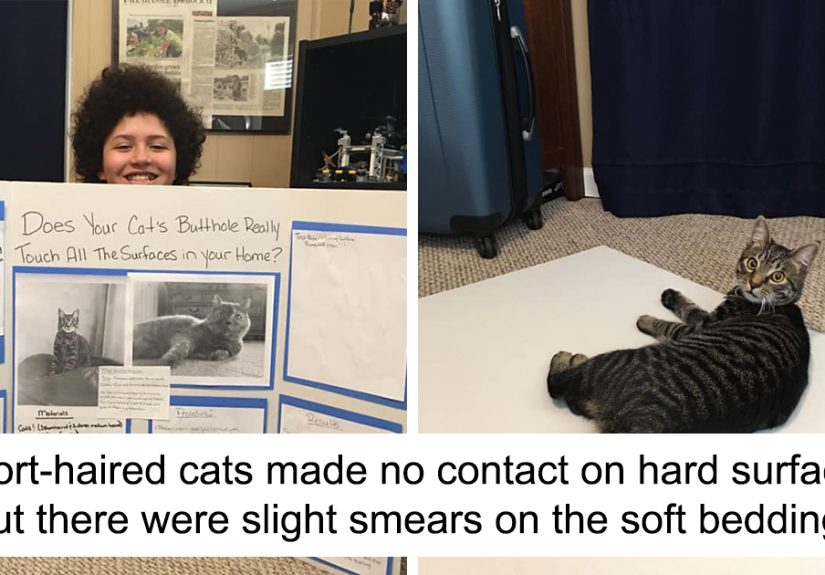
Kaeden’s experiment asked whether a cat’s rear end really touches the surfaces around your home as often as people fear. To test that question, he reportedly used nontoxic lipstick on the anus area of very patient cats and then observed where marks showed up after the animals were instructed to sit, lie down, or jump onto different surfaces.
Pause here to appreciate two things. First, the cats were apparently docile enough to participate, which may be the least believable part of this entire story. Second, the setup may sound ridiculous, but the idea was straightforward: if the cat’s butt touched a surface directly, the lipstick would leave a visible mark.
The result that brought relief to cat owners everywhere
According to the reported findings, long-haired and medium-haired cats did not make contact with either soft or hard surfaces. Short-haired cats reportedly also made no contact on hard surfaces, but there was evidence of a slight smear on soft bedding.
Translation: your cat may be less of a walking butt-stamp machine than your imagination has been suggesting at 2 a.m.
That does not mean your home is a sterile kingdom of feline purity. It simply means the apocalypse scenario some owners imagine is probably exaggerated. The experiment suggested that fur length and surface type matter, and that direct contact is not automatic every time a cat sits down like a tiny emperor on your furniture.
What This Experiment Gets Right, and What It Can’t Prove
Let us be fair to the young scientist: this project was clever, funny, and memorable. It also demonstrates an important truth about everyday science. A question does not have to be fancy to be valid. If it affects real life and can be tested, it matters.
That said, no single at-home experiment settles the issue for all cats everywhere. Different breeds have different fur lengths. Cats sit differently. Sofas, bedding, rugs, and counters all have different textures. Some cats are neat and tidy. Others look like they just survived a very dramatic litter-box weather event. A larger sample size would obviously tell us more.
So the right takeaway is not, “Great, I never need to clean anything again.” The right takeaway is, “Good news: the situation may be less gross than feared, but routine hygiene still matters.”
In other words, Kaeden’s project did not prove cats are spotless angels. It proved that panic is not the same thing as evidence.
Are Cats Actually Clean Animals?
In general, yes. Cats are famously fastidious. They groom themselves often, keep their coats in decent shape, and many rarely need baths. That self-maintenance is part of the reason cats have a reputation for being cleaner than many other companion animals. A healthy cat usually spends a surprising amount of time licking, cleaning, and reorganizing itself as if preparing for a tiny royal inspection.
But “clean” does not mean “sanitized.” That is a distinction many pet owners forget. Your cat may maintain a clean coat and still track litter dust, step in residue, or carry germs associated with feces and the litter box. Cats are animals, not floating hotel towels.
This is where the internet tends to go off the rails. One side acts like cats are biologically blessed little disinfectant devices. The other talks as if every cat on a sofa is the opening scene of a medical documentary. Reality lives somewhere in the middle. Cats are generally clean, but smart household hygiene still matters, especially around food-prep areas, bedding, litter zones, and homes with pregnant people or immunocompromised family members.
What Cat Owners Should Actually Worry About
1. The litter box matters more than your imagination
If you want a cleaner home, start with the litter box. That is the real hub of the issue, not your cat’s dramatic sitting posture on a throw pillow. A dirty litter box can create odor problems, behavior problems, and hygiene problems all at once. Cats often prefer boxes that are clean, easy to access, and free of strong artificial smells.
That means scooping daily, replacing litter regularly, and washing the box with mild soap instead of turning it into a chemical warfare experiment. Strong fragrances may seem like a good idea to humans, but many cats hate them. You are not running a spa. You are negotiating with a tiny furry critic.
2. Kitchens deserve extra caution
If your cat likes kitchen counters, the issue is not just theoretical butt contact. Paws matter too. Cats walk through litter, track particles, then hop onto places where people prepare food. That does not mean you need to panic and burn the kitchen down. It means you should clean food-prep surfaces properly before cooking and decide whether you want to allow counter access at all.
For many households, the practical answer is simple: wipe counters thoroughly, follow normal kitchen sanitation, and discourage counter-surfing if possible. The cat will disagree, of course. The cat always disagrees.
3. Long-haired cats can create their own special category of chaos
One funny twist in the science fair results was that longer fur may actually reduce direct contact on surfaces. But long-haired cats can bring a different problem to the party: soiled fur around the hindquarters. If that area gets matted or dirty, you may trade one concern for another. Regular brushing, observation, and gentle trimming around the rear end when needed can help keep things manageable.
Basically, fluff can be either a shield or a scandal, depending on the day.
How to Keep Your Home Cleaner Without Turning Into a Cat Detective
You do not need a microscope, a spreadsheet, and a full forensic team to live happily with a cat. A few realistic habits go a long way.
Clean smarter, not dramatically
Scoop the litter box every day. Wash your hands afterward. Clean surfaces your cat visits often. Launder pet bedding and blankets regularly. If your cat spends time on your bed, rotate and wash bedding more often instead of pretending not to think about it. Denial has never removed a mystery smear.
Set up the litter box properly
Many feline behavior experts recommend having one litter box per cat, plus one extra, with boxes in accessible locations. Uncovered boxes and unscented litter are often better tolerated than heavily perfumed setups. If the box is too dirty, too loud, too hidden, or too cramped, your cat may decide your rug is a more acceptable bathroom. That outcome helps no one.
Pay attention to your cat’s body and habits
A healthy cat with good grooming habits will generally be easier to keep clean than a cat with diarrhea, matting, obesity, arthritis, or litter-box aversion. If you notice persistent mess, unusual odor, scooting, stool stuck in fur, or sudden bathroom changes, that is not a cue to blame your sofa. It is a cue to speak with a veterinarian.
Why People Loved This Story So Much
At its core, this viral science project worked because it transformed a gross-out joke into a smart conversation about pets, cleanliness, and evidence. It invited people to laugh, but it also nudged them toward a more useful mindset: observe first, panic later.
That is a pretty good lesson for life in general, honestly.
It also reminded people why curiosity in kids is so valuable. Adults often talk themselves out of asking weird questions because the questions seem too silly. Kids ask them anyway. And once in a while, those questions produce answers everyone secretly wanted. Science is not always a lab coat and a grant application. Sometimes it is a sixth grader, two patient cats, and a truly unforgettable research design.
What This Means for Cat Owners in Real Life
If you live with a cat, the verdict is encouraging. No, your home is probably not being systematically stamped by your cat’s butt every time it sits down. Yes, there is still a case for keeping shared surfaces clean, staying on top of litter-box hygiene, and taking extra precautions around kitchens, babies, pregnancy, or weakened immune systems.
The healthiest perspective is both practical and emotionally stable. Love your cat. Clean your house. Do not assume every cushion has been personally betrayed. But also do not pretend your cat is a sterile decorative pillow with whiskers.
That balance is what good pet ownership looks like. Less panic. More maintenance. Fewer dramatic monologues directed at the couch.
Experiences Cat Owners Relate To, Even If They Never Planned to Think About This Topic
One reason this story resonates so deeply is that almost every cat owner has lived some version of the same mental spiral. It usually starts innocently. Your cat leaves the litter box, does that brisk little trot of confidence, and immediately jumps somewhere that feels emotionally expensive. Maybe it is your pillow. Maybe it is the folded laundry. Maybe it is the dining chair you were literally about to sit on. You freeze, stare, and begin conducting a silent internal trial with no witnesses except the cat, who is already licking one paw and refusing legal counsel.
Then comes the absurd negotiation phase. You tell yourself the cat is clean. Then you remember the litter box. Then you remind yourself that cats groom constantly. Then you remember seeing a stray litter grain on the bedspread yesterday. This is how ordinary people end up laundering blankets at 10:30 p.m. because a twelve-pound animal looked too comfortable.
Some cat owners respond by becoming cleaning minimalists with excellent hand soap. Others become part-time detectives. They inspect favorite sitting spots. They learn which blanket textures attract the cat most. They discover, usually against their will, that there is a big difference between a cat who simply exists on furniture and a cat who treats every soft surface like a personal throne room.
There is also the social side of this issue. Every cat person has experienced the moment a guest spots the cat on the kitchen counter and gives that look. You know the one. It is part alarm, part moral judgment, part “I suddenly understand why you own so many disinfecting wipes.” And to be fair, the guest is not entirely wrong. Counter hygiene matters. But longtime cat owners also know the deeper truth: a determined cat often views household rules as creative writing prompts.
What makes Kaeden’s experiment so delightful is that it validates this whole experience. Cat owners were not ridiculous for wondering. They were simply underfunded researchers without a formal protocol. His project gave shape to the exact question people joke about in group chats and mutter to themselves while changing sheets.
It also reflects the daily comedy of living with cats. These are creatures that can be majestic and disgusting in the same ten-minute window. They can groom with the precision of a luxury detailer and then sit in a cardboard box they found near the recycling bin. They can act deeply offended by a slightly dusty litter box while casually placing themselves on your laptop keyboard with no regard for ownership boundaries or email drafts.
In that sense, the story is bigger than one weird science fair project. It captures what cat ownership really feels like: affection mixed with uncertainty, delight mixed with disinfectant, and the ongoing realization that your home is not entirely your own. It belongs, at least partly, to a tiny furry being who pays no rent, ignores instructions, and still somehow runs the place.
So yes, this topic is funny. But it is also weirdly relatable. Because every cat owner has wondered about cleanliness, every cat owner has cleaned something twice after “just in case,” and every cat owner has accepted that love sometimes looks like vacuuming, scooping, washing, and then letting the little goblin curl up beside you anyway.
Conclusion
In the end, this unforgettable sixth-grade experiment gave the internet something rare: a funny pet story that actually leads to a useful takeaway. Kaeden Griffin’s cat-butt investigation suggested that direct contact with household surfaces may be less common than anxious owners imagine, especially depending on coat length and surface type. That is the good news.
The practical news is that responsible cat ownership still comes down to the basics. Keep the litter box clean. Wash hands after handling it. Clean kitchen surfaces before food prep. Pay attention to grooming, especially in long-haired cats. And remember that a well-maintained home is not about distrusting your pet. It is about living realistically with an animal you adore.
So the next time your cat leaps onto the bed with the confidence of a creature who has never once apologized for anything, take a breath. You do not need to panic. But you should probably wash the sheets on schedule.