Table of Contents >> Show >> Hide
- The Setup: One Episode, Three Pop-Culture Universes Collide
- The Cold Open: A White House Greeting Line, But Make It Unhinged
- And Then: “A Man Proclaiming to Be the Prime Minister of Italy”
- The Punchline After the Punchline: The Prime Minister Was Real (In the Sketch)
- So… Why Was Giorgio Armani There?
- Why the Cameo Feels So Weird (In the Best Way)
- The Part That Hasn’t Aged Well (And How to Watch It Anyway)
- The Bigger SNL Tradition: Celebrity Cameos as Cultural Shortcuts
- How to Spot the Armani Moment Without Missing It
- Conclusion: A Perfectly Tailored Little Slice of TV Weirdness
- Bonus: of Experiences Around the Armani Cold Open (Because This Is Exactly How Pop Culture Haunts You)
If you’ve ever watched an old Saturday Night Live episode and felt like you accidentally time-traveled into a very specific pop-culture snow globecongrats, you are emotionally prepared for the moment Giorgio Armani wandered into an SNL cold open and then… promptly wandered back out again.
Yes, that Giorgio Armani: the designer whose name became shorthand for crisp suiting, Hollywood polish, and the kind of “quiet luxury” that isn’t actually quiet so much as it is loudly expensive. And yet his cameo wasn’t a monologue, a sketch showcase, or a glamorous wink at the camera. It was a blink-and-you’ll-miss-it appearance in a political cold open where the audience barely reactedlike the show had accidentally booked fashion royalty and then forgot to tell the crowd.
This is the story of the Giorgio Armani SNL cold open cameo: why it happened, what made it so strange, why it’s funny in a uniquely early-’90s way, and why it also feels like a small cultural artifact from an era when celebrity operated on different rules (and sometimes… no rules at all).
The Setup: One Episode, Three Pop-Culture Universes Collide
The episode in question aired on February 6, 1993, during SNL Season 18, Episode 12. The host was Luke Perry (at the height of Beverly Hills, 90210 fame), and the musical guest was Mick Jagger, who also popped up in additional segments because Mick Jagger doesn’t merely “visit” a showhe occupies it.
Even before Armani enters, the episode is already juggling three different kinds of stardom:
- TV-heartthrob celebrity (Luke Perry)
- rock-legend celebrity (Mick Jagger, doing Mick Jagger things)
- fashion-icon celebrity (Giorgio Armani, doing “briefly exist on camera” things)
Add in the cast of the eraPhil Hartman’s political impressions, the show’s heavy reliance on big-character energy, and that early-’90s preference for “let’s see how far we can push this premise”and you’ve got the perfect environment for a cameo that feels simultaneously random and inevitable.
The Cold Open: A White House Greeting Line, But Make It Unhinged
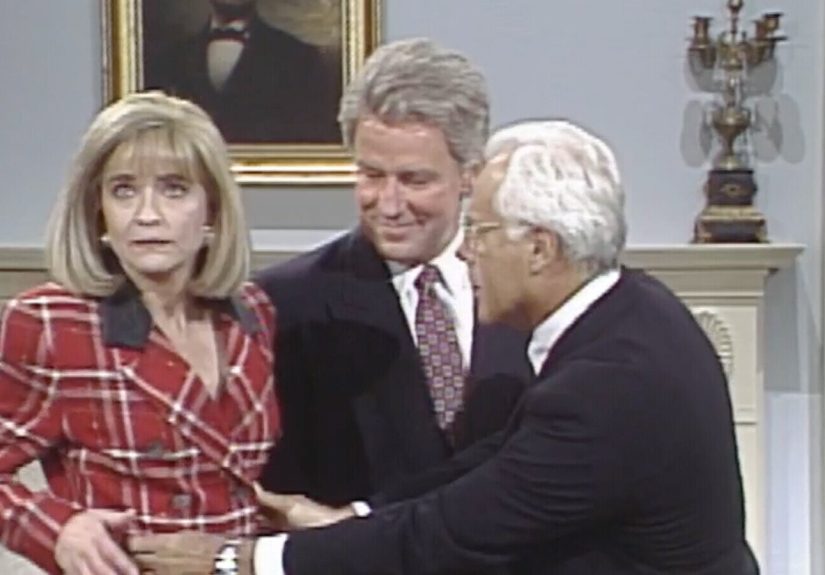
The cold open is framed as a C-SPAN-ish White House moment. Phil Hartman plays President Bill Clinton. Jan Hooks plays Hillary Clinton. They’re greeting guests in a receiving line, which is already a strong comedy setup because it’s basically a conveyor belt of awkwardness: one person comes in, says something unexpected, and the hosts must keep smiling like they’re auditioning for the job of “Most Patient Humans Alive.”
The premise: the Clintons are hosting visitors in honor of “National Mental Health Week”and the sketch leans into the “crazy people” trope in a way that reads as very dated now. At the time, the joke structure is: “Look at these wildly inappropriate characters… and look at the Clintons trying to be polite.” It’s a classic SNL engine: a serious setting + escalating oddballs = comedic friction.
The Beats That Matter (And the One That Becomes Armani’s Entrance Ramp)
The Clintons meet an intense, paranoid man who treats his “notes” like classified documents and questions whether Hillary can be trusted. It’s tense, absurd, and built for Hartman’s “I’m smiling through chaos” charm.
Then the guard leans in with a straightforward announcementsomething like a formal diplomatic introduction. And this is where the sketch quietly opens a trap door into fashion history.
And Then: “A Man Proclaiming to Be the Prime Minister of Italy”
Giorgio Armani enters as a man “proclaiming to be the Prime Minister of Italy.” He speaks Italian. He greets Clinton. He turns to Hillary, gives a quick complimentfamously, “Nice jacket”and then the moment veers into an uncomfortable physical gag that lands poorly today.
The key detail isn’t just what he doesit’s how the show treats him. There’s no big reveal, no “ladies and gentlemen, Giorgio Armani,” no applause pause that signals, “Hey, this isn’t an actor; this is a famous person doing a cameo.” The sketch keeps moving like he’s just another character actor who wandered in from central casting.
That’s why it feels so surreal on rewatch: you’re expecting the show to underline the celebrity. Instead, Armani appears in a tuxedo-level dose of seriousness, says his line, does the bit, exits, and the machine continues. It’s a cameo that refuses to behave like a cameo.
The Punchline After the Punchline: The Prime Minister Was Real (In the Sketch)
The cold open doesn’t stop at “we greeted weird people.” It goes one step further: later, the show implies the “Prime Minister” actually was Giuliano Amatobut because he didn’t speak English and “wandered onto the bus,” the White House security treated him like one of the “crazy people.” Then Clinton issues a formal apology as if this whole diplomatic incident is just another scheduling hiccup.
Structurally, it’s a neat comedic twist: the sketch turns its own premise back on itself. The Clintons weren’t just meeting oddballsthey were also the oddballs in a situation where bureaucracy and politeness collide with absurd misunderstanding.
And Armani is central to that twist, because he’s the hinge between “random weirdo cameo” and “oops, this was a real dignitary.” In other words: he isn’t just an Easter egg; he’s part of the mechanism.
So… Why Was Giorgio Armani There?
The most honest answer is: because SNL has always loved a surprising pop-in, and 1993 was a great year for surprise pop-ins.
But Armani isn’t just any celebrity. Even in the early ’90s, he was a global brand nameespecially in the U.S., where his designs had become synonymous with a specific kind of screen-ready sophistication. Hollywood loved him, and he loved Hollywood right back. His aesthetic had already helped define the “modern power suit” vibe that dominated red carpets and boardrooms.
That’s what makes his cameo extra funny: he represents the most controlled, curated, perfectly tailored version of public image… and he shows up in a sketch built around social chaos.
The Anti-Zoolander Energy
When fashion designers cameo in pop culture, it’s often meta, loud, and wink-wink. Think: “Yes, I’m famous, and yes, I’m in on the joke.” Armani’s moment is the opposite. He doesn’t play himself doing a glam bit. He plays a diplomatic figure in a cold open that pretends he’s just another guy in line.
It’s almost as if the show wanted the credibility of Armani’s presence without the distraction of acknowledging Armani’s presencewhich is a very Armani way to exist, honestly. Subtle. Controlled. Understated. (Except for the part where it’s on live television in Studio 8H.)
Why the Cameo Feels So Weird (In the Best Way)
Most celebrity cameos on SNL work like neon signs: the audience recognizes the person, cheers, and the show basks in the recognition. Armani’s cameo is more like a hidden logo stitched inside a jacket: if you notice it, you feel like you discovered something.
And it’s not just “oh wow, he’s there.” It’s the contrast that makes it funny:
- A world-famous designer appears… as an untranslated Italian-speaking dignitary.
- He delivers the line like it’s a real diplomatic moment.
- The audience barely signals recognition.
- The sketch treats him like a plot device, not a celebrity.
Today, that kind of cameo would be clipped, tweeted, turned into a reaction GIF, and monetized as a “moment.” In 1993, it can feel like an accidental artifactlike the show caught Armani passing by in the hallway and handed him a line card.
The Part That Hasn’t Aged Well (And How to Watch It Anyway)
Let’s not pretend the cold open is a perfect time capsule. It leans hard on mental health stereotypes, and it includes physical humor that plays like “awkward harassment as a punchline.” That doesn’t mean you can’t watch it; it just means you’re watching something from a different comedy era with different blind spots.
One way to approach it is to treat it like a museum exhibit:
- Notice what the sketch is trying to do (escalating absurdity in a formal setting).
- Notice what it normalizes (language and gags that wouldn’t fly now).
- Notice what still works (Hartman’s composure, the structure, the surprise twist).
- Notice what you’re really there for: the unbelievable fact that Giorgio Armani shows up, says “Nice jacket,” and then disappears into the fog of live TV history.
If anything, the “hasn’t aged well” factor makes the Armani moment stand out even more, because it’s so incongruous. He’s a symbol of timeless polish dropped into a sketch that feels very much of its time.
The Bigger SNL Tradition: Celebrity Cameos as Cultural Shortcuts
Armani’s cameo also shows how SNL uses celebrity like seasoning. Sometimes it’s the main ingredient (a host-driven episode). Sometimes it’s a garnish (a quick pop-in). And sometimes, like here, it’s a garnish that you don’t realize was truffle oil until the aftertaste hits.
Political cold opens are especially cameo-friendly because they mimic “official” eventspress conferences, summits, ceremonieswhere special guests naturally belong. Insert a famous face and the sketch gains instant texture: “This is a world where important people show up.” Armani’s presence, even unannounced, adds that texture.
The Episode’s Afterlife: A Re-Airing That Reminded People It Existed
The Luke Perry / Mick Jagger episode didn’t vanish into the vault forever. In 2019, NBC re-aired it as part of an SNL classic tribute after Luke Perry’s death, which brought fresh attention to the episodeand, by extension, to the Armani cameo hiding inside the cold open like a designer label you suddenly notice on a thrifted blazer.
How to Spot the Armani Moment Without Missing It
Practical viewing advice, because this cameo moves fast:
- Start with the cold open (don’t skip aheadArmani is not in the monologue, not in a later sketch, not waiting patiently for you).
- Watch for the guard’s announcement about the “Prime Minister of Italy.”
- Keep your eyes on Hillary’s jacketthe compliment is the cue.
- Don’t blink. Armani’s screen time is the definition of “limited edition.”
If you’re streaming the episode, you might find it listed with the host and musical guest details, and in modern listings it’s often available through major streaming hubs that carry SNL episodes.
Conclusion: A Perfectly Tailored Little Slice of TV Weirdness
Giorgio Armani’s cameo in an SNL cold open isn’t just triviait’s a snapshot of how fame used to move. A global icon could stroll into Studio 8H, deliver a line in Italian, and exit without the internet turning it into a full-time personality.
It’s funny because it’s unexpected. It’s memorable because it’s barely announced. And it’s oddly fitting because Armani’s brand was always about the power of subtletyso of course his most famous TV acting moment is one that almost dares you to miss it.
Bonus: of Experiences Around the Armani Cold Open (Because This Is Exactly How Pop Culture Haunts You)
Watching the Armani cold open for the first time is a very specific experience, and it usually goes like this: you press play thinking you’re getting a normal nostalgia hitLuke Perry, early-’90s studio lighting, the cast wearing suits that look like they came with free checks from a bank. You’re half paying attention, because cold opens are familiar territory. Politicians, a line of guests, a few big swings. You’re settled in.
Then the guard announces the “Prime Minister of Italy,” and your brain goes, “Okay, sure,” because SNL has introduced fictional dignitaries since the beginning of time (or at least since Lorne Michaels realized an accent is a plot). A man steps forward, speaks Italian with total confidence, and for one second you’re still in sketch modeuntil the face clicks. Not a cast member. Not a random extra. That’s Giorgio Armani. And suddenly you sit up like you just heard your name in another room.
The second phase is disbelief: you rewind a few seconds. You watch again. You’re looking for audience applause, for the camera to “announce” him with framing, for anything that says, “Yes, this is a real-world celebrity cameo.” But the sketch treats him like a normal character. It’s the comedic equivalent of someone handing you a rare vintage jacket and insisting it’s “just something I found.” Meanwhile, you’re gripping the sleeves like, “Do you understand what this is?”
The third phase is the group text phase. Because this is not the kind of information you keep to yourself. You message a friend: “Armani is in an SNL cold open. No, I’m not kidding.” They respond the way friends respond when you’ve clearly lost your mind: “The designer?” You respond: “THE designer.” And now you’re both watching a 1993 political sketch like it’s breaking news.
The funniest part is that the cameo doesn’t behave the way your modern media brain expects. Today, a celebrity cameo is a stop-the-show moment. The camera gives them a hero shot. The audience cheers. Someone makes a meta joke about how famous they are. In the Armani cold open, the show just keeps rolling. It’s almost punk in its refusal to celebrate itself.
And after it’s over, you carry it around in your head like a secret handshake. You’ll be scrolling, see a photo of Armani on a red carpet, and your mind will whisper, “Nice jacket,” as if you personally shared a joke with 1993 television. That’s how pop culture works at its best: it gives you tiny, strange memories that feel like they belong to you, even though they’re borrowed from a stage in New York where a designer once walked on, spoke Italian, and vanished into historyperfectly tailored, perfectly weird, and perfectly SNL.