Table of Contents >> Show >> Hide
- Why Swatting Is Not a Serious Pest-Control Plan
- Start With Mosquito Math: Kill the Next Generation First
- Build a Bite-Proof Work Setup
- When You Actually Need to Kill Adult Mosquitoes
- What Usually Does Not Work Very Well
- Timing Matters More Than People Think
- Mistakes That Make Mosquito Problems Worse
- The Best Strategy Is a Layered One
- Experience-Based Notes From Real Outdoor Work Situations
- Conclusion
-5.4 Thinking
If you work outdoors long enough, mosquitoes will eventually clock in for their shift too. They show up uninvited, ignore personal boundaries, and act like your elbows are a free buffet. Whether you’re landscaping, gardening, roofing, painting, surveying, farming, or just trying to finish one honest afternoon of yard work, mosquitoes can turn a productive day into a slap-happy mess.
Here’s the good news: the best mosquito strategy is not wild arm-flailing and dramatic sighing. It’s a layered plan. The smartest approach combines killing mosquitoes before they mature, knocking back adults where they rest, and making yourself such an annoying target that they look elsewhere. In other words, you do not win the mosquito battle with one citronella candle and a dream.
This guide breaks down practical, real-world strategies for killing mosquitoes when working outdoors, plus the habits that help keep them from taking over your job site in the first place.
Why Swatting Is Not a Serious Pest-Control Plan
Swatting a mosquito can be emotionally satisfying. It is not, however, a management system. If mosquitoes are ruining your workday, the real problem usually starts nearby with water, shade, humidity, and protected resting spots. Adult mosquitoes only tell you the story’s ending. The beginning is usually a clogged gutter, a forgotten bucket, a wheelbarrow with rainwater in it, or dense vegetation holding cool, damp air.
That is why the most effective mosquito control plan starts with one simple idea: kill them before they become biting adults. Then make the area less welcoming for the survivors. Then protect yourself from the stubborn few that didn’t get the memo.
Start With Mosquito Math: Kill the Next Generation First
Dump, drain, or cover standing water
If your outdoor workspace has standing water, it is basically running a tiny mosquito nursery. Buckets, tarps, wheelbarrows, planter saucers, clogged gutters, trash-can lids, tires, birdbaths, pet bowls, watering cans, and low spots in the yard can all help mosquitoes multiply. A quick inspection once or twice a week does more good than most people realize.
For outdoor workers, this matters because mosquito control is often less about the entire neighborhood and more about the immediate work zone. If you can reduce breeding spots around where you are working, you can noticeably cut the number of adults hovering around your face like judgmental little helicopters.
- Empty containers after rain
- Store equipment upside down when possible
- Clear clogged gutters and downspouts
- Fix tarps that sag and hold water
- Fill puddling depressions in driveways or work areas
- Refresh pet water and birdbath water regularly
Treat water you cannot remove
Some water sources cannot simply be dumped. Decorative ponds, rain barrels, drainage spots, water features, and livestock-related water sources may need a different plan. In these cases, larval control is your friend. Products containing Bacillus thuringiensis israelensis (Bti) are commonly used to kill mosquito larvae in standing water before they become adults. Think of it as cutting off the mosquito problem at the toddler stage.
This is often one of the smartest strategies for outdoor work sites because it addresses the source instead of just reacting to bites. If the water must stay, it should not also become a mosquito day care center.
Manage shade and resting zones
Adult mosquitoes love cool, shaded, humid places. Tall grass, dense shrubs, weedy fence lines, overgrown hedges, stacked materials, and damp corners around sheds can all become daytime hangouts. Pruning vegetation, trimming weeds, and improving airflow can make the area less attractive.
No, trimming shrubs is not as exciting as unleashing some cinematic bug-slaying gadget. But reducing resting spots can matter a lot, especially around decks, entry points, work trailers, patios, and garden beds where people spend long periods standing still.
Build a Bite-Proof Work Setup
Dress for protection without overheating
When mosquitoes are bad, exposed skin becomes an open invitation. Long sleeves, long pants, socks, and closed shoes can cut down on bites dramatically. The trick is choosing lightweight, breathable fabrics so you do not trade mosquito misery for heat misery. Outdoor workers already have enough going on without feeling like a baked potato in denim armor.
Loose-fitting clothing helps too. Mosquitoes can sometimes bite through tight fabric if it sits right against the skin. If bugs are especially intense, a head net or face net can make a huge difference, especially for workers in marshy, wooded, or still-air areas.
Use an EPA-registered insect repellent
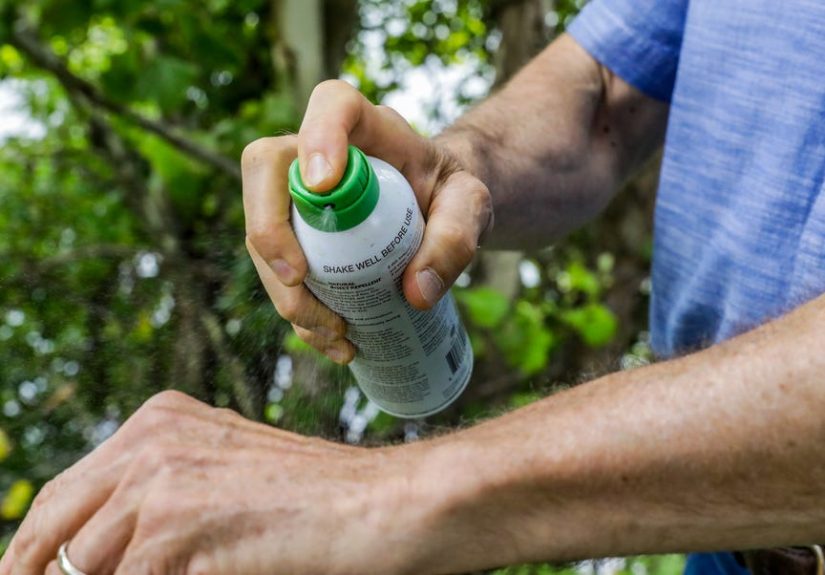
For exposed skin, a proven repellent is one of the best tools you have. The most commonly recommended active ingredients include DEET, picaridin, IR3535, oil of lemon eucalyptus, and 2-undecanone. The best choice depends on your activity, how long you will be outside, your sweat level, and the product’s label directions.
The key is not to buy the fanciest bottle with the most aggressive jungle graphics. The key is to use the product correctly. Apply it to exposed skin as directed, reapply when needed, and do not assume one morning spray will last through an afternoon of heat, sweat, and movement.
If you are also wearing sunscreen, apply sunscreen first and repellent second. That order matters. Your skin gets enough mixed messages already.
Treat clothing and gear with permethrin
Permethrin-treated clothing is a major upgrade for people who work outside. It repels and kills mosquitoes on contact, and it can be especially useful for pants, socks, boots, sleeves, hats, and gear. You can buy pretreated clothing or use an EPA-registered product made for treating clothing and gear.
One very important rule: permethrin is for clothing and gear, not skin. That distinction matters. Used correctly, it adds another protective layer that can make outdoor work much more bearable, especially during mosquito-heavy seasons.
Use fans when possible
If you are working in one place for a while, air movement helps. Mosquitoes are weak fliers, so fans can make it harder for them to land and easier for you to exist in peace. This works especially well on porches, patios, worktables, potting benches, outdoor prep stations, and covered areas where still air would otherwise let mosquitoes hover comfortably.
No, a fan will not solve an entire yard-wide mosquito problem. But for a localized work zone, it can be surprisingly effective. Sometimes the most advanced pest-management technology is just “make it windy.”
When You Actually Need to Kill Adult Mosquitoes
Targeted residual sprays
If adult mosquito pressure is high, targeted residual sprays can help reduce activity in the areas where mosquitoes rest. These applications are typically aimed at shady vegetation, fence lines, around doors, under decks, or other protected surfaces where adult mosquitoes shelter during the day.
This is not a “spray everything that has a pulse” situation. Careful, label-directed treatment of known resting areas is smarter than broad, casual spraying. It is also important to avoid unnecessary pesticide use and to be mindful of non-target effects. For many homeowners and crews, a focused application around high-use work areas works better than treating the whole property like it insulted you personally.
Foggers and space sprays for short-term relief
Foggers and other space sprays can knock down adult mosquitoes quickly, but the effect is usually temporary. These tools are best thought of as short-term relief before an outdoor task, gathering, or several-hour work session. They are not a replacement for water management, repellents, or treated clothing.
If you use one, follow the label carefully, pay attention to timing, and do not expect a miracle. A fogger can help clear the room, so to speak, but if nearby breeding sites remain untouched, the sequel arrives fast.
Larvicides beat chasing adults
If your goal is efficiency, killing larvae is almost always more strategic than chasing adults one by one. Adults fly in from nearby areas. Larvae stay put. That makes standing water the most useful place to focus your energy. Outdoor workers who do regular property maintenance often get the best results by combining weekly water checks with occasional adult control in high-pressure areas.
What Usually Does Not Work Very Well
There is a long and profitable history of mosquito products that sound amazing and perform like decorative nonsense. A few common disappointments include:
- Ultrasonic devices that promise to scare mosquitoes away
- Bracelets and stickers used as the only repellent method
- Bug zappers that look dramatic but do not reliably solve mosquito problems
- Random home remedies that smell powerful but do not offer dependable protection
- One-time yard spraying without fixing standing water
Could some of these tools provide a little help in certain settings? Maybe. Are they a smart primary plan for someone working outdoors for hours? Not really. Proven methods beat gadget theater every time.
Timing Matters More Than People Think
Know the worst hours
Many mosquitoes are most active around dawn and dusk, though some species bite during the day too. If your work schedule is flexible, the most mosquito-heavy tasks are easier when moved away from those windows. This will not always be possible, especially for contractors, farm workers, or crews with fixed schedules, but even small timing adjustments can reduce the number of bites.
Create a pre-work mosquito routine
Outdoor workers benefit from routine because routine prevents “Oops, I forgot the repellent and now my ankles are a tragedy.” A solid pre-work system might look like this:
- Check the area for standing water
- Wear lightweight protective clothing
- Apply repellent to exposed skin
- Use permethrin-treated gear or clothing
- Set up fans if working in one fixed location
- Use targeted adult control only when needed
That checklist is not glamorous, but it works. Mosquito control is often won through repetition rather than drama.
Mistakes That Make Mosquito Problems Worse
The biggest mistake is relying on only one tactic. Another common problem is focusing only on adults while ignoring breeding sites. People also tend to underestimate tiny water sources. It does not take a picturesque swamp to support mosquitoes. Sometimes it takes one neglected flowerpot saucer and a week of warm weather.
Another mistake is using products carelessly. More is not always better. Stronger smelling is not always smarter. And “my cousin said this works” is not nearly as reliable as an EPA label and a little common sense.
The Best Strategy Is a Layered One
If you want the short version, here it is: kill larvae, reduce adult resting spots, protect your skin, protect your clothes, and use adult-control sprays selectively when pressure is high. That layered approach gives you the best shot at working outdoors without donating a pint of blood to the local mosquito union.
No single trick solves the entire problem. But when multiple smart methods are used together, outdoor work becomes far more manageable. The goal is not perfection. The goal is to shift the odds so thoroughly in your favor that mosquitoes start having a rough day instead of you.
Experience-Based Notes From Real Outdoor Work Situations
Anyone who has worked outdoors in summer knows mosquito problems are rarely abstract. They are personal, loud, itchy, and usually timed to appear exactly when both your hands are full. In real life, the worst mosquito days often happen when a person is stuck in one area for a long stretch: pulling weeds along a fence, repairing irrigation, painting trim near shrubs, cleaning gutters, pressure-washing a deck, or setting posts in damp soil after rain.
A common experience goes like this: the yard seems fine at first, then ten minutes into the job the mosquitoes find your ankles, ears, and wrists like they had your calendar invite all along. You start swatting, then stepping faster, then pretending you are still focused on the project while slowly losing your dignity. In those moments, the people who prepared usually come out ahead. The worker wearing treated pants, socks, and a hat, with repellent on exposed skin, often keeps moving while everyone else is performing slap-based choreography.
Another pattern shows up on properties with hidden water sources. People often think, “There’s no pond here, so why are the mosquitoes so bad?” Then they find a clogged gutter, a kiddie pool behind the shed, a wheelbarrow with three inches of rainwater, or a tarp that has been holding water long enough to qualify as a habitat. Once those sources are removed or treated, the difference can be dramatic within a relatively short period. It is one of those annoying but useful lessons: the mosquito problem usually has an address.
Workers also notice that some tools help more than expected. Fans are a great example. People do not always think of airflow as mosquito control, but if you are doing detailed work at a table, on a porch, in a garage opening, or under a covered patio, a fan can turn a miserable session into a manageable one. It is not glamorous, but neither is scratching your calves through your jeans.
Then there is the lesson many outdoor workers learn the hard way: gimmicks are expensive optimism. Bug zappers may look busy. Wristbands may feel convenient. Scented candles may create a nice mood if your goal is “summer evening with hints of citrus.” But when mosquitoes are truly active, people usually end up going back to the basics: drain water, wear protective clothing, use a real repellent, and treat gear properly.
Perhaps the most useful real-world experience is this: consistency beats intensity. A huge once-a-month effort usually does less than small, regular actions done on schedule. Five minutes spent checking containers after rain, keeping gutters clear, and staying stocked with repellent often prevents the kind of infestation that ruins outdoor work for weeks. In practical terms, mosquito control works best when it becomes a habit instead of a crisis response.
Conclusion
The smartest strategies for killing mosquitoes when working outdoors are not flashy. They are practical, layered, and stubbornly effective. Eliminate standing water, use larval control where water must remain, reduce shady resting sites, wear protective clothing, apply EPA-registered repellent, and use permethrin-treated gear for extra defense. Then, if adult mosquitoes are still a major issue, use targeted sprays or short-term knockdown tools carefully and correctly.
That combination gives outdoor workers the best balance of control, comfort, and common sense. Mosquitoes may never send an apology card, but with the right system, they can at least stop running the job site.