Table of Contents >> Show >> Hide
- The Night the Dutch Sky Put on a Techno-Cosmic Light Show
- What Starlink Actually Is
- Why the Satellites Look Like a Train of Lights
- Why the Netherlands Became Part of the Story
- A Beautiful Sight, and a Complicated One
- SpaceX’s Response and the Bigger 2026 Context
- Why the Public Could Not Look Away
- Specific Lessons From the Netherlands Sighting
- What It Feels Like to Watch a Starlink Train Over the Netherlands
- The Lasting Meaning of the Celestial Show
One minute you are minding your own business under the night sky, and the next minute it looks like the universe has accidentally switched to parade mode. That was the feeling many skywatchers had when SpaceX’s Starlink satellites created a glowing procession over the Netherlands, turning an ordinary night into something that felt part science fiction, part public astronomy event, and part “should we call someone?” moment.
The sight was stunning. A neat line of bright points moved across the sky in formation, almost too organized to seem real. For some people, it looked like a fleet of UFOs. For others, it was a marvel of modern engineering. For astronomers, it was both impressive and a little alarming. And that contrast is exactly what makes the Starlink story so fascinating: it is a tale of innovation, internet access, spectacle, controversy, and a sky that suddenly feels much busier than it used to.
This article explores what happened over the Netherlands, why Starlink satellites can look so dramatic just after launch, what the event revealed about public fascination with space, and why the same display that makes casual stargazers gasp can make astronomers sigh into their telescopes.
The Night the Dutch Sky Put on a Techno-Cosmic Light Show
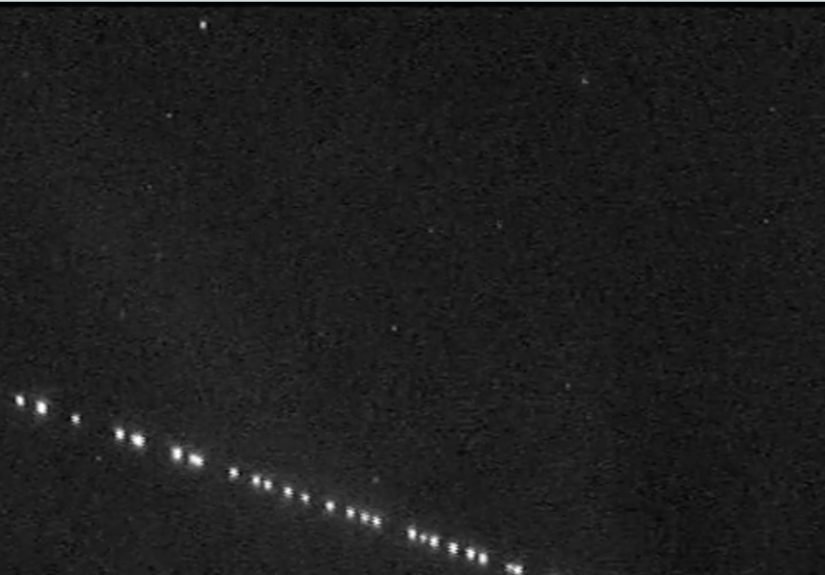
The event that inspired so much excitement took place shortly after SpaceX launched its first batch of 60 Starlink satellites. Dutch astronomer and satellite tracker Marco Langbroek captured the now-famous sight from Leiden, showing the satellites moving overhead in a bright, orderly line. The video spread quickly because it looked surreal. It had the clean geometry of a computer animation, except it was very much real.
That detail matters. These were not random lights, meteors, or aircraft. They were newly launched satellites still traveling in a closely packed formation before spreading out into their operational positions. In those early hours and days after deployment, Starlink satellites can appear like a string of pearls in the sky. The phrase fits so well it almost sounds like a public relations slogan, but it came from people trying to explain what they were seeing without sounding like they had swallowed a sci-fi script.
Over the Netherlands, the effect was especially dramatic because the satellites were visible against a dark sky while still clustered and reflective enough to catch sunlight. The result was a clean, bright procession that looked choreographed by somebody with a flair for drama. SpaceX may have launched internet satellites, but for a brief moment it also launched a sky show.
What Starlink Actually Is
Starlink is SpaceX’s satellite internet constellation, designed to deliver broadband service across the globe, especially in rural, remote, or underserved areas where traditional infrastructure is slow, expensive, or simply unavailable. The basic idea is ambitious but straightforward: instead of relying only on cables and cell towers, send internet coverage down from low Earth orbit.
The company’s first 60 Starlink satellites launched in May 2019, and that mission immediately grabbed attention not just because of the technology, but because people could actually see the satellites. Since then, the constellation has grown enormously, becoming one of the most visible examples of how commercial spaceflight is reshaping both communications and the night sky.
That is a huge part of the Starlink appeal. It is not some abstract engineering concept hidden in a lab or buried in a white paper. You can literally look up and see part of the system moving overhead. That creates a rare overlap between advanced aerospace infrastructure and ordinary human experience. Most people will never tour a rocket factory. Plenty of them, however, can walk outside, tilt their heads back, and spot a Starlink train.
Why the Satellites Look Like a Train of Lights
Freshly launched satellites travel together
Right after launch, the satellites remain grouped closely in similar trajectories. From the ground, that makes them appear like a bright line of evenly spaced lights crossing the sky. This is when they are most likely to produce the “wow, what is that?” reaction.
They reflect sunlight at the right angle
Even when it is dark on the ground, the satellites can still be illuminated by the sun high above Earth. If the geometry is right, they reflect sunlight toward observers below. Think of it as cosmic timing with a side of orbital physics.
They become harder to see later
As the satellites climb to their higher operating altitudes and spread apart, they usually become less obvious to the naked eye. That means the dramatic train effect is often temporary. The celestial conga line is not permanent. The internet infrastructure is.
This helps explain why the Netherlands sighting felt so spectacular. It captured Starlink at the stage when the satellites were at their most visually striking. In other words, the public got front-row seats to a phase of deployment that is unusually photogenic and a little eerie in the best possible way.
Why the Netherlands Became Part of the Story
The Netherlands was not important because Starlink was built there or launched there. It became part of the story because of observation, timing, and documentation. Marco Langbroek knew what to look for, calculated the pass, and had the skill to record it. That transformed a fleeting sight into a widely shared event.
There is also something fitting about the moment happening over the Netherlands. It is a country with a strong tradition of science, careful observation, and public curiosity about the natural world. When something strange appears in the sky, people do not only point and stare. Some of them calculate orbital paths, set up cameras, and calmly turn viral confusion into useful documentation. That is a very efficient way to respond to a sky mystery.
The Dutch sighting also showed how modern astronomy is no longer confined to giant observatories and research institutions. Skilled observers with cameras, tracking tools, and solid knowledge can capture globally important moments from a backyard or local field. In that sense, the Netherlands did more than witness the event. It helped define how the world would remember it.
A Beautiful Sight, and a Complicated One
Here is where the Starlink story gets more interesting. The satellites over the Netherlands were undeniably beautiful. But beauty does not automatically settle the argument. For astronomers, the same brightness that delights the public can interfere with observations. A bright satellite streaking through a telescope’s field of view is not charming. It is a photobomb from orbit.
That concern appeared almost immediately after the first Starlink launches. Astronomers worried that very large satellite constellations could contaminate images, complicate observations, and reshape the visual character of the night sky. Long-exposure astronomy is especially vulnerable because a passing satellite can leave a bright trail across the frame. Multiply that by thousands of satellites and the concern stops sounding theoretical very quickly.
There is also the broader cultural issue. The night sky is not just a backdrop. It is part of science, heritage, navigation, storytelling, and shared human experience. For most of history, when people looked up, they saw stars, planets, and the occasional comet if the universe was feeling generous. Now they may also see organized fleets of private satellites. That is not automatically bad, but it is a real change, and people are still figuring out how they feel about it.
SpaceX’s Response and the Bigger 2026 Context
To be fair, SpaceX has not ignored the criticism. Over time, the company has worked on ways to reduce satellite brightness and coordinate more effectively around space traffic and operational safety. The issue has evolved from “look at that weird line in the sky” to a much bigger conversation about how to manage a crowded orbital environment.
By early 2026, Starlink had grown from that first eye-catching batch of 60 satellites into a constellation numbering in the thousands, with company plans and public debates expanding right along with it. Space traffic coordination, collision avoidance, brightness mitigation, and orbital safety are now part of the everyday vocabulary around the project. That means the Dutch sighting now reads not just as a viral astronomy moment, but as an early preview of a new era.
And what an era it is. On one hand, satellite internet can support communities that lack reliable service, assist in emergencies, and connect remote regions that terrestrial networks struggle to reach. On the other hand, the more infrastructure we place in low Earth orbit, the more visible and contested that space becomes. Progress, as always, arrives with a receipt.
Why the Public Could Not Look Away
The reason the Netherlands footage resonated so strongly is simple: it turned a technical deployment into a shared emotional experience. Most people do not track payload separations or care about orbital insertion profiles. But they do care when the sky suddenly starts behaving like it has insider information.
Starlink’s visual drama taps into several instincts at once. There is wonder, because the sight is beautiful. There is curiosity, because it looks unusual. There is mild panic, because a moving row of lights naturally triggers the question, “Is this normal?” And there is the deeper realization that space is no longer only the domain of governments and astronauts. It is increasingly commercial, increasingly crowded, and increasingly visible from the sidewalk outside your house.
That is a powerful shift. Space used to feel distant. Starlink makes it feel local. One moment it is a business model and a communications network. The next moment it is crossing over your neighborhood in a glowing line like orbit decided to make a public appearance.
Specific Lessons From the Netherlands Sighting
Lesson 1: Space infrastructure is now publicly visible
People are not just reading about satellite networks. They are seeing them with their own eyes. That changes the public conversation in a major way.
Lesson 2: Viral moments can shape perception of technology
The Netherlands footage helped define Starlink not only as an internet service, but as a visual phenomenon. Public memory often begins with a striking image, and Starlink got one almost immediately.
Lesson 3: Wonder and worry can exist at the same time
You can be impressed by the view and still ask hard questions about astronomy, regulation, orbital crowding, and the future of dark skies. Those responses are not contradictory. They are mature.
What It Feels Like to Watch a Starlink Train Over the Netherlands
Imagine stepping outside on a calm Dutch evening expecting the usual cast of nighttime characters: a few bright stars, maybe a planet, maybe the moon doing its reliable moon thing. Instead, you notice a moving line of lights advancing across the sky with the kind of precision that immediately makes your brain abandon all ordinary explanations. It is not blinking like an airplane. It is not streaking like a meteor. It is not drifting randomly. It is organized. Almost too organized.
That first reaction is usually silence. Then comes the second reaction, which is either awe or a very sincere “What on Earth is that?” Sometimes it is both at the same time. Watching a Starlink train is strange because it blends the emotional language of stargazing with the visual rhythm of technology. It feels ancient and futuristic at once. You are standing under the same sky humans have watched for thousands of years, but now that sky contains a moving line of human-made objects that seem to glide with unnerving confidence.
In the Netherlands, the effect carries a special kind of atmosphere. The sky can feel broad and open, the horizon relatively generous, and the quiet of the evening adds to the surreal quality of the sight. The lights do not rush in with theatrical noise. They simply appear, continue, and pass, as if orbit is conducting a rehearsal you accidentally wandered into. That calm is part of what makes the moment so memorable. The satellites are not explosive or chaotic. They are eerie because they are orderly.
For amateur skywatchers, the experience can feel like a reward for paying attention. The modern world is loud, rushed, and often glued to small screens. A Starlink pass has a funny way of making everyone look up together. Neighbors point. Strangers compare guesses. Someone says UFO. Someone else opens an app. Someone more scientifically prepared nods with the quiet satisfaction of a person who knows orbital mechanics just well enough to become the most interesting person on the sidewalk.
There is also a curious emotional split that often follows the initial excitement. The sight is beautiful, no question. Yet many viewers quickly realize they are not watching a natural phenomenon. This is engineered brightness, infrastructure made visible, connectivity crossing the heavens in a straight line. For some people, that realization adds to the wonder. For others, it introduces a twinge of loss. If the future sky contains more and more of these moments, what happens to the old idea of an untouched night?
That tension is why the Starlink sighting over the Netherlands has remained so compelling. It was not just pretty. It was revealing. It showed how quickly wonder can turn into reflection. You start by admiring a celestial show and end by thinking about broadband, orbital traffic, telescope interference, and the strange new fact that humanity is now redesigning the visual experience of looking up. Not bad for a few bright dots in formation.
The Lasting Meaning of the Celestial Show
The Starlink display over the Netherlands was more than a viral skywatching moment. It was one of the earliest public glimpses of how commercial satellite constellations could reshape the visual environment above us. It was beautiful, yes, but it was also symbolic. It showed that the future of space would not stay neatly offstage.
That future is already here. A line of satellites can now stir wonder, spark debate, and become part of the global conversation in a single evening. The Netherlands sighting captured that shift perfectly. It reminded us that space technology is no longer only something that happens far away. Sometimes it happens overhead, in plain view, while the rest of us stand there in a jacket, squinting upward, trying to decide whether to feel amazed, concerned, or both.
Honestly, “both” is probably the right answer.