Table of Contents >> Show >> Hide
- What Happened Between Solar Orbiter and Comet ATLAS?
- Meet Solar Orbiter: The Sun-Watching Spacecraft With a Side Quest
- Comet ATLAS: The Comet That Almost Stole the Sky
- Why Do Comets Have Tails?
- Why This Encounter Was Scientifically Special
- What Could Solar Orbiter Detect?
- Solar Wind: The Invisible Sculptor
- The Role of STEREO and Hubble
- What This Means for Future Space Missions
- Why the Public Should Care
- Experiences and Reflections: What It Feels Like to Follow a Story Like This
- Conclusion
Space has a wonderful habit of making even the best-planned missions look delightfully improvised. One moment, a spacecraft is quietly cruising through its early checkout phase, preparing to study the Sun with the seriousness of a graduate student before finals. The next moment, it is asked to greet the ghostly tail of a crumbling comet. That is exactly the charm behind the story of Solar Orbiter and Comet ATLAS: a mission built to study our star unexpectedly found itself in the right place, at the right time, to sample material from a comet’s tail.
The title sounds almost casualSolar Orbiter says hello to a comet tail this weekbut the science is anything but casual. The encounter involved ESA’s Solar Orbiter, a mission developed with strong NASA participation, and Comet C/2019 Y4 ATLAS, an icy object that became famous in 2020 for promising a bright sky show before dramatically falling apart. Think of it as the comet equivalent of announcing a concert tour and then canceling because your nucleus has become several dozen smaller nuclei. Space, as usual, has flair.
During the week around May 31 to June 6, 2020, Solar Orbiter was predicted to pass through two different regions associated with Comet ATLAS: first the ion tail, then the dust tail. The spacecraft was not originally designed as a comet-chasing mission, but scientists recognized the rare opportunity in time to prepare several instruments. In doing so, Solar Orbiter turned a chance crossing into a valuable experiment in heliophysics, comet science, and the fine art of cosmic eavesdropping.
What Happened Between Solar Orbiter and Comet ATLAS?
Solar Orbiter launched in February 2020 to study the Sun, the solar wind, magnetic fields, energetic particles, and the environment of the inner solar system. Its main assignment is to help scientists understand how the Sun creates and controls space weather, including solar storms that can affect satellites, communications, astronauts, and even power systems on Earth. It is not, strictly speaking, a comet mission. It does not carry a little butterfly net labeled “comet dust,” although that would be adorable.
But space missions often become more interesting when geometry gets involved. Scientists studying the orbit of Comet ATLAS realized that Solar Orbiter would pass downstream of the comet, where solar wind and sunlight could stretch material from the comet into long tails. The projected crossing was special because it was predicted in advance, allowing mission teams to switch on relevant instruments even though the spacecraft was still in its commissioning phase.
The expected timeline was elegant: Solar Orbiter would cross the ion tail of Comet ATLAS around May 31 to June 1, then pass through the dust tail around June 6. The ion tail is made of charged particles influenced strongly by the solar wind and magnetic fields. The dust tail is made of tiny grains released as sunlight warms cometary ice and dusty material escapes into space.
Meet Solar Orbiter: The Sun-Watching Spacecraft With a Side Quest
Solar Orbiter is one of the most ambitious Sun-studying spacecraft ever launched. Its mission is to observe the Sun up close, connect solar surface activity to the solar wind measured around the spacecraft, and eventually capture views of the Sun’s polar regions. Those polar regions matter because they are deeply connected to the Sun’s magnetic cycle, the 11-year rhythm that helps drive solar activity.
The spacecraft uses two major styles of science. First, it has remote-sensing instruments, which look at the Sun from a distance, imaging its atmosphere and surface features. Second, it carries in-situ instruments, which measure the local space environment directly. In plain English: some instruments look at the Sun, while others taste the space soup around the spacecraft. During the comet-tail event, the in-situ instruments were the stars of the show.
Four instruments were especially relevant. The magnetometer, known as MAG, could detect changes in the interplanetary magnetic field. The Solar Wind Analyzer, or SWA, could measure particles in the solar wind and potentially identify cometary material. The Energetic Particle Detector, or EPD, could watch for energetic particles. The Radio and Plasma Waves instrument, RPW, could detect plasma disturbances, including possible signals from tiny dust impacts.
That instrument lineup made Solar Orbiter unusually well suited to the surprise encounter. It was like sending a weather balloon into a storm and discovering it also had a microphone, a chemistry kit, and a notebook with excellent handwriting.
Comet ATLAS: The Comet That Almost Stole the Sky
Comet C/2019 Y4 ATLAS was discovered on December 28, 2019, by the Asteroid Terrestrial-impact Last Alert System, better known as ATLAS. Early in 2020, the comet brightened rapidly, creating excitement among sky watchers. Some hoped it might become visible to the naked eye as it approached the Sun. In a year when many people were stuck at home and refreshing news feeds with the enthusiasm of anxious squirrels, a bright comet sounded like a cosmic gift basket.
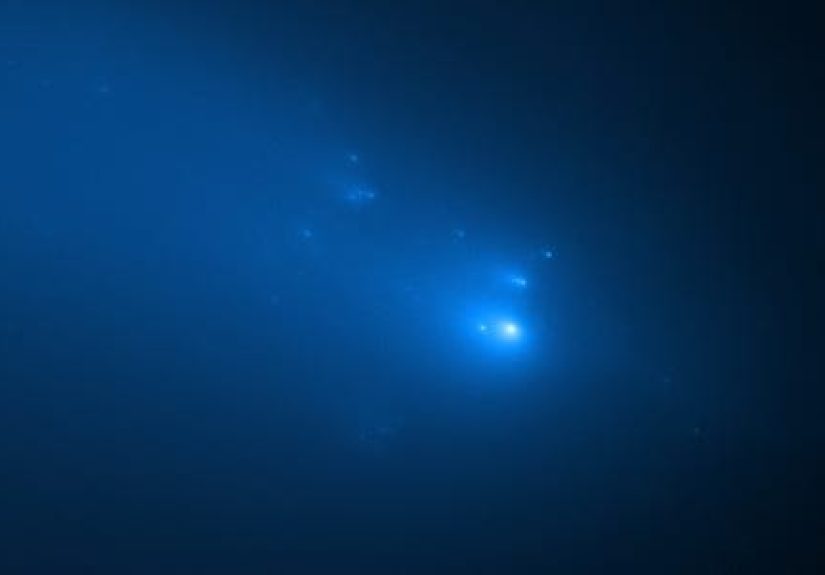
Then ATLAS did what fragile comets sometimes do: it broke apart. Hubble Space Telescope observations in April 2020 showed the comet’s nucleus fragmenting into many pieces. As the comet weakened, its brightness dropped. The potential naked-eye spectacle faded, but scientifically the situation became even more interesting. A disintegrating comet can reveal clues about the structure, composition, and behavior of icy bodies that formed in the early solar system.
Comets are often described as dirty snowballs, icy dirtballs, or frozen leftovers from planetary construction. None of those descriptions sound glamorous, but they are accurate enough for a first impression. They preserve ancient material from the early solar system, which makes them valuable to researchers. When they approach the Sun, heat releases gas and dust, forming a glowing coma and often one or more tails.
Why Do Comets Have Tails?
Comet tails are not simple trails left behind like exhaust from an airplane. That is one of the most common misunderstandings about comets. A comet’s tail generally points away from the Sun because sunlight and the solar wind push material outward. In fact, when a comet moves away from the Sun, its tail can appear to lead the comet rather than follow it. Space enjoys confusing our Earth-based intuition.
The Ion Tail
The ion tail forms when gas released by the comet becomes electrically charged. Ultraviolet sunlight and interactions with the solar wind can strip electrons from atoms and molecules, creating ions. These charged particles are swept along by the solar wind and guided by magnetic fields. Ion tails are often straighter and can respond quickly to changes in solar wind conditions.
For Solar Orbiter, the ion tail crossing was important because its instruments could potentially detect changes in the magnetic field or identify charged particles linked to the comet. If cometary ions were dense enough, the spacecraft might observe a measurable disturbance in the solar wind. That would give scientists a rare in-situ look at how a comet interacts with the stream of charged particles constantly flowing outward from the Sun.
The Dust Tail
The dust tail is made of small solid grains released as cometary ice warms and sublimates. Unlike ions, dust grains are not carried as neatly by magnetic fields. They are influenced by sunlight, solar radiation pressure, gravity, and the comet’s motion. Dust tails can appear broader and more curved than ion tails.
During the predicted dust-tail crossing, scientists considered the possibility that tiny grains might strike Solar Orbiter. These grains would be extremely small, but at speeds of tens of kilometers per second, even tiny impacts can create detectable plasma clouds. The spacecraft was not expected to be in danger, but its instruments might sense the microscopic collisions. In space science, even a speck can have a résumé.
Why This Encounter Was Scientifically Special
The Solar Orbiter-Comet ATLAS encounter was special for several reasons. First, it was a rare predicted tail crossing by a spacecraft not originally designed to chase comets. Scientists have discovered accidental comet-tail crossings in older mission data before, but knowing about one in advance is much better. It gives mission teams time to plan, adjust instrument schedules, and collect targeted data.
Second, the encounter happened relatively close to the Sun. Comet ATLAS approached perihelion, its closest point to the Sun, at a distance inside Mercury’s orbit. That near-Sun environment is energetic, dynamic, and difficult to study. Solar wind conditions, dust behavior, magnetic fields, and comet activity can all become more intense there. Studying a comet tail in that region helps scientists test models of how dust and plasma behave in the inner heliosphere.
Third, Solar Orbiter’s mission is already focused on connecting the Sun to the surrounding space environment. A comet tail is basically a natural detector stretched across space. It reacts to sunlight, solar wind, magnetic structure, and particle flows. By crossing such a tail, Solar Orbiter could sample a region where cometary material and solar activity meet.
What Could Solar Orbiter Detect?
Scientists hoped Solar Orbiter might detect several types of signals. In the ion tail, the magnetometer could register variations in the magnetic field caused by the interaction between cometary ions and the solar wind. The Solar Wind Analyzer could potentially capture particles that did not match the ordinary solar wind, hinting at cometary origin.
In the dust tail, the Radio and Plasma Waves instrument could detect plasma clouds created when dust grains hit the spacecraft and vaporized. These would not be dramatic impacts. Nobody expected Solar Orbiter to dodge boulders like a movie spacecraft escaping an asteroid field. Real space science is usually subtler: a small signal, a careful comparison, a graph that makes one scientist whisper, “Well, that is interesting.”
Even a non-detection would matter. If Solar Orbiter detected little or no cometary material, scientists could refine their models of how Comet ATLAS fragmented, how dense its tail became, and how solar wind conditions shaped the material. In science, “we did not see what we expected” is not failure. It is often the beginning of better questions.
Solar Wind: The Invisible Sculptor
The solar wind is a constant flow of charged particles from the Sun. It fills the solar system, shapes comet tails, influences planetary magnetospheres, and helps create space weather. Because it is invisible to human eyes, it is easy to forget how active it is. But the solar wind is always there, streaming outward and carrying the Sun’s magnetic field with it.
Comet tails help make the solar wind visible indirectly. When an ion tail bends, kinks, disconnects, or changes direction, it can reveal shifts in solar wind conditions. In that sense, comets are not just pretty objects; they are moving solar-wind indicators. They are cosmic windsocks, only much older, colder, and less likely to be found outside a roadside diner.
Solar Orbiter was designed to study this invisible environment in detail. Its unexpected encounter with ATLAS added another way to observe the relationship between cometary material and solar wind. The event also connected comet science with heliophysics, showing how different fields of astronomy often overlap.
The Role of STEREO and Hubble
Solar Orbiter was not the only spacecraft involved in the broader story. NASA’s STEREO spacecraft observed Comet ATLAS as it moved near the Sun. STEREO’s viewpoint helped scientists watch the comet’s behavior while Solar Orbiter crossed one of its tails. Meanwhile, Hubble provided sharp images of the comet’s breakup in April 2020, showing that the nucleus had fragmented into many pieces.
Together, these observations created a richer picture. Hubble showed the comet’s physical breakdown. STEREO watched the comet near the Sun. Solar Orbiter offered the possibility of sampling the tail environment directly. That combination is powerful because comets change quickly, especially near the Sun. Observing them from multiple angles and with different methods is like interviewing several witnesses instead of trusting one blurry security camera.
What This Means for Future Space Missions
The Solar Orbiter encounter with Comet ATLAS is a reminder that spacecraft can do valuable science beyond their original mission goals. When mission teams remain flexible, a spacecraft designed for one purpose can contribute to another field. Solar Orbiter’s main job is solar science, yet its instruments were able to support comet research because scientists noticed the orbital alignment in time.
This matters for future missions. As spacecraft travel through the inner solar system, their paths may cross comet tails, dust streams, plasma structures, or other temporary features. Predicting these encounters requires good orbital models, solar wind estimates, and communication between research teams. The more scientists can forecast such opportunities, the more value they can extract from existing missions.
The encounter also supports the case for dedicated comet missions, including missions designed to intercept dynamically new comets or study pristine material from the outer solar system. Every accidental or semi-accidental comet encounter gives researchers more experience, better models, and sharper questions.
Why the Public Should Care
At first glance, a spacecraft crossing a comet tail might sound like a niche event for people who own telescope eyepieces in more sizes than normal households own spoons. But the story has wider appeal. It shows how science works in real time: prediction, preparation, uncertainty, observation, and analysis. It also shows that space is not a static museum of pretty objects. It is an active environment where the Sun, comets, dust, plasma, and spacecraft all interact.
There is also something wonderfully human about the event. Solar Orbiter was brand-new, still preparing for its main mission, and suddenly scientists realized it had a bonus appointment with a comet tail. Instead of shrugging, teams adjusted plans and made the most of it. That is curiosity in action. It is the scientific version of taking the scenic route and discovering a bakery that sells excellent cinnamon rolls.
Experiences and Reflections: What It Feels Like to Follow a Story Like This
Following a space story like “Solar Orbiter Says Hello To a Comet Tail This Week” feels different from reading a routine mission update. There is a sense of surprise baked into it. The spacecraft was not launched to chase Comet ATLAS, and Comet ATLAS was not exactly behaving like a reliable appointment on a calendar. The comet brightened, excited observers, fragmented, faded, and still managed to leave behind a scientific opportunity. It is the kind of cosmic plot twist that makes astronomy feel alive.
For anyone who enjoys skywatching, the ATLAS story carries a familiar emotional rhythm. First comes discovery: a faint object appears in survey data. Then comes possibility: maybe it will brighten, maybe it will become visible, maybe it will be the comet people talk about for years. Then comes reality, which in this case arrived carrying a tiny hammer and broke the comet into pieces. Disappointment is part of skywatching. Clouds arrive on meteor-shower nights. Telescopes misbehave. Batteries die. Comets fail to perform. The universe does not offer refunds.
But the Solar Orbiter encounter turns that disappointment into something richer. Even though Comet ATLAS did not become the bright public spectacle many hoped for, its tail still became a laboratory. The broken comet was not useless. Its dust and ions could still interact with the solar wind. Its remains could still teach scientists how fragile comet nuclei behave near the Sun. In a way, the comet’s failure as a sky show became its success as a science target.
There is also a practical lesson here for students, amateur astronomers, and curious readers: science often rewards attention. The encounter was not magic. It happened because researchers compared the paths of spacecraft and comets, understood how solar wind could shape a tail, and recognized that Solar Orbiter might cross the right region. That kind of pattern recognition is one of the quiet superpowers of science. It is not always dramatic, but it changes what we notice.
Imagine watching a spacecraft mission unfold from Earth. You know Solar Orbiter is out there, millions of kilometers away, surrounded by a thin flow of charged particles from the Sun. You know a comet has recently fallen apart near the inner solar system. Then someone calculates that the spacecraft may pass through the comet’s invisible tail. Suddenly, empty space is not empty anymore. It has structure. It has history. It contains material from a fragile icy body that may have traveled for thousands of years before meeting sunlight, breaking apart, and spreading a faint signature across space.
That is the emotional magic of the story. It makes the solar system feel connected. The Sun drives the solar wind. The solar wind shapes comet tails. A comet releases ancient dust. A spacecraft built to study the Sun crosses the comet’s path. Instruments designed for plasma and particles listen carefully. Back on Earth, scientists wait for data and try to understand what the spacecraft experienced. No single piece of that chain is the whole story, but together they form a beautiful example of modern exploration.
For writers and educators, this topic is also a gift. It lets us explain comet tails, solar wind, spacecraft instruments, mission planning, and scientific uncertainty without turning the article into a textbook wearing uncomfortable shoes. The phrase “says hello to a comet tail” is playful, but it opens the door to serious ideas. Sometimes the best science communication begins with a friendly image: a spacecraft waving at a comet’s dusty goodbye.
Conclusion
Solar Orbiter’s encounter with the tail of Comet ATLAS was a rare and meaningful moment in space science. It brought together a Sun-studying spacecraft, a fragile comet, solar wind physics, dust detection, magnetic-field measurements, and the quick thinking of mission teams. The event also proved that scientific discovery is not only about perfect plans. It is also about recognizing lucky geometry when it appears and being ready to learn from it.
Comet ATLAS may not have become the brilliant naked-eye object many people hoped for, but it still gave scientists something valuable. Its tail became a natural experiment stretched across the inner solar system. Solar Orbiter, still early in its mission, had the tools to listen. In that quiet crossing, the spacecraft helped turn a broken comet into a story about curiosity, flexibility, and the invisible forces that connect the Sun to everything around it.