Table of Contents >> Show >> Hide
- Why the “Bass” Joke Landed So Fast
- The Backstory Behind Meghan Trainor’s New Look
- When Fan Reactions Turn Funny, Weird, and a Little Too Personal
- The Strange Burden of Being a “Body Positive” Celebrity
- Why the Story Became Bigger Than Meghan Trainor
- Meghan’s Response: Less “Explain Myself,” More “I Feel Great”
- The Real Takeaway From the “She Lost Her Bass” Moment
- Related Experiences: Why This Story Feels So Familiar
It takes a very specific kind of pop-culture irony for the woman who once turned All About That Bass into a full-blown cultural event to post new photos and make the internet collectively blurt out, “Wait… where did the bass go?” And yet, that is exactly the sort of online chaos Meghan Trainor’s latest transformation inspired. Some fans laughed. Some gasped. Some acted like they had just discovered a plot twist in a show they forgot they were watching. And some, naturally, opened the social media app formerly known as “a peaceful place” and clocked in for a full shift of hot takes.
The headline-grabbing joke, “She lost her bass,” spread because it was instantly memeable, a little cheeky, and tied directly to the song that made Trainor famous. But the reaction was never just about one joke. It was about memory, image, celebrity branding, body politics, and the internet’s favorite hobby: acting personally betrayed when a famous woman changes her hair, face, clothes, weight, vibe, or general atmospheric pressure. In other words, this wasn’t just celebrity gossip. It was a full pop-culture mood board with lip gloss, nostalgia, and way too many opinions.
Why the “Bass” Joke Landed So Fast
The reason the internet reached for “bass” jokes in record time is simple: Meghan Trainor will probably always be linked to All About That Bass. The 2014 smash did more than launch her career. It gave her a signature theme, a public identity, and one of the stickiest pop hooks of the last decade. The song didn’t just chart well; it became a shorthand for Trainor herself. She was the singer with the retro-pop sound, the playful confidence, and the big body-positive anthem that people could quote from memory whether they wanted to or not.
That kind of breakout hit is both a blessing and a tiny lifelong curse. On the one hand, it makes you famous. On the other hand, it turns your entire public image into a frozen frame from one chapter of your life. Fans begin to treat a debut-era persona like a legal contract. If you shift your style, change your body, revise your beauty routine, or simply age like a human being, somebody online will behave as if you have personally edited their childhood.
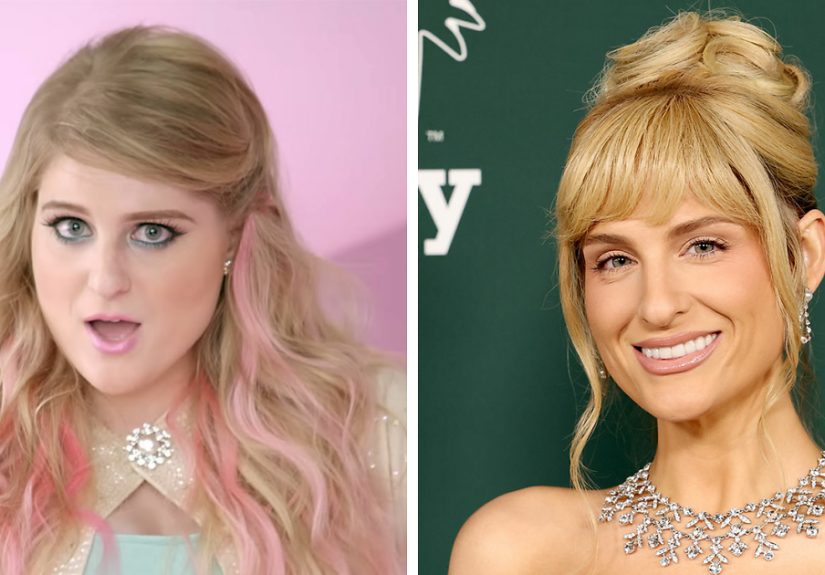
So when newer photos and videos of Trainor circulated, many reactions were less about surprise and more about contrast. People were not just looking at her current appearance. They were comparing it to the mental screenshot they had saved from 2014. That is how you get a comment section that reads like a combination of stand-up material, nostalgia posting, and an unlicensed sociology seminar.
The Backstory Behind Meghan Trainor’s New Look
To be fair, Trainor’s newer image did not appear out of nowhere like a celebrity jump scare. She had already been open about changes in her health routine and appearance. Over the past year, she discussed working with a dietitian, exercising with a trainer, lifting weights, and using Mounjaro as part of a medically supported health journey after pregnancy. She also spoke publicly about getting breast augmentation, framing it as a personal decision that made her feel more confident after having children and living through major body changes.
That matters because some online reactions treated her transformation like a mystery, when in reality Trainor had been unusually candid by celebrity standards. She did not exactly send a smoke signal from a mountaintop, but she was not hiding under a sequined rock either. She explained that her goal was to feel stronger, healthier, and more at home in her body. Whether every fan agreed with her choices was beside the point. The point was that she did, in fact, explain them.
And then came the visual moments that kicked the commentary into high gear: red-carpet appearances, polished glam, a sleeker silhouette, a dramatic hair look, and videos that had people doing digital double takes. One group of fans praised her. Another group asked whether it was really her. A third group, because this is the internet and subtlety has never really taken off, acted like they had just uncovered a witness-protection makeover.
When Fan Reactions Turn Funny, Weird, and a Little Too Personal
The phrase “She lost her bass” is funny because it is compact, clever, and attached to a song title everybody recognizes. It works like a pop-culture dad joke with better timing. But the wider reaction revealed something less funny: people often do not know how to separate commentary about a celebrity’s image from commentary about that celebrity’s worth.
Some reactions were clearly playful. They were the digital equivalent of friends seeing someone with new bangs and saying, “Okay, who is this diva and what has she done with our girl?” Other reactions crossed into the familiar territory of internet overreach, where strangers speak with shocking confidence about another person’s face, body, motives, or authenticity. Trainor did not merely receive comments about style. She got hit with the old, exhausting celebrity cycle: first you are judged for looking one way, then judged for looking another way, and somehow both juries believe they are defending truth.
That contradiction is a huge part of why this story traveled. Meghan Trainor became famous in part because listeners connected with a song that pushed back on narrow beauty expectations. Years later, when her own look evolved, some fans interpreted the change as a betrayal of the anthem rather than a reminder that people are allowed to change. The internet can handle plot twists in prestige television. It is much worse with women having autonomy.
The Strange Burden of Being a “Body Positive” Celebrity
Body positivity has always been a complicated space in pop culture, and Trainor’s career sits right in the middle of that mess. Once an artist becomes associated with self-love messaging, audiences often expect them to remain a fixed symbol instead of a person with phases, insecurities, experiments, and contradictions. That expectation is wildly unrealistic. It also turns every haircut, fitness update, or cosmetic procedure into a referendum on ideology.
Here is the uncomfortable truth: a lot of people do not actually want celebrities to feel free. They want them to be legible. They want public figures to stay in one clearly labeled box so fans can point and say, “See? That one represents this exact message forever.” But real people are rarely that tidy. Trainor in 2014 and Trainor in 2025 are still the same person, just with more life lived, more scrutiny endured, more motherhood, more career mileage, and probably better contour.
That is why the reaction felt so intense. People were not only reacting to how she looked. They were reacting to what they believed her look was supposed to mean. In celebrity culture, aesthetics are never allowed to remain aesthetics for long. A new hairstyle becomes a statement. A new body becomes a debate. A new outfit becomes a think piece. Somewhere in there, the person under all that projection is expected to smile and thank everyone for their concern. What a bargain.
Why the Story Became Bigger Than Meghan Trainor
Once the jokes started flying, the story quickly expanded into a broader conversation about celebrity transformations, weight-loss medications, cosmetic procedures, and the way social media rewards extremes. Fans who were amused by the “bass” line mixed in with people who were worried, judgmental, nostalgic, defensive, or oddly possessive. That blend is basically rocket fuel for virality.
There is also a broader media context here. In the age of endless before-and-after posts, audiences are primed to read bodies like headlines. If a celebrity looks even slightly different, people assume there must be a dramatic explanation. Sometimes there is one. Sometimes there is not. But the algorithm loves a reveal, a reversal, and a side-by-side comparison that makes everyone feel like an unpaid detective. Meghan Trainor happened to collide with that machine at exactly the moment when conversations around weight, beauty, and public honesty were already supercharged.
And then there is the celebrity memory problem. Fans rarely remember the full person; they remember the era that meant something to them. For one listener, Meghan Trainor will always be the voice of a 2014 summer anthem. For another, she is the singer behind Made You Look. For someone else, she is a podcast host, a mom, a reality-TV judge, a headline, or a TikTok clip. Put all those versions together and you get a public image that is constantly being rewritten in real time. No wonder the comment section looked confused. Half the internet was operating from old software.
Meghan’s Response: Less “Explain Myself,” More “I Feel Great”
One reason the story kept resonating is that Trainor did not respond like someone trying to win a public debate. Instead, she spoke about her health, her confidence, and the fact that the fixation on her body often overshadowed her actual work. That is an important distinction. She was being recognized professionally while much of the public conversation focused on her appearance. If that sounds familiar, congratulations: you have noticed how celebrity culture treats women.
She also made it clear that the criticism was not harmless. Later comments about being “too thin” or “unrecognizable” reportedly affected her more than she wanted them to. That part tends to get buried under the jokes, but it is worth remembering. Internet humor can feel weightless to the person typing it and heavy to the person receiving it. Eventually, that backlash even fed into later music, including the defiant energy around Still Don’t Care. In classic pop fashion, the comment section became content.
And honestly, that may be the sharpest twist in this whole saga. Fans said she lost the bass. Meghan Trainor, meanwhile, may have simply changed the arrangement.
The Real Takeaway From the “She Lost Her Bass” Moment
If there is one lesson in the Meghan Trainor reaction cycle, it is that the internet loves a tidy narrative even when real life refuses to cooperate. People wanted one of two easy stories: either she betrayed her old message, or she was bravely reinventing herself. But reality is much messier and much more human than that. She can be someone who once made a body-positive anthem, someone who later chose medical and cosmetic support, someone who enjoys glamour, and someone who still dislikes being reduced to a body. None of those identities cancel the others out.
That is why the funniest line, “She lost her bass,” is also the most revealing one. It sounds like a joke about her appearance, but it is really a joke about public expectation. People were not only noticing that Meghan Trainor looked different. They were reacting to the fact that their old idea of Meghan Trainor no longer matched the latest version standing in front of them. The internet hates when nostalgia meets reality without warning.
So yes, the fan reactions were hilarious. Some were genuinely clever. Some belonged in a museum of overcommitted comment sections. But underneath the memes was a familiar story about fame in the social media age: once a celebrity becomes a symbol, people struggle to let them remain a person. And that, more than any hairstyle or glam routine, is what made this moment hit so hard.
Related Experiences: Why This Story Feels So Familiar
Part of the reason this Meghan Trainor moment traveled so far is that it mirrors a very ordinary human experience, just with more ring lights and headlines. Most people know what it feels like to have others freeze them in time. Maybe it is a relative who still talks to you like you are fifteen. Maybe it is a classmate who sees you after a few years and says, “Wow, you look so different,” in a tone that somehow manages to be curious, complimentary, and mildly alarming all at once. Maybe it is an old friend who cannot let go of the haircut, fashion phase, or personality trait you had in one specific season of your life. We all laugh about glow-ups and throwbacks, but there is a weird pressure in realizing that other people are attached to an outdated version of you.
Artists feel that pressure at a bigger volume. A singer makes one huge song, and suddenly the public treats that era like sacred text. Imagine being known forever for something you wrote ten years ago, then being told every haircut, outfit, and decision you make has to remain in conversation with that one old chapter. It is like being forced to wear your high school yearbook quote as a legal name tag for the rest of your career. You can change, but everyone else wants the old branding because it is what they recognize.
There is also the deeply modern experience of posting one thing and having people react to a completely different thing. You share a video because you like the outfit, and people start talking about your face. You post about work, and the comments turn into a referendum on your body. You upload a happy memory, and complete strangers decide they are now licensed emotional archaeologists. That disconnect makes social media exhausting. It can feel like you are speaking in one language while the internet answers in another, louder one.
And then there is the humor problem. Jokes are often how people process surprise. A funny comment can be harmless, even affectionate. But humor can also work like camouflage. A mean opinion gets dressed up in a punchline and slips into the room pretending it is just there to have fun. That is why so many public reaction cycles feel slippery. Some people are laughing with you. Some are laughing at you. Some are doing both at once and hoping the emoji will sort it out.
That is what makes this story relatable beyond celebrity culture. It is about ownership. Who gets to decide who you are: you, or the people who remember an earlier version of you? Meghan Trainor’s situation is extreme because fame magnifies everything, but the emotional mechanics are familiar. People want consistency from others because it makes the world easier to understand. Growth ruins their filing system. Reinvention confuses the labels. And confidence, especially in women, tends to attract both admiration and resentment at the same time.
So when fans joked that Trainor “lost her bass,” they were also acting out something older and more universal. They were reacting to change. They were reacting to the collapse of a simple story they had told themselves about who she was. That is why this moment felt funny, uncomfortable, and weirdly revealing all at once. It was never only about Meghan Trainor. It was about the strange public ritual of watching someone evolve and deciding whether to applaud, panic, or make a joke before anyone else does.