Table of Contents >> Show >> Hide
- The Viral Puma Story That Made Everyone Do a Double Take
- Why A Puma Can Seem So Weirdly Familiar
- The Part The Cute Posts Usually Skip
- What Contact-Type Zoos And Petting Operations Get Wrong
- Why Rescue Does Not Automatically Mean “Good Pet”
- The Law Finally Started Catching Up
- So Is This A Happy Story Or A Warning Story?
- Extended Related Experiences: What Life Around A Rescued Puma Actually Feels Like
- Conclusion
Every so often, the internet finds a story so wildly adorable that our collective judgment clocks out early. A puma lounging in a hallway. A giant cat getting brushed like a suburban tabby. A full-grown predator looking less like a wilderness icon and more like the world’s most overqualified couch ornament. That is exactly why the story of a rescued puma living as a house cat keeps pulling people in.
And honestly, it is easy to see the appeal. The headline has everything: rescue, survival, drama, mystery, and a feline who seems to have skipped the memo about being a mountain lion. But beneath the viral sweetness is a more complicated, more important story about captivity, contact zoos, exotic pet culture, and the uncomfortable truth that a wild animal can look happy on camera while still representing a system that was deeply broken from the start.
So yes, this is a story about one very famous puma. But it is also about the bigger picture: why people fall for “house cat” narratives, what rescue actually means, and why animal welfare experts keep insisting that wild cats are not pets with better cheekbones.
The Viral Puma Story That Made Everyone Do a Double Take
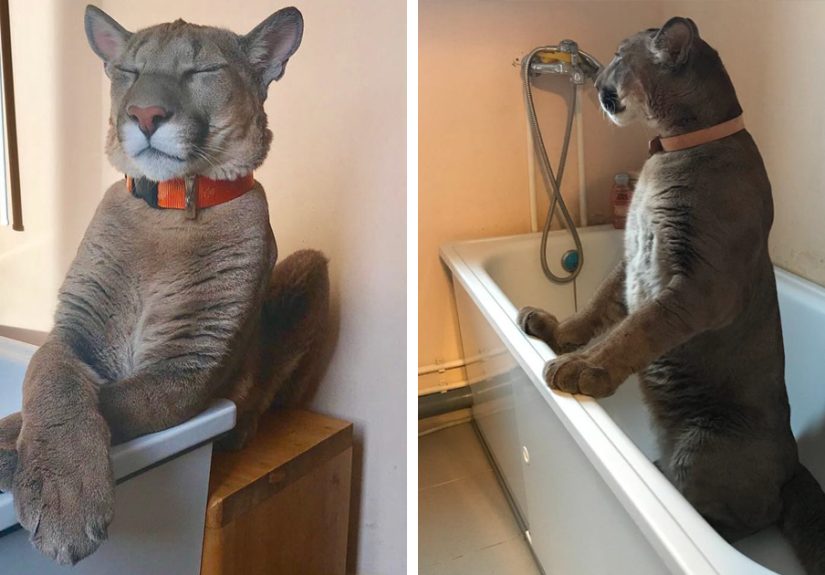
The best-known version of this story centers on Messi, a rescued puma who became famous online after being taken in by a couple in Russia. In widely reported coverage, Messi had been born in captivity, later sold to a petting-style zoo, and was in such poor health when he was purchased that he could barely walk. His caretakers said they had to teach him how to run and jump. Over time, he became a social-media sensation because his daily life looked strangely familiar: brushing, cuddling, training, strolling, lounging, and all the domestic-cat chaos people already know and lovejust supersized, with a face that says, “I own this house now.”
That contrast is exactly what made the story explode. A puma is supposed to belong to cliffs, canyons, forests, and moonlit silence. Instead, here was one acting like a giant roommate who might knock over your lamp and then stare at you as if you were the unreasonable one.
But the phrase “lives as a house cat” is doing a lot of heavy lifting. It makes the story sound cozy, almost whimsical, as if the only real difference between a puma and a domestic cat is that one needs a bigger scratching post and could probably open your refrigerator without asking.
That framing is emotionally powerful. It is also a little dangerous.
Why A Puma Can Seem So Weirdly Familiar
Part of the fascination comes from the fact that pumas really do feel oddly close to household cats. They are known by a ridiculous number of namespuma, cougar, mountain lion, panther, catamountand despite their size, scientists do not place them among the roaring Panthera cats. In fact, they are often described as more closely aligned with the “small cat” side of the feline family because they purr instead of roar. In other words, nature built a sleek apex predator and then sprinkled in just enough familiar cat energy to confuse humanity for generations.
That is why viral videos of a rescued puma can scramble people’s instincts. The face is expressive. The body language can seem affectionate. The movements are cat-like enough to feel recognizable. Viewers think, Well, that is basically a cat… just with a larger mortgage payment in meat.
But resemblance is not domestication. A wolf sleeping by a fireplace would still be a wolf, and a puma rubbing against a human leg is still a wild feline with physical instincts, environmental needs, and behavioral complexity that no living room can magically erase.
The Part The Cute Posts Usually Skip
Here is the piece that gets trimmed out of the feel-good montage: pumas are solitary, wide-ranging, highly adapted predators. In the wild, they do not live small. They do not think small. They do not schedule their lives around your sofa, your slippers, or your desire to film a “look who stole my pillow” reel for the internet.
National Park Service information on mountain lions notes that these animals maintain enormous territories and are generally solitary. Males can hold ranges exceeding 100 miles, and some sources describe home ranges around 150 square miles. They are ambush predators built for stealth, power, and independence. That means the “house cat” label is emotionally catchy but biologically misleading. A puma is not a domestic cat who hit the gym and never stopped bulking.
That matters because language changes public perception. When people repeatedly see wild cats framed as cuddly companions, they may start to believe private ownership is manageable, ethical, or even aspirational. Animal welfare groups have warned for years that this kind of portrayal softens the public’s view of captivity and can fuel interest in exotic pet ownership. The image sells a fantasy: buy the impossible, tame the untamable, post the proof.
The trouble is that fantasy usually ends badly for the animal.
What Contact-Type Zoos And Petting Operations Get Wrong
The title of this story matters because “contact-type zoo” is not just colorful wording. It points to a real business model: animal attractions built around physical proximity, novelty, selfies, bottle-feeding, petting, and “once in a lifetime” access. The public sees magic. The operators see inventory.
Animal welfare advocates in the United States have long criticized roadside zoos and cub-petting operations for turning wild animals into props. The logic is brutally simple. A tiny cub is marketable. A slightly older cub is still profitable. An adolescent or adult big cat? Much harder to monetize when direct contact becomes dangerous, expensive, and legally risky.
That is why critics describe the system as a pipeline, not a one-time attraction. Cubs are bred for interaction, separated early, shuffled through encounters, and then “age out” when they become too large to handle safely. Reports from animal welfare organizations have described how cub-petting businesses burn through baby animals fast, with some big cat cubs becoming too big for those interactions at roughly 12 weeks. That is not conservation. That is a costume change with claws.
Even when a specific animal like a puma becomes a rescue success story, the larger structure behind that rescue can still be ugly. Viral exceptions do not erase systemic cruelty. In fact, they can accidentally camouflage it. One charming survivor can make people forget the assembly line that created the crisis in the first place.
Why Rescue Does Not Automatically Mean “Good Pet”
This is the ethical knot in the center of the whole topic. A rescued animal can be loved. A rescued animal can be safer in a home than in a bad zoo. A rescued animal can even appear bonded to a caregiver. None of that proves the species is suitable for private life.
Groups like the ASPCA and Born Free USA are blunt about this: wild and exotic animals are not appropriate family pets. They require specialized care, housing, diet, enrichment, veterinary oversight, and safety measures far beyond what most people can provide. They can also pose serious risks to owners, neighbors, first responders, and other animals.
And then there is the psychological side. Sanctuaries that care for rescued wild cats often emphasize the importance of avoiding over-imprinting animals on humans. The goal is not to make them “pet-like.” The goal is to help them live with dignity, autonomy, enrichment, and species-appropriate boundaries for the rest of their lives. That is a completely different mission from raising a wild cat to behave like a novelty roommate.
Put differently: rescue should be about the animal’s needs, not the human fantasy.
The Law Finally Started Catching Up
For a long time, U.S. policy around big cats and exotic ownership looked like a patchwork quilt sewn during a power outage. Some states banned certain species. Others regulated them weakly. Others left giant loopholes big enough to drive a tiger cub photo-op booth through.
That changed in an important way when the Big Cat Public Safety Act became law in December 2022. The law prohibits public contact with big cats, including cubs, and largely ends new private ownership of covered species as pets, while also imposing rules and registration requirements for animals already in private hands before the law took effect. Notably, the law includes cougarsmeaning pumas are part of the conversation, not a legal footnote wandering around in mountain-lion disguise.
That law matters because it signals a cultural shift as much as a regulatory one. The old pitch was, “Pay to cuddle the wild thing.” The new legal reality is much closer to, “No, actually, maybe we should stop treating apex predators like party favors.” Progress can be beautiful.
So Is This A Happy Story Or A Warning Story?
The honest answer is: both.
It is a happy story in the narrow sense that one puma appears to have survived a rough beginning and ended up in a setting where he received intensive care, attention, and stability. For viewers, that is deeply moving. Rescue stories give people hope because they suggest damage can be interrupted. Sometimes that hope is deserved.
But it is also a warning story because the very existence of such a headline points to a larger failure. A puma should not have to become a viral house cat to escape bad captivity. A wild predator should not need internet fame before people ask whether the system that handled him was ethical in the first place.
And perhaps most importantly, the story is not a blueprint. It is an anomaly born from captivity, illness, and unusual circumstances. The right lesson is not, “Maybe I should get a cougar.” The right lesson is, “Maybe we should make sure wild animals never end up in these situations to begin with.”
Extended Related Experiences: What Life Around A Rescued Puma Actually Feels Like
To understand why the “house cat” label is both charming and misleading, it helps to imagine the real experience around a rescued pumanot the ten-second clip, but the full daily rhythm. The viral version is all giant paws, sleepy eyes, and cozy domestic comedy. The lived version is much closer to a full-time management system wrapped in fur.
Start with the obvious: space. Even in a home that has been adapted for a rescued puma, ordinary architecture stops being ordinary. Hallways become dens. Walls become scratching zones. Doors, corners, flooring, and furniture are no longer simple design choices; they are part of a behavioral environment. You are not decorating. You are negotiating with a muscular feline who could treat your carefully curated interior style as a suggestion.
Then there is routine. A puma does not thrive on random affection and a cute toy mouse from the pet aisle. Life revolves around structurefeeding schedules, enrichment, exercise, grooming, training, observation, and constant awareness of mood and energy. If the animal had early health problems, the attention becomes even more intense. Every movement matters. Every change in appetite matters. Every new behavior may mean something. It is less like owning an unusual pet and more like operating a one-animal care program with fur all over your plans.
The emotional experience is complicated too. Caregivers can form powerful bonds with rescued wild animals, especially those that arrived sick, stressed, or deeply dependent on human intervention. There is tenderness in that bond, but also pressure. When a huge cat seeks comfort, trust, or routine from a person, the moment can look heartwarming from the outside. Inside the household, it can also carry a silent question: what happens if instincts, maturity, fear, or stress suddenly shift the relationship?
That is why even caretakers in these stories often sound both devoted and realistic. Affection does not cancel danger. Familiarity does not erase biology. A calm rescued puma may still be a predator testing boundaries, reading body language, and responding to social cues in ways humans only partially understand. The relationship may be loving, but it is never casual. Nobody should watch a polished online video and assume the off-camera reality is easy.
And then there is the public response, which becomes part of the experience whether the caregivers asked for it or not. Viewers project all kinds of meaning onto a rescued puma. Some see a miracle. Some see proof that wild cats can be domesticated. Some see a dream pet with better bone structure than their ex. Others see a moral disaster disguised as content. Living with that level of public fascination means existing inside a permanent misunderstanding: the animal can be both genuinely cared for and still represent something that should never become normal.
That may be the strangest experience of all. A rescued puma living in a domestic setting becomes a symbol before he remains an animal. People argue about him, romanticize him, imitate him, and repost him. Meanwhile, the actual lesson is much less glamorous: wild cats need stability, specialized care, strict boundaries, and a life built around their welfare rather than our fantasies. If the story teaches that, it has real value. If it teaches only that giant cats look cute in hallways, then the internet has once again missed the point by approximately the length of a cougar’s tail.
Conclusion
The story of a puma rescued from a contact-type zoo and living as a house cat is unforgettable because it hits two emotional buttons at once: rescue and familiarity. We want to believe love fixed everything. We want to believe the giant predator on the couch is just a bigger, fancier version of the cat currently judging us from the windowsill.
But the more responsible reading is richer than that. This story is not really about proving wild cats make good pets. It is about what happens when captivity distorts an animal’s path so completely that “normal” stops being an option. It is about why contact zoos and cub-petting operations deserve scrutiny. It is about why rescue should lead toward dignity, not spectacle. And it is about learning to admire a puma without trying to turn one into a lifestyle accessory.
Yes, the internet-famous puma is compelling. Yes, the photos are wild in the best possible way. But the deepest truth here is not that a puma can live like a house cat. It is that humans should stop creating the conditions that force wild animals into such strange compromises in the first place.