Table of Contents >> Show >> Hide
- What Exactly Is a Decacorn?
- Why Late-Blooming Decacorns Happen More Often Than People Think
- Case Studies: Decacorns That Took Their Time
- UiPath: A rocket ship with a very long runway
- Procore: Proof that vertical software can be worth the wait
- Squarespace: The dorm-room business that grew up very, very well
- Airbnb: A strange idea that needed the world to catch up
- Toast: Complex products often look slower until they click
- Canva, Figma, and Databricks: Not overnight, just obvious in hindsight
- What Founders Should Learn From Late-Blooming Decacorns
- The Real Experience of Building a Late-Blooming Company
- Conclusion
Startup culture loves a dramatic origin story. Two founders, one tiny apartment, three laptops, a heroic amount of instant noodles, and then boom: a billion-dollar valuation before the coffee gets cold. It is a great story. It is also, very often, nonsense.
The truth is messier, slower, and a lot more encouraging. Plenty of decacorns, private companies valued at more than $10 billion, did not arrive in a blaze of overnight glory. They took years to find product-market fit, years to educate customers, and years to grow into the kind of businesses investors could no longer ignore. In other words, many of the biggest winners in tech were late bloomers.
That matters because the startup world has a bad habit of making founders feel late by Tuesday. If your company is not growing like a science experiment in hyperdrive by year two, the internet can make it seem like you missed the train, the station, and possibly the continent. But history tells a different story. In software, marketplaces, fintech, and vertical SaaS, some of the most valuable companies looked ordinary, awkward, or painfully slow in their early chapters.
This is not a love letter to moving slowly for the sake of moving slowly. Nobody gets a trophy for being stuck. But there is a huge difference between stuck and still compounding. Many decacorns were not failures in disguise. They were businesses building in markets that needed time to mature, customers that needed time to trust them, and products that needed repeated reinvention before the growth curve finally bent upward.
What Exactly Is a Decacorn?
A decacorn is a privately held company valued at more than $10 billion. It is a fancy venture-capital label, but it points to something real: these are companies that investors believe can dominate massive markets. The bar is much higher than unicorn status, and that is why the category still feels rare even in an age of giant private-company valuations.
What is easy to forget is that valuation is the headline, not the whole movie. A company does not become decacorn material just because it raises a mountain of cash and hires an army of people who own matching fleeces. The strongest businesses eventually earn that status by proving a bigger point: they are solving a large problem, winning repeat customers, and expanding into a market with enough room to support long-term scale.
That journey can happen quickly, especially in hot markets. But plenty of major winners took the scenic route, and the scenic route turned out to be just fine.
Why Late-Blooming Decacorns Happen More Often Than People Think
1. Some markets are early before they are huge
A startup can be right about a problem and still be early about the timing. That happens all the time in enterprise software. Customers may agree that a process is inefficient, but they are not yet ready to replace legacy systems, retrain teams, or trust a new vendor with mission-critical work. So the company spends years looking smaller than its eventual destiny.
That is especially common in industries like construction, restaurants, automation, design, and data infrastructure. These are not impulse-buy categories. They involve workflows, budgets, behavior change, and, occasionally, the ancient corporate ritual known as “let’s revisit this next quarter.”
2. Trust-heavy businesses compound slowly at first
Many late-blooming decacorns operate in categories where customers need evidence before they commit. A collaboration platform has to feel reliable. A payments business has to feel safe. A marketplace has to convince strangers to trust each other. A software platform for physical industries has to prove it can survive the chaos of real-world operations.
Trust is annoying like that. It rarely arrives on launch day with balloons.
3. The first version is rarely the final business
Another reason giant companies take time to break out: the early product is often just the opening move. Great startups frequently change packaging, pricing, use cases, target customers, distribution, or the entire center of gravity of the business. They do not always pivot in a cinematic, “we changed everything overnight” way. Sometimes they simply keep learning, layering, and narrowing until the product becomes obviously valuable.
Research on young companies in emerging markets has shown that entrepreneurs often learn by acting, observing peers, and refining business models over time. That learning process is not glamorous, but it is often what turns a promising startup into an enduring company.
Case Studies: Decacorns That Took Their Time
UiPath: A rocket ship with a very long runway
UiPath is one of the clearest examples of the late-bloomer pattern. Founded in 2005, the automation company spent years building before growth really exploded. Its early story was not one of instant market domination. It was long, technical, and, frankly, not built for flashy cocktail-party storytelling.
Then the wave hit. As robotic process automation became a boardroom priority, UiPath went from looking like a patient specialist to looking like a rocket. That is the important part. The company did not become smart only after investors noticed it. It had been building capabilities and credibility for years. When market demand caught up, the acceleration was dramatic.
The lesson here is simple: sometimes the market spends years ignoring the future before suddenly demanding it all at once.
Procore: Proof that vertical software can be worth the wait
Construction is not the kind of industry Silicon Valley traditionally romanticized. It is physical, fragmented, paperwork-heavy, and full of stakeholders who do not enjoy replacing systems just because a startup demo looked pretty. Which is exactly why Procore’s long climb is so instructive.
Founded in 2002, Procore spent years building software for construction teams before the broader market really leaned in. That slower adoption curve was not evidence of a weak idea. It was a reflection of the category. Construction technology needed education, trust, workflow integration, and repeat proof in the field. Once digital adoption accelerated, Procore was positioned to benefit because it had already done the hardest part: surviving long enough to matter.
If you are building for a traditional industry, Procore is a reminder that “slow” can actually mean “the market has not caught up yet.”
Squarespace: The dorm-room business that grew up very, very well
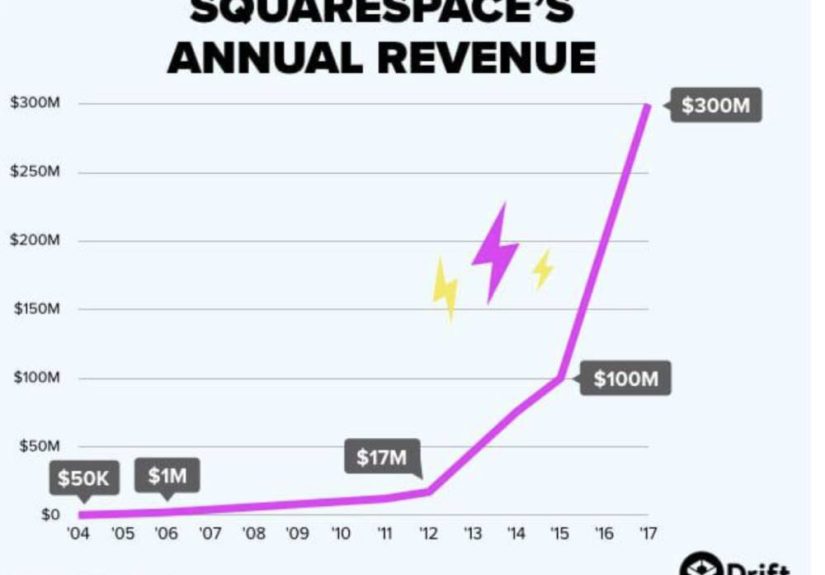
Squarespace is another wonderful insult to the myth of overnight success. Founded in 2003 by Anthony Casalena, it began as a founder-led product built with remarkable patience. For years, the company grew without the kind of hype cycle that makes venture capitalists speak entirely in metaphors.
That steady approach paid off. What looked modest early on turned into a durable platform business with strong brand recognition, subscription revenue, and broad appeal across creators, entrepreneurs, and small businesses. Squarespace did not become meaningful because it moved the fastest in year one. It became meaningful because it kept shipping, kept refining, and kept compounding.
There is something deliciously satisfying about a company that quietly builds itself into relevance while louder competitors are busy announcing that they are “redefining the future of digital experiences” for the seventeenth time.
Airbnb: A strange idea that needed the world to catch up
Airbnb’s early story is famous now, but it was not obviously destined for greatness at the beginning. The founders were rejected by investors, demand was inconsistent, and the company became so cash-starved that the team famously sold novelty cereal boxes to stay alive. That is not the usual sign of unstoppable momentum. That is the sign of people trying very hard not to be evicted.
And yet Airbnb kept going. Why? Because the core idea was bigger than the early skepticism around it. Over time, the company built trust systems, expanded supply, normalized peer-to-peer lodging, and benefited from a broader shift in how people thought about travel. What once sounded weird became mainstream. What once felt risky became routine. That is the essence of a late-blooming giant: the company did not merely improve; the world around it changed in ways that made the business feel inevitable.
Toast: Complex products often look slower until they click
Toast started in 2011 with an ambitious idea: build modern software for restaurants, an industry notorious for operational complexity and aging technology. On paper, it sounds smart. In practice, it meant dealing with payments, point-of-sale, ordering, staff workflows, hardware, and deeply embedded customer habits. In other words, easy if you are a wizard.
Toast’s ambition made the business harder to build, not easier. But complexity can become a moat when it is executed well. Once the pieces fit together, the company had a more powerful product and a more defensible model. That is a pattern founders should study closely: sometimes the businesses that look hardest to get off the ground become the hardest to dislodge later.
Canva, Figma, and Databricks: Not overnight, just obvious in hindsight
Not every late bloomer takes a decade to wake up, but many still take longer than startup mythology admits. Canva launched in 2013 and spent years expanding from accessible design tools into a broader platform for teams and visual communication. Figma was founded in 2012, but its collaborative browser-based approach needed time, product maturity, and user behavior change before it looked unstoppable. Databricks, founded in 2013, grew with the enterprise appetite for large-scale data and AI infrastructure rather than through a single flashy consumer moment.
Seen from a distance, each of these companies now looks like a giant was born. Seen up close, each one spent years earning that status.
What Founders Should Learn From Late-Blooming Decacorns
Do not confuse early speed with ultimate quality
Fast growth is wonderful. It can also be noisy. Markets get overheated, customer acquisition gets subsidized, and a hot category can make mediocre execution look brilliant for a while. Late bloomers remind us that durable businesses are often built on harder things: retention, customer trust, product depth, and timing that aligns with real adoption.
Endurance is a strategic advantage
A lot of startup advice treats endurance like a personality trait. It is better understood as strategy. If a company can stay alive long enough to keep learning, it buys itself more shots on goal. That matters in markets where adoption is gradual. Surviving the awkward middle period is often what separates the category leader from the company that had a clever slide deck and no tomorrow.
Compounding beats theater
The best late bloomers rarely win because they are louder. They win because each year adds something meaningful: better product, stronger distribution, deeper customer loyalty, more integrations, more trust, better economics. From the outside, the breakout can look sudden. From the inside, it usually looks like ten thousand boring decisions that turned out to be exactly right.
The Real Experience of Building a Late-Blooming Company
If you spend time around companies that bloom late, the experience is surprisingly emotional. In year one, everybody is energized because possibility still feels romantic. In year two or three, reality shows up with a clipboard. Growth is harder than expected. Sales cycles are longer. Customers want features you did not plan for. The market nods politely while still refusing to move. This is when many outsiders start using phrases like “concerning traction,” which is a very elegant way of saying, “I am nervous and would like you to be nervous too.”
Inside the company, though, a different kind of progress is often happening. The team gets sharper at explaining the problem. Customer conversations get less theoretical and more specific. Product decisions improve because they are based on lived pain, not imagined pain. You begin to notice that early adopters are not just buying the product; they are depending on it. That is not hype. That is infrastructure being born in real time.
Another common experience is that late bloomers often look messy before they look brilliant. Teams rebuild products. They narrow focus. They change pricing. They fire some ideas into the sun and keep the ones that survive. From the outside, that can look uncertain. From the inside, it often feels like the company is finally becoming honest. It is no longer trying to impress the market with possibility alone. It is trying to earn loyalty through usefulness.
There is also a psychological challenge that founders rarely talk about enough. Watching other startups sprint ahead in headlines can make steady progress feel invisible. But late-blooming companies usually learn a healthier rhythm. They stop managing for applause and start managing for evidence. Are customers renewing? Are they spending more over time? Is the product becoming harder to replace? Are you solving a painful problem in a market that is gradually waking up? Those questions are not glamorous, but they are wildly more useful than checking whether a rival just announced an “AI-powered transformation layer” with suspiciously little explanation.
The most revealing moment often comes when the market finally turns. Suddenly, the “slow” company looks prepared while the hot newcomers look shallow. The late bloomer has references, data, product depth, hard-won credibility, and an organization that has learned how to operate under pressure. What looked like delay was often incubation. What looked like a long detour was actually foundation work.
That is why the story of late-blooming decacorns matters beyond startups. It is a reminder that meaningful growth is not always loud at first. Sometimes the best businesses spend years becoming undeniable. They are not behind. They are building the part of the company that lasts when fashion changes, capital gets tighter, and customers become more demanding. And when those companies finally break out, the public calls it sudden. The people inside usually just call it Tuesday.
Conclusion
The startup ecosystem loves youth, speed, and explosive charts. But plenty of decacorns remind us that scale does not always arrive on schedule. Some of the biggest private companies in tech spent years looking ordinary before they looked inevitable. They learned, adapted, waited for markets to mature, and kept building while louder stories came and went.
That is not just comforting. It is strategically important. If a company is solving a real problem, earning genuine loyalty, and improving with each cycle, then a slower start may be less of a warning sign and more of a setup. The world tends to celebrate the breakout moment. The wiser founders learn to respect the long middle that makes the breakout possible.