Table of Contents >> Show >> Hide
- The Quick Verdict: Helpful as a Swap, Not as an Add-On
- Why Olive Oil Gets So Much Attention
- How Olive Oil Could Support Weight Loss (Without Being a Diet Fairy)
- What the Research Suggests (In Plain English)
- How to Use Olive Oil for Weight Loss (Without Accidentally Bulking Up Your Salad)
- Common Myths That Keep Floating Around the Internet
- Who Should Be a Little More Careful
- So… Is Olive Oil Beneficial for Weight Loss?
- Real-World Experiences: What People Notice When They Add Olive Oil (About )
- Conclusion
Olive oil has a reputation: the “good fat” that somehow makes everything taste better and your life choices look more responsible. Drizzle it on a salad and suddenly you’re basically on a Greek island, emotionally. But if you’re here for one specific questioncan olive oil help with weight loss?let’s talk honestly.
Olive oil isn’t magic. It’s not a detox. It doesn’t “melt” belly fat while you sleep. It’s also not the enemy. The real answer is a little more interesting:
olive oil can support weight loss when it replaces less helpful calories and makes your overall diet easier to stick with.
The Quick Verdict: Helpful as a Swap, Not as an Add-On
If olive oil becomes extra calories on top of what you already eat, it can slow or stop weight loss. If olive oil replaces butter, creamy dressings, fried fast food, or snacky “mystery fats,” it can help your plan feel satisfyingwithout weight gain and sometimes with better results.
Think of olive oil like a talented supporting actor. It can elevate the whole film, but it’s not supposed to play every role.
Why Olive Oil Gets So Much Attention
It’s calorie-densebut in a “worth it if used right” way
One tablespoon of olive oil is roughly 120 calories. That’s not “small.” That’s not “free.” That’s “measure it, don’t guess it.”
The upside is that those calories come with mostly monounsaturated fat (especially oleic acid), plus minor compounds in extra-virgin olive oil that are linked with antioxidant and anti-inflammatory activity.
Extra-virgin vs. regular: what’s the difference?
Extra-virgin olive oil (EVOO) is the least processed and typically contains more of the natural plant compounds (often called polyphenols).
“Pure” or “light” olive oil usually has a milder flavor and fewer of those compounds because it’s more refined.
For weight loss, the biggest difference isn’t mysticalit’s practical: EVOO tastes stronger, so a little goes a long way. Flavor can be a strategy.
How Olive Oil Could Support Weight Loss (Without Being a Diet Fairy)
1) It can increase satisfaction and help you feel full
Fat slows digestion and can make meals feel more satisfying. That matters because most weight-loss plans fail at the same place:
someone gets hungry, tired, annoyed, and suddenly a “healthy snack” becomes a family-size bag of chips.
Olive oil is rich in oleic acid, which has been studied for its potential role in appetite signaling. Translation: the body may register certain fats as “we ate something real,” which can reduce the urge to keep grazing.
2) It works best through the replacement effect
A lot of the health research around olive oil points to something simple:
what you replace matters more than what you add.
Swapping saturated-fat-heavy foods (like butter) for unsaturated fats (like olive oil) can improve heart-health markers and overall diet qualityoften without weight gain.
For weight loss, replacement helps because you’re controlling calories while improving the “stick-with-it” factor of meals. Dry chicken and steamed broccoli are not a long-term love story. Olive oil can be the couples counselor.
3) It’s part of eating patterns that actually work in real life
Olive oil is a cornerstone of the Mediterranean-style dietan eating pattern rich in vegetables, beans, fruit, whole grains, fish, and nuts.
People often lose weight on Mediterranean-style eating not because olive oil is a fat-burning spell, but because the overall diet tends to be:
- Higher in fiber (fullness)
- Higher in protein from real foods (satiety)
- Lower in ultra-processed foods (less “can’t-stop-eating-this” energy)
- More enjoyable (consistency beats perfection)
4) It may support better metabolic health while you lose weight
Weight loss isn’t only about the scale. Many people want improvements in blood sugar, cholesterol, blood pressure, and inflammation markers.
Olive oilespecially EVOOhas been studied for benefits in these areas as part of an overall healthy diet.
This matters because when people feel better (steady energy, fewer cravings, better digestion), they’re more likely to keep going. Weight loss loves momentum.
What the Research Suggests (In Plain English)
Here’s the best “grown-up” way to summarize the evidence without turning this into a textbook:
- Olive oil doesn’t automatically cause weight gain when used in reasonable amountsespecially when it replaces other fats or fits into an overall balanced eating pattern.
- In some studies, adding olive oil within a calorie-controlled plan has been associated with similar or slightly improved body composition results compared with other fat sources.
- Long-term observational research in large U.S. groups suggests that higher olive oil intake can be linked to less weight gain over timebut observational findings don’t prove cause-and-effect.
The “headline” is not “drink olive oil and shrink.” The headline is:
use olive oil strategically to make healthy eating easier and more sustainable.
How to Use Olive Oil for Weight Loss (Without Accidentally Bulking Up Your Salad)
Portion sizes that make sense
A practical range for many adults is 1–2 tablespoons per day, depending on calorie needs and how much fat is coming from other sources (nuts, avocado, cheese, etc.).
If you’re actively trying to lose weight, start with 1 tablespoon and see how it fits.
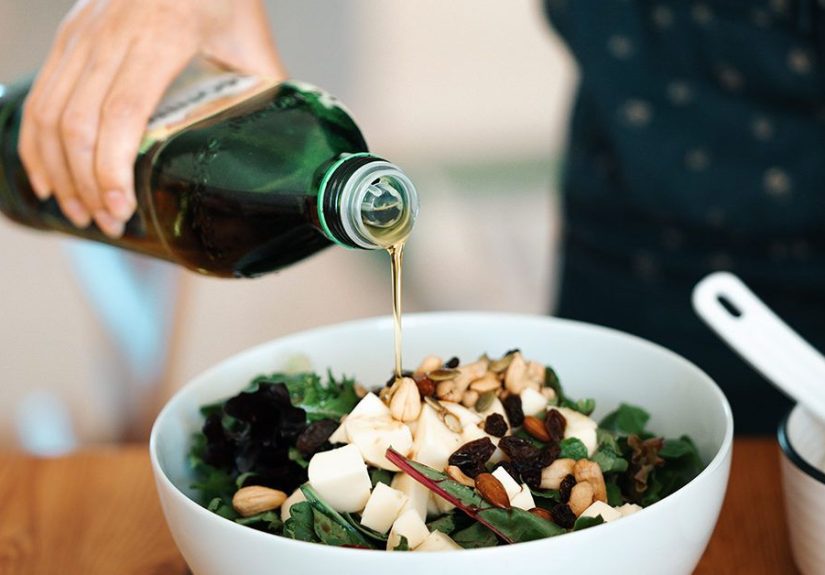
Pro tip: if you free-pour olive oil straight from the bottle, your “one tablespoon” becomes “a generous artistic interpretation.”
Use a measuring spoon for a weekjust long enough to calibrate your eyeballs.
Make it a swap, not a bonus
Olive oil helps most when it replaces something else. Easy swaps:
- Butter on veggies → olive oil + lemon + pepper
- Heavy creamy dressing → vinaigrette with olive oil, vinegar, mustard
- Mayo-heavy tuna/chicken salad → mostly Greek yogurt + a drizzle of olive oil
- Store-bought “flavor oil” sauces → olive oil + herbs + garlic
Pair it with high-volume foods
Olive oil shines when it’s combined with foods that have a lot of volume and fiber:
big salads, roasted vegetables, bean bowls, lentil soups, whole-grain dishes, and sautéed greens.
You get flavor and satisfaction without making calories run wild.
Use it for cookingjust don’t treat it like a deep fryer pool
Olive oil works well for sautéing and roasting. For maximum flavor and those “fresh” notes, EVOO is also great as a finishing drizzle on cooked vegetables, soups, or grilled fish.
If you’re cooking at very high heat, choose an oil appropriate for that method, but for most everyday home cooking, olive oil is a solid choice.
Common Myths That Keep Floating Around the Internet
Myth: “Olive oil shots burn fat”
Taking a shot of olive oil adds calories fast and doesn’t magically increase fat loss compared with using olive oil in meals.
If someone loses weight doing this, it’s usually because they changed other parts of their dietor they’re too nauseous to snack. (Not recommended.)
Myth: “If it’s healthy, more is better”
Olive oil is healthy, but it’s still energy-dense.
More tablespoons can quietly turn a calorie deficit into a calorie tie. And ties do not win weight-loss championships.
Myth: “All olive oil is the same”
Quality varies. Extra-virgin generally has more flavor and more naturally occurring plant compounds.
For weight loss, the biggest advantage of higher-quality EVOO is that it can deliver bigger taste with less quantity.
Who Should Be a Little More Careful
Olive oil is generally safe for most people, but these situations benefit from extra mindfulness:
- If you’re not losing weight despite “eating healthy”: hidden calories from oils, nuts, and dressings are a common reason. Measure briefly and reassess.
- If you have digestive or gallbladder issues: higher-fat meals can bother some people. Start small and talk with a clinician if symptoms flare.
- If you’re a teen still growing: weight goals should focus on health and strength, not aggressive restriction. A trusted healthcare professional can help set safe targets.
So… Is Olive Oil Beneficial for Weight Loss?
Yeswhen it’s used as a smart replacement and part of a satisfying, whole-food-based diet.
Olive oil can help meals taste better, support fullness, and make healthier eating patterns easier to maintain.
But olive oil isn’t a “free food,” and it’s not a shortcut. If weight loss is your goal, use it like a powerful seasoning and a better-fat swap:
measured, intentional, and paired with fiber-rich foods.
Real-World Experiences: What People Notice When They Add Olive Oil (About )
Research is useful, but most people don’t live in a clinical trial with a clipboard following them around (thankfully). In everyday life, the “olive oil experience” tends to fall into a few common patterns. If you’ve ever wondered why one person swears olive oil helped them lose weight while another says it did nothing, this is usually why.
Experience #1: “I stayed full longer.”
A lot of people notice that meals with a little olive oil feel more “complete.” For example, a giant salad can still feel like rabbit food if it’s dry or dressed with something watery and bland. But a measured tablespoon of olive oil in a vinaigrette (especially with mustard, vinegar, and spices) can make the same salad feel satisfying enough to stop the post-lunch snack hunt. The key detail: these people usually aren’t adding olive oil on top of an already calorie-heavy lunchthey’re upgrading a low-satisfaction meal into one they can actually stick with.
Experience #2: “It helped me cook at home more.”
This one is sneaky powerful. People who keep EVOO on the counter and use it for quick sautéing tend to make more simple meals: eggs with spinach, sheet-pan vegetables, bean bowls, chicken and peppers, pasta with a veggie-loaded sauce. Weight loss often happens not because olive oil is special, but because it becomes the gateway to cooking with real ingredients. Convenience foods don’t just add caloriesthey often add a weird kind of hunger that comes back fast.
Experience #3: “I gained weight at first.”
Yepthis happens. Usually it’s because olive oil joins the party without kicking anyone else out. Someone starts drizzling generously on salads, roasting veggies with enthusiasm, and dipping bread “just a little” (which somehow becomes a hobby). If weight loss stalls, the fix is rarely “ban olive oil forever.” It’s “measure it, then decide what it’s replacing.” Once people swap olive oil for butter, creamy dressings, or fried sidesrather than stacking it on topprogress often returns.
Experience #4: “My cravings calmed down.”
Some people report fewer cravings when they stop fearing fat and include a moderate amount of satisfying fats like olive oil. This doesn’t mean cravings disappear, but the intensity can drop. A dinner of roasted vegetables, beans, and a drizzle of olive oil can feel more emotionally and physically satisfying than a “diet plate” that tastes like regret. When meals are satisfying, willpower doesn’t have to do all the work.
Experience #5: “I learned the difference between ‘healthy’ and ‘helpful.’”
Many people end up realizing that olive oil is both: healthy and helpfulwhen used with intention. The “helpful” part comes from portioning it, using it to replace less supportive fats, and pairing it with high-fiber foods. In other words, olive oil often works best when it’s part of a bigger pattern: meals you enjoy, habits you can repeat, and a plan that doesn’t make you miserable.
Conclusion
Olive oil can absolutely belong in a weight-loss planjust not as a free-for-all. Treat it as a high-impact ingredient: measure it, use it for swaps, and let it make healthy meals taste like meals you’d actually choose again tomorrow. When olive oil helps you stay satisfied, cook more, and rely less on ultra-processed convenience foods, it’s doing exactly what you want: supporting consistency. And consistency is the most underrated “fat burner” on the planet.